The most expensive subwoofer in the world will still sound like a muddy mess if it is trapped inside a generic, mass-produced box. You’ve likely experienced the frustration of “one-note” bass that rattles your trim panels instead of blending with your music. It is a common hurdle for enthusiasts who invest in high-end gear but overlook the importance of custom subwoofer box design for sound quality. We believe that your audio system should be as unique as your vehicle, and that starts with a precision-engineered enclosure.
In this 2026 guide, we’ll show you how to turn that vibrating trunk into a high-fidelity soundstage. You will learn how to achieve tight, punchy bass that perfectly complements your front speakers while maximizing your usable cargo space. We are going to explore the latest material standards, from the current grading of Baltic Birch plywood to the efficiency of modern DSP integration. This is your roadmap to a professional-grade install that prioritizes the internal experience of the listener over flashy numbers. Whether you are driving an electric vehicle or a classic truck, we have the specialized knowledge to help you hear the difference.
Key Takeaways
- Learn why generic pre-fab boxes often fail to deliver and how professional custom subwoofer box design for sound quality ensures your driver performs to its full potential.
- Understand the distinct acoustic benefits of sealed versus ported enclosures to choose the right balance between surgical precision and musical efficiency.
- Discover how high-grade materials like Baltic Birch and strategic internal bracing eliminate unwanted box flex for a cleaner, tighter response.
- Master the science of cabin gain and subwoofer orientation to ensure your bass integrates seamlessly with your front speakers rather than fighting your vehicle’s acoustics.
- See how we use 3D modeling and CNC precision to create factory-fit solutions that look as good as they sound.
What Defines a Custom Subwoofer Box for Sound Quality?
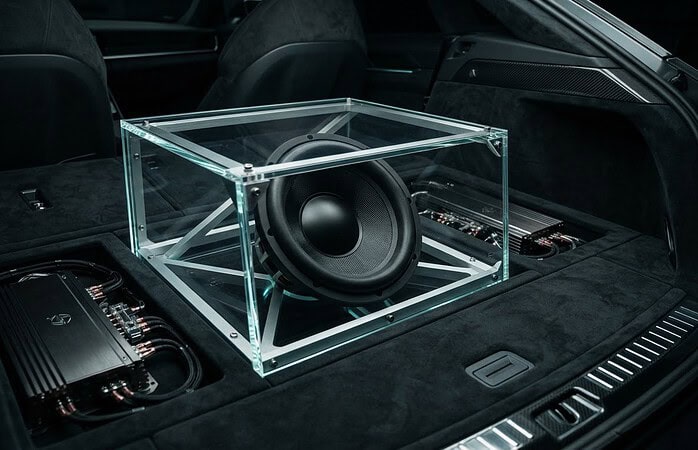
A subwoofer driver is only half of the equation. Without a properly engineered Loudspeaker enclosure, even the highest-end driver will fail to reproduce music accurately. We view the box as a specialized acoustic filter. It controls the movement of the speaker cone and shapes the final output to match your vehicle’s interior. When we discuss custom subwoofer box design for sound quality, we’re talking about a level of precision that off-the-shelf options simply cannot match. Generic boxes are built for a broad market. They aren’t built for your specific driver or the unique acoustics of your car’s cabin.
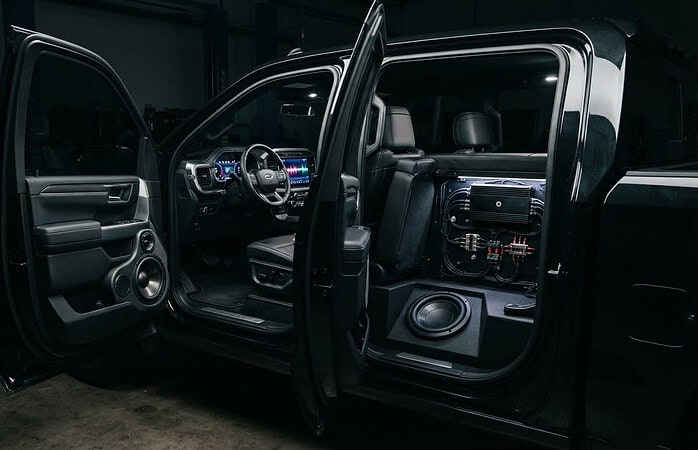
Many enthusiasts start with a pre-fab box because it’s convenient. However, these universal solutions are often the weakest link in a high-fidelity system. They typically use thinner materials to save on shipping costs. This leads to panel resonance. This vibration adds unwanted noise to your music, coloring the sound and masking fine details. Our approach focuses on eliminating these variables. We use custom design to create stealthy, space-saving solutions that tuck into factory cubbies or under seats. This ensures you get maximum performance without losing the utility of your trunk. We prioritize the delivery of a finished result over the mere transaction of goods.
The SQ Difference: Accuracy over Volume
Sound Quality (SQ) is about faithful reproduction. While Sound Pressure Level (SPL) focuses on maximum volume, an SQ-focused build prioritizes transient response. This is the ability of the subwoofer to start and stop exactly when the music does. We aim for a flat frequency response. This avoids that annoying, boomy peak at 50Hz that plagues generic builds. Our goal is a seamless transition. The bass should feel like it’s coming from your front speakers, not from a box in the back. This creates an immersive, front-and-center soundstage that makes you feel like you’re in the front row of a concert.
Limitations of Universal Enclosures
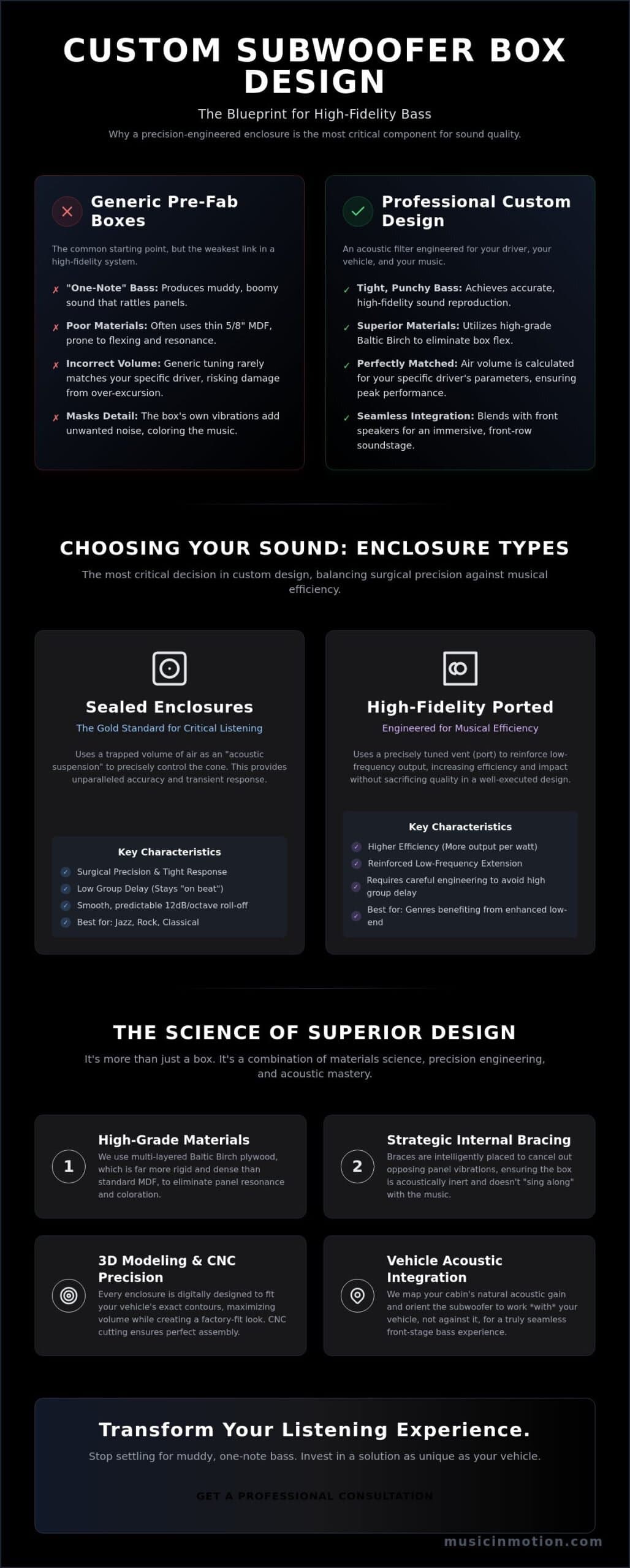
Universal boxes suffer from several design flaws. They often use 5/8 inch MDF, which is prone to flexing under pressure. This flex acts as a secondary radiator, muddying the signal. Additionally, generic tuning frequencies are rarely ideal for every genre of music. If the internal volume is off by even a small percentage, it can lead to driver over-excursion. This doesn’t just sound bad; it can physically damage your equipment. We solve this by calculating exact air volumes for your specific driver parameters. This level of technical precision is essential for effective custom subwoofer box design for sound quality. Our team ensures that every cubic inch of the enclosure serves the music.
Enclosure Types: Sealed vs. Ported for the Audiophile
Choosing the right enclosure type is the most critical decision in custom subwoofer box design for sound quality. It determines the fundamental character of your bass. For most audiophiles, the debate centers on sealed versus ported designs. While sealed boxes are famous for their tight response, ported boxes offer superior efficiency. The key differentiator is group delay. This technical term describes the timing of the bass note. High group delay makes music feel sluggish or “behind” the beat. We prioritize low group delay to keep your subwoofers perfectly in sync with your mid-range speakers.
The engineering behind these choices is complex. It often requires a study on optimal speaker cabinet design to fully grasp how internal volume affects frequency response. We use these principles to ensure the air inside the box supports the driver rather than fighting it. Every vehicle presents a different acoustic challenge, and the box type is the first tool we use to solve it.
Sealed Enclosures and Acoustic Suspension
Sealed enclosures are the gold standard for critical listening. They use a trapped volume of air to act as a spring, which controls the subwoofer cone’s movement. This “acoustic suspension” provides exceptional transient response. You get a smooth 12dB per octave roll-off that pairs beautifully with the natural acoustics of a car cabin. This synergy creates a deep, linear extension that never sounds forced. If your playlist is full of Jazz, Rock, or Classical music, a sealed box is usually the best answer. It provides the surgical precision required to hear the individual pluck of a bass guitar string.
High-Fidelity Ported Designs
Ported designs use a vent to reinforce low-frequency output. While many people associate ports with boomy SPL systems, a high-fidelity ported box is a different animal altogether. We tune the port for a flat response rather than a narrow “hump” in volume. This requires careful calculation of the port area to prevent chuffing. Chuffing is the audible noise of air rushing through a port that is too small. A well-designed ported box offers more low-end output than a sealed one without sacrificing musicality. It allows for more efficiency, which is helpful in larger vehicles or when using lower-powered amplifiers.
For those with specific goals, we also explore advanced options like Infinite Baffle or Bandpass systems. Infinite Baffle uses the entire trunk as an enclosure, providing an incredibly natural sound if the vehicle is properly sealed. Bandpass boxes are more complex but can offer extreme efficiency within a specific frequency range. Regardless of the type, our goal remains the same: a finished acoustic result that enhances your daily drive. If you are unsure which path fits your listening style, we can help you choose the right custom subwoofer enclosures for your vehicle. This tailored approach is the cornerstone of effective custom subwoofer box design for sound quality.
The Science of Internal Enclosure Dynamics
The interior of your enclosure is where the real magic of custom subwoofer box design for sound quality happens. While the exterior might look great, the internal physics dictate the final acoustic performance. We focus on two primary enemies: panel resonance and standing waves. If the walls of your box vibrate, they act like a second, out-of-tune speaker. This destroys the clarity you expect from high-end components. We use advanced construction techniques to ensure the only thing moving is the subwoofer cone itself.
Rigidity is the foundation of any audiophile build. To achieve this, we look toward JBL’s guide to enclosure design for proven methods of minimizing mechanical loss. We often choose between Medium-Density Fiberboard (MDF) and Baltic Birch plywood. While MDF is a standard choice at approximately $35 to $55 per sheet, Baltic Birch is the premium alternative. It is lighter, stronger, and significantly more rigid. This rigidity helps eliminate the parasitic vibrations that can muddy your low-end detail. We also manage standing waves by avoiding parallel walls where possible, which prevents sound waves from bouncing back and forth and creating unwanted frequency peaks.
Material Science in Fabrication
We prefer Baltic Birch for high-end custom builds because its multi-layer construction offers superior density and strength. To further enhance this, we often utilize double-baffles. This involves gluing two layers of material together for the mounting surface. This creates a rock-solid foundation that prevents the driver from shifting or causing the front panel to flex. Panel flex absorbs the energy of the bass note and replaces it with distorted vibrations that destroy low-end detail. By removing this flex, we ensure every watt of power translates into pure sound.
Internal Airflow and Turbulence
Internal airflow management is equally vital. We round over internal corners and port openings to reduce air turbulence. Turbulence creates noise and limits the efficiency of the driver. We also carefully calculate the displacement caused by internal bracing. While bracing is necessary for rigidity, it takes up space that changes the internal volume. We manage the effective volume using damping materials like poly-fill or fiberglass. These materials slow down the air molecules, making the box “feel” larger to the driver. However, we are careful not to over-stuff the enclosure. Too much damping material can make the bass sound sluggish and disconnected from the rest of the music. This level of detail is what separates a basic box from a true custom subwoofer box design for sound quality.
Vehicle Integration: Mapping the Cabin’s Acoustics
Every vehicle has a unique acoustic signature that fundamentally changes how you hear bass. We don’t just build a box and hope for the best. We treat your car’s interior as a secondary enclosure. This environment creates a phenomenon known as cabin gain. Because a car is a small, enclosed space, it acts as a pressure chamber for low frequencies. This naturally boosts the bass as the frequency drops. Effective custom subwoofer box design for sound quality must account for this boost, or the result will be overwhelming and boomy.
Our goal is to create a seamless transition between your subwoofer and your front speakers. This requires precise placement and orientation. Whether we choose an up-firing, down-firing, or rear-firing configuration depends entirely on your vehicle’s body style. A hatchback requires a different approach than a luxury sedan or a pickup truck. We analyze these variables to ensure the sound waves reach your ears in a coherent, musical way. We are dedicated specialists who focus on the internal experience of the listener, ensuring every note feels intentional.
The Transfer Function Explained
The transfer function is the difference between how a speaker performs in an open room versus inside your car. A box that sounds perfectly flat on a test bench might sound muddy once it’s installed in a trunk. We design our enclosures to match the roll-off of the subwoofer with the natural boost of your cabin. This creates a balanced, high-fidelity response. If we ignore this relationship, the bass will likely peak at certain frequencies, creating that “one-note” sound that ruins the musicality of a high-end system. We prioritize the delivery of a finished acoustic result that complements your specific vehicle.
Physical Placement and Phase
Placement is about more than just finding a corner that fits. We use the “Quarter-Wave” rule to determine the ideal distance from the vehicle’s boundaries. This helps prevent phase cancellation, which happens when sound waves bounce off a window or seat and “cancel out” the direct sound from the sub. Boundary loading increases efficiency by placing the enclosure near a physical surface to direct more energy toward the listener without adding extra electrical power. To perfect the timing, we often integrate a Digital Signal Processor (DSP). This allows us to delay the signal to the front speakers so the bass note hits your ears at the exact same millisecond as the high notes. If you want to transform your listening experience, we invite you to explore our professional custom installations to see how we can optimize your vehicle’s acoustics.
The Music In Motion Approach to Custom Fabrication
We believe that a premium listening experience is the result of a finished acoustic goal, not just a transaction of hardware. This philosophy is the foundation of our build process. To achieve the absolute best custom subwoofer box design for sound quality, we rely on a collaborative team environment. We use 3D laser scanning and precision CNC cutting to ensure that every enclosure fits your specific vehicle with surgical accuracy. This technology allows us to create complex, high-performance shapes that would be impossible to build by hand. We are masters of the technical details, but our ultimate focus remains on how the music makes you feel behind the wheel.
Our expertise is universal, reaching across every medium of transport. We show equal enthusiasm for land and water-based projects, whether we are upgrading a classic car, a modern electric vehicle, or a marine audio system. By integrating specialized car audio fabrication techniques, we overcome the limitations of factory interiors. We don’t just add bass; we enhance the lifestyle of the driver through reliable, high-end technology. This steady, organized approach ensures that every detail of your property is in safe hands.
Advanced Design and Materials
For vehicles with challenging contours, we utilize composite materials and custom fiberglass molding. These materials allow us to tuck enclosures into unused cavities, preserving your cargo space while maximizing internal air volume. We prioritize aesthetic integration to ensure the install looks like a factory option. Our team carefully matches OEM upholstery, grain patterns, and trim colors for a seamless finish. We also engineer these systems for long-term reliability. Every enclosure is braced and secured to handle high-vibration environments, ensuring the structural integrity of your vehicle remains intact. This creates a balance between creative custom projects and the practical needs of the user.
System Calibration and Tuning
The fabrication process is only one part of the solution. We use Real-Time Analysis (RTA) and digital signal processing to verify the enclosure’s performance within the cabin. This allows us to identify and correct any acoustic anomalies caused by the vehicle’s interior. We fine-tune crossover points and phase alignment to create a cohesive front-to-back soundstage. The result is a system where the bass is felt and heard as a natural extension of the music. It is about the internal experience of the user, not just the hardware. Ready for a transformation? Contact our experts for a custom audio consultation and let us design a solution tailored to your needs.
Take Control of Your Soundstage
Achieving the perfect custom subwoofer box design for sound quality is a journey that moves from technical theory into sensory reality. You’ve now seen how material rigidity, enclosure volume, and cabin acoustics work together to create a seamless listening experience. A precision build is the only way to ensure your driver performs exactly as intended. By prioritizing acoustic integrity over generic dimensions, you can finally eliminate muddy bass and replace it with tight, punchy accuracy.
We bring over 30 years of custom fabrication experience to every project we touch. We are specialists in advanced DSP tuning and acoustic integration for a wide range of land and water-based transport. From high-performance car systems to rugged marine environments and motorcycle installs, we have the specialized knowledge to deliver. We’re dedicated to providing a finished result that improves your daily life behind the wheel or at the helm. This commitment to excellence ensures that every detail of your property is in safe hands.
Start Your Custom Audio Project with Music In Motion. We look forward to helping you hear your favorite tracks like never before.
Frequently Asked Questions
Is a sealed or ported box better for sound quality?
Sealed enclosures are generally the best choice for surgical accuracy and transient response. They provide a tight, controlled bass that follows the music perfectly. Ported designs offer more efficiency and deeper extension, but they require much more precise engineering to avoid sounding boomy. We analyze your musical preferences and vehicle size to determine which alignment will deliver the most faithful reproduction for your system.
Does the shape of the subwoofer box affect the sound?
The internal volume is the most critical factor, but the physical shape influences internal standing waves. Parallel walls can cause sound waves to bounce back and interfere with the driver’s movement. We use custom shapes to fit your vehicle’s contours while diffusing these internal reflections. This ensures a cleaner output that is free from the muddy resonance often found in rectangular, mass-produced boxes.
How do I calculate the correct volume for my subwoofer?
You must use the Thiele/Small parameters provided by the manufacturer to find the ideal air volume. These specifications dictate how the driver interacts with air pressure inside the enclosure. We utilize professional modeling software and tools like the Speaker Box Lite app, which was updated in May 2026, to ensure mathematical precision. This technical accuracy is a cornerstone of custom subwoofer box design for sound quality.
What is the best material for a custom subwoofer enclosure?
13-ply Baltic Birch plywood is the premium choice for high-fidelity builds due to its extreme rigidity and lower weight. While standard 3/4 inch MDF is a reliable option costing between $35 and $55 per sheet, Baltic Birch ranges from $90 to $160 in early 2026. This superior material prevents panel flex, ensuring that the energy from your subwoofer translates into pure sound rather than box vibration.
Can a custom box make a cheap subwoofer sound good?
A custom enclosure will significantly improve the performance of any subwoofer driver. It provides the exact air-spring required for the cone to move efficiently within its physical limits. While a custom box cannot change the quality of the driver’s motor or materials, it eliminates the distortion and “one-note” bass caused by poor housing. We focus on maximizing the potential of your specific hardware to deliver a professional result.
How does port tuning affect the frequency response?
Port tuning determines the specific frequency where the enclosure provides the most acoustic reinforcement. If a port is tuned too high, the bass will sound aggressive and peaky. We tune our ports lower to achieve a flatter, more musical response that blends seamlessly with your front speakers. This allows for deep, authoritative low-end extension without sacrificing the clarity needed for critical listening.
Why do custom boxes cost more than pre-fabricated ones?
Custom enclosures involve specialized engineering, high-grade materials, and significant labor. Pre-fab boxes are mass-produced with thinner materials to keep shipping costs low. A quality custom build often requires 15 to 25 hours of work, including 3D modeling and precision CNC cutting. You are investing in a finished acoustic result that is tailored specifically to your vehicle’s interior and your personal listening taste.
What is cabin gain and why does it matter for my box design?
Cabin gain is the natural boost in low-frequency sound caused by the small interior space of a vehicle. Your car acts as a pressure chamber that increases bass output as frequencies drop. We account for this phenomenon during the custom subwoofer box design for sound quality process. By matching the enclosure’s natural roll-off to your vehicle’s boost, we create a balanced soundstage that never feels boomy or overwhelming.