Imagine you’re anchored in a quiet cove, the sun is setting, and your favorite playlist is providing the perfect soundtrack. Then you turn the key, and all you hear is a heart-sinking click. We’ve all felt that spike of anxiety when the music we love threatens the power we need to get home. You shouldn’t have to choose between a premium acoustic experience and a reliable engine start. This article explores the essentials of boat audio battery management to help you design a system that handles high-output amplifiers without breaking a sweat.
We understand that the technical side of marine electronics often feels overwhelming. Many boaters struggle with confusing manual battery switches or audio that cuts out just when the party gets started. We’re going to change that. You’ll learn how to implement intelligent isolation and dedicated charging paths that prioritize your engine’s cranking power while feeding your hungry subwoofers. We’ll preview the latest in lithium technology and updated safety standards to give you total confidence on the water. By the end, you’ll have the blueprint for a set-it-and-forget-it power solution that delivers crystal clear sound and a guaranteed ride back to the dock.
Key Takeaways
- Understand why high-output marine amplifiers require more current than standard factory battery setups can provide during long days on the water.
- Master the fundamentals of boat audio battery management by separating your “Start” and “House” banks to ensure your engine always has the power it needs.
- Learn why Automatic Charging Relays (ACR) are the superior, “set-it-and-forget-it” alternative to risky manual battery switches.
- Discover why tinned copper wiring and precise voltage drop calculations are essential for maintaining peak performance in a harsh marine environment.
- See how professional custom fabrication and expert integration create a reliable, high-performance system that focuses on the finished result.
Why Premium Marine Audio Demands Advanced Battery Management
We’ve all seen it happen. You’re out at the sandbar, the music is hitting hard, and everyone is having a great time. Then, the music suddenly cuts out or, worse, the engine won’t turn over when it’s time to head back to the dock. High-performance marine audio systems are a different beast than the standard electronics your boat was built to handle. While your factory setup might manage a GPS and some LED cabin lights just fine, a premium amplifier demands a level of power that standard systems simply can’t provide. We’ve spent decades refining how we integrate these systems to ensure they’re as reliable as they are loud.
The Amp Draw Problem: Audio vs. Standard Electronics
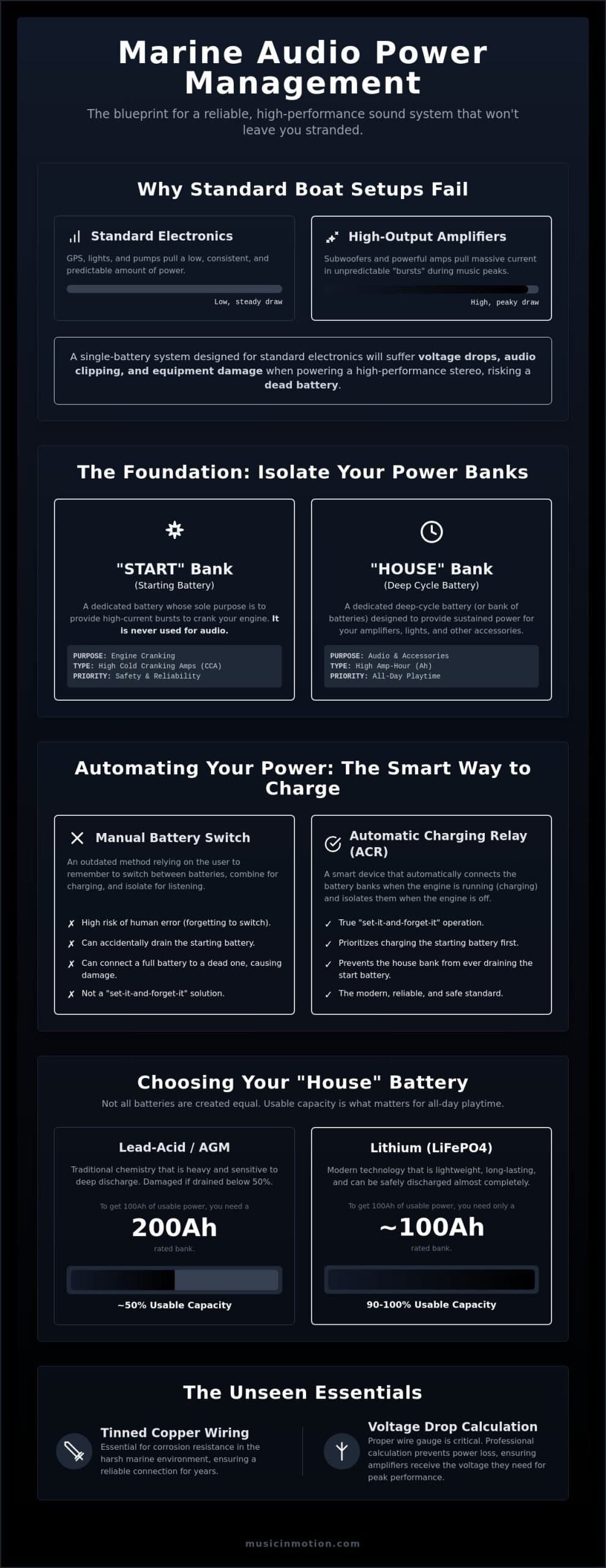
Most marine electronics pull a consistent, low-level current. Your chartplotter or bilge pump doesn’t suddenly spike its power needs. High-output amplifiers are different. They pull massive amounts of current in “bursts” during peak musical passages, especially when driving subwoofers. If your boat audio battery management isn’t up to the task, you’ll experience significant voltage drops. These drops don’t just make the music sound thin; they cause the amplifier to clip. Clipping creates excessive heat, which is the primary killer of expensive marine electronics. We’ve seen factory-installed wiring and single-battery setups fail repeatedly because they weren’t designed for these high-demand “burst” power needs. Standard batteries simply aren’t built to sustain that kind of draw over several hours of floating.
Avoiding the Dead Battery Scenario
Relying on a single battery for both starting your engine and powering a 1,000-watt stereo is a recipe for trouble. We believe in providing our customers with absolute peace of mind. A dedicated power bank ensures your engine always has the cranking amps it needs, regardless of how long you’ve been playing music at the dock. Modern solutions often include an integrated Battery Management System (BMS) to monitor health and prevent over-discharge. While some boaters carry a portable jump pack as a backup, we don’t consider that a primary strategy. It’s a band-aid for a flawed design. Proper boat audio battery management removes the stress of a potential emergency call to the Coast Guard. Our team focuses on professional integration that separates your “fun” power from your “safety” power; this ensures the music stays clear and the engine stays ready.
Understanding Dual-Bank Systems for Dedicated Audio Power
We believe the secret to a stress-free day on the water lies in separation. A dual-bank system is the foundation of any professional boat audio battery management strategy. It splits your electrical loads into two distinct groups: “Start” and “House.” By isolating your engine’s cranking needs from your audio system’s consumption, you ensure that the party never interferes with your ability to get home. This architecture is the first step toward a “set-it-and-forget-it” power solution that protects your equipment and your safety.
Starting Battery vs. Deep Cycle House Battery
Starting batteries are built for one specific job. They provide massive Cold Cranking Amps (CCA) in short, high-intensity bursts to turn over your engine. Their internal plates are thin and numerous to maximize surface area for that quick release of energy. Deep-cycle house batteries are constructed differently. They feature thicker plates designed for slow, steady discharge over many hours. Using a starting battery to power your audio system is a common mistake that leads to premature sulfation. This occurs when lead sulfate crystals harden on the battery plates, permanently reducing capacity and shortening the battery’s lifespan. A deep-cycle battery is essentially the fuel tank for your amplifiers. It needs to be large enough to sustain your sound without running dry before the sun goes down.
Sizing Your Battery Bank for All-Day Playtime
Calculating your power needs requires looking at your system’s total current draw. We help our clients estimate their Amp-Hour (Ah) requirements based on their specific listening habits and the number of amplifiers in the vessel. If your amplifiers pull an average of 25 amps and you want 4 hours of playtime, you need 100Ah of usable power. However, the chemistry you choose changes the math significantly.
- Lead-Acid and AGM: These should only be discharged to 50% of their capacity to avoid internal damage. To get 100Ah of usable power, you need a 200Ah battery bank.
- Lithium (LiFePO4): These offer nearly 100% usable capacity and maintain higher voltage throughout the discharge cycle. This means your music sounds just as clear and punchy at hour four as it did at hour one.
Safety is our priority. Every boat audio battery management system we design follows U.S. Coast Guard (USCG) standards for battery mounting and overcurrent protection. This involves securing batteries to prevent movement and ensuring all terminals are protected against accidental shorts. If you are ready to upgrade, we can help you integrate a marine audio system that delivers crystal clear sound without compromising your vessel’s safety. Professional integration ensures that your high-output amplifiers get the voltage they need while your engine battery remains untouched and ready to fire.
Manual Switches vs. Automatic Charging Relays (ACR)
Choosing how to control your power flow is a pivotal decision in boat audio battery management. For decades, the industry standard was the traditional manual battery selector switch. You likely recognize the red dial with “1,” “2,” “Both,” and “Off” positions. While these switches are mechanically simple, they introduce a significant element of human error into your day on the water. We believe that technology should work for you, not the other way around. Modern systems have evolved beyond manual toggling to embrace intelligent, automated solutions that protect your vessel without requiring a second thought.
The Risks of Manual Battery Selectors
The biggest flaw with a manual switch is that it relies on your memory. When you’re anchored and the music is playing, it’s easy to forget which position the dial is in. If you leave the switch on “Both,” your high-performance amplifiers will draw power from every battery on the boat simultaneously. This leads to the nightmare scenario we discussed earlier: two dead batteries and a stranded vessel. Even if you remember to switch to the house bank, manual selectors suffer from internal mechanical wear. Over time, the contacts inside these rotary switches can corrode or loosen. This creates electrical resistance, which causes voltage drops that starve your amplifiers of the clean power they need to perform at their peak.
Why ACRs are the “Set It and Forget It” Solution
We recommend an Automatic Charging Relay (ACR) for almost every professional dual-battery setup we install. An ACR is a smart component that acts as an automated bridge between your battery banks. Its logic is straightforward but incredibly effective. When the ACR senses a charging voltage from your engine’s alternator, it automatically combines the batteries so both banks receive a charge. It intelligently prioritizes the starting battery first, ensuring your engine’s power source is topped off before it directs energy to the house bank.
The real magic happens when you turn the engine off. The ACR senses the drop in voltage and immediately isolates the two banks. This means your boat audio battery management system is now protecting your starting battery by “locking” it away. Your amplifiers can pull as much current as they need from the house bank while the starting battery remains untouched and ready to fire the engine. It’s a seamless experience that allows you to focus on the music and the company rather than a plastic dial in the bilge. While we still include a manual switch in our custom builds, we position it as an emergency override only. This gives you the ability to “parallel” the batteries for an emergency jump-start if needed, while the ACR handles the daily heavy lifting automatically.
Essential Wiring and Protection for Marine Audio Power
We’ve established that a dual-bank system and an ACR are the heart of your power setup. However, even the best batteries are useless if the “veins” of the system, the wiring, can’t handle the load. In a harsh marine environment, standard automotive wiring is a liability. We prioritize high-conductivity materials that resist the constant assault of salt and humidity. Effective boat audio battery management depends as much on the quality of your connections as it does on the capacity of your batteries. Without the right gauge of wire and proper protection, your high-end equipment will never reach its potential.
Marine-Grade Wire vs. Standard Automotive Cable
Untinned copper is a poor choice for boats. When exposed to moisture, it undergoes a chemical reaction that turns the strands green. This oxidation increases resistance and eventually stops the flow of current entirely. We only use tinned copper wire. In this construction, each individual strand is coated in a thin layer of tin to prevent corrosion before it starts. It’s a small detail that makes a massive difference in long-term reliability.
You’ll often see two types of copper in the market: Oxygen Free Copper (OFC) and Copper Clad Aluminum (CCA). In a marine context, CCA is dangerous. Aluminum is less conductive and more brittle than copper. It corrodes at an accelerated rate when salt is present. We follow ABYC standards for insulation and wire gauge, ensuring that every cable we install can withstand the heat, vibration, and moisture of a moving vessel. We also pay close attention to grounding. Since fiberglass boats don’t have a metal chassis to act as a ground, we run dedicated ground wires back to the battery bank to avoid the “engine hum” and ground loops that ruin a listening experience.
Proper Fusing for High-Draw Amplifiers
Safety is our number one rule. Every power wire must be fused within seven inches of the battery connection. This protects your vessel from a catastrophic fire if a wire is ever pinched or shorted. We often use high-speed fuses for audio systems because they react faster than thermal breakers to sudden current surges. While breakers are convenient for resetting, fuses provide a cleaner connection for high-current audio applications.
A solid power foundation is the starting point for everything we do. We know that professional car audio tuning requires a stable voltage to achieve the perfect sound. If your amplifier is starving for current, no amount of digital processing can fix the resulting distortion. We use precise voltage drop calculations to ensure your amps get the full 14.4V they need for peak performance. If you’re tired of seeing your lights dim with every bass hit, our team can design a custom marine audio installation that combines safety with high-fidelity performance. We focus on the finished result, ensuring your system is as safe as it is powerful.
Professional Battery System Integration with Music In Motion
We don’t just sell marine electronics; we deliver a finished result that prioritizes your peace of mind. Since 1994, our team has applied high-end custom fabrication techniques to the unique challenges of the marine environment. While many shops might offer a basic installation, we focus on the total integration of your boat audio battery management system. We believe that a truly professional setup should be as organized and reliable as it is powerful. By treating your boat’s electrical system as a single, cohesive unit, we ensure that your music never comes at the expense of your safety.
A common issue with DIY projects or standard retail installations is the “spaghetti wiring” that often plagues boat bilges. Messy wiring isn’t just an eyesore; it’s a maintenance nightmare and a potential fire hazard. We take pride in creating clean, labeled, and secure wiring runs that make future upgrades simple. Our collaborative team environment ensures that every detail, from the gauge of the tinned copper wire to the placement of the circuit breakers, is executed with technical precision. We look at the big picture, consulting on the balance between your alternator output, battery capacity, and amplifier draw to create a system that stays in perfect harmony.
Custom Power Solutions for Extreme Marine Audio
Space is almost always a premium on a vessel. We specialize in fabricating custom battery trays and bus bar mounts that fit into tight or oddly shaped compartments without compromising accessibility. We can also integrate digital voltage monitoring directly into your dash. This provides real-time data on your house bank’s health at a glance. Whether you’re navigating the open waters of the Great Lakes or anchored at a crowded local sandbar, our custom builds provide the rugged reliability required for the journey. We use high-quality materials that withstand the constant vibration and moisture of a moving boat, ensuring your power foundation remains rock solid for years to come.
Ready for Worry-Free Sound?
You deserve to enjoy your favorite playlist without the constant anxiety of a dead battery. Our decades of experience in custom electronics allow us to push creative boundaries while maintaining the safety and functionality of your boat’s utility systems. We bring this same level of dedication to every project, whether you’re looking for a sound system for my car or a complete overhaul of your marine audio. We are your partners in creating an experience that improves your daily life and your time behind the wheel or the helm.
If you’re ready to stop worrying about your battery switch and start enjoying crystal clear audio, we’re here to help. Contact Music In Motion for a custom marine power consultation today. Let’s design a power solution that keeps the music playing and ensures you always have the power to get home.
Set Sail with Confidence and Superior Sound
We believe that your time on the water should be defined by the music you love, not the fear of a dead battery. By embracing a modern approach to boat audio battery management, you can finally move past the era of manual switches and voltage drops. A well-designed system separates your engine’s cranking needs from your audio’s current draw. It uses automatic charging relays to handle the heavy lifting while you focus on the horizon. From tinned copper wiring to custom-fabricated battery mounts, every detail matters in a harsh marine environment.
Since 1994, our team has specialized in high-output audio integration and custom electronics. We don’t just sell hardware; we deliver a finished result that ensures your vessel is as reliable as it is loud. Our specialists understand how to balance complex power requirements with the safety standards required for the open water. Whether you’re planning a complete overhaul or a simple power upgrade, we have the specialized knowledge to enhance your experience.
Upgrade Your Marine Power with Music In Motion
We’re excited to help you design a system that sounds incredible and keeps you moving. Let’s get your boat ready for a worry-free season on the lake.
Frequently Asked Questions
Can I just add a second battery and connect it in parallel to my existing one?
No, we don’t recommend simply connecting a second battery in parallel to your existing one. When you mix a new battery with an older one, the weaker battery will constantly pull down the new one. This imbalance leads to a shorter lifespan for both units. We prefer using a dedicated house bank and an isolation system to ensure both batteries perform at their peak without fighting each other.
What is the best battery type for a boat stereo system: AGM, Gel, or Lithium?
Lithium Iron Phosphate (LiFePO4) is the top choice for high-performance audio. It offers a deeper discharge depth and maintains a higher voltage throughout the cycle. Per ABYC E-13 standards, these must include a Battery Management System (BMS) for safety. If lithium isn’t in the budget, AGM is a solid option. It’s spill-proof and handles the vibration of rough water much better than traditional flooded lead-acid batteries.
How long can I play my boat stereo before the batteries die?
This depends on your system’s total current draw and the amp-hour rating of your battery bank. A 1,000-watt system playing at high volume might pull 30 to 50 amps. With a 100Ah AGM battery, you’d have about one to two hours of safe playtime before hitting the 50 percent discharge limit. Lithium batteries can nearly double that time. We help you calculate these needs to ensure your day isn’t cut short.
Do I need a high-output alternator for my marine audio system?
You might need one if your total current draw exceeds your factory alternator’s capacity. Most standard alternators prioritize the engine’s electronics and only provide a small charge to the batteries. If you have multiple high-output amplifiers, a high-output alternator ensures your batteries actually recharge while you’re cruising between spots. It’s a vital component for systems that run heavy loads for extended periods of time.
What is an Automatic Charging Relay (ACR) and how does it work?
An ACR is an intelligent switch that combines your battery banks only when it senses a charging voltage. It prioritizes your starting battery first. Once that’s topped off, it shares the alternator’s output with your audio bank. When you stop the engine, it automatically separates the banks to protect your starting power. It’s the most reliable way to manage two battery banks without having to remember a manual switch.
Is it safe to mount audio batteries in the engine compartment of my boat?
It’s safe if you follow U.S. Coast Guard regulations for boat audio battery management. Batteries must be secured to prevent more than one inch of movement and must be vented to release hydrogen gas. They also cannot be directly above or below fuel lines. While the engine room is common, we prefer custom mounts in cooler areas. Excessive heat is a silent killer of battery capacity and overall lifespan.
Why does my boat stereo turn off when I start the engine?
This is usually caused by a significant voltage drop during the cranking process. When the starter motor engages, it pulls massive current from the battery, causing the system voltage to dip below the stereo’s operating threshold. This forces the head unit or amplifiers to reboot. A dedicated house battery bank and proper wiring usually solve this annoying interruption, keeping your music playing seamlessly while you fire up the engine.
How do I know if my boat battery management system is working correctly?
The best way is to monitor your voltage levels under load. We recommend installing a digital voltmeter on your dash to see real-time data for both banks. If your house bank stays isolated while the engine is off and recharges once you’re underway, your system is doing its job. Regular inspections of tinned copper connections also ensure that corrosion isn’t hiding any electrical resistance that could lead to a system failure.