A powersports amplifier gives speakers the power to play clearly over wind, helmet padding, and exhaust noise. For motorcycle listening in those conditions, aim for 100 to 150 watts RMS per channel at 4 ohms. A weatherproof amplifier for powersports vehicles is also selected for the exposure, vibration, and space limits of its riding environment.
You need more than a louder system: the amplifier must suit your vehicle and work with the speakers it powers. Marine, off-road, and motorcycle installations each bring different challenges, so standard audio gear may not be the right fit.
This guide explains what a powersports amplifier does, how it differs from standard audio equipment, and which vehicles it can serve. You’ll also learn how to match amplifier RMS output to speaker requirements and what a professional installation involves, so the result is clear, balanced sound tailored to your ride.
Key Takeaways
- Choose the amplifier channel layout around the speakers you want to power, including whether a multi-amp setup makes sense.
- Understand why marine-grade and powersports equipment is designed for different conditions than standard car audio gear.
- See how amplifier choices can be tailored to boats, UTVs, ATVs, motorcycles, and golf carts.
- Learn how to compare amplifier RMS output with speaker requirements for a balanced system and professional installation.
What Does a Powersports Amplifier Do?
A powersports amplifier increases the electrical signal sent to speakers, helping music remain clear amid wind, helmet padding, and exhaust noise. For motorcycle listening, a useful target is 100 to 150 watts RMS per channel at 4 ohms. RMS describes continuous power, giving a more practical basis for system matching than peak power alone.
Channel count determines how many speakers an amplifier can drive. A two-channel amplifier can power a pair of speakers, while a four-channel unit can support four speakers or two stereo zones. For motorcycle fairing speakers paired with lower-fairing or rear-pod speakers, a four-channel amplifier can provide separate outputs. A five-channel amplifier adds a dedicated subwoofer channel, which can simplify a system combining full-range speakers and bass.
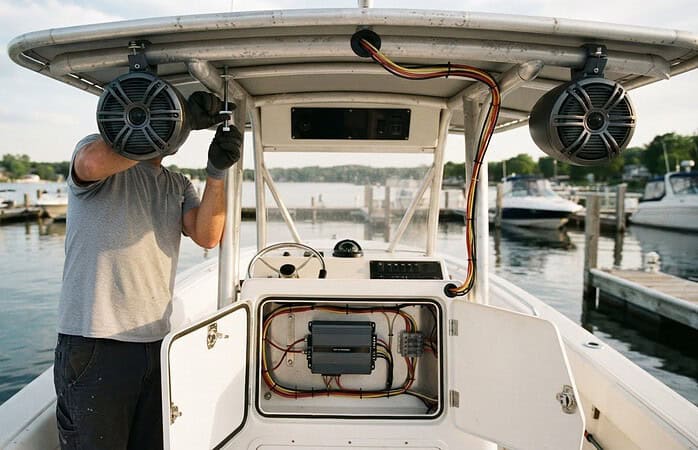
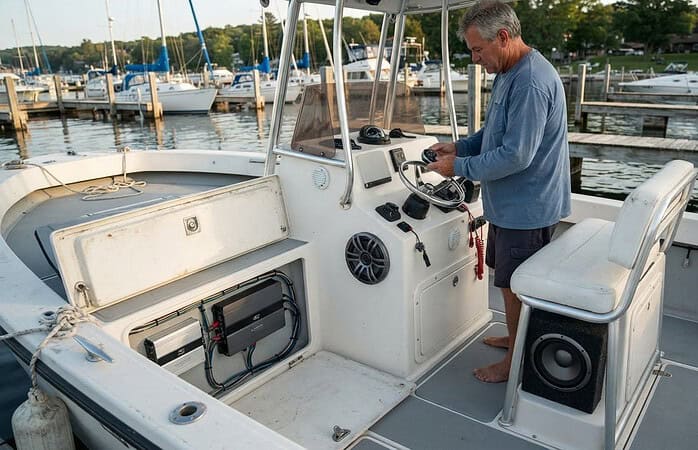
Installers choose channels by mapping each speaker and subwoofer to an amplifier output, then matching RMS power and impedance. For example, a Polaris RZR setup may use a five-channel amplifier when it needs several speaker channels and subwoofer output. A weatherproof amplifier for powersports vehicles also needs an appropriate location, wiring route, and secure mounting.
Battery and charging-system capacity matter because an amplifier draws power from the vehicle’s electrical system. The installation should use high-quality, appropriately sized wiring connected to the battery, with an in-line fuse placed within 12 inches of the battery terminal. The amplifier’s current demand must also suit the charging system’s available capacity.
Warranty terms vary by amplifier, so review coverage, exclusions, and installation conditions before purchase. Safe installation depends on secure mounting, protected wiring, and a fuse matched to the circuit. Loose equipment or poor connections can cause problems on a vibrating vehicle.
Multiple amplifiers can divide system duties, such as using one for speakers and another for a subwoofer. This adds wiring and installation complexity, so installers consider the speaker layout, available mounting space, electrical capacity, and RMS requirements together. The right channel configuration supports the complete system without adding unused outputs or leaving a speaker unaccounted for.
What Sets Motorcycle Amplifiers Apart from Standard Audio Gear?
Motorcycle and off-road installations face water, vibration, dust, and heat that a protected car cabin usually avoids. Choose a weatherproof amplifier for powersports vehicles based on its exposure rating and mounting environment, not just its power output.
Waterproof and Weather-Resistant Ratings
Standard car amplifiers are generally intended for protected cabin locations, while marine-grade and powersports models are built for harsher conditions. Their protection ratings help compare resistance to water and dust, but the rating must suit the amplifier’s actual mounting location. Some powersports amplifiers carry an IP67 rating. That label describes a defined protection level, not unlimited resistance to every exposure or installation condition.
Vibration Resistance and Heat Dissipation
Motorcycle vibration can stress an amplifier’s housing, mounting points, and electrical connections. A professional secures the unit so it cannot shift during operation, then plans space around it for heat to escape. Temperature matters, too: an enclosed front fairing on a scorching summer afternoon can exceed 140 degrees Fahrenheit. A tight, heat-trapping location can challenge an amplifier even when its power rating suits the speakers.
Installation and Wiring
For a motorcycle, ATV, or UTV, a professional selects a protected mounting position, secures the amplifier, and routes wiring away from moving parts and pinch points. The vehicle’s layout, available space, wiring path, and system complexity affect installation scope and quality. Installation price depends on those factors and is provided after a quote request. A professionally planned powersports audio installation brings those decisions together around the vehicle.
Protection from Dust and Corrosion
On a dusty UTV trail, an exposed amplifier can face debris as well as vibration. The installer selects a location and protection suited to those conditions, secures connections, and routes wiring to reduce strain. For a motorcycle used near water, thoughtful placement and suitable weather protection help limit moisture exposure and corrosion. Avoiding heat-trapping spaces also helps maintain appropriate operating conditions.
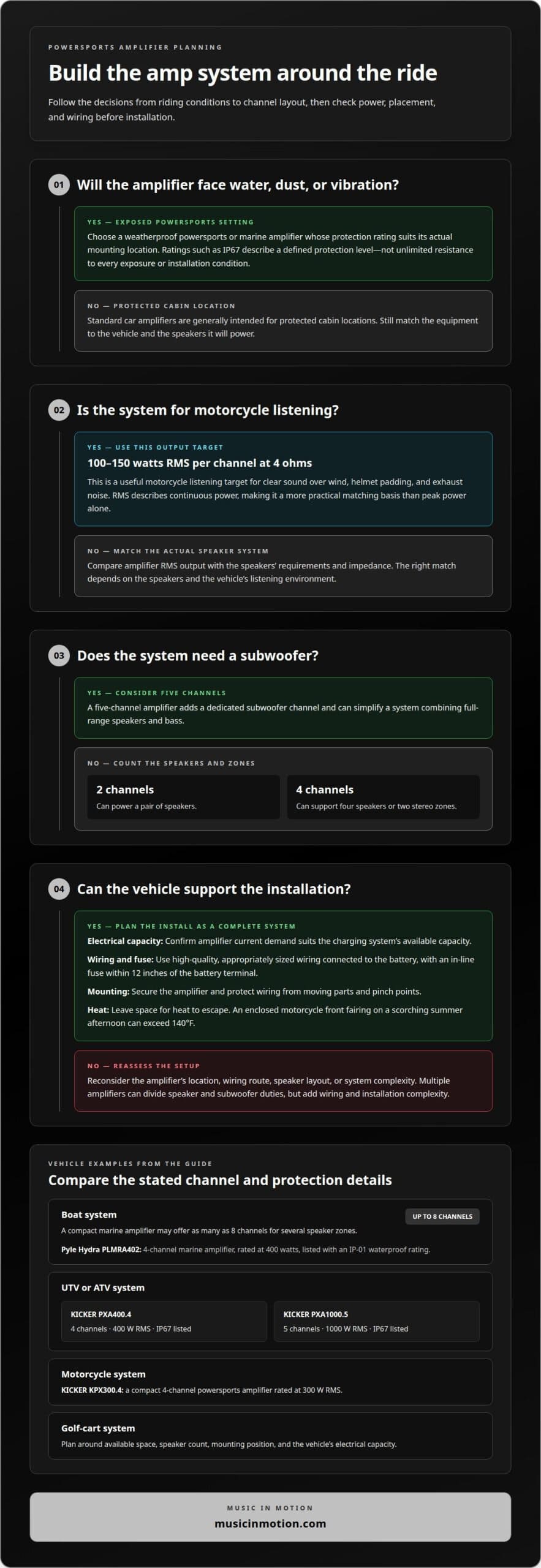
Marine, UTV, ATV, motorcycle, and golf-cart applications
A powersports amplifier must suit the vehicle’s exposure, mounting space, speakers, and listening environment. Marine, off-road, motorcycle, and golf-cart systems can all use dedicated audio equipment, but the installation and channel layout depend on the vehicle.
On a boat, marine-grade equipment is designed for a water-exposed setting. A compact marine amplifier may offer as many as eight channels for a system with several speaker zones. For example, the Pyle Hydra PLMRA402 is a four-channel marine amplifier rated at 400 watts and listed with an IP-01 waterproof rating. That example shows why installers consider both output and the stated protection rating when planning a marine system.
UTVs and ATVs have different layouts and exposure points. A compact unit can suit a limited mounting area, while a multi-channel amplifier can support several speakers. The KICKER PXA400.4 is a four-channel powersports amplifier rated at 400 W RMS and listed as waterproof to IP67. A five-channel option, the KICKER PXA1000.5, is rated at 1000 W RMS and also listed as IP67 waterproof. The configuration helps determine whether speakers and a subwoofer can be served by one amplifier.
Motorcycles place a premium on compact placement and secure mounting. The KICKER KPX300.4 is a compact four-channel powersports amplifier rated at 300 W RMS. For a golf cart, the key planning considerations are similar: available space, speaker count, mounting position, and the vehicle’s electrical capacity. A professional can design the system around those constraints rather than simply choosing the highest output.
An amplifier’s rating is only one part of the match. The installer considers speaker impedance, RMS requirements, channel count, wiring route, and exposure together. This helps create a system suited to how the boat, UTV, ATV, motorcycle, or golf cart is actually used.
RMS power and speaker compatibility
RMS ratings indicate an amplifier’s continuous output, making them more useful for matching speakers than peak-power figures. An installer compares the amplifier’s RMS output per channel with each speaker’s RMS handling, then checks that both ratings apply at the same impedance. A mismatch can affect output and system performance.
Impedance changes an amplifier’s rated output. One two-channel example produces 300 watts per channel at 4 ohms and 550 watts per channel at 2 ohms. Those figures describe different loads, so they aren’t interchangeable. The installer considers the speakers’ impedance and wiring arrangement before choosing the amplifier’s operating load.
Channel-by-channel matching matters in a multi-speaker system. For example, an amplifier rated at 250 watts per channel at 2 ohms delivers that rating under the stated load, not automatically to every speaker configuration. A mono subwoofer amplifier is matched separately to the subwoofer. A compact system still needs output suited to its speakers, rather than the largest rating that fits physically.
Professionals also evaluate continuous RMS output at total harmonic distortion below 1.0%. This gives a clearer comparison of usable output than peak power alone. They consider speaker sensitivity, impedance, channel count, and the listening environment together. On a motorcycle, wind and engine noise influence the required output, while a boat or UTV may need a different speaker layout.
A 500 W RMS mono amplifier, for example, is designed for subwoofer duty, not as a direct substitute for a multi-channel speaker amplifier. The overall system should keep amplifier output, speaker handling, and load requirements aligned. That coordination helps deliver controlled sound without treating a single wattage figure as the whole answer.
Get professional RMS and speaker matching for a powersports audio system tailored to your vehicle.
Music In Motion: Powersports Audio Systems
Music In Motion helps match powersports audio systems to your vehicle, speakers, and riding or driving conditions. Turn to the team for help choosing amplifier channels, matching RMS output to speaker requirements, or planning a professional motorcycle or off-road installation.
For boats, marine audio systems call for equipment and installation choices suited to a water-exposed environment. The right setup depends on the vehicle layout, mounting space, speaker configuration, and how you want the system to sound. Music In Motion also handles custom installations, bringing those details together for a finished system rather than simply selecting components.
Contact Music In Motion to discuss a powersports audio system for your vehicle.
Build a System Around the Ride
Shape your audio system around how and where you use your vehicle. A weatherproof amplifier for powersports vehicles is one part of the plan; speaker placement, the listening environment, and the overall system design matter too. Considering the finished experience helps every component work toward the same goal.
Music In Motion brings these details together through Custom Installations. Its Car Audio Upgrades and Marine Audio Systems are designed for different vehicle environments. The process starts with your vehicle and the sound you want, then matches the equipment and installation to those needs.
Ready to plan an audio system for your ride? Contact Music In Motion for help. A well-matched setup can make every trip sound more like yours.
Frequently Asked Questions
What features make an amplifier weatherproof for powersports vehicles?
Look for a stated water or dust protection rating, suitability for powersports or marine use, and a design that fits the planned mounting location. A motorcycle fairing, boat compartment, and open UTV position expose equipment to different conditions. Installation matters too: secure mounting, protected wiring, and room for heat to escape all help the system suit its environment.
What IP or water-resistance ratings should I look for in a powersports amplifier?
Compare the amplifier’s stated rating with where it will sit and the exposure it will face. Powersports examples include IP67 and IP66/IP67 ratings; the Pyle Hydra PLMRA402 lists IP-01. These labels aren’t interchangeable descriptions. Consider the actual mounting spot, such as a sheltered motorcycle compartment versus a more exposed marine location, and select equipment with a rating suited to that use.
Which weatherproof amplifiers are compatible with motorcycles, ATVs, UTVs, and boats?
Compatibility depends on the vehicle’s installation space, electrical system, speaker layout, and the amplifier’s intended application. The Kenwood Excelon XM802-5 is described as a five-channel powersports/marine amplifier with 1600W maximum power. That category indicates its intended setting, but it doesn’t establish a fit in every motorcycle, ATV, UTV, or boat. A professional assesses the vehicle and complete system together.
How does a professional match amplifier power and impedance to powersports speakers?
A professional compares the speaker’s RMS handling and impedance with the amplifier’s output at that same impedance. For example, the Velocity RZA500-2 is rated at 275 watts per channel at 2 ohms. That rating is useful only when the speaker wiring presents the corresponding load. The installer also considers channel assignments and whether speakers share an amplifier channel, to keep the system configuration compatible.
What are the best-rated powersports amplifiers and how do they compare?
For higher output in one unit, the KICKER PXA1000.5 is a five-channel, 1000 W RMS amplifier listed as waterproof to IP67. The KICKER PXA400.4 offers four channels, 400 W RMS, and IP67 protection; the Pyle Hydra PLMRA402 is a 400-watt, four-channel marine amplifier with an IP-01 rating. Match the choice to your speakers, impedance, and installation conditions.