You are cruising at 35 mph with the sun hitting the wake, but your favorite track is completely lost to the roar of the engine and the whistling wind. It’s a common frustration for boat owners who find their factory systems just can’t compete with the elements. If you are searching for how to make my boat stereo louder, you’ve likely realized that simply turning up the volume knob only leads to muddy distortion. We understand the struggle of wanting a powerful, clear sound that doesn’t leave you stranded with a dead battery at the end of the day.
While upgrading your electrical system for better audio, consider the importance of monitoring other vital components. For comprehensive remote monitoring of bilge pumps and critical equipment, inTouch R&B offers specialized alert systems that provide peace of mind for boat owners.
We believe your time on the water deserves a soundtrack that’s as crisp as the air around you. In this guide, we promise to show you the professional hardware upgrades and tuning secrets needed to win the war against background noise. We’ll cover the essential role of high-efficiency marine amplifiers, the benefits of multi-zone control, and how modern digital signal processing can transform your open-air listening experience into a front-row concert. Whether you’re planning a quiet morning fish or a high-energy sandbar party, we have the expertise to help you achieve total audio performance.
Key Takeaways
- Learn how to fight the “noise floor” by understanding the unique acoustic challenges of open-air environments compared to your car or home.
- Discover why an external marine amplifier is the essential foundation when you’re looking for how to make my boat stereo louder and clearer at high speeds.
- Identify the specific speaker sensitivity ratings and hardware types that allow your music to punch through engine roar without losing clarity.
- Assess your boat’s electrical health to ensure your wiring and power supply can handle a high-performance system without draining your batteries.
- See how custom installation and professional fabrication turn a collection of parts into a reliable, high-output audio experience.
Why Your Boat Stereo Sounds Quiet (and How to Fix It)
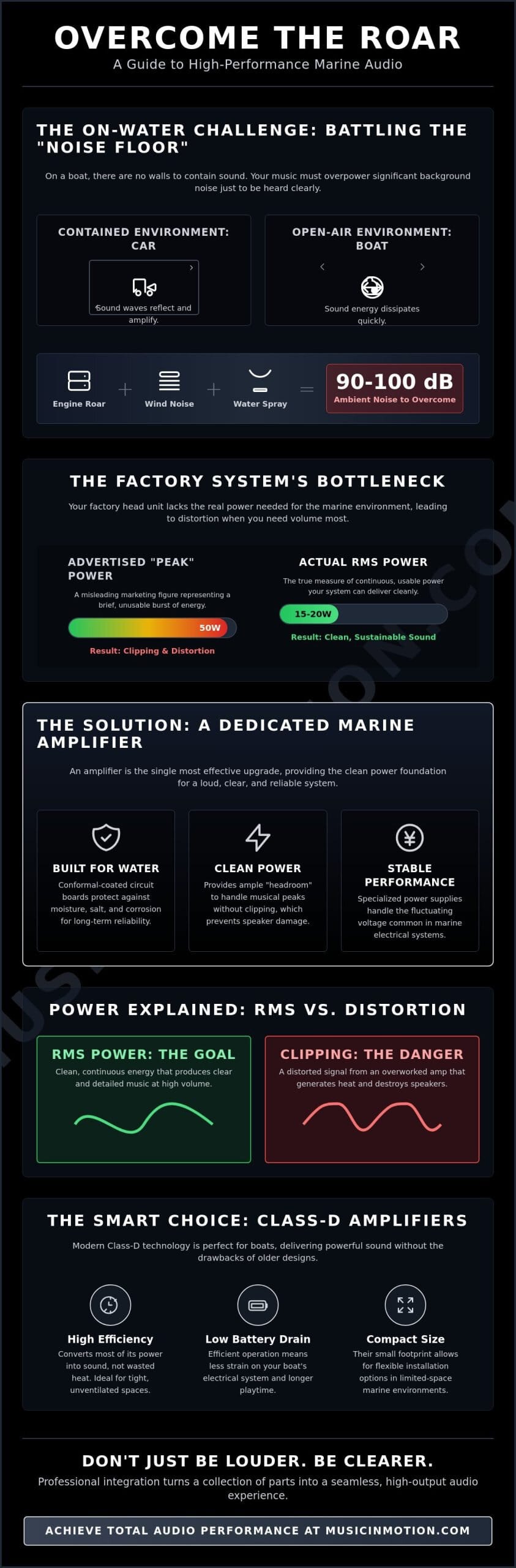
If you’ve ever wondered how to make my boat stereo louder, you first have to understand the invisible enemy: the noise floor. In a car or a living room, sound waves bounce off walls and stay contained within a small, predictable space. On the water, there are no walls. Sound energy simply disappears into the horizon. This open-air environment creates a massive noise floor, which is the baseline level of ambient sound you have to overcome before you can even hear your music.
To win this battle, we focus on increasing the Sound Pressure Level (SPL). This is a measurement of how much acoustic energy your speakers actually push into the air. If your boat is stationary at a quiet cove, a standard system might sound okay. Once you throttle up, the physics change completely. You need a system capable of producing high SPL without falling apart into static or distortion. We prioritize clean power because volume without clarity is just noise.
The Battle Against Wind, Water, and Engine Noise
At cruising speeds, the combination of wind, water spray, and engine roar can easily reach 90 to 100 decibels. If your stereo is only capable of 95 decibels, your favorite songs will sound thin and distant. This happens because low-frequency bass notes are the first to get swallowed by the environment. When you try to compensate by cranking the volume on a weak system, the speakers begin to distort. This creates a harsh, tiring sound that’s actually painful to listen to for long periods. A truly powerful system doesn’t just play louder; it plays with enough authority to keep the music full and rich even at 30 mph.
Understanding the Limits of Factory Head Units
Most factory-installed head units are the weak link in this chain. While the box might claim 50 Watts per channel, that is usually a peak rating intended for marketing. In reality, most internal chips only provide 15 to 20 watts of continuous RMS power. This is barely enough to move a high-quality speaker, let alone cut through a heavy headwind. Pushing these small internal chips to their limit causes internal clipping, where the top of the sound wave is physically cut off. This creates excessive heat that destroys speakers and ruins your audio quality. To get real volume, you need a dedicated Audio power amplifier that provides clean, consistent energy. This is the foundational step in learning how to make my boat stereo louder and more reliable for years to come.
Adding a Marine Amplifier: The Key to Real Volume
Adding a dedicated amplifier is the most effective answer to the question of how to make my boat stereo louder. While a head unit acts as the brain of your system, the amplifier provides the muscle necessary to drive speakers through the heavy resistance of wind and water noise. We often see boaters try to compensate for a quiet system by simply buying larger speakers. Without the power to move those cones, the result is usually just more distortion.
We strictly use marine-grade circuitry for every installation. Unlike car audio equipment, marine amplifiers are designed with conformal-coated circuit boards that resist moisture and salt air. They also feature specialized power supplies that handle the fluctuating voltages common in boat electrical systems. This reliability ensures your music stays clear throughout the entire season. By providing ample power, you create headroom. This is the safety margin that allows your system to handle sudden peaks in music without clipping the signal; clipping is the primary cause of speaker damage.
RMS Power vs. Peak Power: What Actually Matters
RMS power measures the continuous energy an amplifier can deliver; it is the only metric you should use when comparing hardware. When you are researching how to make my boat stereo louder, understanding the difference between RMS and Peak power is vital. Peak power is a marketing figure that represents a burst of energy lasting only milliseconds. To get the best performance, we match the amplifier’s RMS output to the continuous power handling of your speakers. Under-powering a speaker is actually more dangerous than slightly over-powering it. A weak amp will clip sooner and send a distorted, high-heat signal straight to your voice coils.
Class D Amplifiers: Efficiency for the Marine Environment
Modern Class D amplifiers have revolutionized marine audio by offering incredible efficiency in a compact footprint. These units convert nearly all their power into sound energy rather than heat. This is critical when mounting equipment in tight, unventilated storage lockers. This high efficiency also means a lower current draw on your boat’s battery. You can enjoy your music longer at the sandbar without worrying about whether the engine will crank when it is time to head home.
If you are planning on Installing a Marine Stereo upgrade, remember that the amplifier is the foundation of your sound. Our team focuses on delivering a finished result that balances raw power with long-term reliability. We can help you select the perfect components for your specific Marine Audio System to ensure every trip on the water is accompanied by professional-grade sound.
Upgrading to High-Efficiency Marine Speakers and Subwoofers
If you want to know how to make my boat stereo louder, you have to look at speaker sensitivity. Most people focus entirely on wattage, but sensitivity tells you how much sound a speaker produces with just one watt of power. A speaker with a high sensitivity rating, such as 90dB or higher, is significantly more efficient than a standard model. This efficiency allows the speaker to convert more electrical energy into acoustic energy, giving you more volume without straining your amplifier. We prioritize high-efficiency drivers because they provide the punch needed to cut through the open air.
Choosing between coaxial speakers and component systems is another critical decision for your build. Coaxial speakers are the standard choice for most factory locations because they house the tweeter and woofer in a single unit. However, component systems use separate tweeters and woofers with a dedicated crossover. This setup allows us to mount the tweeters higher up, closer to your ears. By placing the high frequencies above the gunwales, we ensure the music reaches you clearly instead of getting muffled by seat cushions or passengers’ legs.
Marine-Grade vs. Car Audio: Why Durability Equals Decibels
Salt air and high humidity are relentless. Car audio speakers use paper cones and untreated metal parts that will corrode and seize within a single season on the water. True marine-grade speakers utilize UV-resistant polymers, Santoprene rubber surrounds, and sealed motor structures. These materials don’t just survive the sun; they maintain their structural integrity so the speaker continues to perform at peak volume. When we perform a professional pontoon boat audio installation, we use specific mounting hardware and gaskets to create a rigid, waterproof seal. This solid foundation prevents air leaks that would otherwise sap your system’s output.
The Role of Subwoofers in Cutting Through Ambient Noise
Bass is the first casualty of speed. Low-frequency sound waves require a massive amount of energy to move through open space. Without a subwoofer, your smaller 6.5-inch speakers have to work double duty to try and produce low notes. This usually leads to distortion and limits how loud the rest of the system can play. A dedicated subwoofer is the secret weapon for anyone wondering how to make my boat stereo louder and fuller. By offloading the heavy lifting to a subwoofer, your main speakers are free to play mid and high frequencies with much more clarity and volume. We often recommend ported enclosures for boats because they offer higher output, which is perfect for overcoming the wind and engine noise you face at 30 mph. To find the right unit for your vessel, explore our guide to the best marine subwoofer options for high-performance bass on the open water.
Step-by-Step: How to Make Your Boat Stereo Louder
Achieving a powerful sound on the water requires a logical, step-by-step approach. If you are looking for how to make my boat stereo louder, the first step is actually invisible: your electrical system. We often see high-end hardware fail because the wiring is too thin to carry the necessary current. You must assess your wiring gauge and ensure you are using tinned copper marine wire. If your system is large, we recommend upgrading the ‘Big Three’ connections. This involves beefing up the charging wire from your alternator, the engine block ground, and the battery ground to ensure your amplifier gets every bit of voltage it needs.
Once the power is stable, we focus on the hardware. Installing high-sensitivity speakers is the most efficient way to increase volume. However, even the best speakers need a dedicated marine amplifier to reach their full potential. When we add an amplifier, we don’t just bolt it in; we integrate it into the boat’s existing electrical architecture to ensure safety and reliability. Finally, we incorporate a subwoofer to fill out the low-end frequencies that the wind usually steals. This creates a balanced, full-range experience that stays clear even at wide-open throttle.
Optimizing Speaker Placement for Maximum Coverage
Line of sight is your best friend in marine audio. High frequencies are directional, meaning they need a clear path to your ears. We use custom fabrication to position speakers higher in the cockpit or on the radar arch. This prevents the sound from being blocked by passengers or gear. For those who enjoy wakeboarding or skiing, tower speakers are essential. These specialized enclosures project sound hundreds of feet behind the boat. By using custom mounting solutions, we can add more speaker locations without cluttering your deck space.
Tuning Your System for Open-Air Performance
Tuning is where a good system becomes a great one. We follow a strict rule: the gain is not a volume knob. It is a sensitivity match between your head unit and the amplifier. Setting this incorrectly leads to distortion and blown equipment. We also use high-pass filters (HPF) to block low-bass frequencies from reaching smaller speakers. This allows them to play much louder without the risk of bottoming out. When we tune the EQ, we adjust it specifically for cruising speeds. This often means a slight boost in the mid-range and bass to compensate for the engine’s roar.
Ready to transform your vessel? Our team specializes in designing Custom Marine Audio Systems that stand up to the toughest conditions. We focus on the finished result so you can focus on the water.
Professional Integration for the Ultimate On-Water Experience
We prioritize the finished result over a simple transaction of hardware. When you ask how to make my boat stereo louder, the answer involves more than just buying the most expensive components on the shelf. It requires a cohesive plan where every piece of equipment works in harmony with your boat’s specific layout. Our team approaches every project as a partnership. We focus on how you use your vessel, whether you are tied up at a quiet dock or leading a crowded sandbar party. This solution-oriented mindset ensures that your system remains reliable and easy to operate in any condition.
Our deep expertise in a car audio upgrade for stock stereo systems provides us with a unique advantage on the water. We understand the complexities of modern signal processing and factory integration, but we know that marine environments demand a different level of durability. We apply a universal standard of excellence across every transport medium we touch. Whether we are working on a center console, a wake boat, or a luxury yacht, our goal remains the same: to improve your daily life through superior technology and craftsmanship.
Custom Fabrication for High-Performance Marine Audio
Standard speaker pods often look like an afterthought. We use custom fabrication to create a factory-plus look that matches your boat’s existing aesthetic. By utilizing CNC technology and specialized marine materials like King StarBoard, we build custom enclosures that are both beautiful and indestructible. We also specialize in creating hidden mounts for amplifiers and processors. This approach allows us to install massive power without sacrificing your valuable storage compartments or changing the lines of your hull. If a mounting location doesn’t exist, we build one that looks like it came straight from the manufacturer.
Ensuring Long-Term Reliability and Battery Health
High-output audio systems require significant energy. To prevent you from getting stranded, we integrate dual-battery systems with smart isolators. This setup allows you to play your music all day on a dedicated “house” battery while keeping your starting battery fully charged for the trip home. We also use professional-grade, tinned copper wiring to eliminate voltage drops. Poor wiring is the primary cause of system failure and fire hazards in marine applications. Once the installation is complete, we perform final testing to dial in the system for the specific acoustics of your hull. This ensures you get the loudest, clearest sound possible without putting unnecessary strain on your electrical system.
We believe that every detail of your property is in safe hands with our team. Our commitment to quality means we don’t just help you with how to make my boat stereo louder; we give you a system that performs flawlessly for years to come. From simple utility upgrades to complex custom projects, we have the specialized knowledge to enhance your time on the water.
Elevate Your Experience on the Water
You now understand that achieving great sound isn’t just about the volume knob. It’s about overcoming the environmental noise floor through high-efficiency marine amplifiers and strategic speaker placement. We’ve shown you why high-sensitivity drivers and dedicated subwoofers are essential for maintaining clarity at cruising speeds. By focusing on professional integration and robust battery management, you can enjoy a system that performs as beautifully as it looks. Learning how to make my boat stereo louder is simply the first step toward creating the perfect atmosphere for every voyage.
Founded in 1994, we bring decades of custom experience to every project we touch. We are specialists in marine, powersports, and high-performance electronics who prioritize the finished result over a mere transaction of goods. Our custom fabrication experts are ready to push creative boundaries to ensure your system integrates seamlessly with your vessel’s design. Let’s build your dream marine audio system. Contact Music In Motion today! We look forward to helping you make every moment on the water truly unforgettable.
Frequently Asked Questions
Will adding more speakers make my boat stereo louder?
Adding more speakers only increases volume if you also increase the power driving them. If you connect six speakers to a head unit designed for four, you actually reduce the power each speaker receives. To see a real difference, we recommend pairing any additional speakers with a dedicated amplifier to ensure they have the energy to perform.
What is the best way to get more bass on a boat?
Installing a dedicated marine subwoofer is the most effective way to improve bass response on the water. Low frequencies are the first to disappear when you are at cruising speeds because they require more energy to travel through open air. A subwoofer in a properly tuned enclosure provides the physical impact needed to cut through the ambient noise. If you are ready to shop for a unit, our roundup of the best marine subwoofers of 2026 covers the top-rated options built to survive UV rays and saltwater.
Do I need a second battery for a loud marine audio system?
We strongly suggest a second battery for any high-performance audio system to ensure you can always start your engine. A dual-battery setup with an isolator allows you to run your stereo for hours at the sandbar without worry. This configuration keeps your starting battery isolated and fully charged for the trip home.
Can I use car audio speakers on my boat to save money?
You should never use car audio speakers on a boat because they lack the necessary protection against the elements. Car speakers use paper or untreated materials that will rot or corrode within months of exposure to salt air and humidity. True marine components use UV-resistant polymers and sealed motors to survive the harsh sun and water.
How many watts do I need for a boat stereo to be heard over the engine?
We recommend a minimum of 50 to 75 watts RMS per channel to ensure your music is audible over a running engine. If you are researching how to make my boat stereo louder at speeds over 30 mph, you may need 100 watts or more per channel. Clean power is the essential factor in hearing your favorite tracks clearly without distortion.
What is a marine-grade amplifier and why is it necessary?
A marine-grade amplifier features conformal-coated circuit boards and corrosion-resistant hardware to withstand humid and salty environments. Standard car amplifiers will quickly fail when exposed to the constant moisture found on a vessel. These specialized units are also built to handle the high vibration and voltage fluctuations common in marine use.
How do I stop my boat speakers from distorting at high volume?
Distortion is usually a sign that your speakers are underpowered, so adding an external amplifier is the best solution. When a factory head unit is pushed to its physical limit, it clips the audio signal, creating harsh noise. Providing clean RMS power allows your speakers to play at higher volumes while maintaining perfect clarity.
Is it possible to add a remote control to my boat’s audio system?
You can easily add wired or wireless remote controls to most modern systems to manage your music from the swim platform or the bow. Many newer head units also integrate directly with your boat’s multi-function display (MFD) using NMEA 2000 networking. This provides total control of your audio environment from your existing helm screens.