A remote starter does more than start your engine from a distance. It lets you prepare the cabin before a drive, while remote start security features can help control access and prevent unauthorized starting. Some systems also let you lock the doors remotely.
It’s reasonable to want convenience without compromising your vehicle’s security. The right setup depends on how the starter works with your vehicle’s existing anti-theft system and whether you choose factory or aftermarket equipment. This article explains how remote starting works, which anti-theft protections may be included, and how systems integrate. You’ll learn what to consider for a practical installation that fits your vehicle.
Key Takeaways
- Understand how remote starting can make a vehicle more comfortable before a drive and what smartphone controls may add.
- Learn how sensors and starter-disable functions can help detect or deter different kinds of vehicle access and theft.
- See why integration with factory security systems matters for safe, reliable starting.
- Compare factory and aftermarket options to identify what to consider for your vehicle and installation.
What is a Remote Starter?
A remote starter lets you start your vehicle without sitting behind the wheel. On a cold morning, you can start the engine before leaving home so the cabin has time to warm up. In warmer weather, the same convenience can cool the interior before a drive. Depending on the system, a smartphone app may also let you lock or unlock doors and start the vehicle. These remote start security features combine comfort with basic access control, but functions vary by system.
Smartphone control works through an app connected to the remote-start system. You might use the app to lock the doors after parking, then start the vehicle before heading outside. Some systems offer smartwatch control through a connected app, while others rely on a remote or smartphone. Available controls depend on the system’s technology and vehicle compatibility. Remote starting doesn’t mean the vehicle can drive itself: you still need to enter and operate it.
Range depends on the remote and the conditions between it and the vehicle. Typical remote-start system ranges span from 800 feet to one mile, while buildings, other signals, and physical obstructions can reduce effective range. A parking structure, for instance, may interfere with a command that works in an open area. Smartphone control may use a different connection method than a handheld remote, so the available operating distance can differ by system.
Use a remote starter only where exhaust can disperse safely. The U.S. Environmental Protection Agency warns that idling cars in garages may cause higher carbon monoxide levels, so never start a vehicle in an enclosed garage. A professionally installed remote starter won’t void the vehicle warranty, according to available market guidance. Insurance coverage depends on the policy terms; the starter alone does not determine whether a particular claim is covered.
Anti-theft features, including engine kill switches and glass-break sensors
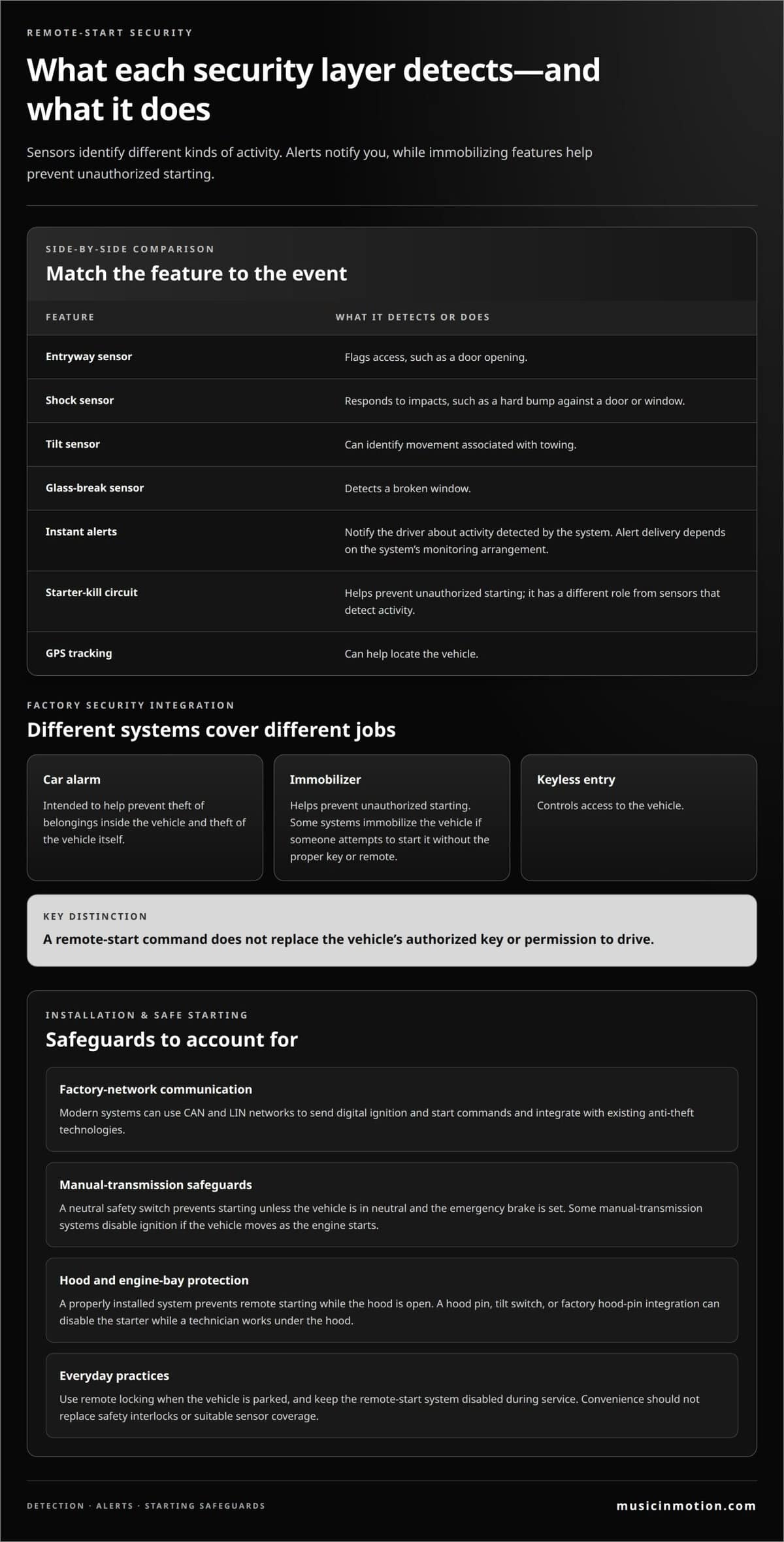
Security sensors respond to different signs of trouble, such as a door opening, an impact, or an attempted tow. For broader protection, pair suitable sensors with an immobilizing starter-kill circuit and alerts.
Shock Sensors and Theft Alerts
A shock sensor detects impacts to the vehicle, such as a hard bump against a door or window. Entryway sensors detect access, while tilt sensors can identify movement associated with towing. Glass-break sensors add another layer by detecting a broken window. Each sensor covers a different event, so consider which risks the system detects and how it sends alerts.
Some security packages combine sensors with instant alerts, a starter-kill circuit, and GPS tracking. A Compustar PRO R5 is an example of a remote-start remote, but remote-start operation and sensor coverage are separate functions to consider.
Security Sensor Monitoring
Monitoring means the system responds to signals from installed sensors, rather than relying on the remote-start command alone. An entryway sensor, for example, can flag a door opening, while a shock sensor can respond to an impact. A monitored vehicle security system may allow police to respond to a break-in. The response depends on the system’s monitoring arrangement and alert process.
Check what each sensor detects and how the system sends alerts to a mobile device or remote. A package with entryway, tilt, and shock sensors covers different events, including access, possible towing, and impacts. An engine-kill circuit has a different role: it helps prevent unauthorized starting.
Improving Remote Start Security
Start by comparing sensor coverage, then consider whether the system includes instant alerts and a starter-kill circuit. Use remote locking when you leave the vehicle parked, and keep the remote-start system disabled during service. A properly installed starter can be disabled while a technician works under the hood using a hood pin, tilt switch, or factory hood-pin integration.
Protection also depends on safe installation and the vehicle’s transmission. Some manual-transmission systems disable ignition if the vehicle moves as the engine starts. Cold or hot weather may make remote starting appealing, but convenience should never replace safety interlocks or suitable sensor coverage.
Integration with factory security and anti-theft systems
A remote-start installation should take a vehicle’s factory security into account. Modern systems can use CAN and LIN networks to send digital ignition and start commands, integrating with existing anti-theft technologies.
How does remote start prevent unauthorized vehicle access? Some systems include anti-theft measures that immobilize the vehicle if someone tries to start it without the proper key or remote. This keeps remote starting separate from permission to drive: a start command does not replace the vehicle’s authorized key.
Does remote start affect a car alarm, immobilizer, or keyless entry system? Each has a different role, but an integrated setup can communicate with factory security electronics. A car alarm is intended to help prevent theft of belongings inside the vehicle and theft of the vehicle itself. The immobilizer helps prevent unauthorized starting, while keyless entry controls access.
Some security packages combine sensors, instant alerts, a starter-kill circuit, and GPS tracking to help protect against break-ins or theft. These technologies address different parts of a security event: sensors detect activity, alerts notify the driver, the kill circuit can prevent starting, and GPS tracking can help locate the vehicle. A car alarm alone does not perform every function in that package.
Manual-transmission vehicles need an additional starting safeguard. A neutral safety switch prevents starting unless the vehicle is in neutral and the emergency brake is set. This matters when a driver sends a remote-start command without being inside to confirm the gear position.
Installation also needs to account for the hood and engine bay. A properly installed remote starter prevents remote starting while the hood is open, helping keep the engine from starting during service. Factory-network communication, authorized-key checks, and physical interlocks work together to preserve key security while allowing remote starting.
Aftermarket versus factory remote-start systems
Factory and aftermarket systems can differ in their controls and security functions. Compare the features on the key fob with the added protections available through an aftermarket module.
Factory Remote-Start Security Limitations
A factory-installed start system may not include additional security features. Some OEM setups provide one-way remote door locks and one-way remote start, which send commands without confirming them back to the remote. A factory alarm, keyless entry, and remote start serve separate purposes. Check whether the system offers protections beyond starting and locking, such as an immobilizer response to an unauthorized start.
Aftermarket systems can add functions a basic factory device may not provide, but features vary. Review how the module works with the vehicle’s existing alarm and key authorization. A well-integrated installation should preserve those functions rather than treat the remote-start command as permission to drive.
Hacking, Relay Risks, and System Security
Can remote-start systems be hacked or relayed, and what are the risks? Unauthorized commands or misuse of keyless-entry signals can raise concerns about access or starting, but a remote-start signal and a keyless-entry signal are not necessarily the same function. The practical risk depends on how the specific system authenticates commands and works with the vehicle’s anti-theft system.
Some remote-start systems include anti-theft measures that immobilize a vehicle if someone tries to start it without the proper key or remote. Push-to-start vehicles use complex digital commands, making them almost impossible to hot-wire. These protections address unauthorized starting, while a car alarm is intended to help prevent theft of belongings and the vehicle itself. Neither label alone describes every security function.
For a system matched to your vehicle, explore remote start installation and how it can integrate with existing security functions.
Music In Motion: Remote Start Systems
Music In Motion installs remote start systems to bring convenient starting to your vehicle while accounting for its existing electronics. If you’re weighing a factory setup against an aftermarket system, or want remote starting integrated with vehicle security, an installation tailored to your vehicle can help align the controls and functions.
The right setup depends on your vehicle and the features you want, such as remote starting or door locking. Music In Motion installs remote car starters and can help match the system to your priorities, integrating it with your vehicle’s existing technology.
For a remote-start setup tailored to your vehicle, contact Music In Motion.
Make Your Next Drive Feel More Seamless
Choosing remote start security features is an opportunity to make your vehicle better suited to your daily routine. Consider which controls you’ll actually use, the protection you want, and how the system should work with your vehicle’s existing technology. A well-planned setup should feel intuitive when you park, start the engine, and head out.
Music In Motion can turn those priorities into a finished installation. Its services also include car audio upgrades, custom installations, and marine audio systems, bringing practical technology to vehicles and boats. The focus is on making the equipment work together to deliver the experience you want.
Ready to discuss a setup for your vehicle? Contact Music In Motion and take the next step toward a more comfortable, confident drive.
Frequently Asked Questions
Why do I need one?
A remote starter adds convenience by letting you start your vehicle before getting inside. It can also help prepare the vehicle for winter driving: warming it can melt snow or ice that obstructs headlights or brake lights. The benefit is practical when you want the cabin ready before departure or clearer lights before driving. It’s a comfort and convenience feature, not a replacement for attentive vehicle care.
What security features do remote start systems include?
Features vary by system, but may include a starter-kill circuit, entryway sensors, shock or tilt sensors, and alerts. Some packages also include GPS tracking. These functions address different needs: sensors detect activity, alerts notify you, and a starter-kill circuit can help prevent unauthorized starting. Consider what matters for your vehicle and parking situation instead of assuming every remote-start system includes the same security package.
Do remote start systems disable the engine if the key is missing?
Some systems include anti-theft measures that immobilize the vehicle if someone tries to start it without the proper key or remote. Other safety functions can shut down the engine if its speed exceeds a preset level before the key or start button is used. These protections depend on the system’s design and integration; remote starting does not mean a vehicle can be driven without its authorized key.
How do factory and aftermarket remote start security features compare?
Factory systems can provide basic remote starting and door-lock control, while aftermarket systems can be configured with additional security functions. OEM alarms typically use one-way remote door locks and one-way remote start, and factory remote start may not include added security features. An aftermarket installation can offer a different combination of features, depending on the system and its integration with the vehicle.