What if your trunk isn’t just a storage space, but the most important part of your speaker cabinet? We’ve all experienced the frustration of a heavy bass drop being ruined by the sound of vibrating metal and buzzing license plates. It’s embarrassing when people outside the car hear rattles instead of your music, and it’s even worse when that resonance distorts the punchy sound you paid for.
We believe your car should work with your audio system, not against it. In this guide, we’ll show you how professional-grade materials transform those trunk rattles into tight, high-impact bass while increasing your system’s overall SPL. We’ll explore the latest 2026 techniques, including how to select the best sound deadening material for subwoofer box enclosures and trunk panels. You’ll learn how a multi-layer strategy using high-purity butyl rubber and acoustic foam can deliver a luxury-car quiet ride when the music is off and a competition-grade performance when the beat drops. It is time to stop the noise and start feeling the music exactly as it was intended.
Key Takeaways
- Understand how stopping panel resonance redirects wasted energy back into the cabin for tighter, punchier bass performance.
- Identify the best sound deadening material for subwoofer box environments by mastering the “Triple Threat” stack of butyl damping, foam decoupling, and vinyl barriers.
- Increase your measurable SPL and bass clarity by lowering your vehicle’s noise floor and eliminating the annoying “bee in a tin can” rattle.
- Learn the professional “Knock Test” and surface preparation secrets that ensure your sound deadening material bonds permanently to your vehicle.
- Discover why treating the trunk environment is a critical final step in perfecting custom car audio upgrades for a truly rattle-free, luxury experience.
Why Your Trunk Rattles: The Physics of Subwoofer Energy
When you install a high-performance subwoofer, you aren’t just adding music to your car; you’re adding a massive energy source. High-excursion subwoofers move a tremendous volume of air, creating intense pressure waves that search for the path of least resistance. In most vehicles, that path is the thin, unreinforced sheet metal of your trunk. We often call this the “Bee in a Tin Can” effect. Your premium subwoofer is trying to deliver deep, soulful notes, but your trunk panels are vibrating so violently they create their own clattering percussion. This isn’t just annoying; it’s a sign that your system is working against itself.
Understanding The Physics of Subwoofer Energy helps us realize that a rattling trunk is a structural problem. There is a major difference between airborne noise, which is the sound traveling through the air, and structure-borne vibration, which is the physical shaking of the car’s frame. Your factory trunk liner, usually a thin layer of carpet or felt, is designed to dampen high-frequency road noise. It offers zero protection against the low-frequency energy of a heavy bass drop. To solve this, we focus on the best sound deadening material for subwoofer box environments to stop the metal from flexing in the first place.
Resonance vs. Acoustic Output
Resonance occurs when your trunk’s metal panels vibrate at the same frequency as your subwoofer’s output. Panel resonance is the primary thief of bass clarity. When a trunk lid vibrates, it acts like a giant, out-of-tune speaker diaphragm. If that panel moves outward while your subwoofer is pulling inward, the sound waves can actually cancel each other out through phase interference. This means you are losing measurable volume and impact. A rattling trunk lid effectively acts as a pressure leak for your system, wasting watts of power on shaking metal instead of moving your ears.
Common Trunk Hot Spots for Vibration
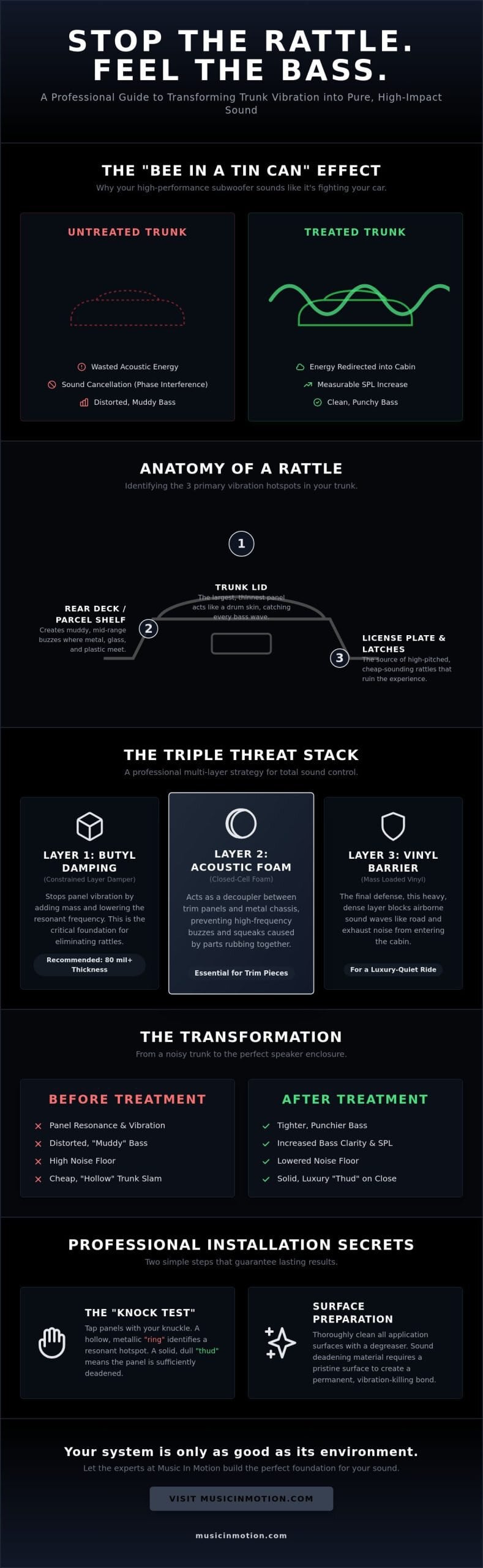
We’ve found that resonance usually hides in three specific areas. Identifying these “hot spots” is the first step toward a quiet cabin:
- The Trunk Lid: This is typically the largest, thinnest, and least reinforced panel in the car. It acts like a drum skin that catches every bass wave.
- Rear Deck and Parcel Shelf: This area is a complex junction where metal meets glass and plastic trim. It’s notorious for creating mid-range buzzes that muddy your soundstage.
- License Plate Frames and Latches: These are the small, high-pitched culprits. Even a perfectly deadened panel can sound cheap if the license plate is flapping against the paint.
By applying a heavy, 80 mil butyl-based constrained layer damper to these surfaces, we can shift the resonant frequency of the metal. This ensures the best sound deadening material for subwoofer box applications stays focused on keeping the energy inside the car where it belongs.
How Sound Deadening Increases Bass SPL and Clarity
We approach sound deadening with a simple philosophy: conservation of energy. When your subwoofer fires, it creates a massive pressure wave. If your trunk panels are thin and flexible, they act like a sponge, absorbing that energy and turning it into heat and physical vibration. By applying the best sound deadening material for subwoofer box environments, we stop that energy from escaping. Instead of the metal moving, the air moves, forcing that acoustic energy back into the cabin where you can actually feel it.
Lowering the noise floor is the secret to what we call “clean volume.” Distorted bass, mixed with the metallic rattle of a trunk lid, sounds messy and fatiguing. When we remove those mechanical artifacts, the bass notes become distinct and musical. You’ll notice a significant improvement in the attack and decay of the music. The kick drum hits with a sharp, defined “thwack” rather than a muddy “thump.” Plus, you get a luxury-car bonus; your trunk lid will close with a solid, high-end thud instead of a cheap, hollow clang.
Turning Your Trunk into a Speaker Cabinet
Think of your trunk as a secondary enclosure. A rigid environment is essential for low-frequency waves to develop properly. When a trunk is untreated, it suffers from “ballooning,” where the panels physically expand under the pressure of the sub. This expansion wastes energy and kills your impact. We consider high-quality damping to be the final stage of car audio fabrication. Choosing the best sound deadening material ensures that your custom setup isn’t limited by the vehicle’s structural weaknesses.
The Impact on Sound Pressure Level (SPL)
Stabilizing the trunk environment can lead to measurable gains. It’s common to see SPL increases of 1 to 3 dB simply by properly treating the resonant surfaces and stopping energy leaks. While some shops only focus on raw volume, we prioritize the tightness of the transient response. This allows you to push your subwoofers harder without the interference of mechanical noise. Utilizing the best sound deadening material for subwoofer box projects ensures that your music stays pure even at high volumes. If you’re ready to hear what your system is truly capable of, our team can help you design a custom installation that maximizes every watt of power.
The Best Sound Deadening Material for Subwoofer Box and Environment
We don’t just slap a single mat onto a panel and call it a day. Achieving a truly rattle-free trunk requires a systematic, multi-layer approach. We call this the Triple Threat stack. It begins with a Constrained Layer Damper (CLD) to stop vibrations. We then add Closed-Cell Foam (CCF) to act as a buffer between panels. Finally, Mass Loaded Vinyl (MLV) serves as a heavy barrier to block external road noise. Using the best sound deadening material for subwoofer box projects means understanding how these layers work in harmony to control every frequency your system produces.
Thickness is a major variable in performance. For standard door speakers, a 50 mil mat might suffice. When you’re dealing with the massive excursion of a high-power subwoofer, we recommend an 80 mil butyl mat. This extra mass is necessary to shift the resonant frequency of heavy trunk steel. We also urge you to stay away from cheap, asphalt-based roofing products. These materials are often sold as budget alternatives, but they release toxic fumes and can melt off your panels during a hot summer. Stick to 100% high-purity butyl rubber for a permanent, odorless bond. Understanding How Sound Deadening Increases Bass SPL starts with selecting materials that can withstand the physical demands of your audio system.
Butyl Mats (CLD): The Foundation
CLD mats are your first line of defense. They consist of a specialized butyl rubber core bonded to a heavy aluminum constraining layer. When your trunk metal tries to vibrate, the butyl core shears against the aluminum skin, converting that kinetic energy into low-grade heat. We often hear about the 100% coverage myth. In reality, following the 75% rule for resonance control on flat panels is usually enough to deaden the metal without adding unnecessary weight. We prioritize high-quality butyl that maintains its adhesion even in extreme temperatures, ensuring your investment doesn’t peel away over time.
Decoupling with Closed Cell Foam (CCF)
While butyl stops the metal from ringing, CCF stops panels from hitting each other. We use CCF as a high-performance gasket between rattling metal surfaces and plastic interior trim pieces. This is essential for the rear deck and parcel shelf, where sub-energy often causes plastic panels to slap against the glass or frame. CCF doesn’t block sound on its own, but it prevents the “panel slap” that occurs during high-excursion bass hits. By integrating this into your build, you ensure the best sound deadening material for subwoofer box applications provides a smooth, silent foundation for your music.
We also consider the total weight added to your vehicle. While mass is your friend for sound control, we balance performance with your vehicle’s fuel economy and suspension limits. A strategic application often yields better results than simply covering every square inch with the heaviest material available.
Professional Installation Secrets for a Rattle-Free Trunk
We’ve seen many DIY enthusiasts treat sound deadening as a simple “peel and stick” task. In reality, even the best sound deadening material for subwoofer box projects will fail if the adhesive doesn’t bond permanently to the vehicle’s surface. Professional results start with meticulous preparation. We use 70% or higher isopropyl alcohol to strip away factory oils, waxes, and dust from the metal. If the surface isn’t surgically clean, the butyl will eventually lift, creating air pockets that trap moisture and kill the material’s damping efficiency.
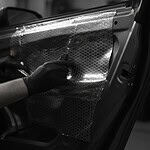
Applying pressure is the next critical step. A wooden or metal roller is non-negotiable for this process. Hand-pressing the material leaves microscopic gaps between the butyl and the steel. You must roll the material until the embossed pattern on the aluminum foil is flattened. This ensures the constraining layer is fully engaged, allowing it to convert vibration into heat. We prioritize treating the outer skin of the trunk first to stop resonance, then we focus on the inner structural braces to add rigidity to the entire assembly.
Diagnosing the Trunk with the Knock Test
We don’t guess where to put the material; we listen. The “Knock Test” is our primary diagnostic tool. Tap your knuckles against the trunk panels. If you hear a hollow, metallic ring, that panel is a source of resonance. If you hear a dull, solid thud, the panel is already well-damped. We mark the ringing “hot spots” with painter’s tape to ensure precise placement. Don’t forget the spare tire well. It’s often the most neglected area, acting like a giant percussion bowl that amplifies low-frequency drone right under your subwoofer enclosure.
Advanced Techniques for Maximum Suppression
Total silence requires looking beyond the large metal flats. We seal the access holes in the inner metal skin to create a semi-sealed acoustic chamber within the trunk structure. This prevents back-wave interference and keeps the bass energy focused toward the cabin. We also address the common license plate buzz by using silicone frames or foam backing. Finally, we secure every factory wiring harness with Tesa tape or zip ties. Even a perfectly deadened panel can’t stop a loose plastic connector from ticking against the frame during a heavy bass hit. To ensure your system reaches its full potential, we recommend choosing our professional custom installations to handle these technical details for you.
Custom Fabrication: The Final Step in Trunk Bass Perfection
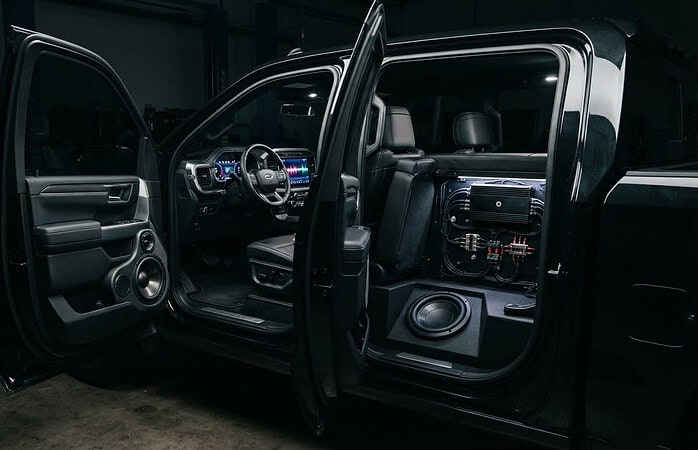
We believe a truly high-end audio system should be felt and heard, but the work behind it should remain invisible. Sound deadening isn’t just a utility; it’s a foundational component of custom fabrication. When we integrate these treatments into a car audio upgrade for stock stereo, we’re ensuring the factory interior can handle the massive increase in energy. Even the most advanced custom enclosure will underperform if the trunk environment is flexible and resonant. By selecting the best sound deadening material for subwoofer box installations, we create a rigid acoustic stage that allows your subs to reach their full potential. This is the Music In Motion philosophy: we deliver a finished result, not just a pile of mats and speakers.
The final stage of a professional build involves the aesthetic side of the trunk. We don’t just stop at vibration control. We finish the space with custom beauty panels, integrated LED lighting, and upholstery that matches your vehicle’s interior. This transforms your trunk from a storage area into a showpiece. We take pride in the fact that our systems look as good as they sound, bridging the gap between technical precision and lifestyle-driven luxury.
Beyond the Mat: Professional Integration
We hide every square inch of sound treatment behind custom upholstery for a “factory-plus” look. It’s important to us that your vehicle remains functional. We prioritize maintaining easy accessibility to factory components like batteries, fuses, and spare tires. A professional installation also ensures your vehicle’s warranty remains intact. We understand the complex electronics in modern cars and motorcycles, so we use non-invasive mounting techniques that respect the integrity of your property.
Why Professional Installation Wins
There’s a “buy once, cry once” mentality that comes with high-end audio. DIY projects often end with a mess of failed adhesives or panels that were broken during disassembly. We use professional-grade measurement tools to verify real-world SPL gains, ensuring you get the performance you paid for. Our team is passionate about the craft, and we treat every vehicle like it’s our own. You get the peace of mind that comes from working with specialists who know the best sound deadening material for subwoofer box applications and how to apply it for maximum impact. If you’re ready to transform your driving experience, we’re ready to build the system you’ve always wanted.
Experience the Power of Pure, Uninterrupted Bass
Your journey to a perfect audio environment doesn’t end with buying the right gear; it starts with controlling how your vehicle reacts to it. We’ve shown how transforming your trunk from a vibrating tin can into a rigid acoustic chamber is the only way to hear the true potential of your subwoofers. By mastering the multi-layer strategy and using the best sound deadening material for subwoofer box projects, you ensure every watt of energy moves air rather than metal. This shift results in punchier bass, higher measurable SPL, and a level of clarity that factory setups simply cannot match.
We bring over 30 years of custom fabrication expertise to every build. As specialists in high-output SPL systems, our team focuses on precision installation using premium butyl and foam composites to deliver a finished result that lasts. Ready for a rattle-free trunk? Contact Music In Motion for a custom consultation. It’s time to stop the rattles and start enjoying a listening experience that feels as good as it sounds.
Frequently Asked Questions
Will sound deadening make my trunk heavier and affect my gas mileage?
Yes, sound deadening adds weight, but the impact on your gas mileage is negligible for most daily drivers. A comprehensive trunk treatment typically adds between 20 and 50 pounds of material. This is roughly equivalent to the weight of a few bags of groceries. Unless you’re competing in a sport where every ounce matters, you won’t notice a change at the gas pump or in your vehicle’s handling.
Do I need to cover 100% of the metal in my trunk for it to work?
No, you don’t need 100% coverage to stop panel resonance. We generally recommend covering 25% to 60% of a flat panel’s surface area with vibration damping mats to achieve excellent results. Adding more material past this point offers diminishing returns for stopping rattles. However, if your goal is to block external road noise, you will need 100% coverage with a barrier material like mass-loaded vinyl.
How much louder will my bass actually be after sound deadening?
You can expect a measurable increase of 1 to 3 dB in Sound Pressure Level (SPL) after proper treatment. While this number sounds small, it represents a significant boost in acoustic power. More importantly, your bass will sound much louder and cleaner to your ears. By removing the distracting mechanical rattles and buzzes, the actual music stands out with far more authority and impact.
Can I use sound deadening spray instead of mats in the trunk?
Sprays are best used as a supplement for hard to reach areas rather than a total replacement for high quality mats. Liquid dampeners work well for wheel wells or complex curves where a mat might not adhere properly. However, they lack the constrained layer of aluminum that makes butyl mats so effective. For the best sound deadening material for subwoofer box environments, we always start with 80 mil butyl mats.
Will sound deadening help with the road noise when my music is off?
Yes, a properly treated trunk significantly reduces tire drone and exhaust hum during your daily commute. Even when your subwoofers are silent, the multi-layer treatment acts as an acoustic shield against the outside world. Closed cell foam and mass loaded vinyl are specifically designed to block airborne noise. This results in a much more refined, luxury car feel that makes it easier to enjoy quiet conversations.
Is it possible to do sound deadening myself, or should I hire a professional?
You can certainly apply the material yourself, but professional installation ensures a permanent bond and expert diagnostics. The most common DIY failure is poor surface preparation, which causes the material to peel off in the summer heat. We have the specialized rollers and experience to identify hidden resonance spots you might miss. If you want a guaranteed result without the mess, our team is here to help.
Does sound deadening help with cold or heat insulation in the car?
Yes, the butyl and foam layers provide a secondary benefit as thermal insulators for your cabin. The aluminum foil on damping mats reflects radiant heat, while the closed cell foam acts as a barrier against temperature transfer. This helps your air conditioning and heater work more efficiently. It is a great way to keep your vehicle comfortable while simultaneously improving the performance of your audio system.
What is the best material for stopping license plate rattle?
A silicone license plate frame or a thin layer of closed cell foam is the best solution for stopping plate buzz. Metal on metal contact is the primary cause of that annoying high pitched clatter. We often use the best sound deadening material for subwoofer box projects to treat the trunk lid, then finish the job with a foam gasket behind the plate. This simple step ensures your music sounds clean from the outside.