What if the difference between a stressful commute and a relaxing drive was hidden just beneath your car’s carpet? Most drivers accept road noise and tire hum as inevitable parts of the journey, but it doesn’t have to be that way. We understand the frustration of rattling door panels and the fear of accidentally snapping a fragile trim clip while trying to fix the problem yourself. When weighing DIY vs professional car sound deadening, it’s easy to focus on the material costs while overlooking the technical precision required for a truly quiet cabin.
You want a luxury-car experience and an audio system that performs at its peak without the interference of outside chaos. We’re here to show you exactly what separates home-applied mats from professional acoustic engineering. You’ll learn how the right approach can reduce noise by 10 to 15 decibels and protect your vehicle’s resale value through a clean, expert installation. We’ll walk you through the science of damping and blocking so you can decide which path leads to the silence you deserve.
Key Takeaways
- Learn how a complete acoustic treatment goes beyond simple damping to include absorbing and blocking for total cabin isolation.
- Understand the “Time vs. Result” trade-off when weighing DIY vs professional car sound deadening to ensure your project delivers the luxury-car silence you’re after.
- Discover why professional tools like Real Time Analyzers are essential for identifying specific noise hot spots that standard kits often miss.
- Learn how we protect your vehicle’s delicate interior trim and long-term resale value with expert techniques that avoid the common pitfalls of home installations.
- Explore the synergy between acoustic engineering and high-performance car audio systems to create a truly immersive listening environment.
The Science of Silence: Understanding DIY vs. Professional Car Sound Deadening
Creating a quiet cabin isn’t just about sticking heavy mats to your doors; it’s a complex interaction of physics. We view sound deadening as a three-part system: damping, absorbing, and blocking. Many enthusiasts start the DIY vs professional car sound deadening debate by looking at material costs, but they often miss how these layers interact. The Science of Soundproofing teaches us that different materials handle different frequencies. Damping stops vibrations, absorbing kills echoes, and blocking prevents outside noise from entering.
Older vehicles were built with heavy steel that naturally resisted some vibration. Today, lightweight alloys and plastics are the standard. This shift makes modern cars much louder than their predecessors. At Music In Motion, we prioritize the finished acoustic result over the mere transaction of goods. We don’t just sell you a box of materials; we provide a solution for your specific vehicle. Choosing between DIY vs professional car sound deadening often comes down to how much you value your time versus a lab-tested result. While the DIY path appeals to hobbyists looking to save on labor, the professional promise offers a guaranteed decibel reduction through precise engineering.
Vibration Damping vs. Sound Barriers: Why One Layer Isn’t Enough
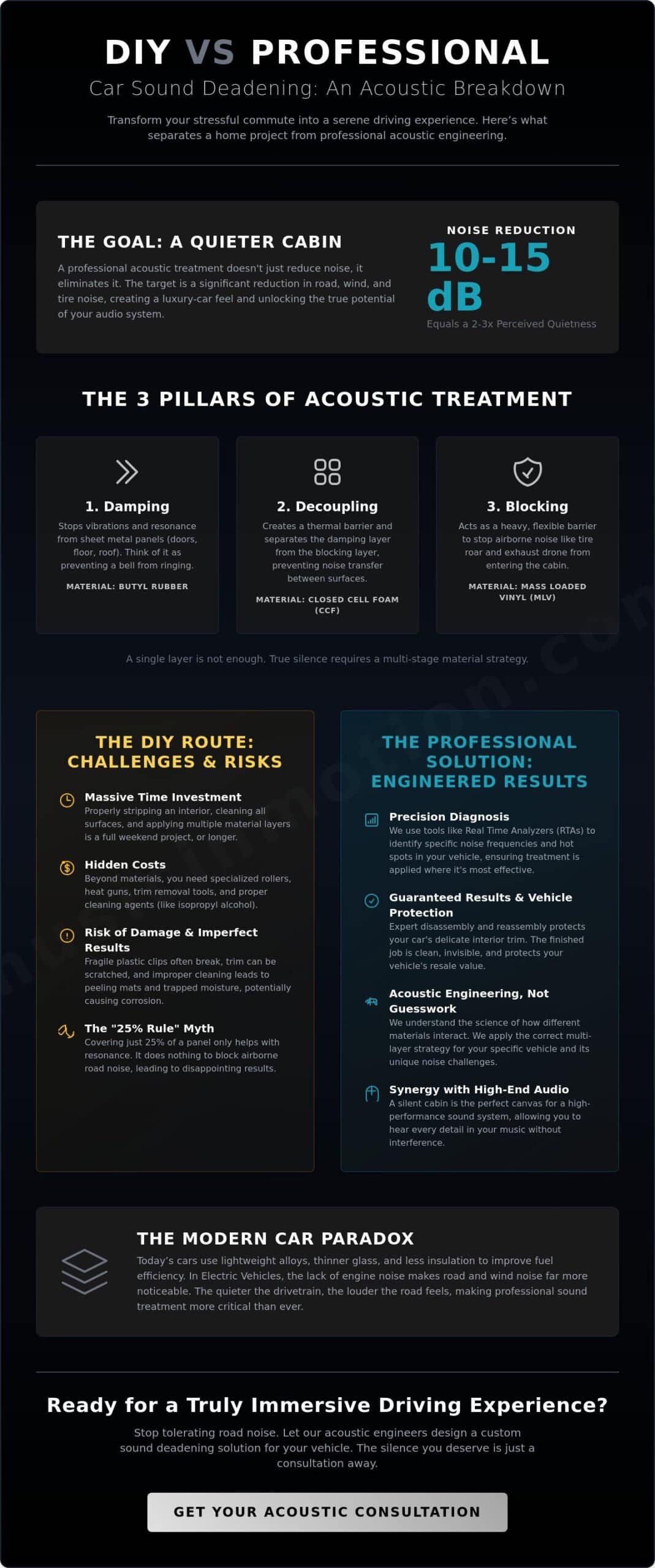
Sheet metal acts like a bell. When you hit a bump, it rings. High-quality Butyl rubber is the answer for damping that resonance by adding mass and lowering the vibration frequency. However, damping alone won’t stop the roar of a semi-truck next to you. For that, you need Mass Loaded Vinyl (MLV). Think of MLV as a heavy, flexible wall that stops airborne road noise in its tracks. We always use a multi-stage material strategy because one layer simply can’t address every type of noise. A professional installation ensures these layers are bonded correctly without air gaps that could trap moisture and cause corrosion.
Why 2026 Vehicles Present Unique Acoustic Challenges
Cars have changed significantly in just a few years. Manufacturers now use thinner glass and lighter insulation to improve fuel efficiency and maximize EV range. In a 2026 electric vehicle, the lack of engine noise makes tire and wind noise much more noticeable. It’s a paradox; the quieter the drivetrain, the louder the road feels. This is where specialized engineering becomes vital. Acoustic decoupling is the process of separating two vibrating surfaces to prevent noise transfer. By using materials like Closed Cell Foam (CCF) between the damping layer and the barrier layer, we prevent those vibrations from ever reaching the cabin.
The DIY Route: Navigating the Challenges of a Home Installation
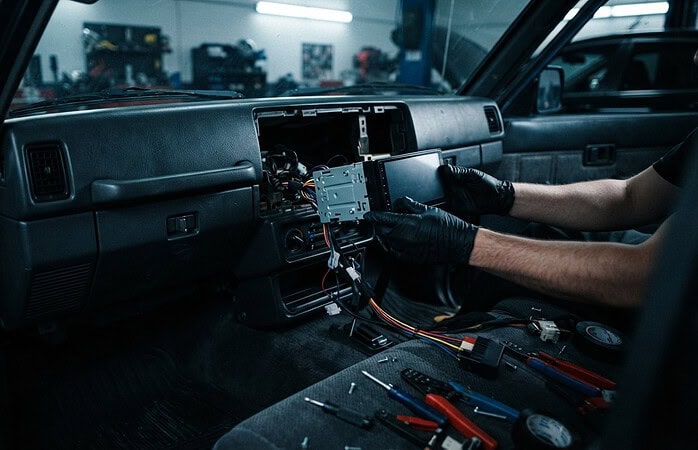
There is a unique satisfaction in stripping a car down to its bones and rebuilding it for comfort. For many hobbyists, the DIY approach is a rite of passage. But when you look at DIY vs professional car sound deadening, the real challenge isn’t the application; it’s the preparation. Prep work is the silent hero of a quiet ride. If you love spending a Saturday in the garage with a set of tools, the hands-on nature of this project can be rewarding. However, you have to be prepared for the invisible labor that happens before the first mat is even peeled.
You cannot skip the cleaning phase. Isopropyl alcohol isn’t just a suggestion; it’s mandatory for a permanent bond. If you leave behind any factory oils, waxes, or dust, the damping material will eventually peel away, losing its effectiveness and potentially creating a sticky mess inside your door panels. Understanding How Sound Deadening Works requires realizing that the material must become one with the vehicle’s metal to stop vibrations. We often see clients who started with great intentions but realized the scale of the work was more than they bargained for. If you want the results without the weekend-long headache, our specialists at Music In Motion can handle the heavy lifting for you.
The hidden cost of DIY often surprises people. Beyond the mats, you’ll need to invest in high-quality rollers to ensure no air is trapped, heat guns for complex curves, and specialized nylon trim removal tools to avoid scratching your dashboard. There’s also the common misconception of the “25% Rule.” While covering a quarter of a panel’s center can stop resonance, it does nothing to block airborne noise. For a truly quiet cabin, you need total coverage and a multi-layered approach.
Essential Materials and Tools for the DIYer
Success depends on your kit. You’ll need precision knives for clean cuts and heavy-duty degreasers for the initial scrub. Be careful with “Amazon specials” that use asphalt-based adhesives; these often emit a foul, tar-like smell in the summer heat. Professional-grade consumer mats use pure butyl rubber, which is odorless and stays stable at high temperatures. An added benefit of a thorough DIY install is thermal management, as these materials help keep your cabin cooler in July and warmer in January.
Common DIY Pitfalls: From Air Bubbles to Broken Clips
One of the biggest dangers in home installation is “bridging.” This happens when a mat is stretched over a gap instead of being pressed into the contours of the metal. These air pockets trap condensation, which eventually leads to rust in places you can’t see. Rushing the reassembly is another trap. If you lose a factory clip or force a panel back into place, you’ll trade road hum for a permanent, annoying interior rattle. Hard-to-reach areas like the firewall or the roof are particularly difficult, often requiring the removal of the entire dashboard or headliner, which can be a daunting task for even a seasoned DIYer.
Why Professional Sound Deadening is an Acoustic Engineering Feat
Professional installation isn’t just about applying more material; it’s about applying the right material in the exact right place. When comparing DIY vs professional car sound deadening, the difference lies in the data. We don’t guess where the noise is coming from. Our team uses Real Time Analyzers (RTA) to identify specific “hot spots” where road vibration and wind whistle are at their peak. This scientific approach allows us to target problematic frequencies without adding unnecessary weight to your vehicle. Research into the acoustic properties of cars shows that every cabin has unique resonant frequencies. We treat your car like a custom acoustic environment rather than a generic project.
This precision is especially vital when you’re planning a car audio upgrade for stock stereo. A quiet cabin acts as a blank canvas for your music. By lowering the noise floor, we allow your speakers to reproduce subtle details that were previously lost to tire roar. We also possess the specialized knowledge required to strip down a modern interior. 2026 vehicles are packed with sensitive electronics. We know how to navigate these systems to avoid triggering airbag warnings or sensor errors, providing a level of security that a home garage setup can’t match.
Advanced Materials: Beyond the Peel-and-Stick Mat
While many DIY kits focus solely on damping, we utilize a sophisticated multi-layer strategy. We focus on preventing “sound flanking,” where noise travels through structural gaps rather than just the panels. This involves using Closed Cell Foam (CCF) as a decoupling layer to separate vibrating surfaces. Mass Loaded Vinyl acts as a limp-mass barrier, which is essential for blocking low-frequency road drone. These professional-grade materials also serve as superior thermal barriers. By better insulating the cabin, we help your HVAC system work more efficiently, keeping you comfortable while reducing the load on your engine or battery.
Protecting Modern Vehicle Safety and Convenience Tech
Modern cars are essentially computers on wheels. We ensure that our acoustic treatments integrate seamlessly with existing vehicle safety systems and internal sensors. A misplaced piece of damping material can interfere with window regulators, door latches, or even the deployment path of side-curtain airbags. We take pride in a clean installation that looks factory-original once the panels are back in place. This level of precision is why the DIY vs professional car sound deadening debate often ends with a trip to a specialist. You get the peace of mind that comes with a professional warranty on both labor and the advanced materials we use.
DIY vs. Professional: The Ultimate Decision Matrix
Deciding between DIY vs professional car sound deadening often comes down to one critical question: how much is your time worth? While the DIY path offers a lower entry cost, a professional treatment is a meticulous investment in long-term comfort. We see a clear distinction in the finished result. A home project usually makes a car “slightly quieter,” but our goal is to deliver an atmosphere of total silence. This difference is felt every time you close the door and leave the world behind.
Resale value is another factor that many owners overlook. A clean, professional installation is completely hidden behind factory panels. In contrast, a messy DIY job with silver foil peeking through trim gaps or sticky residue on the carpet can actually hurt your vehicle’s value. Prospective buyers may view amateur work as a red flag for potential hidden damage. We ensure every layer is applied with factory-level precision, maintaining the integrity of your interior while significantly enhancing the driving experience.
This level of detail provides the essential foundation for custom car audio fabrication. Without a quiet environment, even the highest-end speakers struggle to overcome the noise floor. If you’re ready to experience the true potential of your vehicle, reach out to our team at Music In Motion to see how we can transform your commute.
Calculating the Real ROI of Your Time
A proper, full-vehicle treatment is an exhaustive process. We estimate that a thorough DIY installation can take over 40 man-hours when you factor in disassembly, cleaning, application, and reassembly. Most DIYers start with the doors but stop there because the work is so labor-intensive. Unfortunately, treating only the doors leaves roughly 70% of the road noise untreated, as vibrations continue to travel through the floor, roof, and wheel wells. A professional team completes the entire vehicle correctly the first time, saving you weeks of frustration.
Impact on Audio Fidelity and Dynamic Range
Lowering the “noise floor” is like turning up the resolution on a television. When road roar is removed, your current speakers don’t have to work as hard to be heard, which makes them sound like a much more expensive system. Professional deadening also eliminates panel resonance. This is the rattling you hear during bass-heavy tracks that muddies your mid-bass response and ruins the clarity of the music. By turning the car into a rigid, quiet enclosure, we ensure every note is crisp and every beat is impactful.
Elevating the Experience: The Music In Motion Approach
At Music In Motion, we don’t believe in one-size-fits-all solutions. Every vehicle that enters our shop is treated as a unique acoustic project rather than a generic template. When you weigh the options of DIY vs professional car sound deadening, remember that we aren’t just selling a service; we’re delivering a specific environment. We analyze the specific resonance points of your car’s chassis to determine exactly where material is needed. This tailored approach ensures that we maximize noise reduction without adding unnecessary bulk or weight to your vehicle.
Our commitment to quality extends to the very materials we choose. We only use premium, odorless, and non-toxic damping and barrier products. Many entry-level DIY kits use asphalt-based adhesives that can off-gas and create unpleasant smells when the car sits in the sun. Our materials remain stable and scent-free regardless of the temperature. We also look at the total comfort of your cabin. There is a natural synergy between sound deadening and professional remote start installation. A quiet cabin preserves the temperature of your car longer, making that pre-warmed or pre-cooled interior feel like a true sanctuary the moment you step inside.
From Daily Drivers to Custom Masterpieces
We apply the same level of technical precision to a standard commuter car as we do to a high-end custom build. Our extensive experience in marine and powersports audio informs our automotive standards. If a material can withstand the vibration of a boat hull or the harsh environment of an off-road vehicle, it will easily handle the demands of your daily drive. This cross-industry expertise is the Music In Motion signature. We deliver a finished result that exceeds expectations, providing a level of durability and performance that standard consumer kits simply can’t match.
Start Your Journey to a Quieter Drive
The benefits of a professionally treated cabin are immediate and undeniable. You’ll enjoy improved safety through reduced driver fatigue, enhanced comfort for your passengers, and a level of audio clarity you didn’t know your system was capable of. We invite you to experience the difference that engineering silence can make. Every car has the potential to be as quiet as a luxury cruiser; it just needs the right expert touch. We’re ready to help you transform your vehicle into the quiet, high-performance space you deserve. Contact us to discuss your vehicle’s acoustic transformation and let our team show you what’s possible.
Take Command of Your Driving Environment
Choosing between DIY vs professional car sound deadening is a decision that impacts every mile you drive. While the hands-on nature of a home project offers personal satisfaction, it often lacks the technical precision required for total cabin isolation. We’ve seen that a professional approach doesn’t just add weight; it uses acoustic engineering to target specific noise hot spots while protecting your vehicle’s complex safety systems. You deserve a cabin that feels like a sanctuary, free from the exhaustion of road roar and the distraction of rattling panels.
Since 1994, our team has focused on delivering a finished result that transforms the way you experience your vehicle. We are specialists in premium electronics integration and advanced vehicle safety, ensuring your car remains as functional and secure as it is quiet. Ready for a luxury-quiet ride? See what our professional acoustic treatment can do for your vehicle. We’re here to help you find the perfect balance of comfort and high-performance sound. Let’s make your next journey the quietest one yet.
Common Questions About Car Sound Deadening
Is DIY car sound deadening actually worth the effort?
DIY sound deadening is worth the effort if you are a hobbyist who enjoys hands-on projects and only needs to fix minor panel rattles. It’s a rewarding way to learn about your vehicle’s construction while saving on labor. However, when comparing DIY vs professional car sound deadening, the specialized tools and massive time commitment required for a full cabin transformation often make professional installation the more practical choice for most drivers.
How many decibels can professional sound deadening really remove?
A professional sound deadening treatment can achieve a noise reduction of 10 to 15 decibels. While that might sound like a small number, every 3dB reduction effectively cuts the sound energy in half. Achieving this level of silence requires a multi-layer approach that combines vibration damping with airborne noise barriers, which is far more effective than the single-layer application typical of most home projects.
Will sound deadening materials make my car significantly heavier?
Modern acoustic materials are engineered to be highly effective without adding excessive bulk. A full-vehicle treatment usually adds between 50 and 100 pounds to the total weight of the car. This is roughly equivalent to carrying a few extra bags of groceries or a small passenger. Since the weight is distributed evenly across the floor and doors, you won’t notice a negative impact on your fuel economy or handling.
Can I just do the doors, or do I need to do the whole floor and roof?
Treating only the doors is an excellent first step for improving your speaker’s mid-bass response, but it won’t stop the majority of road noise. To achieve a truly quiet ride, you must address the floor and wheel wells where tire and drivetrain vibrations enter the cabin. The roof is also vital for eliminating wind noise and the drumming sound of heavy rain on the sheet metal.
Does sound deadening help with the car’s heater and air conditioning?
Yes, sound deadening materials provide excellent thermal insulation for your interior. By adding a barrier of butyl rubber and closed-cell foam, you help the cabin maintain its temperature for much longer. This reduces the constant load on your HVAC system, keeping you cooler in the peak of summer and warmer during winter drives while also improving the overall energy efficiency of your vehicle. Just as you optimize your car’s climate, Crome Mechanical can help ensure your home’s heating and cooling systems are running at peak efficiency for year-round comfort.
Will installing sound deadening myself void my vehicle’s manufacturer warranty?
Installing sound deadening usually won’t void your entire warranty, but it can complicate specific claims if a panel is damaged during the process. Under the Magnuson-Moss Warranty Act, a manufacturer must prove that your aftermarket work directly caused a failure to deny a claim. A professional installation provides peace of mind because experts know how to navigate sensitive electronics and safety sensors without causing accidental damage.
What is the best material to use for blocking road noise specifically?
Mass Loaded Vinyl (MLV) is the most effective material for blocking airborne road noise. While vibration dampers stop the metal panels from ringing like a bell, MLV acts as a heavy, limp-mass barrier that prevents external sounds from passing through into the cabin. For the best results, it should always be used with a decoupling layer of foam to prevent it from vibrating against the car’s frame.
How long does a professional shop take to sound deaden a full vehicle?
A complete, full-vehicle treatment typically takes a professional team several days to finish. This process involves stripping the interior down to the bare metal, deep cleaning every surface, and carefully applying multiple layers of material before reassembly. When weighing DIY vs professional car sound deadening, remember that this same task can easily take a solo hobbyist over 40 hours of difficult labor to complete correctly.