Your factory car audio system is likely hiding the true soul of your music. We have all been there; you crank the volume for that one perfect bridge, only to be met with muddled vocals and a complete lack of physical impact. Deciding whether to upgrade your speakers or subwoofer first is the most common crossroads our customers face when they start their audio journey. It is a choice between surgical clarity and raw energy, and getting the order wrong can leave your system feeling unbalanced.
We understand that you want a system that feels as good as it sounds without the fear of a new subwoofer completely drowning out thin factory door speakers. In this 2026 guide, we’ll share our professional framework for prioritizing your components to achieve a balanced, crystal-clear soundstage. You will discover how your specific listening habits dictate the best starting point for your investment. We are also providing a clear roadmap for a multi-stage build that delivers deep, controlled bass response alongside the high-frequency detail you have been missing.
Key Takeaways
- Decide between the “Detail Path” and the “Impact Path” by identifying whether you value vocal clarity or rhythmic energy most.
- Learn why choosing speakers or subwoofer first depends on your favorite music genres and the unique acoustic environment of your vehicle.
- Discover how adding a subwoofer can actually improve your current speakers by offloading the heavy lifting of low-end frequencies.
- Understand the role of factory EQ curves and how they can limit the performance of even the highest quality aftermarket components.
- See why we prioritize the finished acoustic result and professional tuning over the brand names on the equipment boxes.
Speakers or Subwoofer First? Understanding the Car Audio Dilemma
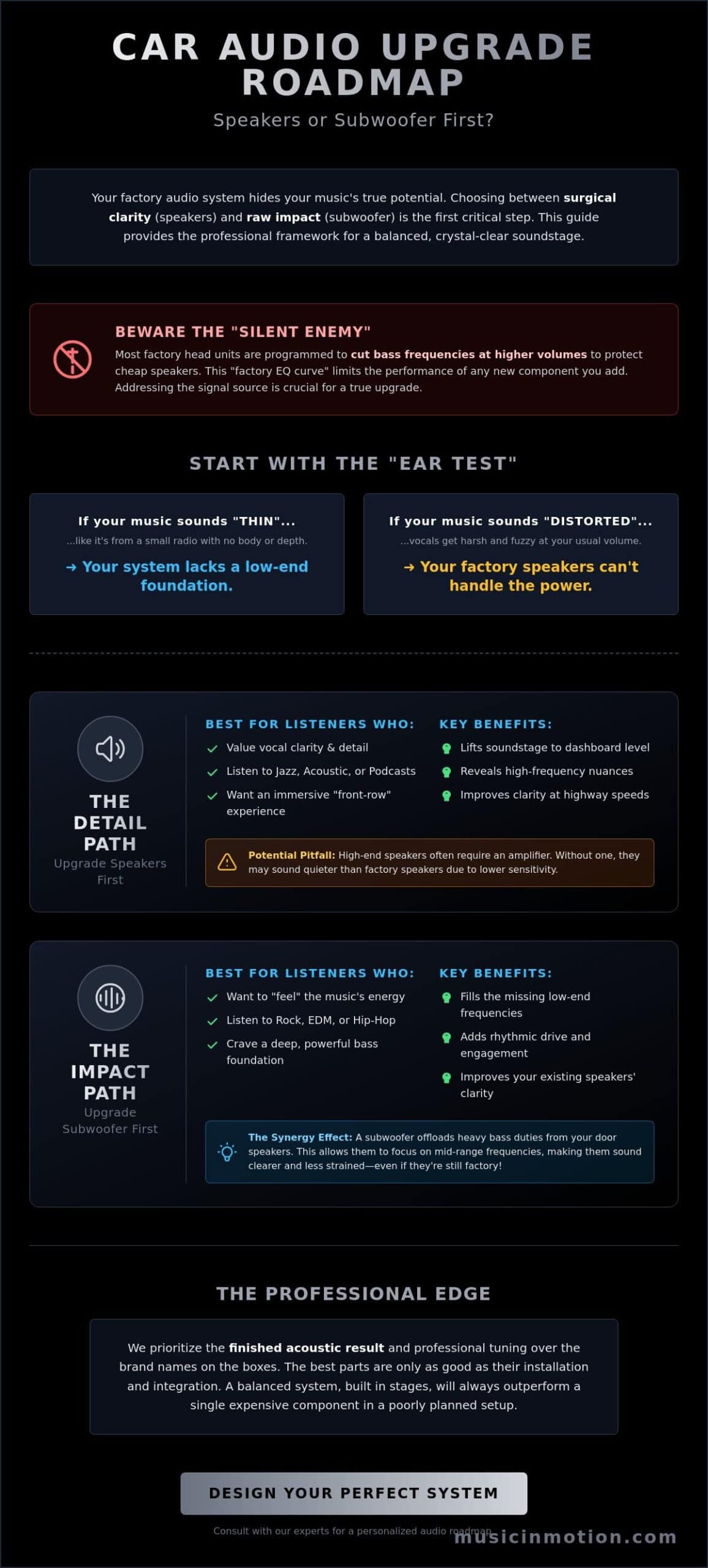
Starting a car audio build is an exciting process, but it often leads to a fundamental question: should you prioritize speakers or subwoofer first? We see this dilemma every day at our shop. Some drivers want to hear every breath in a vocal track, while others want to feel the vibration of a bass guitar in their seat. These are two distinct directions for your investment. We call them the “Detail Path” and the “Impact Path.” Choosing the right one requires an honest assessment of what your current system is missing.
Before we look at hardware, we have to talk about the “silent enemy” hidden inside your dashboard. Most factory head units are designed to protect cheap parts. As you turn the volume up, the car’s computer often automatically cuts the bass frequencies to prevent the factory speakers from blowing out. This means your signal source is actually working against you. If you don’t address how that signal is managed, even the most expensive car audio components will struggle to reach their full potential. We believe in fixing the source first to ensure your new gear has a clean foundation to work with.
We recommend a quick “ear test” to start your journey. Sit in your vehicle and turn the volume to your usual listening level. Does the music sound “thin,” like it’s coming from a small transistor radio? Or does it sound “distorted,” where the voices get fuzzy and harsh? Thin sound usually points toward a lack of low-end foundation. Distortion usually means your factory speakers are being pushed beyond their physical limits. Identifying these issues helps us build a roadmap that solves your specific frustrations.
The Detail Path: Why Most People Think Speakers Come First
Replacing door speakers is the most common car audio upgrade for stock stereo. Factory speakers are typically built from inexpensive paper cones and small magnets that lack precision. They simply cannot reproduce high-frequency nuances. When you upgrade to high-quality aftermarket speakers, you gain “imaging.” This is the ability to hear exactly where the instruments are positioned on a virtual stage. If you value vocal clarity and acoustic detail, this is your starting point.
The Impact Path: Why Bass is the Foundation of Sound
Bass is the physical foundation of music, and small door speakers simply cannot move enough air to reproduce those deep frequencies. It is a matter of physics. A subwoofer adds the “feel” to your drive that factory systems lack. It provides a rhythmic drive that makes your commute more engaging. Adding a sub first is often the right move if you listen to rock, EDM, or hip-hop. It fills the massive acoustic void that factory systems leave behind without needing to be “loud” to be effective.
The Case for Speakers First: Prioritizing Clarity and Soundstage
Choosing to upgrade your speakers or subwoofer first often comes down to how you listen to your favorite tracks. If your daily drive is filled with podcasts, jazz, or acoustic music, you likely crave vocal clarity above all else. Factory speakers often place the sound at your feet, making the music feel distant and muffled. By starting with the door speakers and tweeters, we can lift that soundstage. This creates an immersive experience where the artist feels like they are performing right on your dashboard.
We often talk about the “Weakest Link” theory with our customers. High-quality speakers are extremely revealing. While they bring out the shimmer of a cymbal, they also expose the flaws in low-quality streaming files or poor factory signals. There is also a common trap to avoid: sensitivity. Many premium aftermarket speakers require more power to move than the flimsy paper ones they replace. If you install high-end speakers without an amplifier, they might actually sound “thinner” than the originals. We help you navigate these technical hurdles to ensure your upgrade is a true step forward.
Improving the High-End Detail
The biggest transformation in the “Detail Path” comes from the tweeters. Most factory systems hide these in the dash or doors behind thick plastic grilles. We focus on placing new, accurate tweeters in locations that direct the high frequencies toward your ears. This solves the problem of muddled sound at highway speeds. You won’t have to strain to hear lyrics over wind noise. Instead of “bright” or piercing sound, we aim for accuracy that stays smooth even at high volumes.
Mid-Bass Punch vs. Sub-Bass Depth
It is vital to understand that a 6.5-inch door speaker is a precision tool for mid-bass punch, not deep sub-bass rumble. To get the most out of these drivers, we utilize car audio fabrication techniques like custom mounting baffles. These treatments prevent energy loss and unwanted rattles. Sound deadening can increase the effective bass output of new door speakers by up to 3dB. While some experts argue for a subwoofer as a priority to fill the low-end gap, starting with door speakers provides the “snap” and “attack” that gives music its definition. If you are ready to hear the details you’ve been missing, we can help you design a speaker system that fits your specific vehicle and budget.
The Case for a Subwoofer First: Building the Foundation of Sound
If your playlists are dominated by Hip-Hop, EDM, or Rock, the choice between speakers or subwoofer first often leans toward the low end. We frequently meet customers who believe a subwoofer is only for those who want to wake up the neighborhood; however, that is a common misconception. In our experience, a subwoofer is the most effective way to provide the rhythmic foundation your music currently lacks. It is not about raw volume. It is about the visceral “feel” of a kick drum or the smooth glide of a bass guitar that factory speakers simply cannot reproduce.
Adding a subwoofer provides an immediate “offloading” benefit to your entire system. By using a crossover, we can stop your small door speakers from trying to play deep bass frequencies they were never designed to handle. This instantly makes your factory speakers sound cleaner and more composed. They no longer have to struggle with heavy low-end signals, which reduces distortion and allows them to play louder and clearer. It is a strategic move that enhances your existing soundstage without requiring you to tear apart every door panel on day one.
Mechanical Protection for Your Factory Speakers
Factory speakers are notoriously fragile. When you push them to play deep bass, it causes “over-excursion,” where the speaker cone moves beyond its physical limits. This generates excessive heat in the small voice coils and eventually leads to failure. We use a High-Pass Filter (HPF) to block these dangerous frequencies from reaching your door speakers. Think of it as preventative maintenance; the subwoofer handles the heavy lifting, while your original speakers focus on the vocals and instruments they are actually good at.
Invisible Bass: The Goal of Modern Integration
Our philosophy focuses on “invisible bass.” We want you to feel the impact of the music on your dashboard, not hear a rattling trunk behind you. Achieving this requires professional tuning to ensure the subwoofer blends seamlessly with the rest of your system. For drivers who are concerned about cargo space, we provide several clever solutions:
- Under-seat subwoofers: Compact units that add depth without taking up any trunk space.
- Custom-fit enclosures: Designs that mold into the corner of your trunk or spare tire well.
- Vehicle-specific builds: Utilizing custom subwoofer enclosures to maintain full utility while delivering high-end performance.
A well-placed subwoofer completes the frequency spectrum, creating a balanced experience that makes every drive more exciting.
The Decision Framework: How to Choose Based on Your Goals
Deciding whether to buy speakers or subwoofer first isn’t just about the hardware. It’s about your lifestyle and how you use your vehicle every day. We use a three-part test to help our customers find the right starting point. First, take the “Genre Test.” Look at your recent listening history. If 80% of your music consists of acoustic tracks, jazz, or podcasts, you should start with speakers. If your playlists are driven by rhythmic energy and heavy beats, the subwoofer will provide the biggest immediate satisfaction.
Next, we apply the “Vehicle Test.” Every cabin has its own acoustic challenges. A Jeep Wrangler with a soft top has a high noise floor, meaning you need the volume and clarity of new speakers just to hear the music over the wind. A luxury sedan, however, is a quiet canvas where a subwoofer can reveal subtle low-end textures you never knew existed. Finally, consider the “Budget Test.” If you want the most significant change for a smaller initial investment, a powered subwoofer often wins. If you are planning a long-term, high-end build, starting with quality door speakers and planning for an amplifier later is the smarter path.
Matching the Upgrade to Your Vehicle Type
Large trucks and SUVs have massive cabin volumes that can swallow up sound. We often prioritize a subwoofer in these vehicles just to fill that physical space with energy. On motorcycles and powersports vehicles, the open-air environment changes the rules completely. Speakers and raw volume almost always come first because you are fighting engine and wind noise at every turn. For those on the water, premium marine audio systems require a more balanced approach. You need enough clarity to hear the music while the boat is in motion and enough bass to overcome the sound of the wake.
The “Amp First” Variable
Sometimes, the best answer to the speakers or subwoofer first question is actually “neither.” A 4-channel amplifier is often a better first step than new drivers. It provides the clean power your factory head unit lacks, which improves the performance of your existing speakers immediately. In modern vehicles, we also emphasize the role of the Digital Signal Processor (DSP). A DSP allows us to correct the factory EQ curve and time-align the sound. This ensures that when you eventually add your new speakers or sub, they are receiving a perfect, uncolored signal. If you’re ready to map out your audio journey, talk to our experts about a custom build plan today.
The Professional Edge: Why Results Matter More Than Parts
At Music In Motion, we operate on a philosophy that prioritizes the delivery of a finished acoustic result over the mere transaction of goods. It is easy to get caught up in the technical debate of whether to install speakers or subwoofer first, but the brand name on the speaker magnet matters far less than the expertise of the person handling the installation. High-end gear is simply a collection of tools. Without proper calibration, even the most expensive components will fail to deliver the emotional impact you deserve. We focus on the internal experience of the driver, ensuring that every note feels intentional and every beat hits with surgical precision.
Modern vehicles in 2026 are complex electronic ecosystems. DIY “plug-and-play” kits often struggle to integrate with factory safety systems and pre-set EQ curves that cannot be bypassed with a simple wire adapter. Professional calibration acts as a vital safeguard for your investment. We ensure that your signal levels are perfectly matched and your crossovers are set to protect your hardware. This meticulous approach prevents the common tragedy of a blown tweeter caused by a clipped signal or a subwoofer that sounds disconnected from the rest of the soundstage. We don’t just install parts; we engineer a cohesive listening environment.
Advanced Tuning and System Integration
We utilize specialized tools like Real-Time Analyzers (RTA) to visualize exactly how your car’s unique cabin shape affects sound waves. Every vehicle interior has “peaks” and “dips” where certain frequencies disappear or become overwhelming. Our team focuses heavily on phase alignment. This ensures the sound from your new subwoofer arrives at your ears at the exact same millisecond as the sound from your door speakers. Mike and Kim prioritize reliability and simplicity in every custom build. We want your system to be easy to operate and built to last for the life of your vehicle.
Planning Your Multi-Stage Build
The secret to a successful audio journey is a clear roadmap. We help you design an upgrade path where each stage builds logically on the last. This prevents the frustration of buying a component today that you will have to replace when you add an amplifier tomorrow. Whether you decide on speakers or subwoofer first, we ensure the underlying wiring and signal processing are ready for the next evolution of your system. Building a long-term relationship with a specialized specialist gives you access to consistent expertise. We are here to ensure your property is in safe hands through every stage of the build.
Contact our expert team for a custom audio consultation and let us help you transform your daily drive.
Start Your Custom Audio Journey Today
Choosing to install speakers or subwoofer first depends entirely on your unique listening goals and the acoustic environment of your vehicle. Whether you prioritize the surgical clarity of new door speakers or the visceral impact of a custom subwoofer enclosure, the key is to have a structured roadmap. We have shown that matching your upgrade to your specific habits ensures you get the best value for your investment from day one. Professional tuning remains the essential final step to bridge the gap between high-end parts and a truly immersive experience.
Since 1994, we have used our 30 years of custom integration expertise to help drivers achieve professional-grade results. Our team specializes in high-performance audio for vehicles, marine vessels, and motorcycles, alongside advanced radar defense and vehicle safety technology. We focus on the finished result rather than just the hardware. This ensures your system is simple to use, reliable, and perfectly tuned to your ears. Your journey doesn’t have to be a guessing game. Upgrade your driving experience with a professionally integrated system and feel the difference that three decades of passion can make. We are ready to help you build something extraordinary.
Frequently Asked Questions
Is it better to get a subwoofer or new speakers first for a truck?
In a truck, we usually recommend a subwoofer first to fill the large cabin space with energy. Factory speakers in trucks often struggle to overcome road noise and large interior volume, leaving the sound feeling thin. Adding a sub provides the low-end foundation needed to make the music feel full and balanced. This immediate impact often provides more satisfaction than replacing door speakers in a large cabin.
Will a new subwoofer make my factory speakers sound better?
A new subwoofer will absolutely make your factory speakers sound better by allowing them to focus on what they do best. When we use a crossover to filter out deep bass, your factory drivers no longer have to struggle with low frequencies. This reduces distortion and voice coil heat, resulting in cleaner vocals and more headroom for the rest of your music.
Can I add a subwoofer to my factory stereo without changing the head unit?
You can easily add a subwoofer to a factory stereo without replacing the head unit. We use a high-quality line output converter or an amplifier with speaker-level inputs to tap into the existing audio signal. This allows you to keep your dashboard’s original look and functionality while gaining the deep bass response you have been missing.
Do aftermarket speakers have more bass than factory speakers?
Aftermarket speakers often have less perceived bass than factory speakers because they are designed for accuracy rather than boomy mid-bass. While factory speakers use cheap paper cones that can sound artificially bloated, premium drivers prioritize crystal-clear high-frequency detail. To get true low-end response, you should always look at a dedicated subwoofer rather than relying on door speakers alone.
What is the most cost-effective first step for a car audio upgrade?
The most cost-effective first step is often a compact powered subwoofer. These units combine an amplifier and a driver in one enclosure, providing the biggest “bang for your buck” in terms of sound transformation. If you are debating whether to buy speakers or subwoofer first on a tight budget, the powered sub offers an immediate, visceral change that new speakers alone cannot match.
How much power do I need for my first subwoofer?
For a first subwoofer, 200 to 500 watts RMS is the ideal range for most daily drivers. This provides enough energy to blend with your factory speakers without requiring a massive upgrade to your vehicle’s electrical system. We focus on the quality of the power rather than just the number on the box to ensure your bass stays controlled and musical.
Will upgrading just my speakers make the music louder?
Upgrading your speakers won’t necessarily make the music louder if you are still using the factory head unit. In fact, premium speakers are often less sensitive than factory ones, meaning they require more power to reach the same volume. To achieve a significant increase in loudness, we recommend pairing your new speakers with a dedicated multi-channel amplifier.
Why does my car audio sound worse after I installed new speakers?
New speakers can sound worse if they are underpowered or if the factory radio is still applying a baked-in EQ curve. High-end speakers reveal the flaws in a weak signal, making the sound feel thin or harsh. If you didn’t consider whether to get speakers or subwoofer first alongside a DSP or amplifier, the new drivers may simply be revealing the technical limitations of your stock head unit.