Most riders think high-volume audio is just about adding bigger speakers, but true motorcycle audio system design is actually an exercise in acoustic warfare against the elements. We know the frustration of hitting 80 mph only to have your favorite track turn into a garbled mess of wind noise and distortion. It’s disappointing when your investment can’t keep up with your throttle, or when you’re constantly worried that a sudden rainstorm might ruin your gear. You deserve a system that sounds as powerful as your engine feels.
In this guide, we’ll show you the professional engineering principles behind designing a soundstage that cuts through the roar without sacrificing high-fidelity clarity. We’ll explain how high-efficiency Class D amplifiers and IP67-rated components provide the reliability you need for the long haul. You’ll learn how we use digital signal processors to tune out vibration and muddy bass, ensuring your vocals stay sharp and your mid-bass stays punchy. From managing battery draw to optimizing speaker placement, we’re sharing the technical secrets to achieving perfect audio on any road.
Key Takeaways
- Learn why open-air environments require specific engineering to overcome frequency masking and wind noise at highway speeds.
- Discover how a Digital Signal Processor (DSP) acts as the architect of your sound by correcting factory EQ and tuning for vibration.
- Understand why precise speaker aiming through custom fabrication is more effective for clarity than simply choosing the largest speaker available.
- Master the principles of high-efficiency motorcycle audio system design to balance powerful Class-D amplification with your bike’s limited electrical output.
- Find out why custom-tailored solutions outperform universal kits by focusing on finished results and your specific riding goals.
The Challenge of Open-Air Acoustics: Why Standard Audio Fails
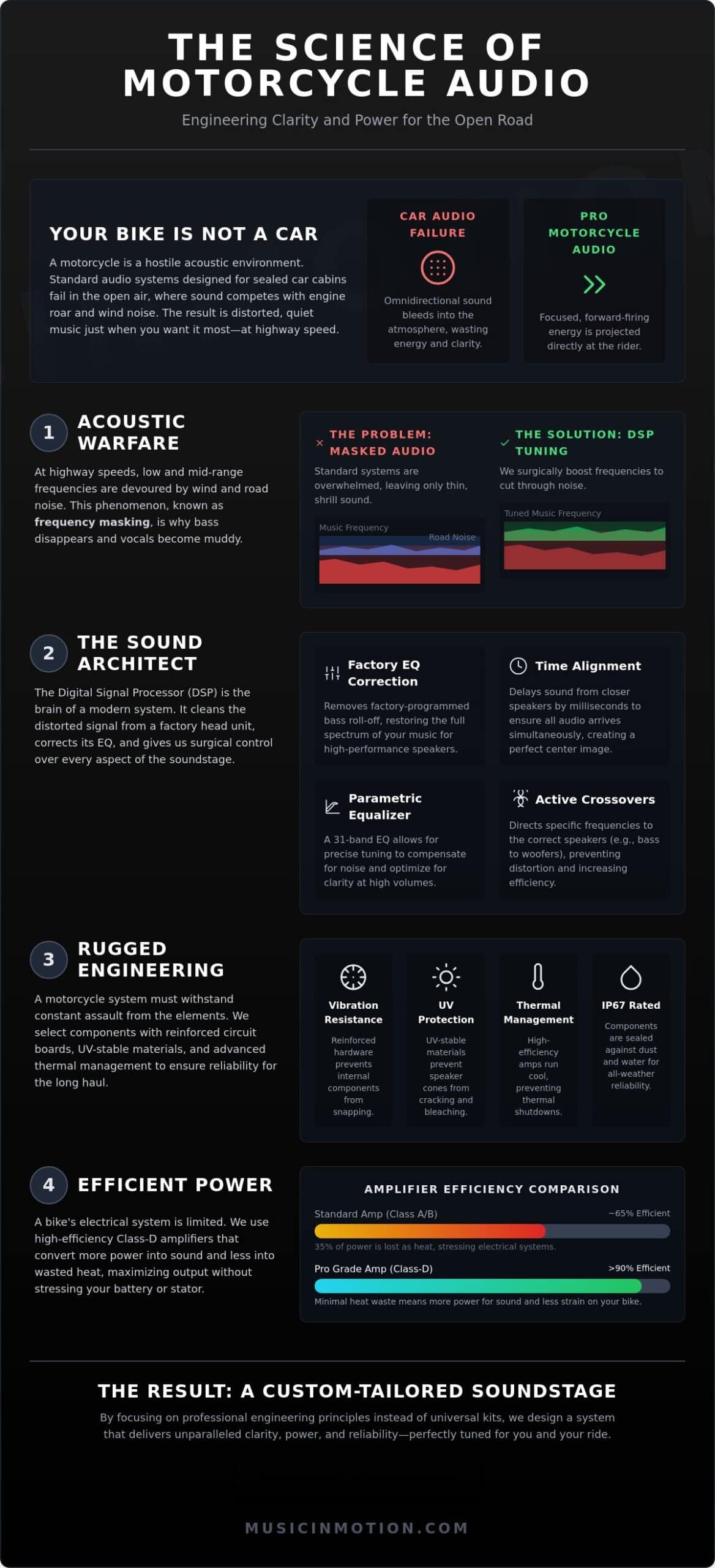
We understand that a motorcycle isn’t just a vehicle; it’s a moving, open-air stage. While most vehicle audio systems operate in a cozy, sealed cabin, a bike sits in a hostile environment. Sound waves don’t have walls to bounce off. Instead, they compete with the roar of the engine and the scream of the wind. This is where standard audio principles fall apart. If you’ve ever installed “premium” car speakers on a bike only to hear nothing but static at 60 mph, you’ve seen this failure firsthand. Professional motorcycle audio system design requires a different set of rules because we’re engineering for projection rather than just volume.
Off-the-shelf car speakers are designed for omnidirectional sound. In a car, this fills the cabin and creates a rich experience. On a bike, that same design allows sound to bleed out into the atmosphere. You lose half your energy before it ever reaches your ears. We solve this by selecting components that prioritize forward-firing energy. We don’t just want it loud; we want it aimed. Without this focus, you’re just wasting wattage and stressing your electrical system for a result that sounds thin and muddy once you leave the driveway.
Frequency Masking and the Highway Environment
Road noise isn’t just loud; it’s predatory. It specifically targets the low and mid-range frequencies of your music. This phenomenon, known as frequency masking, is why your bass disappears the moment you twist the throttle. To fix this, we emphasize high-frequency “sparkle.” These sharp, clear notes cut through the turbulence. We also focus on mid-range presence to ensure vocals don’t get buried. Acoustic Projection is the ability to focus sound energy specifically at the rider’s position to minimize atmospheric loss.
Durability Beyond Waterproofing
Waterproofing is the bare minimum. We look at the bigger picture. Vibration is a constant threat that can snap internal components in standard gear. We use hardware built with reinforced circuit boards and heavy-duty casing. UV exposure is another silent enemy. Standard speaker cones often bleach and crack under the sun, so we choose UV-stable materials that stay flexible for years. We also tackle thermal management. Tucking a powerful amp into a cramped fairing creates a heat trap. Our motorcycle audio system design uses high-efficiency hardware that moves heat away from the core, preventing the dreaded “thermal shutdown” halfway through your ride.
The Digital Signal Processor (DSP): The Architect of the Ride
We view the Digital Signal Processor (DSP) as the most critical component in modern motorcycle audio system design. It isn’t just an add-on; it’s the architect that builds your soundstage. While standard kits focus on volume, a DSP focuses on intelligence. It takes the messy, distorted signal from a factory head unit and cleans it before it ever reaches your speakers. This ensures that every watt of power from your amplifier is used to produce music, not noise. Without this brain, even the most expensive speakers will struggle to overcome the acoustic hurdles of the open road.
Most modern touring bikes come with a pre-programmed “factory EQ” designed to protect low-quality stock speakers. As you turn the volume up, the head unit automatically rolls off the bass to prevent blowing them. This leaves you with a shrill, thin sound that lacks any punch. Many of the same car audio upgrade for stock stereo principles apply here. We use the DSP to flatten that curve, restoring the full spectrum of your music so your high-end speakers actually perform as intended.
A bike presents a unique challenge because speakers are often placed at unequal distances from your ears. You might have two in the fairing and two in the saddlebags. Without time alignment, the sound arrives at different intervals, muddying the clarity and destroying the stereo image. We use the DSP to delay specific speakers by milliseconds. This tricks your brain into hearing a perfect center image, making it feel like the band is playing right on your handlebars. It’s about creating an immersive experience that moves with you, regardless of where the speakers are mounted.
Precision Tuning for the Open Road
A 31-band parametric EQ gives us surgical control over your sound. We can identify the specific frequencies where wind noise is most aggressive and boost the music to compensate. Conversely, we can cut harsh frequencies that become piercing at high volumes. We also set active crossovers. These digital barriers protect your speakers from over-excursion, ensuring they only play the frequencies they were designed for. It’s the difference between a “parking lot tune” that sounds good at a stoplight and a “highway tune” that stays crystal clear at 80 mph.
Integration with Factory Electronics
You shouldn’t have to sacrifice your handlebar controls or infotainment features for better sound. We specialize in professional integration that maintains every factory function while bypassing internal limiters. We can even create “Speed Sensitive EQ” profiles that adjust automatically based on your riding conditions. If you want to explore how these professional tuning principles can transform your bike, our team is ready to help you build a custom-tailored system that delivers results without compromises.
Optimizing Speaker Placement through Custom Fabrication
We believe that the most expensive speaker in the world will underperform if it is poorly placed. In motorcycle audio system design, speaker “aiming” is often more critical than raw speaker size. While many competitors rely solely on bolt-in fairing kits for specific models, we look at the entire geometry of the bike. If a speaker is firing at your shins, the wind will strip away the detail before it reaches your helmet. Our goal is to direct sound energy precisely where you need it, ensuring your music remains the focus of your ride regardless of your speed.
Custom Fairing and Pillar Pods
Standard fairing locations are frequently restricted by factory molds that prioritize aesthetics over acoustics. We break these boundaries by fabricating custom pods that allow for 6.5-inch or even 8-inch speaker upgrades. This process lifts the soundstage from your knees to your ears, creating a much more natural and immersive listening experience. By using fiberglass and specialized composite materials, we create seamless enclosures that match your bike’s lines perfectly. These complex builds utilize the same high-level skills found in our custom car audio fabrication work, delivering professional results that look like they came from the factory floor.
Saddlebag and Subwoofer Integration
Achieving deep bass on a moving motorcycle is a significant engineering challenge. Low frequencies naturally dissipate in open-air environments, which is why “off-the-shelf” solutions often sound thin. To combat this, we integrate saddlebag lid speakers to add “rear fill” and a sense of depth to the soundstage. For riders who want a truly physical impact, we build custom subwoofer enclosures inside the bags. These are carefully designed to provide the specific air volume the subwoofer needs without sacrificing all your storage space. This level of customization is a hallmark of sophisticated motorcycle audio system design.
We also focus on structural integrity. High-output speakers can cause saddlebags to vibrate or rattle, which ruins the clarity of your mid-bass and creates annoying mechanical noise. We reinforce the mounting points and internal walls to ensure the energy goes into the air, not the plastic. Lower fairing and crash bar speakers complete the system by filling in the mid-bass gap, surrounding you in a wall of sound that wind noise simply cannot penetrate. We don’t just sell parts; we engineer a finished environment that stands up to the rigors of the road.
High-Efficiency Power: Amplification for the 2026 Rider
High-output audio requires significant current, but most bikes have a finite amount of electrical energy to spare. In professional motorcycle audio system design, we prioritize efficiency above all else. Older Class AB amplifiers are notoriously inefficient, turning much of their energy into heat rather than sound. This is a recipe for disaster in a cramped fairing where airflow is limited. Instead, we utilize Class D amplification, which offers between 85% and 95% efficiency. This technology allows us to deliver massive wattage to your speakers without overwhelming your bike’s stator or draining your battery during a long ride.
Power delivery is only as good as the path it takes. We strictly use 100% oxygen-free copper (OFC) power wire for all our installations. Many budget kits use copper-clad aluminum (CCA), which has higher resistance and can lead to voltage drops or even fire hazards under heavy load. A solid ground is equally vital. Because many motorcycle frames are powder-coated or use rubber-isolated mounts, finding a true chassis ground requires expertise to avoid introducing engine hum or whine into your music. We ensure every connection is vibration-resistant and sealed against the elements.
Managing the Electrical Load
We start every project by calculating the total current draw of your audio system against your bike’s charging capacity. If you’re running multiple high-wattage amps, we often recommend upgrading to a high-performance AGM or lithium battery to support high-wattage bursts without flickering your headlights. Professional installers use a Real Time Analyzer (RTA) to ensure the power delivered to the speakers is clean and free of clipping, which prevents hardware failure. If you’re ready to upgrade your ride with a system that won’t leave you stranded, contact our team for a power-matched installation today.
Multi-Amp Configurations
For complex builds, a single amplifier often isn’t enough to drive a full soundstage. We frequently design systems with dedicated multi-amp configurations, using one compact micro-amp for the fairing speakers and a second, high-current amp for saddlebag subwoofers. These micro-amps are small enough to fit in the tightest touring bike fairings while still packing a punch. We also pay close attention to cooling. By engineering custom amplifier racks with proper spacing, we ensure reliable airflow to prevent thermal protection modes during hot summer rides. This balanced approach ensures your system stays loud and clear from the moment you start the engine until you pull back into the garage.
The Music In Motion Philosophy: Professional Results, No Compromises
We believe that a truly great ride is defined by the quality of the experience, not just the hardware on the spec sheet. Many riders are tempted by “universal” kits that promise a quick fix in a single box. These products often fall short because they are designed for the average bike rather than your specific machine. A generic bracket or a one-size-fits-all wiring harness rarely accounts for the unique vibration patterns or electrical nuances of your motorcycle. In our view, professional motorcycle audio system design is about moving beyond the transaction of goods to deliver a finished, calibrated result that stands the test of time.
Our approach starts with a consultation focused on your goals. We want to know how you ride. If you prefer a full-face helmet or have an aggressive aftermarket exhaust, those factors change how we tune your system. We prioritize reliability by using professional-grade wiring looms, weather-sealed connectors, and robust mounting hardware that won’t rattle loose on the interstate. This dedication to quality isn’t limited to bikes. We apply the same high-fidelity standards to our marine audio systems and RV upgrades, ensuring every vehicle we touch provides a premium internal experience for the user.
The Value of a Finished Result
Hardware is the foundation, but calibration is what creates the magic. We move beyond the “box of parts” approach to provide a fully realized acoustic environment. This involves surgical tuning that accounts for your specific riding conditions. We have the expertise to adjust for different helmet types and the low-frequency drone of your engine. By focusing on the outcome, we provide national-level expertise for riders who demand clarity at any speed. We don’t just want your system to be loud; we want it to be accurate and reliable for years to come.
Ready to Upgrade Your Ride?
Starting your custom motorcycle audio system design project is a straightforward process with our team. We focus on a spectrum of solutions that range from subtle, high-quality speaker swaps to extreme, ground-up custom builds with integrated subwoofers. Our goal is to reassure you that your property is in safe hands while exciting you about the possibilities of what your bike can sound like. We encourage you to see our recent custom motorcycle projects to witness the level of detail we bring to every installation. Whether you’re cruising the coast or hitting the highway, we’re here to ensure your soundtrack never fades away.
Take Command of Your Open-Road Soundstage
We’ve explored how professional motorcycle audio system design is about winning the battle against wind noise and engine rumble. It requires a strategic combination of surgical DSP tuning to correct factory signals and custom fabrication to aim sound energy directly at the rider. By choosing high-efficiency Class D amplification and premium copper wiring, you protect your bike’s electrical system while ensuring your music stays punchy and clear at highway speeds.
As custom fabrication specialists since 1994, we have built a nationwide reputation for high-performance vehicle electronics. We understand the unique physics of open-air acoustics and provide expert DSP tuning for open-air environments to ensure your vocals never get lost in the turbulence. We’re ready to move beyond the transaction and deliver a finished result that improves your life behind the bars. Transform your ride with a custom motorcycle audio system from Music In Motion. Your next adventure is waiting, and it’s time to make sure it sounds exactly the way you’ve always imagined.
Frequently Asked Questions
What is the difference between motorcycle speakers and car speakers?
Motorcycle speakers are engineered for open-air projection and extreme environmental resistance. Unlike car speakers that sit in a protected cabin, bike speakers use UV-stable materials and water-resistant cones to survive rain and sun. They are designed to be heard at a distance while moving, whereas car speakers focus on filling a small, sealed space with omnidirectional sound.
Do I need a special battery for a high-power motorcycle audio system?
You don’t always need a new battery, but high-performance AGM or Lithium-ion upgrades are helpful for high-wattage builds. These batteries handle rapid discharge cycles much better than standard lead-acid versions. We always check your bike’s charging capacity first to ensure your stator can keep up with the extra demand of your new amplifiers.
Can I still hear my motorcycle audio if I wear a full-face helmet?
Yes, you can hear your music clearly if the system is tuned for proper projection. A well-designed soundstage uses high-frequency clarity to cut through helmet padding and wind turbulence. We use Digital Signal Processors to adjust the equalization, ensuring the audio remains sharp and audible even when you’re tucked behind a windscreen with a closed visor.
Will adding an audio system void my motorcycle warranty?
Adding an aftermarket audio system typically won’t void your warranty because of the Magnuson-Moss Warranty Act. As long as the installation is professional and doesn’t damage factory components, your coverage stays intact. We use vehicle-specific, plug-and-play harnesses whenever possible. This approach ensures we don’t have to cut your factory wiring, which keeps your dealership happy and your bike safe.
How do I protect my motorcycle speakers from rain and washing?
The best protection is choosing components with an IP67 rating. These parts are completely dust-tight and can survive being sprayed with water. When you’re washing your bike, it’s a good idea to avoid hitting the speaker faces directly with a high-pressure hose. A gentle rinse is all they need to stay clean without risking damage to the speaker surrounds or internal electronics.
What is the best speaker location for a bike without a fairing?
Handlebar-mounted pods and crash bar enclosures are the most effective options for naked bikes or cruisers without fairings. These locations allow us to aim the sound energy directly at your chest and helmet. We often use custom-fabricated mounts to keep the installation looking clean while ensuring the speakers are positioned for maximum acoustic impact at highway speeds.
Why does my motorcycle audio sound distorted at high speeds?
Distortion usually happens when an underpowered amplifier clips while trying to overcome wind noise. This is a classic sign of poor motorcycle audio system design where the hardware can’t handle the “acoustic warfare” of the road. We solve this by matching high-efficiency amplifiers with speakers that have enough power handling to stay clean and clear even when the volume is turned up.
How much power (wattage) do I really need for a motorcycle system?
Most high-performance systems need between 100 and 200 watts RMS per channel to stay clear at 70 mph. We focus on continuous RMS power rather than peak wattage ratings, which are often misleading. Having sufficient headroom is vital for motorcycle audio system design because it allows the music to handle sudden peaks without distorting. This ensures your favorite tracks sound just as good at full throttle as they do at a red light.