Most people think that getting the best car audio setup for bass lovers 2026 simply means throwing the biggest box possible into the trunk and hoping for the best. We know the frustration of a system that rattles your body panels more than it moves your soul, or worse, a setup that dims your headlights every time the kick drum hits. You want that deep, visceral impact, but you shouldn’t have to sacrifice all your storage space or settle for a muddy, boomy mess that lacks real definition. It is about the feeling of the music, not just the volume.
We are here to show you that achieving a world-class low-end experience is about more than just raw wattage; it is about precision engineering and smart integration. You’ll discover how to build a deep, impactful, and distortion-free bass system using 2026 technology and professional techniques that keep your gear cool and your factory dash tech intact. We will guide you through selecting elite components like the JL Audio 12W7AE-3, optimizing power with compact amplifiers, and using Digital Signal Processors to tune your cabin for absolute perfection.
Key Takeaways
- Understand why the modern bass ecosystem prioritizes transient response over raw volume to create a system that is as musical as it is powerful.
- Learn the critical importance of matching RMS power and selecting the right voice coil configuration to ensure your equipment stays reliable and distortion-free.
- Discover how custom fabrication and the choice between sealed or ported enclosures can tailor your low-end output to your specific musical taste.
- Explore how acoustic treatments and “Big Three” electrical upgrades provide a stable foundation that eliminates rattles and prevents power drops.
- Master the professional integration techniques needed to build the best car audio setup for bass lovers 2026 while keeping your factory dashboard features completely intact.
Designing the 2026 Bass Ecosystem: Beyond the Subwoofer
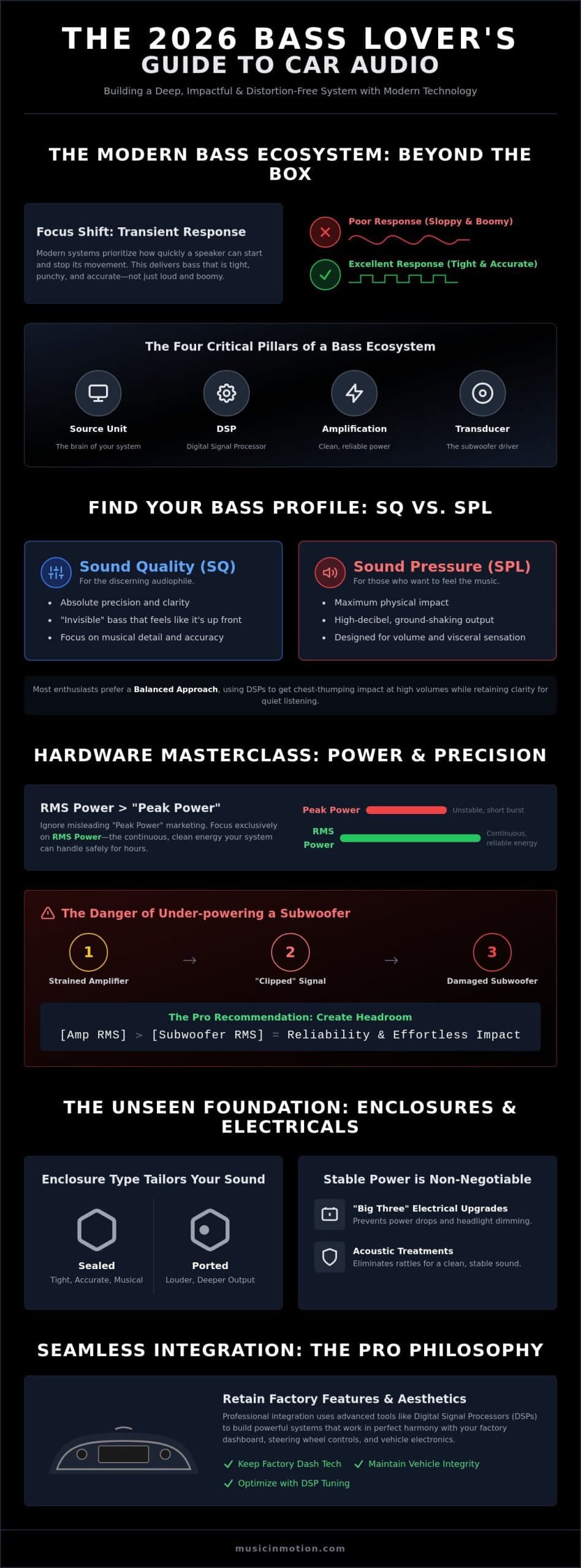
Building the best car audio setup for bass lovers 2026 requires moving beyond the simple “speaker in a box” mentality. We view your vehicle as a complete acoustic environment where every component must work in harmony. A true bass ecosystem consists of four critical pillars: the source unit, digital signal processing, amplification, and the transducer. If any of these links are weak, the entire experience suffers. When we design a system, we aren’t just selling parts; we are engineering a finished result that transforms your daily commute into a front-row concert experience.
In 2026, the industry has shifted its focus toward transient response. This refers to how quickly a speaker can start and stop its movement. A system with excellent transient response delivers bass that is tight, punchy, and accurate, rather than loose or “sloppy.” While the subwoofer is the most visible part, its performance is dictated by the control of the amplifier and the precision of the signal it receives. We also account for “cabin gain,” which is the natural reinforcement of low frequencies caused by the small, enclosed space of a car. By understanding your vehicle’s specific acoustics, we can use this physics-based boost to our advantage, creating massive impact without needing oversized equipment.
The Evolution of Low-Frequency Performance
Modern technology has revolutionized how we integrate high-output gear. In 2026, compact Class D amplifiers and shallow-mount drivers allow us to hide massive power in small spaces. Factory “premium” systems often fail because they use lightweight materials and restricted power to save on manufacturing costs. They might provide a hint of bass, but they lack the high-resolution low-end that true enthusiasts crave. We replace that thin, strained sound with components designed for effortless authority and depth.
Identifying Your Bass Profile: SQ vs. SPL
When we help you choose the best car audio setup for bass lovers 2026, we first identify your listening style along a spectrum. Sound Quality (SQ) focuses on absolute precision. These systems are designed to be “invisible,” where the bass feels like it is coming from the dashboard rather than the trunk. Sound Pressure Level (SPL) is for those who want maximum physical impact and high-decibel output. Most of our clients prefer a balanced approach. We utilize modern DSPs and the ISO 226:2023 equal-loudness standards to ensure your system delivers chest-thumping impact at high volumes while remaining clear and detailed during quiet listening.
Our Music In Motion philosophy is built on this sense of balance. We don’t just hand you a pile of hardware; we deliver a calibrated system that respects your vehicle’s electronics and enhances your lifestyle. Whether you are looking for subtle enrichment or a system that demands attention, we have the specialized knowledge to make it happen.
Selecting Subwoofers and Amps for Maximum Impact
Choosing the right hardware for the best car audio setup for bass lovers 2026 is about understanding the relationship between the amplifier and the driver. Many enthusiasts get distracted by “Peak Power” ratings printed on the box. We ignore those numbers. Peak power is a marketing myth that describes a burst of energy the component can only handle for a fraction of a second. Instead, we focus exclusively on RMS (Root Mean Square) power. This is the continuous, clean energy your system can handle for hours. We prioritize matching the RMS output of your amplifier to the RMS handling of your subwoofers to ensure the system remains stable and reliable.
One common mistake is under-powering a subwoofer. It sounds counterintuitive, but a small amplifier is often more dangerous than a large one. When an under-powered amp is pushed to its limit, it begins to “clip” the audio signal. This creates a distorted square wave that generates excessive heat, which can quickly melt a subwoofer’s voice coils. We recommend choosing an amplifier that provides slightly more RMS power than your sub needs. This creates “headroom,” allowing the system to hit those deep notes effortlessly without straining the hardware. We often suggest custom subwoofer enclosures to help manage this power and maximize the efficiency of your chosen drivers.
In 2026, efficiency is the name of the game. While Class D amplifiers remain the standard for high-output bass, Gallium Nitride (GaN) technology has become the new benchmark. GaN transistors switch faster and run much cooler than traditional silicon-based components. This allows us to install massive power in incredibly small spaces, like under a seat or behind a panel, without the fear of the system overheating during a long summer drive.
Subwoofer Sizes and Their Musical Personalities
- 8-inch and 10-inch: These are the masters of “transient response.” They are fast, punchy, and perfect for genres like rock or metal where you want the kick drum to feel tight and immediate.
- 12-inch and 15-inch: If your goal is deep extension and moving serious air, these are the heavy hitters. They excel at the low-frequency rumbles found in hip-hop and electronic music.
- Thin-mount (shallow) subs: These have come a long way. Modern shallow subs now deliver performance that rivals traditional drivers, making them the perfect solution for trucks or compact vehicles where space is limited.
Amplifier Technology: Clean Power for Deep Notes
Control is just as important as power. We look for amplifiers with a high damping factor. This is the amp’s ability to stop the subwoofer cone from vibrating the instant the music stops. A high damping factor ensures your bass doesn’t sound “muddy” or “boomy.” We also emphasize high-quality signal inputs. Starting with a clean, high-voltage signal from your source unit ensures that the best car audio setup for bass lovers 2026 delivers pure, undistorted low-end that you can feel in your chest.
Custom Fabrication: The Physics of the Enclosure
The box is not just a container; it is a functional component of the speaker itself. In the best car audio setup for bass lovers 2026, the enclosure acts as the “acoustic engine” that determines how much air your system moves. While many people spend weeks researching subwoofer brands, we know that a mediocre driver in a perfect box will outperform a world-class driver in a generic, pre-made enclosure. We focus on the physics of air displacement to ensure your system hits with authority and remains musical.
Your choice of enclosure style dictates the character of your bass. Sealed enclosures are the gold standard for audiophile accuracy. They provide a “shallow” roll-off and excellent control, making them perfect for those who want tight, punchy bass that never sounds bloated. On the other hand, ported (vented) enclosures use a tuned air column to reinforce the subwoofer’s output. This design is significantly more efficient and produces the massive “boom” that many enthusiasts crave. For extreme custom projects, we may employ bandpass designs or infinite baffle setups, which use the vehicle’s own structure to create a unique, high-output listening environment.
Why Custom Fabrication Trumps Pre-Loaded Boxes
Pre-loaded boxes are designed to work “okay” for a wide range of speakers, but they rarely match the specific Thiele/Small (T/S) parameters of your driver. We build custom subwoofer enclosures that are mathematically optimized for your specific subwoofer. This ensures the internal volume is exact, preventing the driver from over-extending or losing control. Beyond the math, custom fabrication allows us to contour the box to your vehicle’s specific geometry. We can tuck a high-output system into a corner of the trunk or under a seat, utilizing fiberglass and leather to match your factory interior perfectly.
The Design Process: Tuning for Your Genre
We don’t believe in a one-size-fits-all sound. If you listen to Hip-Hop or EDM, we might tune a ported enclosure to a lower frequency to capture those deep, rolling sub-harmonics. If your playlist is full of Rock or Jazz, we prioritize a design that emphasizes speed and kick-drum impact. The materials we choose also play a role; while MDF is a reliable standard, we often use Baltic Birch for its superior strength-to-weight ratio and reduced resonance. Tuning frequency is the mechanical sweet spot where the enclosure maximizes output. By getting this right, we ensure the best car audio setup for bass lovers 2026 delivers a finished result that feels like it was built specifically for your ears.
Power Management and Acoustic Treatment
You can have the most expensive subwoofers in the world, but they’ll never reach their potential if your vehicle’s electrical system is starving for power. For the best car audio setup for bass lovers 2026, we prioritize a rock-solid electrical foundation. This begins with understanding that your factory alternator and battery weren’t designed to support a 2,000-watt load. We treat power management as the starting point of every high-performance project. Without stable voltage, even the best gear will suffer from clipping and premature failure.
One of the biggest myths we encounter is the total reliance on old-school capacitors. While they might stop your headlights from flickering slightly, they’re often just a band-aid for a larger problem. A capacitor stores a small amount of energy and releases it quickly, but it doesn’t solve a lack of overall current. For modern, high-draw systems, we recommend moving toward high-output alternators and lithium (LiFePO4) batteries. Lithium batteries offer a much higher discharge rate and maintain a stable voltage throughout the entire power cycle. This keeps your amplifiers running efficiently and ensures your bass hits with consistent authority.
Acoustic Treatment: The Silent Performance Booster
Acoustic treatment is about more than just a quiet ride. It’s about efficiency. When your trunk lid or door panels rattle, they’re literally absorbing the energy that should be hitting your ears. By applying high-quality sound deadening materials, we stop those panels from vibrating. Research shows that a 10-decibel reduction in cabin noise is perceived by the human ear as halving the noise level. This creates a “blacker” background for your music, making your bass feel significantly louder and more defined. We focus on decoupling panels in the trunk and rear deck to eliminate energy loss. If you want to maximize your investment, we recommend starting with professional car audio upgrades that include sound deadening to ensure every watt of power is converted into sound, not rattles.
Electrical Infrastructure for High-Draw Systems
The “Big Three” upgrade is a cost-effective way to improve your vehicle’s electrical foundation. This involves replacing the factory wiring between the alternator, battery, and chassis with 0-gauge Oxygen-Free Copper (OFC) cable. We insist on OFC because it carries significantly more current than cheaper copper-clad aluminum alternatives. We also calculate your total current draw to determine if a high-output alternator is necessary. Keeping your voltage stable is the only way to ensure your amps stay in their optimal performance range. We build systems that are as reliable as they are loud, ensuring the best car audio setup for bass lovers 2026 remains a source of joy rather than a drain on your vehicle’s health.
Professional Integration: The Music In Motion Philosophy
The hardware is only half the story. Achieving the best car audio setup for bass lovers 2026 depends entirely on how those components are integrated into your vehicle’s unique environment. We don’t just bolt subwoofers into trunks; we engineer a cohesive listening experience. Modern vehicles come with complex factory head units that often have “baked-in” equalization designed to protect cheap factory speakers. This usually means the car automatically rolls off the bass as you turn up the volume. We use advanced integration techniques to strip away these factory limitations, giving you back the full range of your music.
We utilize Digital Signal Processing (DSP) as the brain of every high-end system. By using Real Time Analyzers (RTA), we can visualize the acoustic response of your cabin. Every car interior has natural peaks and valleys where certain frequencies become overwhelming or disappear. We use this data to flatten the response, ensuring your bass is smooth, controlled, and authoritative. This process allows us to add high-end bass to a factory head unit without losing your steering wheel controls, backup cameras, or navigation features. It is about enhancing your vehicle, not compromising it.
The Secret Sauce: Digital Signal Processing
- Time Alignment: We delay the signal to your door speakers by milliseconds so the bass from the trunk hits your ears at the exact same moment. This makes the music feel like it is happening right in front of you.
- Phase Correction: We ensure your subwoofers are moving in perfect sync with your mid-bass drivers. This prevents “cancellation,” where speakers fight each other and make the bass sound thin.
- Subsonic Filters: These protect your gear by cutting out ultra-low frequencies that the human ear cannot hear but can cause your subwoofer to over-extend and fail.
Our expertise extends beyond the traditional car. We apply this same philosophy of universal application to marine audio systems, powersports audio systems, and motorcycles. Whether you are on the road or the water, the physics of great sound remain the same. We take pride in our ability to push creative boundaries for custom projects while keeping the safety and functionality of your vehicle’s electrical system as our top priority. We build systems that are meant to be enjoyed for years, not just for the first few months.
Your Path to Superior Sound
Every great system starts with a conversation. We don’t believe in a one-size-fits-all approach because every driver has different needs and every vehicle has different acoustics. A professional consultation allows us to identify your specific bass profile and design a system that fits your lifestyle. Our goal is to provide a finished result that exceeds your expectations and makes you excited to get behind the wheel every single day. We stand behind our work with professional, warranty-backed installations that give you total peace of mind.
Ready to feel the music? Contact us for a custom bass consultation.
Ready to Redefine Your Low-End Performance?
Achieving the best car audio setup for bass lovers 2026 is a journey from simple loudness to refined, high-resolution impact. We’ve explored how a balanced ecosystem of high-efficiency amplifiers, custom-tuned enclosures, and rock-solid power management creates a system that hits hard without compromising your vehicle’s health. By prioritizing digital signal processing and professional integration, you ensure that every beat is tight, accurate, and perfectly timed to your listening position. It’s about more than just moving air; it’s about moving you.
Since 1994, our team has specialized in push-the-limit custom fabrication and advanced electrical upgrades for everything from daily drivers to marine vessels. We bring decades of expertise in DSP tuning to every project, ensuring your new system integrates seamlessly with your factory technology. We don’t just sell components; we deliver finished results that change how you feel every time you start your engine. Your perfect soundtrack is waiting, and we have the specialized knowledge to make it a reality. Let’s build something incredible together.
Start your custom bass project with Music In Motion
Frequently Asked Questions
Will adding a large subwoofer drain my car battery?
A large subwoofer system can drain your battery if your vehicle’s charging system isn’t prepared for the additional load. High-performance amplifiers draw massive amounts of current that can quickly overwhelm a standard factory alternator. We prevent this by calculating your total power needs and recommending upgrades like the “Big Three” wiring or a high-output alternator to keep your electrical foundation stable and your battery healthy.
What is the difference between a sealed and a ported subwoofer box?
The primary difference lies in how the air inside the box is managed to produce sound. A sealed enclosure is completely airtight and provides the most accurate, punchy response for critical listening. A ported box uses a vent to reinforce low frequencies, making it a popular choice for the best car audio setup for bass lovers 2026 who want maximum volume and deep, rolling rumbles.
Can I keep my factory radio and still add a high-performance bass setup?
You can absolutely keep your factory radio while enjoying premium bass. We use specialized integration tools and digital signal processors to “clean” the signal from your stock dashboard unit before it reaches your amplifiers. This allows you to retain all your steering wheel controls and screen features while drastically improving the sound quality and impact of your new subwoofer system.
How much power (watts) do I really need for good bass in 2026?
Most enthusiasts find that 500 to 1,000 watts RMS provides plenty of impact for daily driving. If you want a system that truly shakes the vehicle, you may look toward 1,500 to 2,500 watts. It’s important to always focus on RMS ratings rather than peak power to ensure your system remains reliable and distortion-free during long listening sessions.
Why does my car rattle so much when the bass hits, and how do I fix it?
Rattles occur when acoustic energy causes thin metal panels or loose plastic trim to vibrate. You can fix this by applying multi-layer sound deadening materials to the trunk lid, door skins, and rear deck. This stops the “phantom” noises and actually makes your bass sound louder by preventing energy loss, ensuring you feel the music instead of hearing the car shake.
Do I need a second battery for my car audio system?
A second battery is usually necessary for systems pushing 2,000 watts RMS or more. For modern setups, we often recommend a single high-performance lithium battery over two traditional lead-acid batteries. Lithium offers faster discharge rates and better voltage stability, which is critical for keeping your amplifiers from clipping during heavy bass hits and protecting your vehicle’s electronics.
What is a DSP and do I need one for my subwoofer?
A Digital Signal Processor (DSP) acts as the brain of your audio system by allowing precise control over equalization and time alignment. It is a vital component for the best car audio setup for bass lovers 2026 because it fixes cabin-related acoustic issues. By using a DSP, we can ensure your subwoofers blend perfectly with your other speakers, creating a seamless and impactful listening experience.
Is a 12-inch sub better than two 10-inch subs?
Two 10-inch subs generally move more air because they have more total cone surface area than a single 12-inch driver. This often results in more output and a punchier sound. However, a single high-quality 12-inch sub in a custom-built enclosure can often play deeper frequencies and takes up less trunk space, making it a versatile choice for many vehicles.