The loudest system isn’t automatically the best-sounding one. A sound pressure level (SPL) vs sound quality (SQ) comparison comes down to two goals: SPL measures sound pressure and perceived loudness, while SQ focuses on how clearly and accurately a system reproduces music. A well-designed setup can deliver both, but turning up the volume alone won’t create balanced, detailed sound.
It’s easy to focus on peak volume, especially when powerful bass makes an immediate impression. But the enclosure, vehicle interior, speaker placement, and installation all shape what you hear from the driver’s seat. This guide explains how SPL and SQ differ, what loudness readings can and can’t tell you about hearing risk, and why the build matters as much as the equipment. For context, NIOSH recommends a workplace noise exposure limit of 85 dB(A) averaged over an 8-hour workday. You’ll also see how to think about volume and clarity together, so your audio goals start with the experience you want on the road.
Key Takeaways
- Choose your system’s priorities around the listening experience you want: maximum output, faithful reproduction, or a balance of both.
- Use decibel readings as context for loudness and potential hearing risk, not as a complete measure of sound quality.
- Account for the enclosure and vehicle interior, since both can change how bass and other frequencies sound from the driver’s seat.
- Consider frequency response, distortion, and signal-to-noise ratio when judging clarity, then match the installation to your goals.
Can sound pressure level (SPL) measurements indicate the potential for hearing damage?
SPL readings help describe exposure, but they don’t capture how loud every frequency feels. Reading the measurement correctly matters for hearing risk and sound quality.
SPL as a Loudness Measure
SPL measures sound pressure as a decibel value, giving a numerical way to compare sound levels. In a car, a meter reading can show whether a system’s output rises when volume increases. A change of about 10 dB is generally needed for sound to seem twice as loud. That distinction helps explain why a higher reading doesn’t always feel like an equally large jump in loudness.
Measured Pressure and Subjective Loudness
Measured sound pressure describes an acoustic level; perceived loudness is how strongly a listener experiences that sound. The two are related, but they aren’t identical. For example, a 3 dB increase represents approximately double the sound power, while listeners may perceive only a modest difference. Duration also matters: prolonged exposure above 85 dB can cause hearing damage. A reading is useful context, not a complete account of the listening experience.
Frequency Sensitivity and Equal-Loudness Contours
Equal-loudness contours show how the sound pressure needed to hear tones as equally loud changes with frequency. Human hearing is most sensitive between 2 kHz and 5 kHz, so bass may need greater measured pressure to seem as loud as midrange sound. At 70 dB, a 50 Hz tone must be 15 dB higher than a 1 kHz tone for the same subjective loudness. This helps explain why bass-heavy music can feel different from a meter’s single overall reading.
Sound level meters commonly provide A-, C-, and Z-weighted decibel readings and must meet standards such as IEC 61672-2013, according to the International Electrotechnical Commission. Weighting changes how a meter accounts for frequency, so readings with different settings aren’t directly interchangeable. Note the weighting when interpreting a measurement.
For workplace noise, the National Institute for Occupational Safety and Health (NIOSH) recommends an exposure limit of 85 dB(A) averaged over an 8-hour workday. That benchmark concerns workplace exposure, not a guarantee that every shorter listening session is safe. In car audio, balance clear reproduction with sensible listening levels; pursuing peak volume alone can obscure both detail and exposure.
Balancing volume with accurate sound reproduction
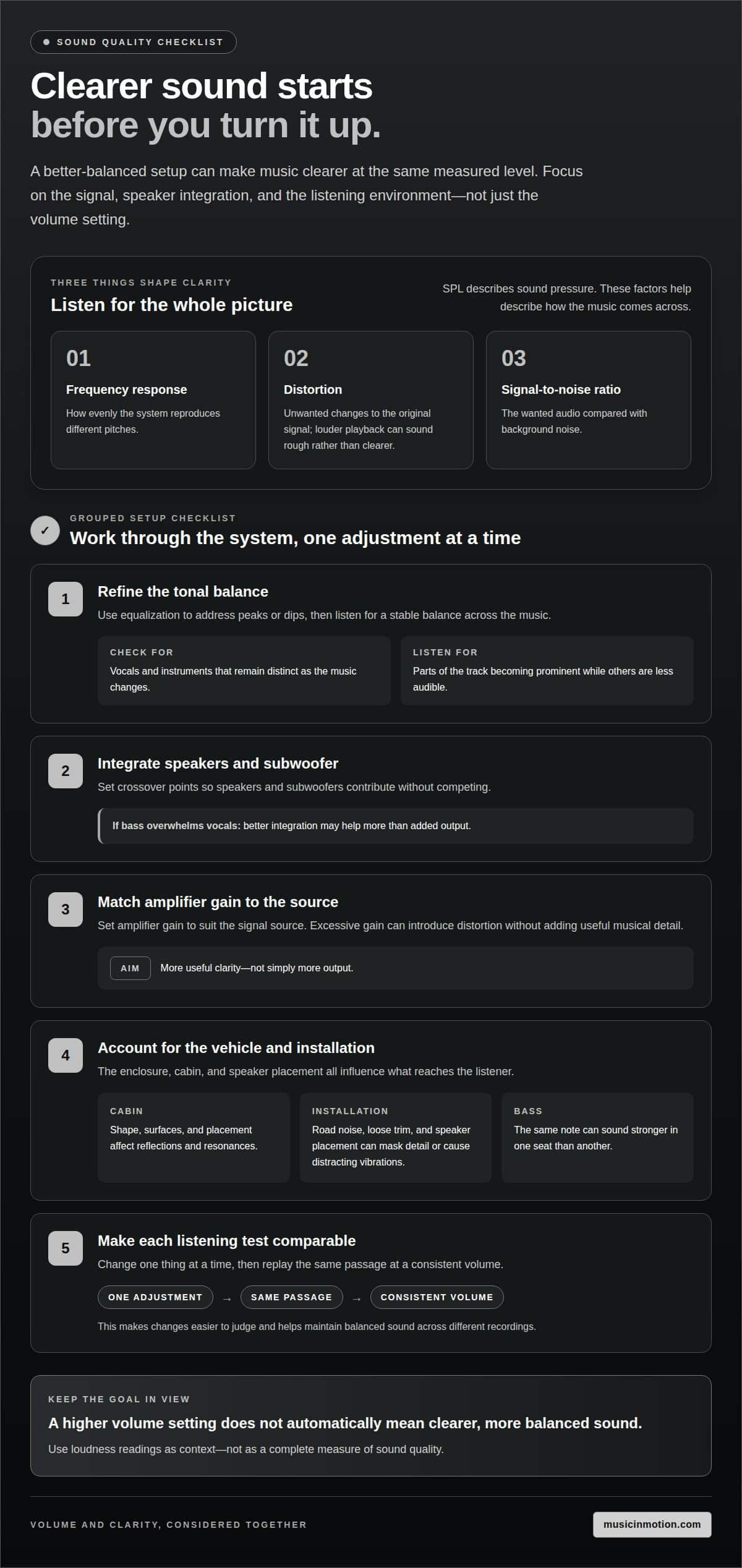
Accurate playback depends on balance, not simply a higher volume setting. Improve sound quality without increasing SPL by refining tonal balance, reducing distortion, and addressing noise in the signal path.
Sound Quality Factors
Frequency response describes how evenly a system reproduces different pitches, while distortion adds unwanted changes to the original signal. Signal-to-noise ratio (SNR) compares the wanted audio with background noise. Together, these factors shape whether music sounds clear, balanced, and detailed from the driver’s seat.
A system’s output may not rise evenly across every frequency as you turn up the input. Some parts of a track can become prominent while others remain less audible. Distortion can also make louder playback sound rough rather than clearer. For accurate reproduction, listen for stable tonal balance and vocals or instruments that remain distinct as the music changes.
Improving Quality Without Raising SPL
Improving quality at the same measured level means refining the signal and setup rather than turning up the volume. Adjust equalization to address peaks or dips, and set crossover points so speakers and subwoofers contribute without competing. Match amplifier gain to the signal source, since excessive gain can introduce distortion without adding useful musical detail.
Then assess the listening environment: road noise, loose trim, and speaker placement can mask detail or create distracting vibrations. If bass overwhelms vocals, better integration may help more than added output. Make one adjustment at a time and replay the same passage at a consistent volume. This makes changes easier to judge and helps maintain balanced sound across different recordings.
For a setup tailored to the vehicle and listening goals, consider a custom-tuned car audio system. A considered balance can make familiar tracks clearer without making every listening session louder.
Enclosure, vehicle interior, and installation effects
Speaker sensitivity, amplifier power, and cabin acoustics shape both measured SPL and perceived clarity. Sensitivity affects how efficiently a speaker converts power into sound, while the enclosure, installation, and vehicle interior influence what reaches the listener.
Enclosure and Vehicle Interior Effects
An enclosure affects how a subwoofer performs, while the vehicle cabin changes how its sound is heard. The same subwoofer can produce different bass in different vehicles because interior shape, surfaces, and placement affect reflections and resonances.
For example, a bass note may sound stronger in one seat than another, even with the same signal. Enclosure design also affects output across frequencies, so a setup that emphasizes deep bass may not reproduce every note evenly. The enclosure and cabin are part of the acoustic system, not just containers around the equipment.
Installation and Acoustic Factors
Installation determines how speakers couple to the vehicle and direct sound toward listeners. A speaker’s sensitivity describes its output for a given input; one example is 90 dB SPL at 1 meter with 1 watt of input power. Higher sensitivity can produce more output from the same power, but it doesn’t alone determine fidelity.
Amplifier power provides capacity to drive speakers, while poor matching or excessive input can introduce distortion. In a car, nearby glass, seats, and trim reflect or absorb sound differently from an open listening space. These conditions can shift tonal balance and affect how clearly instruments come through. Sound-pressure and sound-quality measurements can therefore vary with the enclosure, vehicle interior, and installation.
Good system design considers the complete signal path: source, amplifier, speaker placement, and enclosure. For instance, a subwoofer that overwhelms door speakers may make bass prominent but vocals less distinct. Adjusting placement or enclosure design can improve integration without relying only on added power. The goal is even, controlled output at the listening position, where cabin reflections and speaker interaction shape the final sound.
How frequency response, distortion, and SNR affect SQ
Frequency response, distortion, and signal-to-noise ratio (SNR) describe different aspects of audio performance. Together, they help explain why a system can sound unbalanced or unclear even when its volume is sufficient. A familiar recording can reveal these issues: vocals, bass, and cymbals should remain distinct, without one element masking another.
Frequency response affects the relative level of bass, midrange, and treble. A dip can make part of a recording seem recessed, while a peak can draw attention to a narrow range. In a car, compare familiar tracks with different instrumentation. If voices sound thin across tracks, or bass consistently overwhelms other parts, the system may have an uneven response at the listening position.
Distortion changes the signal rather than simply making it louder. It can make a sustained bass note sound rough or a clean vocal seem harsh, especially as playback demands increase. Listen for these changes in demanding passages, then compare them at a lower volume. If the roughness recedes, the system may be struggling to reproduce that passage cleanly at the higher level.
SNR compares the wanted audio signal with background noise. A low SNR can make quiet details harder to hear because hiss, electrical noise, or vehicle sounds compete with the music. A quiet intro is a useful listening test: notice whether soft strings or room ambience remain audible between louder notes. Improving clarity may involve addressing noise in the signal path, not raising playback volume.
Assess the factors separately before changing settings. Use familiar recordings to identify tonal imbalance, listen for distortion during complex passages, and notice noise during quiet sections. Then adjust one element at a time and replay the same passage at a consistent volume. This makes each change easier to judge and prevents louder playback from disguising the underlying issue.
For help refining your system around clearer, more balanced playback, get your car audio sound tuned to your listening goals.
Music In Motion
Music In Motion helps drivers shape car audio around the listening experience they want, from powerful output to clear, balanced playback. In a real vehicle, the enclosure, speaker placement, and installation all influence how SPL and SQ goals come together. Custom Installations and Custom Subwoofer Enclosures address these system-level choices, while Car Audio Upgrades can support a broader audio refresh.
Turn to Music In Motion when you’re weighing volume against clarity or want an installation designed around your vehicle and listening preferences. The focus is the finished sound, not simply adding equipment. Contact Music In Motion to discuss your car audio goals.
Shape a Sound That Fits Your Drive
The sound pressure level (SPL) vs sound quality (SQ) decision doesn’t have to lock you into one extreme. Think about the listening experience you want during everyday drives: energetic bass, clear vocals, or a balanced mix that works across different music. That preference gives your system a practical starting point.
From there, a tailored system can be planned around your vehicle and priorities, rather than chasing a number that doesn’t reflect how you want music to sound. The right details are the ones that make your regular drive more enjoyable, whether you’re listening to a favorite album or catching the news on the way to work.
Ready to explore a setup that suits your listening goals? Talk through your car audio goals with Music In Motion, and take the next step toward a sound that feels right for your drive.
Frequently Asked Questions
What is the difference between SPL and SQ in car audio?
The sound pressure level (SPL) vs sound quality (SQ) distinction is output versus fidelity: SPL describes sound pressure at a location, while SQ concerns how faithfully music comes through. A system might deliver a forceful bass hit but blur a quiet vocal behind it. Compare a bass-heavy track with an acoustic recording; each reveals different strengths, so one peak reading can’t describe the full listening experience.
Can a Sub Be Both Loud and Good Sounding?
Yes, a subwoofer can play loudly and sound good if the system keeps bass controlled and integrated with the rest of the music. Listen for clear pitch changes between notes rather than one booming tone, and check whether vocals remain distinct during a bass-heavy passage. Rattles or roughness can also signal that the installation or playback level needs attention, not simply more output.
Car Subwoofers: SPL or SQ?
Choose based on how you want bass to function in your music. An SPL-oriented subwoofer setup emphasizes strong output, often around selected frequencies; an SQ-oriented approach prioritizes musical definition and blending with other speakers. For mixed listening, check whether bass-heavy tracks feel energetic while spoken vocals and lighter instruments remain clear. Enclosure design and tuning help shape that balance.
How do humans perceive changes in sound pressure?
People perceive sound changes through more than pressure alone: frequency content and duration also affect perceived loudness. For example, sounds shorter than 70 milliseconds are generally perceived as quieter than longer sounds at the same SPL. A brief click and a sustained tone can therefore register differently to a listener, even when a meter reports the same sound pressure level.
How does the SPL change with the distance from the source?
In a free-field example, SPL falls by 6 dB each time the distance from the source doubles. This describes sound spreading without nearby reflections, so a car cabin can behave differently as glass, seats, and surfaces affect the sound. For a meaningful comparison, keep the meter and source positions consistent; moving the microphone changes the reading even if playback settings stay the same.
How is SPL measured?
SPL is measured with a sound level meter that uses a microphone to capture pressure and reports a decibel reading. In air, the reference pressure is 20 μPa. A-, C-, and Z-weighting settings shape how the meter accounts for frequency, so record the selected weighting and microphone position alongside the reading. That makes comparisons between listening tests more useful.