Why does your premium subwoofer sound like it’s trapped under a thick, wet blanket? You invested in the hardware to feel the rhythm, but instead, you’re dealing with a boomy mess that drowns out the vocals and leaves your ears fatigued. We understand that frustration. Learning how to fix muddy bass in car audio isn’t just about turning down a knob; it’s about mastering the unique acoustics of your vehicle’s cabin to let the music breathe.
Our team believes in delivering a finished result that exceeds factory expectations every time you turn the key. This guide provides the expert strategies you need to transform your sound from flat to phenomenal. You’ll learn how to tighten up those low frequencies and create a soundstage that feels like a front-row seat at a live performance. We’ll walk you through the essential roles of digital signal processors, custom enclosures, and modern sound deadening to ensure every note is crisp, clear, and perfectly balanced.
Key Takeaways
- Understand why automotive cabins are naturally hostile to sound and how to overcome these acoustic challenges for a clearer listening experience.
- Discover how to fix muddy bass in car audio by resetting your system to a flat baseline and focusing on professional signal tuning.
- Learn why sound deadening is the essential foundation for audio clarity, effectively lowering the noise floor to reveal hidden musical details.
- Follow a performance-first strategy that prioritizes component speakers and custom enclosures to get the most out of your audio investment.
- Explore how professional integration ensures your high-end audio upgrades work seamlessly with your vehicle’s complex computer and safety systems.
The Physics of Sound: Why Your Car Audio Sounds Muddy and Flat
The automotive cabin is a uniquely challenging space for music. It is essentially a pressurized box made of glass and plastic, which are materials that actively work against high-fidelity sound. When we help customers understand how to fix muddy bass in car audio, we start by looking at the environment itself. Most factory vehicle audio system components are chosen for their low weight and manufacturing cost, not their ability to reproduce a clean kick drum or a crisp vocal.
Car manufacturers prioritize weight savings and assembly speed over acoustics. They use thin wiring, plastic brackets, and paper cones that lack the rigidity needed for tight, impactful bass. These components are designed to be functional for basic listening, but they fail when pushed to reproduce a full dynamic range. This inherent weakness is why a simple speaker swap often isn’t enough; you’re fighting against a foundation built for economy rather than performance.
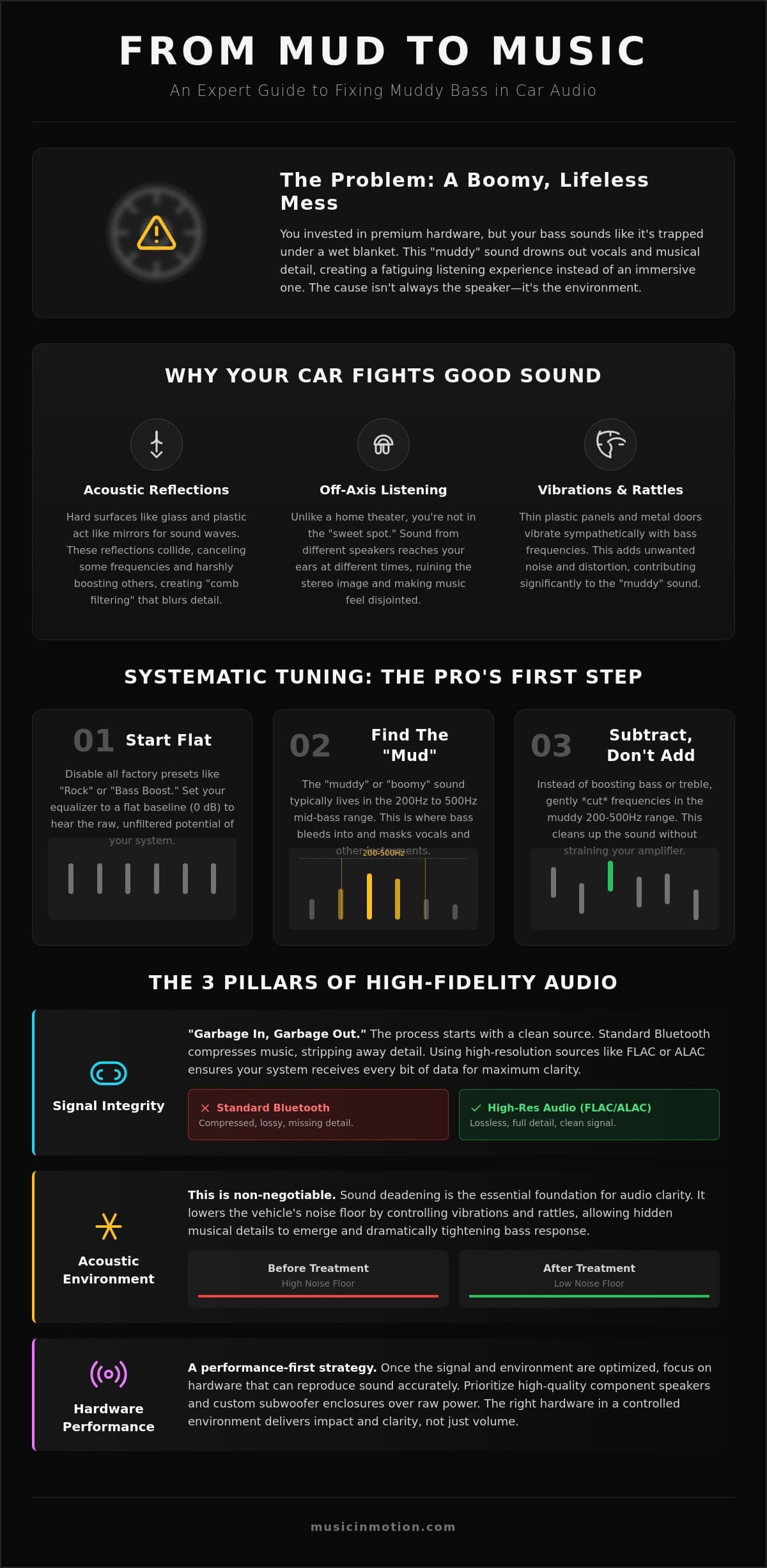
We focus on three primary pillars to achieve excellence: Signal Integrity, Acoustic Environment, and Hardware Performance. If your signal is weak or your environment is vibrating, even the most expensive subwoofer will sound like a boomy mess. You also have to contend with “Off-Axis” listening. Unlike a home theater where you sit in the “sweet spot,” a car forces you to the left or right. This ruins the stereo image and causes the bass to arrive at your ears at a different time than the high frequencies, making the music feel disjointed.
The Signal Chain: Why Source Quality is the First Bottleneck
Garbage in always results in garbage out. Many drivers rely on standard Bluetooth connections, but these often use heavy compression that strips away the fine details of your music. If the source material is missing data, no amount of tuning can bring it back. In 2026, we prioritize high-resolution streaming standards like FLAC or ALAC to ensure the head unit receives every bit of information possible. Maintaining signal integrity from the very first step is the only way to avoid that flat, uninspired sound that leaves you wanting more.
Reflections and Absorption: The Battle Against Glass and Plastic
Hard surfaces like your windshield and side windows act as mirrors for sound waves. These reflections create “comb filtering,” where certain frequencies cancel each other out while others become unpleasantly harsh. This is compounded by factory speaker locations, which are often buried in the lower door panels near your feet. This placement forces sound to travel through carpet and upholstery before it ever reaches your ears, muffling the high-end detail.
Acoustic reflection occurs when sound waves bounce off hard surfaces like windshields and door panels, creating secondary waves that collide with the original signal and blur the audio’s detail. This collision is exactly what creates that “muddy” sensation that masks the clarity of your favorite tracks. By understanding these physical hurdles, we can begin to apply the professional strategies needed to clean up your soundstage.
Systematic Tuning: Fixing ‘The Mud’ Without Buying New Gear
We often find that the biggest improvements in sound quality don’t come from a box; they come from the settings menu. Effective car audio upgrade for stock stereo strategies prioritize signal processing and tuning over simply throwing more power at the problem. If you want to know how to fix muddy bass in car audio, you must first strip away the digital processing that your car manufacturer added to hide cheap speaker flaws. This allows you to hear the raw potential of your system before making any hardware changes.
Start by setting your head unit to a “Flat” baseline. Factory presets like “Rock” or “Bass Boost” often introduce artificial peaks that cause distortion and bloat. True clarity is found when you start at zero and build your soundstage intentionally. The “mud” usually lives in the 200Hz to 500Hz range. This is where mid-bass becomes boomy and starts to mask the lower-mid frequencies of vocals and guitars. Our goal is to clean this area without losing the warmth and body of the music. We also have to account for the psychological impact of volume. High volume often masks poor quality, but a truly clear system sounds impactful even at lower levels.
The Art of the Equalizer: Subtracting to Gain Clarity
Most people try to fix poor sound by adding more bass or treble. This is a mistake. The science of audio equalization shows that cutting frequencies is far more effective for maintaining amplifier headroom. When you boost a frequency, you’re asking your amp to work harder, which leads to clipping and distortion. Instead, try cutting the 300Hz band by two or three decibels. You’ll notice the vocals suddenly pop out from the background. For further refinement, focus on the 1kHz to 3kHz bands to bring out the detail in a singer’s voice. We recommend using a Real Time Analyzer (RTA) app on your smartphone to visualize these peaks; it’s a simple tool that reveals what your ears might be missing in a noisy cabin.
Time Alignment: Bringing the Soundstage to Your Dashboard
In a car, you are never sitting in the middle of the speakers. The sound from the driver’s side door reaches your left ear before the passenger side sound reaches your right ear. This timing gap is why your music feels like it’s coming from your knees or shifted to one side. Time alignment allows us to delay the signal to the closer speakers by milliseconds. This ensures that every sound wave hits your ears at the exact same moment. This creates a rock-solid “Center Image” right on your dashboard, making it feel like the band is performing on your hood. This is the single most important feature of modern Digital Signal Processors (DSPs). If you’re ready to hear the difference a professional tune can make, our team at Music In Motion can help you dial in these complex settings for a perfect finish.
Controlling the Environment: Why Sound Deadening is Non-Negotiable
We often see enthusiasts spend thousands on high-end drivers only to install them into a vibrating metal door. This is like placing a world-class orchestra inside a tin shed during a hailstorm. If you are serious about how to fix muddy bass in car audio, you must address the cabin’s acoustics first. Sound deadening isn’t just an add-on for luxury cars; it’s the structural foundation that allows your speakers to perform as they were designed.
The primary goal is lowering the noise floor. Every vehicle has a level of ambient road, wind, and engine noise that naturally masks the subtle details in your music. When you reduce this interference, you reveal the dynamic range of your system. This means the quietest vocal passages remain clear and the loudest bass hits feel impactful rather than strained. By quieting the environment, you don’t have to turn the volume up as high to hear the nuances. This reduces ear fatigue and prevents system distortion before it starts.
We use a systematic three-layer approach to achieve these results. This includes vibration damping to stop metal panels from ringing, sound absorption to soak up internal reflections, and noise barriers to block external sounds. This transformation stops the “speaker box” effect. Without it, your thin metal door panels act like a poorly constructed cabinet that colors the sound with unwanted resonance and blur.
Vibration Damping: Turning Doors into Rigid Enclosures
Metal car panels are thin and prone to vibration. When your mid-bass drivers move, they transfer energy into the door skin, causing it to hum along with the music. This creates a blurred, boomy sound. We use mass-loading materials to add weight to these panels, which lowers their resonant frequency and stops the ringing. We prioritize problem areas like door skins, trunk lids, and rear decks because these surfaces have the largest surface area and the highest potential for noise. Professional car audio fabrication techniques use these deadening materials to create a rigid, airtight environment that forces all the speaker’s energy forward into the cabin instead of wasting it on panel vibrations.
Decoupling and Absorption: Eliminating Rattles and Road Noise
Once the metal is quiet, we focus on the plastic trim. We use closed-cell foam to decouple the door panels from the metal frame. This prevents that annoying plastic-on-metal rattle that often ruins a deep bass note. Acoustic foam inside the door cavity plays a different role; it absorbs high-frequency reflections that would otherwise bounce back and hit the rear of the speaker cone. There is a functional difference between blocking noise and absorbing it. We use heavy barriers to block the roar of the tires while using soft foams to absorb internal echoes. This combination creates a premium, studio-like feel inside your vehicle. It makes every drive a more immersive experience.
Strategic Hardware Upgrades: A Performance-First Priority List
If you’ve optimized your settings and treated your doors but still find the sound lacking, it’s time to look at your hardware. We believe in a logical upgrade path that maximizes your investment by addressing the weakest links first. Many enthusiasts make the mistake of buying the most expensive speakers available without a plan to power them. If you want to know how to fix muddy bass in car audio through hardware, you must prioritize components that provide better control and separation over sheer volume.
Our priority list starts with component speakers, followed by clean amplification, and finally, a dedicated subwoofer and DSP. This order ensures that each new piece of gear builds upon the last. You avoid redundant costs by not replacing “entry-level” gear twice. We focus on providing the right power and the right enclosure for every driver to ensure the finished result sounds like a cohesive, high-fidelity system rather than a collection of mismatched parts.
- Priority 1: Component Speakers. These separate the tweeter from the woofer to lift the soundstage to ear level.
- Priority 2: Amplification. High-quality power provides the “damping factor” needed to stop a speaker cone instantly, preventing blurred notes.
- Priority 3: Subwoofers. A dedicated sub handles the heavy lifting, allowing your door speakers to focus on the midrange.
- Priority 4: Digital Signal Processing (DSP). This is the final brain of the system that ties every upgrade together with surgical precision.
Component Speakers vs. Coaxial Designs: Elevating the Image
Coaxial speakers, which place the tweeter in the center of the woofer, are convenient for factory replacement but compromise on imaging. We prefer component systems because they allow us to mount tweeters at ear level, typically in the A-pillars or dash corners. This drastically improves the soundstage, making the music feel like it’s in front of you rather than at your ankles. The external crossover in a component set also does a better job of protecting your speakers by ensuring only the correct frequencies reach each driver. When choosing materials, consider silk domes for a smooth, warm signature or metal domes if you prefer extra “sparkle” and clinical detail in your high frequencies.
The Role of the Subwoofer: Adding Body, Not Just Boom
A common misconception is that subwoofers are only for bass-heavy genres. In reality, a subwoofer adds essential “body” to every type of music, from acoustic folk to classical. It fills in the bottom two octaves that a standard door speaker simply cannot reach. However, the enclosure is just as important as the driver itself. We specialize in custom subwoofer enclosures designed specifically for your vehicle’s air space and your musical tastes. A small, well-placed 10-inch sub in a tuned box can make your entire system sound twice as large without sacrificing all your trunk utility. This specialized approach ensures your bass is tight, impactful, and perfectly integrated with the rest of your audio.
Professional Integration: The Secret to a Seamless Finish
The most sophisticated hardware in the world is only as good as its integration. Modern vehicles are rolling computers, and we treat them with the technical respect they deserve. Knowing how to fix muddy bass in car audio involves more than just selecting high-end components; it requires the technical precision to integrate them without compromising the vehicle’s integrity. We approach every project with a system-first mindset, ensuring that your new audio performance lives in harmony with your car’s complex electronics.
We’ve been custom fabrication experts since 1994, and we’ve seen how quickly automotive technology has evolved. Today, we prioritize professional calibration as the final bridge between good gear and great sound. Our team uses specialized tools like oscilloscopes to identify the exact point of signal clipping and calibrated microphones to measure the cabin’s acoustic response. This data-driven approach allows us to eliminate the “mud” at its source, providing a level of clarity that DIY methods simply can’t match. We ensure that vehicle safety systems, sensors, and data buses remain fully functional and protected throughout the process.
Seamless Integration with Factory Infotainment
You shouldn’t have to sacrifice your car’s modern conveniences for better sound. We specialize in professional integration that keeps your steering wheel controls, backup cameras, and chime alerts functioning exactly as they did on day one. By using advanced integration modules, we tap into factory signals without cutting or splicing the main wiring harness. This “Stealth” installation philosophy is a hallmark of our work. We can hide high-performance amplifiers and processors behind factory panels, delivering a massive jump in audio quality while maintaining a clean, original equipment (OEM) aesthetic.
Custom Fabrication for Ultimate Acoustic Precision
Sometimes the factory speaker locations are the biggest obstacle to great sound. We solve this through custom fabrication, building specialized A-pillar pods that aim tweeters directly at the listener for perfect imaging. This moves the soundstage from your floor mats up to your dashboard. We also design custom trunk layouts that merge high-output audio with beautiful aesthetics, ensuring you don’t lose the utility of your vehicle. Every cut and every stitch is made with the goal of improving your daily life behind the wheel. Ready to transform your drive? Consult with the experts at Music In Motion to start your custom system design today.
Take Control of Your Soundstage Today
Achieving a high-fidelity listening experience is about more than just buying the loudest gear on the shelf. We’ve shown you that how to fix muddy bass in car audio requires a balanced approach that combines precise digital tuning with a quiet, well-treated environment. When you address the physics of your cabin and prioritize clean power over sheer volume, you transform your daily commute into a front-row concert. It’s a journey from boomy noise to tight, impactful rhythm. You deserve to hear every detail exactly as the artist intended.
Our team at Music In Motion has been custom fabrication specialists since 1994. We are locally owned and operated by passionate experts who focus on the finished result rather than just a transaction. Whether you need expert integration of safety and audio technology or a completely custom subwoofer enclosure, we have the specialized knowledge to enhance your ride. We believe every vehicle deserves a sound system that excites the senses while remaining reliable and functional. Design your dream sound system with Music In Motion and start your journey toward acoustic perfection. Your ears will thank you.
Frequently Asked Questions
Can I improve my car’s sound quality without replacing the head unit?
Yes, you can significantly improve your sound without replacing the factory head unit. We use integration modules to tap into the existing signal and send it to a Digital Signal Processor. This allows us to clean up factory EQ curves and provide a pure signal to your amplifiers. It is the best way to keep your dashboard looking original while enjoying high-performance audio.
Is it worth upgrading speakers if I don’t have an external amplifier?
Upgrading speakers is helpful, but you must choose high-sensitivity models if you aren’t using an amplifier. Factory head units have very low power output. If you install heavy, high-end speakers without an amp, they may actually sound quieter or flatter than the originals. We recommend adding a compact amplifier to ensure your new drivers have the energy they need to move accurately.
What is the difference between sound deadening and sound proofing?
Sound deadening focuses on stopping vibrations within the vehicle’s metal panels, while sound proofing aims to block outside noise from entering the cabin. We use vibration damping sheets to stop doors from ringing like bells. Noise barriers and foams are then used to decouple panels and absorb road roar. Using both techniques together is a key step in learning how to fix muddy bass in car audio.
How much does a professional car audio tuning session cost?
Professional tuning costs vary based on the complexity of your system and the number of channels being processed. While industry data shows that remote tuning services can start around $500, a full in-person session involves physical calibration with specialized microphones. We focus on the finished result, so we recommend checking with a specialist to get an accurate estimate for your specific vehicle and hardware configuration.
Will upgrading my audio system void my vehicle’s manufacturer warranty?
Upgrading your audio system does not void your vehicle’s manufacturer warranty. Under the Magnuson-Moss Warranty Act, a dealer cannot deny a warranty claim unless they can prove the aftermarket part or its installation caused the specific failure. We prioritize professional integration to ensure all factory safety systems and wiring remains protected and functional.
Why do my new speakers sound worse than my old factory ones?
New speakers often sound worse because they require more power than the factory head unit can provide. Factory speakers are made of very light materials that move easily with little power, but they lack detail. High-quality aftermarket speakers have heavier magnets and stiffer cones. Without enough amplification, they can’t produce the punchy, clear sound they were designed for.
Do I really need a Digital Signal Processor (DSP) for my car audio?
A Digital Signal Processor is essential if you want to achieve a true high-fidelity soundstage. It is the only tool that allows us to correct for the acoustic flaws of a car’s cabin, such as speaker placement and hard reflections. A DSP gives us control over time alignment and crossover points. This is often the most effective way to address how to fix muddy bass in car audio.
What is the best music streaming service for car audio quality?
The best streaming services for audio quality in 2026 are those that offer lossless or high-resolution files. We recommend services like Tidal, Qobuz, or Apple Music because they provide FLAC or ALAC formats. These files contain much more data than standard compressed Bluetooth streams. Using a high-quality source ensures your system has the detail it needs to produce a clear, immersive sound.