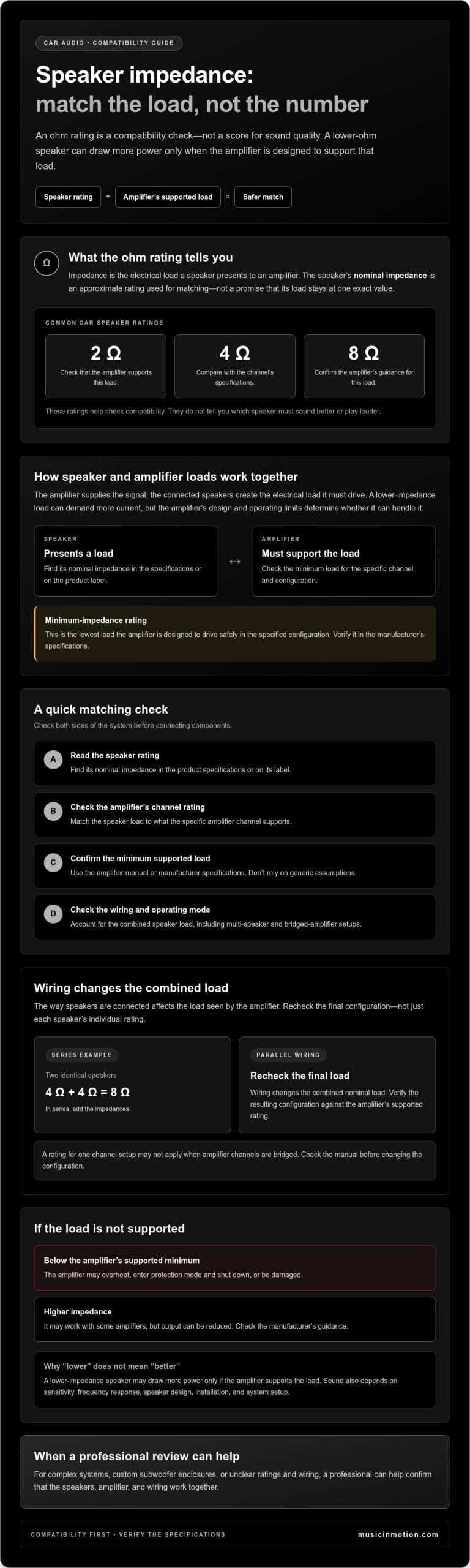
A lower-ohm speaker isn’t automatically the better choice. It can draw more power, but only if the amplifier is designed to handle that load. That’s the key to understanding car speaker impedance: an ohm rating is a compatibility check, not a score for sound quality.
If 2-, 4-, and 8-ohm ratings feel confusing, you’re not alone. Amplifier specifications can be just as tricky, and choosing by the lowest number alone can put extra stress on your equipment. A few checks can help you make a confident match before connecting anything.
This guide explains impedance in plain language, shows how speaker ratings relate to amplifier capability, and outlines what to check in your system’s specifications. You’ll also learn how wiring affects the final load, why lower impedance isn’t always better, and when a professional review can help. The goal is to make sure your components work together reliably and deliver the sound you want.
Key Takeaways
- Understanding car speaker impedance means treating an ohm rating as a compatibility check, not a measure of sound quality.
- Compare each speaker’s impedance with the amplifier’s channel ratings and supported minimum load before connecting components.
- Check the amplifier manual or manufacturer specifications to confirm which loads it supports. Don’t rely on generic assumptions.
- Account for how wiring changes the load, especially in multi-speaker or bridged-amplifier setups.
- For complex systems or custom subwoofer enclosures, a professional review can help confirm that the speakers, amplifier, and wiring work together.
What Does Car Speaker Impedance Mean, and Why Does It Matter?
Impedance is the electrical load a speaker presents to an amplifier. Measured in ohms (Ω), it describes how much the speaker resists alternating current from an audio signal. The rating matters because amplifiers are designed to operate within specific load limits. Match the load to the amplifier’s specifications, and the components can work together as intended.
Nominal speaker impedance is the approximate ohm rating used to describe a speaker’s electrical load for amplifier matching. The word “nominal” matters: it’s a useful rating, not a promise that the speaker’s impedance stays at one exact value. The Nominal impedance reference explains why this value is a standard description rather than a fixed measurement.
What does an Ohm rating tell you?
Look for the nominal impedance in the speaker’s specifications or on its product label. Common car speaker ratings include 2, 4, and 8 ohms. Use the rating to check compatibility with the amplifier, not to decide which speaker must sound better or play louder.
Impedance and resistance are related, but they aren’t interchangeable. Resistance describes opposition to steady electrical current. Impedance describes opposition to an alternating signal, such as audio, and accounts for additional electrical effects. A speaker’s impedance can change with signal frequency, so its nominal rating is a practical reference for matching components, not its exact load at every moment.
Why does impedance matter in a car audio system?
An amplifier sends power to connected speakers, and those speakers present the load the amplifier must handle. A lower-impedance speaker can draw more power than a higher-impedance one from the same amplifier, but only if the amplifier is rated to support that load. For example, don’t assume a 2-ohm speaker is a safe substitute for a 4-ohm speaker without checking the amplifier’s specifications.
If the connected load falls below the amplifier’s supported minimum, the amplifier may overheat, enter protection mode and shut down, or be damaged. A higher-impedance speaker may work with some amplifiers, but output can be reduced. Check the manufacturer’s guidance rather than guessing.
Understanding car speaker impedance starts with checking both sides of the system: the speaker’s nominal rating and the amplifier’s supported load for the specific channel or configuration. This is a compatibility check, not a sound-quality score. Sensitivity, frequency response, installation, and other system choices also influence what you hear. If the ratings or wiring setup are unclear, a professional review can help confirm that the components are suited to work together.
How Speaker Impedance and Amplifier Load Work Together
Think of the amplifier and speakers as a working pair: the amplifier supplies the signal, while the connected speakers create the electrical load it must drive. A lower-impedance load can demand more current, but how the amplifier responds depends on its design, power supply, and operating limits. As Bose explains speaker impedance, ohms are part of the relationship between speakers and amplifier output, not a standalone measure of sound quality.
A lower-ohm rating doesn’t automatically mean louder or better sound. An amplifier may produce more power into a lower load if it’s built and rated to do so, but output isn’t guaranteed to rise in a fixed way. Sensitivity, speaker design, amplifier limits, and system setup also shape what you hear. The practical question is whether the amplifier supports the connected load.
An amplifier’s minimum-impedance rating sets the lowest load it’s designed to drive safely in the specified configuration. Check the manufacturer’s specifications for the exact channel or operating mode. An unsupported load may cause excess heat, trigger a protection shutdown, or damage components, but amplifiers don’t all respond identically. Understanding car speaker impedance means checking the specifications for your equipment instead of assuming every amplifier behaves the same way.
What happens when speaker impedance is lower?
If the amplifier is designed for a lower load, it may deliver more power. If the load drops below its supported minimum, the increased current demand can strain the amplifier. It might overheat or shut down to protect itself, and continued operation under unsupported conditions can risk damage. A rating for one channel configuration may not apply when channels are bridged, so check the manual before changing the setup.
How do multiple speakers change the load?
Wiring changes the combined nominal load. For two identical speakers, these examples show the difference:
- Series: Add the impedances. Two 4-ohm speakers give 4 + 4 = 8 ohms.
- Parallel: For two identical speakers, divide one speaker’s impedance by the number of speakers. Two 4-ohm speakers give 4 ÷ 2 = 2 ohms.
These calculations are a starting point based on nominal ratings. A speaker’s impedance varies with frequency, and real system wiring can include more than one channel or branch. Dual voice coil subwoofers add options because their coils can often be wired in series or parallel, but the correct configuration depends on the coil ratings and amplifier limits. Don’t choose a wiring pattern by the lowest number alone.
For a multi-speaker setup, bridged amplifier, or custom subwoofer enclosure, a professional review can help check the complete signal path and load. If you’re planning a system-wide upgrade, professional car-audio installation can help confirm that the components and wiring are compatible.
How to Match Car Speakers to an Amplifier’s Impedance Rating
Use the specifications for your exact speakers and amplifier, rather than a rule of thumb based on ohms alone. Follow these steps to turn understanding car speaker impedance into a practical compatibility check:
- Identify the speaker load. Record each speaker’s nominal impedance. For a subwoofer, note the impedance and number of voice coils.
- Check the amplifier’s ratings. Find its supported impedance and RMS power per channel. Note separate figures for stereo and bridged operation, if listed.
- Map the connection. Work out the resulting load for the planned wiring, then compare it with the amplifier’s stated minimum load for that configuration.
- Confirm before connecting. Check the manual or manufacturer’s specifications for the exact model. If the configuration isn’t clearly covered, don’t assume it’s supported.
Impedance is only one part of the match. The amplifier’s power ratings matter too. For a broader overview of how ohms relate to amplifier and speaker pairing, Bose explains speaker impedance. If you’re upgrading speakers while keeping the factory stereo, see this guide to car audio upgrades for stock stereos.
Which amplifier specifications should you check?
Find the rated impedance and RMS power for the exact amplifier model. Check whether each figure is per channel or applies to bridged operation. Bridging changes how the amplifier drives the load, so a stereo rating may not apply. Most important, locate the manufacturer’s minimum supported load for the configuration you plan to use. That specification takes precedence over generic assumptions.
How should you check speaker and voice-coil compatibility?
For each speaker, write down its nominal impedance and voice-coil count. A dual voice coil speaker has separate coils that can be connected in different ways, so determine the intended wiring before checking the resulting load. The table shows common speaker ratings as examples, not as a guarantee that any amplifier supports them.
| Example speaker rating | What to confirm in the amplifier specifications |
|---|---|
| 2 ohms | Support for a 2-ohm load on the intended channel or configuration |
| 4 ohms | Support for a 4-ohm load on the intended channel or configuration |
| 8 ohms | Guidance for operating with an 8-ohm load and the expected power output |
These are example ratings, not universal recommendations or compatibility claims. Consider the speaker’s nominal impedance and the amplifier’s minimum-load rating alongside the actual wiring. If you can’t confirm the complete setup from the manuals, a professional review can help you check the system before installation.
Common Impedance Mistakes: Wiring, Ratings, and Sound Expectations
The lowest possible impedance isn’t automatically the best choice. A speaker’s ohm rating describes its electrical load, not whether it will sound louder, clearer, or better in your vehicle. Understanding car speaker impedance means treating the rating as one part of a system match, along with amplifier capability, speaker characteristics, and installation.
Keep these factors distinct. Impedance describes the load presented to the amplifier. Sensitivity indicates how effectively a speaker converts input into sound under stated test conditions. Frequency response describes the range of frequencies a speaker can reproduce. None of these alone guarantees how the whole system will sound. Speaker placement, vehicle acoustics, tuning, and the other components also influence the result.
A common matching error is comparing the wrong amplifier ratings. An amp may list power per channel for stereo operation and a separate rating for bridged operation. Bridging combines channels to drive a load differently, and the minimum supported impedance may change with that configuration. Don’t use a per-channel rating to judge a bridged setup. Check the amplifier’s specifications for the exact mode you plan to use.
Can a lower-impedance speaker damage an amplifier?
It can create a risk if the resulting load is below what the amplifier supports. A lower load may demand more current, and an amplifier that isn’t designed for it may overheat, activate protection, or sustain damage. Unusual heat or a protection shutdown can signal a problem, but those symptoms alone don’t identify its cause.
If the system behaves abnormally, stop using it and check the speaker wiring and amplifier specifications before trying again. Don’t assume the amplifier can handle the load just because it powers on.
Why do printed ratings and real-world sound differ?
A speaker’s nominal impedance is a useful reference for matching, not a complete description of its electrical behavior at every audio frequency. Its actual impedance can vary with frequency. Likewise, two speakers with the same nominal impedance may not deliver the same perceived output. Sensitivity and installation matter, and amplifier power depends on the amplifier’s design and supported load.
Before changing wiring or adding speakers, review the complete system: speaker and voice-coil ratings, connections, amplifier channel or bridged mode, and the manufacturer’s minimum-load guidance. This helps prevent one change from creating an unsupported load elsewhere. If you’re unsure how the pieces fit together, Music In Motion’s professional car-audio installation is one way to get the system reviewed.
When to Get Help Matching and Installing Car Speakers
Understanding car speaker impedance gives you a solid starting point, but a full system still needs to be checked as a whole. Before choosing components or changing wiring, gather the details that let you compare the equipment with the planned setup.
- Component details: Record the exact model numbers and manufacturer specifications for every speaker and amplifier.
- Speaker configuration: Note each speaker’s nominal impedance, voice-coil details, and intended series or parallel connections.
- Amplifier setup: List which speakers connect to each channel, and whether any channels will be bridged.
- Existing equipment: Include the head unit, amplifier, speakers, and any other audio components already in the vehicle.
- Listening goal: Describe what you want to improve, such as clearer vocals, fuller bass, or a balanced everyday listening experience.
With that information, you can check compatibility without relying on guesswork. If a specification is missing or the proposed wiring makes the amplifier’s load difficult to confirm, pause before connecting the system.
When can a professional installer simplify the decision?
Some setups benefit from a careful system-wide review. Multiple speakers sharing amplifier channels, bridged amplifier configurations, and dual voice-coil subwoofers can make the wiring plan harder to evaluate. A custom enclosure adds another consideration: the speaker, enclosure design, amplifier, and installation all need to support the intended result. Explore how those design and integration choices fit together in this guide to custom car audio fabrication.
A professional review can help confirm component compatibility while considering how everything will be installed and how you want the system to sound. That support is especially useful if you can’t verify the resulting load from the equipment manuals or if you’re combining new components with factory audio equipment. It’s a practical option, not a requirement for learning the basics.
If you’d like help planning a compatible system, talk with our vehicle-audio installation team. Bring your component details and listening goals to discuss how professional audio integration may fit your setup.
Build a System That Works Together
Understanding car speaker impedance comes down to checking compatibility, not chasing the lowest ohm rating. Match each speaker’s nominal impedance and planned wiring to the amplifier’s supported load for the specific channel or bridged configuration. Then consider power ratings and the rest of the system, since impedance alone can’t predict how your music will sound.
If a multi-speaker setup, custom enclosure, or wiring plan leaves you unsure, you don’t have to guess. Music In Motion offers professional car-audio installation and custom audio integration and fabrication for cars, boats, motorcycles, RVs, and powersports vehicles. A system review can help ensure the components work together and the listening experience fits your needs.
Talk with Music In Motion’s vehicle-audio installation team about planning a compatible system. Bring your component details and listening goals so the team can help you consider the right integration for your setup.
Frequently Asked Questions
What does impedance mean on car speakers?
Impedance is the electrical load a speaker presents to an amplifier, measured in ohms (Ω). The rating helps you determine whether the amplifier can safely drive that speaker or speaker combination. A speaker’s nominal impedance is a useful reference, not a fixed value at every audio frequency. When understanding car speaker impedance, start by comparing the speaker’s listed rating with the amplifier’s specifications for the channel you plan to use.
Is a 2-ohm or 4-ohm car speaker better?
Neither rating is automatically better. A 2-ohm speaker may draw more power than a 4-ohm speaker from an amplifier that supports both loads, but the actual output depends on the amplifier’s design and ratings. A 4-ohm speaker may be the appropriate match for an amplifier that doesn’t support a 2-ohm load. Check the manufacturer’s specifications first, then compare sensitivity and other speaker characteristics for your listening needs.
How do I match car speaker impedance to an amplifier?
Check the speaker’s nominal impedance, then find the amplifier’s supported load for the exact channel arrangement. If you’re connecting multiple speakers or using bridged mode, calculate the resulting load based on the planned wiring and compare it with that configuration’s minimum rating. Also review the amplifier’s RMS power specifications and the speaker’s power handling. The manual or manufacturer’s documentation for your exact models should guide the decision.
What happens when you wire speakers in series or parallel?
Series wiring adds the impedances: two 4-ohm speakers in series present an 8-ohm nominal load. Parallel wiring lowers the combined load: two identical 4-ohm speakers in parallel present a 2-ohm nominal load. These examples assume identical speakers and describe nominal values. Before wiring, confirm the amplifier supports the resulting load. With different speaker ratings or multiple branches, calculate the network carefully rather than relying on a simple shortcut.
Do speaker Ohms affect sound quality or loudness?
Ohms describe the speaker’s electrical load, not its sound quality. A lower-impedance speaker may allow more power from an amplifier designed for that load, but it doesn’t guarantee greater loudness. Sensitivity, frequency response, amplifier capability, speaker placement, and the vehicle’s acoustics all affect perceived sound. Compare those factors alongside impedance, and avoid choosing a speaker based on its ohm rating alone.
Can I connect speakers with different impedance ratings to one amplifier?
It may be possible, but compatibility depends on the wiring, channel assignments, and load each amplifier channel sees. For example, connecting speakers with different ratings in parallel produces a combined load different from either speaker’s individual rating. The speakers may also receive different amounts of power. Work out the configuration and check it against the amplifier manufacturer’s limits before connecting them. For a complex setup, have the complete system reviewed.