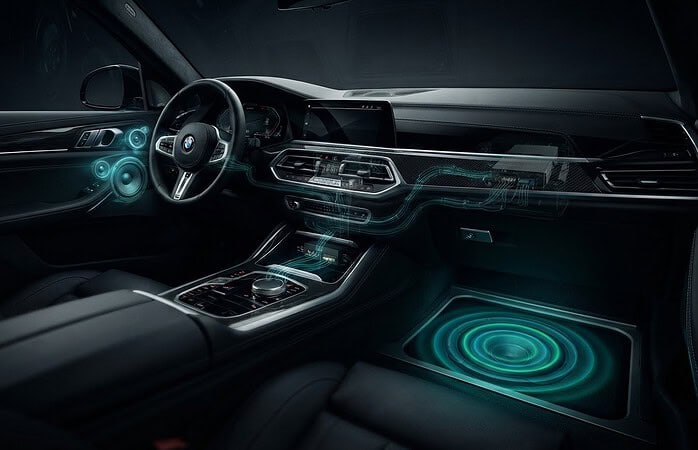
A louder system isn’t always a better-sounding one. If your music turns harsh, muddy, or distorted when you raise the volume, the problem may not be a lack of power. Learning how to improve car audio without an amplifier starts with finding what’s holding the system back: the audio source, speaker match, settings, or cabin noise.
You can often make a noticeable difference without adding a separate amplifier or taking on complex wiring. First improve the signal and listening conditions, rather than expecting new speakers to solve every problem. This guide covers practical changes you can make with your existing head unit, including checking your source and settings, choosing compatible speakers, and reducing unwanted vibration and road noise.
You’ll also learn how to spot the real bottleneck, avoid upgrades that don’t work well together, and recognize when your current head unit has reached its limits. The goal is a balanced system with clearer vocals, cleaner bass, and sound you can enjoy at a comfortable volume.
Key Takeaways
- Set a realistic goal: improve clarity, balance, and everyday listening without expecting factory power to deliver unlimited volume or bass.
- Notice when the sound falters, then check your audio source, balance, fader, tone controls, and equalizer before replacing equipment.
- Learn how to improve car audio without an amplifier by matching speaker upgrades and fitment fixes to the problem you actually hear.
- Address rattles and cabin noise as part of the upgrade. New speakers alone may not fix issues caused by the vehicle’s panels or setup.
- Use a step-by-step approach to identify when persistent distortion, limited volume, or unmet bass goals mean it’s time to reassess the system.
How Much Can You Improve Car Audio Without an Amplifier?
You can often make a factory system sound clearer, more balanced, and more enjoyable without installing a separate amplifier. The realistic goal is better sound quality and usability, not unlimited volume. A factory head unit already contains a small amplifier to power the speakers, but its usable output is limited by the vehicle’s system design. Replacing speakers or correcting setup issues can help, but won’t necessarily increase the system’s maximum clean volume.
Amplifier-free upgrades improve the source, speakers, setup, or cabin conditions while relying on the head unit’s built-in amplification instead of adding a separate amp. Understanding how the car audio components work together helps set expectations: one component can only do so much if another is the bottleneck.
What does “without an amplifier” mean in a car?
In everyday conversation, “without an amplifier” usually means without a separately installed aftermarket amplifier. The factory head unit still amplifies its signal, and passive speakers use that existing output. A powered subwoofer is different because it contains its own amplifier, even though it doesn’t require a separate amp unit. If your goal is no additional amplification at all, a powered subwoofer doesn’t fit that definition.
Which sound problems can amplifier-free changes address?
Different symptoms point to different causes, and more power isn’t always the answer. Weak bass might relate to speaker fitment or how the door supports the speaker. Harsh treble can come from tone settings or the recording itself. A buzz or rattle may come from a loose panel, grille, or mounting point rather than a faulty speaker. Poor-quality or heavily compressed audio can also sound rough through otherwise functional equipment.
Start by noting when the problem occurs. If the sound is unbalanced, incorrect balance, fader, or equalizer settings may be part of the issue. If one speaker sounds weak at every volume, inspect its connection and fitment before buying parts. If the system has low output or becomes distorted as you turn it up, the factory head unit may be reaching its clean-output limit. Settings and fitment fixes can still help, but they can’t remove that power ceiling. That distinction is central to how to improve car audio without an amplifier: correct what you can with the existing system, and keep expectations aligned with its limits.
Find the Bottleneck Before Changing Your Car Audio
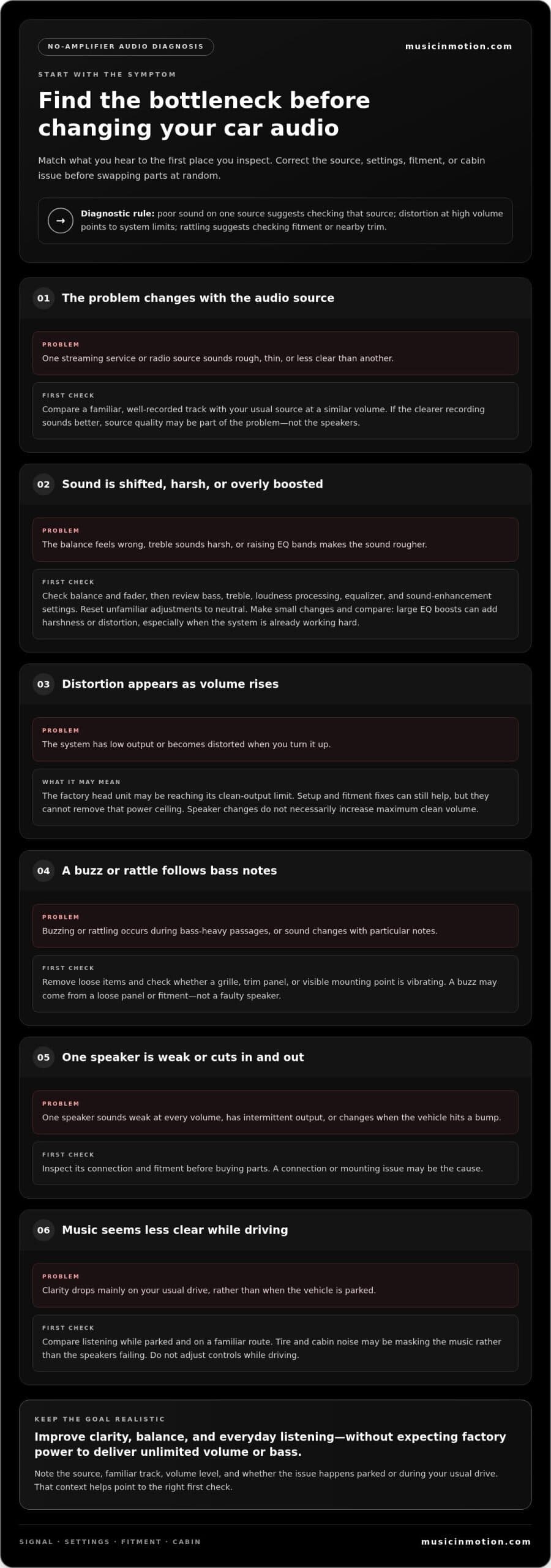
Before replacing speakers or adjusting the system, identify when and where the sound falls short. Note which source you’re using, which familiar tracks reveal the issue, the volume level, and whether it happens while parked or during your usual drive. For example, if bass sounds weak on one streaming service but fuller from another source, the recording or source settings may be the issue, not the speakers. If the problem appears only as you raise the volume, the system may be struggling at higher output.
Diagnostic rule: match the symptom to the first place you inspect. Poor sound on one source suggests checking that source; distortion at high volume points to system limits; rattling suggests checking fitment or nearby trim. This process helps you learn how to improve car audio without an amplifier by correcting the right problem instead of swapping parts at random.
How to tell whether the source or settings are the problem
Compare a familiar, well-recorded track with your usual streaming or radio source at a similar volume. If the clearer recording sounds better, source quality may be part of the problem. Then check balance and fader to make sure sound isn’t shifted to one side or end of the vehicle. Review bass, treble, loudness processing, and any equalizer or sound-enhancement settings as well.
Reset unfamiliar adjustments to neutral and listen again. Large EQ boosts can make a frequency louder, but may also introduce harshness or distortion, especially when the system is already working hard. Make small changes and compare instead of boosting every band to chase more volume.
How to spot speaker, fitment, or cabin-noise issues
Listen for buzzing, rattling, intermittent output, or distortion, and note whether it changes with volume or particular notes. A rattle during bass-heavy passages may come from a grille, trim panel, loose object, or speaker mounting point. Remove loose items and check that visible grilles and trim aren’t vibrating before assuming the speaker needs replacement.
If one speaker cuts in and out, or its sound changes when the vehicle hits a bump, the connection or fitment may need attention. Road noise is a different issue: if music seems less clear mainly while driving, tire and cabin noise may be masking it rather than the speakers failing. Compare the sound while parked and on a familiar route. Don’t adjust controls while driving.
When the cause isn’t obvious, a properly matched car audio upgrade can account for the vehicle’s existing system and installation needs. Explore professional car audio upgrades for an integrated approach.
Compare the Best No-Amplifier Car Audio Improvements
The right upgrade depends on the symptom, not just the part that seems easiest to replace. Source and settings adjustments require no installation, while speaker changes or sound treatment address different physical limits. Use this comparison to narrow down how to improve car audio without an amplifier and avoid expecting one change to solve every issue.
| Upgrade | Best for | Likely benefit | Amplifier-free limitation |
|---|---|---|---|
| Source and settings | Uneven tone, weak sound from one source, or shifted audio | Can restore balance and reduce harshness through cleaner source choices and sensible adjustments | Won’t increase the head unit’s maximum clean output |
| Speaker replacement | Worn or poor-performing factory speakers | Suitable replacements may improve clarity, detail, or tonal balance | New speakers don’t automatically play louder; results depend on system compatibility and available power |
| Fitment corrections | Buzzing, rattles, or inconsistent output | Securing or correcting speaker and trim fit can reduce unwanted noise | Won’t fix a weak source or a head unit that distorts at higher volume |
| Sound treatment | Selected panel vibration or road noise affecting listening | Can reduce targeted vibration and help the cabin sound less distracting | Doesn’t add speaker power or create more maximum volume |
Can replacing factory speakers improve sound without an amp?
Yes, if the factory speakers are the weak link and the replacements suit the existing system. A well-matched set may deliver clearer vocals or more even sound, but new speakers aren’t guaranteed to play louder or sound better on factory power. Check vehicle-specific speaker impedance, physical fit, wiring, and any factory equalization before choosing replacements. Compatibility matters more than assuming a particular speaker will work in every car.
Do sound treatment and powered subwoofers count as amplifier-free upgrades?
Sound treatment can help control selected panel vibration or reduce some noise, but it can’t increase electrical power to the speakers. A powered subwoofer includes its own amplifier, so it isn’t strictly amplifier-free, even though it doesn’t require a separate amp unit. For broader guidance on planning around factory equipment, see our car audio upgrade for stock stereo guide.
How to Improve Car Audio Without an Amplifier Step by Step
A measured process makes it easier to hear what actually helped. Change one thing at a time and compare the same recordings before and after. This helps you improve the system without buying parts that don’t address the problem.
- Document the symptoms. Note which source and familiar tracks reveal the issue, whether it happens at low or high volume, and whether it changes while driving. Describe what you hear, such as weak vocals, thin bass, harsh treble, or a rattle.
- Test sources consistently. Compare a familiar recording from your usual source with another version or source. Keep the listening volume similar. If the sound differs noticeably, investigate the source or its audio-quality settings before blaming the speakers.
- Review the system settings. Check balance, fader, tone controls, loudness processing, and any equalizer or sound-enhancement options. Reset settings you don’t recognize, then make small adjustments. Avoid extreme EQ boosts, which can add distortion rather than clean output.
- Inspect fitment and cabin noise. Remove loose items and check for obvious obstructions, rattling grilles, or vibrating trim. Correct simple, visible issues before shopping for replacements. A speaker or panel that buzzes may need a fitment correction, not a new audio component.
- Confirm compatibility before replacing speakers. Check the vehicle’s speaker size and mounting needs, the factory system’s impedance requirements, wiring, and head-unit compatibility. Sensitivity describes how effectively a speaker converts the signal it receives into sound, but a higher figure alone doesn’t guarantee a better match or result. Wattage figures alone can’t predict how a speaker will perform with the factory system.
- Retest after each change. Use the same tracks, source, settings, and listening level you noted at the start. Compare clarity, balance, bass, and any distortion. If you change several things at once, it’s harder to tell which adjustment made a difference.
When speaker fitment needs a tailored solution
Some vehicles have mounting constraints or factory integration details that make a straightforward speaker swap difficult. A secure fit and correct integration matter as much as the component choice. If the installation calls for custom work, read our custom car audio fabrication guide to understand how tailored fitment can support a finished system.
For a system planned around your vehicle and listening goals, explore professional car audio installation. Matching the existing equipment, replacement components, and fitment is central to how to improve car audio without an amplifier.
Know the Limits and Choose Your Next Car Audio Step
Keeping the factory head unit means a simpler system with fewer components and less added wiring. The tradeoff is that you’re working within the output the existing system can deliver. Settings changes, compatible speaker upgrades, and fixing rattles can make everyday listening clearer and more balanced, but they can’t guarantee higher maximum volume or deep bass at high levels.
When will amplifier-free upgrades be enough?
This approach may suit you if you want cleaner sound for commutes, podcasts, and familiar music rather than maximum volume or competition-level output. Correcting settings, choosing speakers that work with the factory system, and addressing cabin rattles can each improve the listening experience. Results vary with the vehicle, its factory electronics, the condition of its components, and what you like to hear.
After making those changes, listen at the levels you normally use. If the system sounds more balanced and stays clean at a comfortable volume, you may have reached the result you wanted. If you still hear distortion when you raise the volume, or the system lacks the bass you’re after, the limitation may be the system’s available output rather than a setting or loose panel.
When should you consider a professionally integrated upgrade?
Persistent distortion, insufficient volume, or unmet bass goals can call for a broader system plan instead of another isolated speaker change. Factory electronics, speaker fitment, and component compatibility all affect what will work well together. A tailored installation can account for those details and integrate upgrades with the vehicle’s existing system, rather than treating each component as a standalone fix.
That doesn’t mean every vehicle needs the same solution or that you have to add equipment you don’t want. The next step depends on what you hear, what you want to improve, and how the factory system is built. A practical plan may focus on better integration or address a system limit that settings and speaker changes can’t solve.
If you’re ready to explore a system designed around your vehicle and listening goals, take a look at Music In Motion. Knowing how to improve car audio without an amplifier also means knowing when a carefully matched upgrade can take you further.
Make Your Next Audio Upgrade Count
Better car audio doesn’t always start with more power. Identify the source of the problem, make sensible setting and fitment corrections, and choose components that work with the vehicle’s existing system. That’s the practical approach to how to improve car audio without an amplifier, while staying realistic about the factory system’s limits.
If distortion, limited volume, or missing bass persists, it may be time to look beyond one isolated change. A coordinated upgrade can account for factory electronics, speaker fitment, and how each component works with the rest of the system. Music In Motion provides professional car audio installation and custom integration focused on the finished listening experience.
Ready to explore an upgrade tailored to your vehicle and listening goals? Explore professionally integrated car audio upgrades.
Frequently Asked Questions
Can you improve car audio without an amplifier?
Yes, you can improve clarity and balance without adding a separate amplifier. Start by checking your audio source and head-unit settings, then address rattles or loose speaker fitment. Compatible replacement speakers may also help if the factory speakers are the weak point. These changes can make everyday listening more enjoyable, but they won’t necessarily increase maximum clean volume or deliver deep bass if the factory system’s output is limited.
Will replacing car speakers make them sound better without an amp?
They may sound better if the original speakers are limiting clarity or balance, but replacement alone doesn’t guarantee an improvement. Speakers need to suit the factory system’s electrical requirements and physical fit. Head-unit output and factory equalization can also affect the result. Check compatibility for your specific vehicle before buying. A well-matched upgrade can improve the listening experience, while an unsuitable speaker may perform poorly on the available power.
How can I make my car speakers louder without an amplifier?
First, make sure the source is clear and the balance, fader, and sound settings aren’t reducing output. Avoid pushing equalizer controls to extremes, since heavy boosts can create distortion rather than clean volume. Check for loose fitment or rattling that makes sound seem weaker. If the system still lacks volume or distorts as you turn it up, the factory head unit may have reached its usable output limit.
Can I add a subwoofer to my car without an amplifier?
A passive subwoofer needs amplification, so it generally can’t be added as a simple amp-free upgrade. A powered subwoofer has an amplifier built into its enclosure, which means you don’t install a separate amp unit, but the system still uses amplification. Either option needs to be considered alongside the vehicle’s existing audio system, available space, wiring, and listening goals for a clean, integrated result.
What settings can improve car audio quality?
Check balance and fader first to ensure sound isn’t shifted away from your listening position. Set bass and treble controls modestly, and review loudness processing, equalizer, and sound-enhancement features. If the current settings are unfamiliar, return them to neutral and listen again. Make one small adjustment at a time using the same familiar recording. Large EQ boosts can make sound harsher or introduce distortion, especially at higher volume.
Why do my car speakers sound distorted when I turn up the volume?
Distortion at higher volume can mean the head unit or speakers are reaching their usable limits. It may also come from an overly boosted equalizer, a poor-quality source, damaged speakers, or loose trim vibrating with certain notes. Try a familiar recording with neutral settings and listen at a lower level. If distortion persists across different sources, tracks, and settings, a system-level diagnosis can help identify the cause before you replace components.
Are higher-sensitivity speakers better for a factory stereo?
Higher-sensitivity speakers can be a useful choice with factory power because sensitivity describes how effectively a speaker converts the signal it receives into sound. But a higher rating alone doesn’t guarantee better results. The speaker also needs to match the vehicle’s impedance, fitment, wiring, and factory equalization. Compare compatible options as a complete system rather than relying on sensitivity or wattage figures by themselves.