What if the best way to break in a new subwoofer isn’t to push it hard, but to give it time to settle in? If you’re wondering how to break in new car subwoofers without damaging them, a cautious approach makes sense. Advice about playback time can conflict, and the right duration depends on the manufacturer. Initial use may allow the suspension to loosen gradually, but it won’t transform the subwoofer’s sound or make unsafe amplifier settings harmless.
A careful approach is straightforward: follow the manufacturer’s instructions, start with moderate playback, and avoid excessive bass boost or volume while the driver is new. This guide explains what break-in can and can’t do, how to choose suitable music and settings, and why amplifier gain and clean installation matter just as much. You’ll also learn what to listen for and when enclosure fit, wiring, or system tuning may need professional attention. The goal is dependable bass, not a risky test of how loud your new subwoofer can play.
Key Takeaways
- Learn how to break in new car subwoofers with a gradual, manufacturer-led routine instead of relying on one-size-fits-all advice.
- Use the manual’s power-handling and enclosure guidance to understand what your specific subwoofer can safely handle.
- Understand why RMS power is more useful for matching equipment than peak-power figures alone.
- Know why extreme tones and louder playback aren’t shortcuts, and recognize changes that may point to setup issues rather than break-in.
- See how gain, crossover, enclosure fit, wiring, and system integration shape the finished bass experience.
How to Break In New Car Subwoofers: What the Process Actually Does
A new subwoofer can make you eager to turn up the bass, but it’s reasonable to wonder whether playing it too hard could cause damage. First, understand what initial use may change, then follow the instructions for your specific model rather than relying on a one-size-fits-all routine. Break-in isn’t a magic upgrade. It’s a cautious approach to early playback while you learn how the subwoofer behaves in its installed system.
What changes in a new subwoofer during initial use?
A subwoofer’s cone moves back and forth to create sound. The surround connects the cone’s outer edge to the frame, while the spider sits inside the driver. Together, these parts form the suspension, which helps guide and control the cone’s movement. In simple terms, break-in means using the speaker gradually so its suspension can flex during normal operation. This overview of loudspeaker mechanics explains how the cone, voice coil, and suspension work together to produce sound.
Suspension materials and construction differ between models, so the amount or audibility of any change can differ too. A driver may become somewhat more compliant with use, but that doesn’t mean every subwoofer changes in the same way or that you’ll hear a dramatic difference. Treat break-in as measured initial use, not a way to force a particular sound.
Does every new car subwoofer need a break-in period?
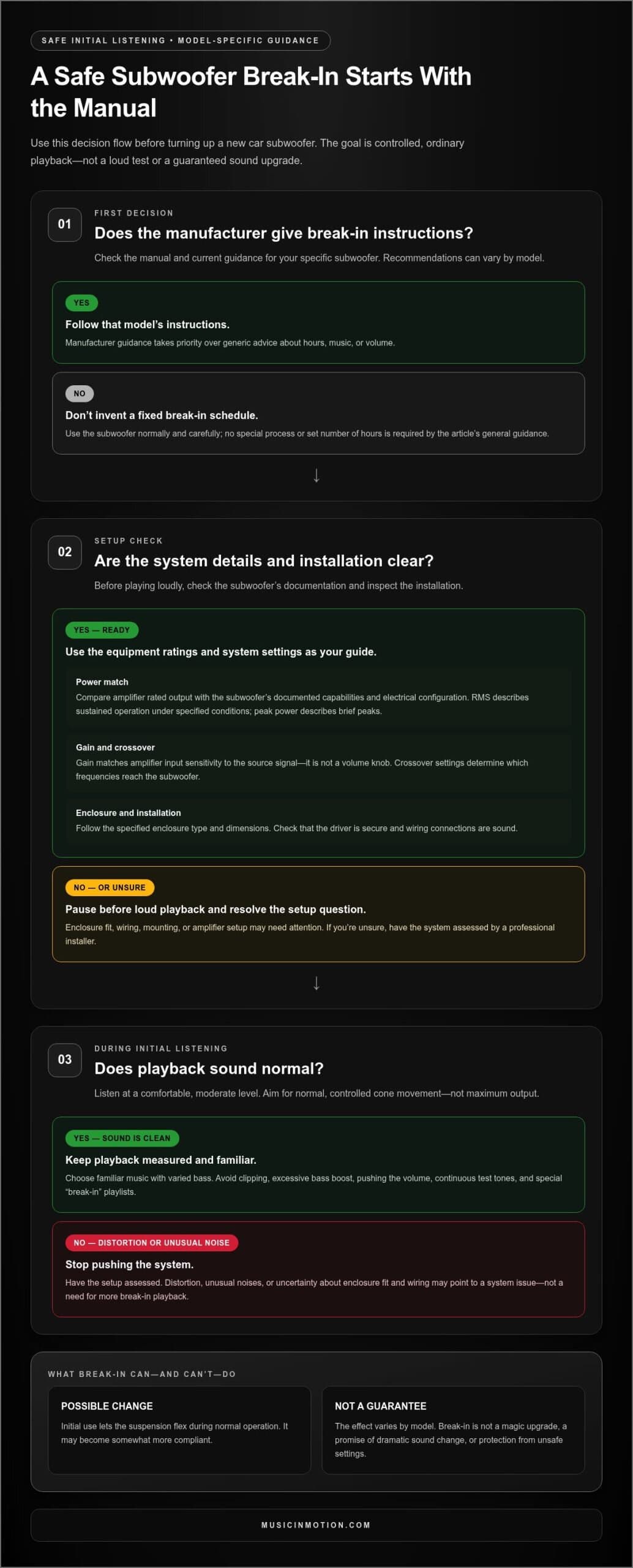
No single routine applies to every model. Some manufacturers provide specific break-in recommendations, while others may not call for a special process. Check the manual and current manufacturer guidance for your subwoofer before deciding how to use it. Those instructions take priority over generic advice about a set number of hours, a particular type of music, or a fixed volume level.
For how to break in new car subwoofers safely, keep the distinction clear: follow model-specific guidance, and don’t assume a break-in period guarantees better performance or protects against every problem. Correct installation and appropriate system settings still matter. If the sound is distorted, the driver makes an unusual noise, or you’re unsure whether the enclosure and wiring are right, stop pushing the system and have the setup assessed. A careful start helps, but dependable bass comes from the whole system working together.
Before Playing New Car Subwoofers, Check the Setup and Safety Limits
Before turning up a new subwoofer, check the manual. Look for power-handling ratings, supported enclosure type and size, wiring configuration, and any warnings or setup instructions. These details vary by model. A safe routine for one driver may not suit another, so use the manufacturer’s documentation as your reference before playing it loudly.
Which subwoofer and amplifier details should you check first?
Compare the amplifier’s rated output with the subwoofer’s documented capabilities and electrical configuration. RMS power is a continuous power-handling or output rating used to describe sustained operation under specified conditions. Peak-power figures describe brief peaks, so they aren’t a reliable basis for everyday equipment matching on their own. Check the ratings and configuration for the specific equipment rather than comparing numbers without context.
Also understand the amplifier’s gain control. It matches the amplifier’s input sensitivity to the signal from the audio source. It isn’t a volume knob, and turning it up isn’t a break-in setting. Crossover settings determine which frequencies reach the subwoofer, so configure the system for its components instead of copying a universal setting. The science of acoustics helps explain why sound depends on how components work together, not on one control alone.
Why enclosure fit and installation affect safe playback
Sealed and ported enclosures have different designs and acoustic behavior. The right choice and dimensions depend on the subwoofer’s specifications and intended use. A mismatch can affect how the driver operates, so follow the enclosure guidance in its documentation. Music In Motion’s custom subwoofer enclosure guide explains the differences between these designs.
Check that the subwoofer is securely mounted and that wiring connections are sound. A loose driver or enclosure can rattle, while wiring problems can cause unreliable operation. If enclosure fit, wiring, or amplifier setup is uncertain, professional car-audio installation can help bring the components together as an integrated system.
- Read the manual for power, enclosure, wiring, and warning details.
- Compare amplifier output with the subwoofer’s RMS rating and configuration.
- Set gain and crossover for the system, not as break-in shortcuts.
- Inspect mounting and connections before raising the volume.
Safety takeaway: Correct system setup matters more than a special break-in track. For support with an integrated subwoofer installation, explore car-audio installation.
A Safe Step-by-Step Method to Break In New Car Subwoofers
The safest routine is steady and uneventful. Follow the subwoofer manufacturer’s current instructions first, since recommended use and duration vary by model. If the manual doesn’t call for a special process, don’t assume you need to run the system for a fixed number of hours. Use the subwoofer normally and carefully, paying attention to how it sounds.
What volume and music should you use during initial listening?
Choose familiar music with varied bass rather than a continuous test tone or a special “break-in” playlist. Keep playback at a comfortable, moderate level. The goal is ordinary, controlled movement, not maximum output. Avoid clipping or pushing the volume until the sound becomes harsh or strained. As Audioholics explains in Loudspeaker Break In: Fact or Fiction?, physical break-in is often misunderstood, so extreme playback isn’t a shortcut to better sound.
How long should you break in a new car subwoofer?
There’s no universal number of hours that applies to every subwoofer. The manufacturer’s guidance is the best reference. Online hour counts aren’t a guarantee or a substitute for model-specific instructions. Let normal listening sessions guide the process, and don’t leave audio playing unattended just to accumulate playback time.
Use this cautious routine for how to break in new car subwoofers:
- Start with the instructions. Read the manual for break-in recommendations and operating limits. Keep the system within the manufacturer’s guidance.
- Begin at a moderate level. Play familiar music with a range of bass. Avoid sustained maximum output, extreme test tones, and attempts to speed up the process.
- Listen during ordinary trips. Use the system for normal sessions, increasing playback only conservatively and staying within the subwoofer and amplifier limits.
- Pay attention to changes. Stop playback if you hear mechanical knocking, scraping, or other unusual noises, or notice an unusual odor. Don’t keep playing to see whether the symptom goes away.
- Follow the model’s timeline. If the manufacturer specifies a duration or other steps, use those directions. If it doesn’t, there’s no need to invent a fixed endpoint.
Keep the aim practical: give the equipment controlled use, not a stress test. If a warning sign appears or you’re unsure whether the system is operating correctly, pause playback and have the installation and settings assessed before turning it up again.
Break-In Myths, Warning Signs, and How to Judge the Results
A new subwoofer doesn’t need to be pushed to its limits to “loosen up.” Loud playback and extreme tones aren’t reliable shortcuts, and they can create unnecessary stress if the signal clips or the driver moves beyond its safe range. Enthusiast routines may sound convincing, but they shouldn’t override the instructions for your specific model. Safe use and careful observation matter more than trying to force a change.
Does a subwoofer need special tones or high-volume playback to break in?
No special tone or playlist should take priority over manufacturer guidance. Familiar music played at a controlled level is a sensible way to use the system. Prolonged test tones or maximum-volume sessions can put extra strain on the subwoofer and amplifier. Clipping, which occurs when an amplifier’s output signal becomes distorted, can produce harsh sound and risk equipment damage. Treat claims that extreme playback speeds up break-in cautiously.
It can be hard to tell whether a sound has changed because of break-in. Listening volume, the music itself, equalizer settings, cabin conditions, and the way the subwoofer is integrated with the rest of the system can all affect what you hear. A perceived difference isn’t proof that break-in caused it. Judge the subwoofer during normal listening with consistent settings, rather than chasing a dramatic before-and-after result.
When should you pause playback and troubleshoot?
Some bass movement and sound are expected during operation. Repeated distortion, scraping, knocking, rattling that seems to come from the driver or enclosure, or an unusual odor deserve attention. A visibly loose mount or enclosure is another reason to stop. Don’t turn the volume up to test whether the symptom will disappear.
- Pause playback if an unusual noise, odor, or repeated distortion occurs.
- Review the manual and check the amplifier settings, wiring, mounting, and enclosure before playing again.
- If the cause isn’t clear, have the system assessed rather than continuing to experiment.
Key takeaway: Stop and inspect unusual behavior instead of trying to force the suspension to loosen. A correctly integrated system depends on more than the subwoofer alone. For broader context on balancing upgraded components, read our car-audio upgrade guide. If enclosure fit, wiring, or tuning is uncertain, get help with your car-audio system.
After Break-In: Get the Best Sound from Your Installed Subwoofer
Once you’ve followed the manufacturer’s break-in guidance, return to everyday listening and keep the system within its stated limits. You don’t need to keep a subwoofer on a special routine indefinitely. The point of learning how to break in new car subwoofers is to start carefully, then enjoy the bass as part of a properly matched system.
How can you tell whether the subwoofer is performing as expected?
Listen to familiar music at a reasonable level. Bass should sound clean and consistent, without repeated distortion, scraping, or rattling. Try a few tracks with different bass notes and rhythms. One song alone won’t tell you how the system handles every part of the music.
There’s no single sound profile that suits every vehicle. Bass balance depends on the subwoofer, amplifier, crossover settings, enclosure, and how the system integrates with the vehicle’s other speakers. A boomy or weak result doesn’t automatically mean the driver needs more break-in. It may point to settings or system matching that need attention. Break-in can’t correct a poor installation, mismatched equipment, or incorrect tuning.
When can professional installation or tuning help?
If you’re unsure whether the enclosure suits the subwoofer or the wiring and amplifier setup are correct, avoid turning the system up while guessing. Persistent distortion or mechanical noises also call for a closer look. A professional can assess how the components work together and help address installation or setup concerns.
Music In Motion provides professional car-audio installation and custom subwoofer enclosure fabrication. A custom installation considers how the subwoofer, enclosure, amplifier, and rest of the audio system fit together in the vehicle. That integrated approach matters: the driver is only one part of the finished sound.
Ready to refine your setup or plan an audio upgrade? Explore car-audio solutions and find a system approach that fits your vehicle and listening goals.
Set Up Your Subwoofer for Confident Everyday Listening
Breaking in a new subwoofer is about starting carefully, not chasing a dramatic sound change. Follow the manufacturer’s instructions, use moderate playback, and stop if you hear repeated distortion or unusual mechanical noise. Once you’re ready for everyday listening, stay within the equipment’s limits and remember that clean, balanced bass depends on the whole system. Amplifier settings, crossover, enclosure, wiring, and integration all play a part.
If enclosure fit, wiring, or tuning feels uncertain, professional installation can help bring those details together. Music In Motion provides professional car-audio installation, including custom subwoofer enclosure fabrication for integrated systems. Explore car-audio solutions and take the next step toward a system that fits your vehicle and listening goals. With a careful start and a solid setup, you can enjoy your new bass with greater confidence.
Frequently Asked Questions
How long does it take to break in a new car subwoofer?
There’s no single break-in duration that applies to every subwoofer. Follow the manufacturer’s manual, since suspension materials and recommendations vary by model. If the manual doesn’t specify a special procedure, careful normal listening is more sensible than relying on a fixed number of hours from an online post. Treat any recommended duration as guidance, not a guarantee of louder or better-sounding bass.
Do new car subwoofers really need to be broken in?
Some manufacturers provide initial-use recommendations, while others don’t call for a special break-in routine. The suspension may become more compliant through use, but that doesn’t mean every listener will notice a dramatic change. Check the model’s documentation and make sure the subwoofer is installed and configured correctly. During initial listening, avoid extreme playback. Break-in isn’t a substitute for proper system setup.
What is the safest way to break in a new subwoofer?
Start with the manufacturer’s instructions and check that the subwoofer, enclosure, wiring, and amplifier are suitably matched. Listen to familiar music at a moderate level, then use the system normally without pushing it into distortion or excessive cone movement. Stop if you hear repeated distortion or mechanical noises. If you’re learning how to break in new car subwoofers, skip high-volume playback as a shortcut.
Should I play test tones to break in a car subwoofer?
A special test tone isn’t necessary unless the manufacturer specifically recommends one. Sustained tones can place a concentrated demand on the system, especially if the amplifier settings or enclosure aren’t suitable. For initial listening, ordinary music at a moderate level is a conservative choice. Don’t let an online break-in routine override the product manual or the operating limits of your subwoofer and amplifier.
Can I damage a new subwoofer by playing it too loud?
Yes. Excessive output, amplifier clipping, or too much cone movement can stress or damage audio equipment, whether the subwoofer is new or well used. Keep playback within the manufacturer’s limits, and don’t turn up the volume to speed up break-in. If the sound distorts repeatedly or the subwoofer behaves unusually, stop playback and review the system setup before using it again.
Does breaking in a subwoofer make it sound louder or produce deeper bass?
Break-in isn’t a reliable way to create a dramatic increase in loudness or bass depth. Initial use may affect suspension compliance, but the overall sound also depends on the enclosure, amplifier, crossover, installation, and vehicle. Listen for clean, consistent performance rather than expecting break-in to fix weak or uneven bass. A mismatched system or incorrect tuning needs attention of its own.
Should I leave my new car subwoofer playing overnight to break it in?
No. An overnight playback routine shouldn’t take priority over the manufacturer’s instructions or safe operation. Extended unattended playback doesn’t guarantee better results, and it leaves the system running without you there to notice a problem. Use moderate volume during ordinary listening sessions and pay attention to unusual noises or odors. If anything seems wrong, stop playback and check the manual and setup.