
A truck’s size isn’t the only factor that affects how confidently you can reverse. Body shape, bumper design, and sensor placement all influence what a parking system can detect. That’s why parking sensor installation for trucks needs to be planned around the vehicle, not treated as a one-size-fits-all add-on.
If reversing into a tight space or judging what’s behind a large vehicle feels challenging, you’re not alone. Parking sensors can help by sending out sound waves, measuring the returning echoes, and alerting the driver to nearby obstacles. But sensors have limits: they don’t replace a clear view or careful manoeuvring.
This guide explains how truck parking sensors work, which vehicle and driving details matter when planning fit and placement, and how sensors can work alongside camera safety systems. It also covers why professional integration matters: a well-planned setup should work with the truck’s existing technology and support the way you use it, helping you approach close-quarters manoeuvres with greater awareness.
Key Takeaways
- Truck length, body shape, and rear overhang can affect how a parking system is planned for close-quarters manoeuvres.
- Useful coverage depends on sensor positioning and system design, not simply the number of sensors.
- Compare sensor alerts, camera images, and combined systems by the type of information each provides while reversing.
- Professional parking sensor installation for trucks can account for the vehicle’s layout, existing technology, and intended use.
- A thoughtful installation process brings assessment, placement planning, integration, and testing together for a practical safety setup.
Why Truck Parking Sensors Need Vehicle-Specific Plans
Truck parking sensors are driver-assistance devices that alert the driver when an object is nearby during low-speed manoeuvres. Unlike a camera, which shows an image of the area, sensors communicate proximity through the alerts provided by the system. For a general overview of how systems detect obstacles, see parking sensor technology.
A truck’s shape affects what sits close to its body and what the driver can see from the cab. Length and width can make it harder to judge clearance in a crowded lot, while a long rear overhang may extend well beyond the rear axle. Box bodies, utility bodies, and other configurations also create different surfaces and edges to consider when planning sensor positions.
That’s why parking sensor installation for trucks should account for the whole vehicle, not just the bumper. A position that works on one body style may provide different coverage on another. The goal is a practical arrangement for the truck’s layout and regular manoeuvres, not simply adding sensors without considering what they need to detect.
Which truck parking situations make sensors especially useful?
Sensors can add useful proximity awareness during low-speed reversing, loading, and close approaches to fixed objects such as walls, posts, or dock structures. They may also help drivers manage tight turns into crowded parking spaces. These situations can make distance harder to judge from the cab, especially when the truck is large or has limited visibility.
Recurring routes and work sites bring their own challenges. A familiar loading area may involve the same narrow approach each day, while a new site may have different obstacles or clearances. Sensors can support awareness in either setting, but they don’t guarantee collision prevention. Drivers still need to move carefully and respond to conditions.
What sensors can and cannot tell a truck driver
A sensor alert tells you that an object is within the system’s detection area. It doesn’t show the object’s shape or provide the full visual context a camera can offer. Detection depends on the system design, installation, and the object’s position. For example, an obstacle’s location relative to the sensors can affect whether it’s detected.
Use alerts as one input alongside mirrors, direct observation, and the truck’s operating procedures. If the view is unclear, pause and reassess rather than relying on a warning system alone. Sensors support driver awareness; they don’t replace careful driving or a clear view of the surroundings.
How truck parking sensors detect obstacles and where placement matters
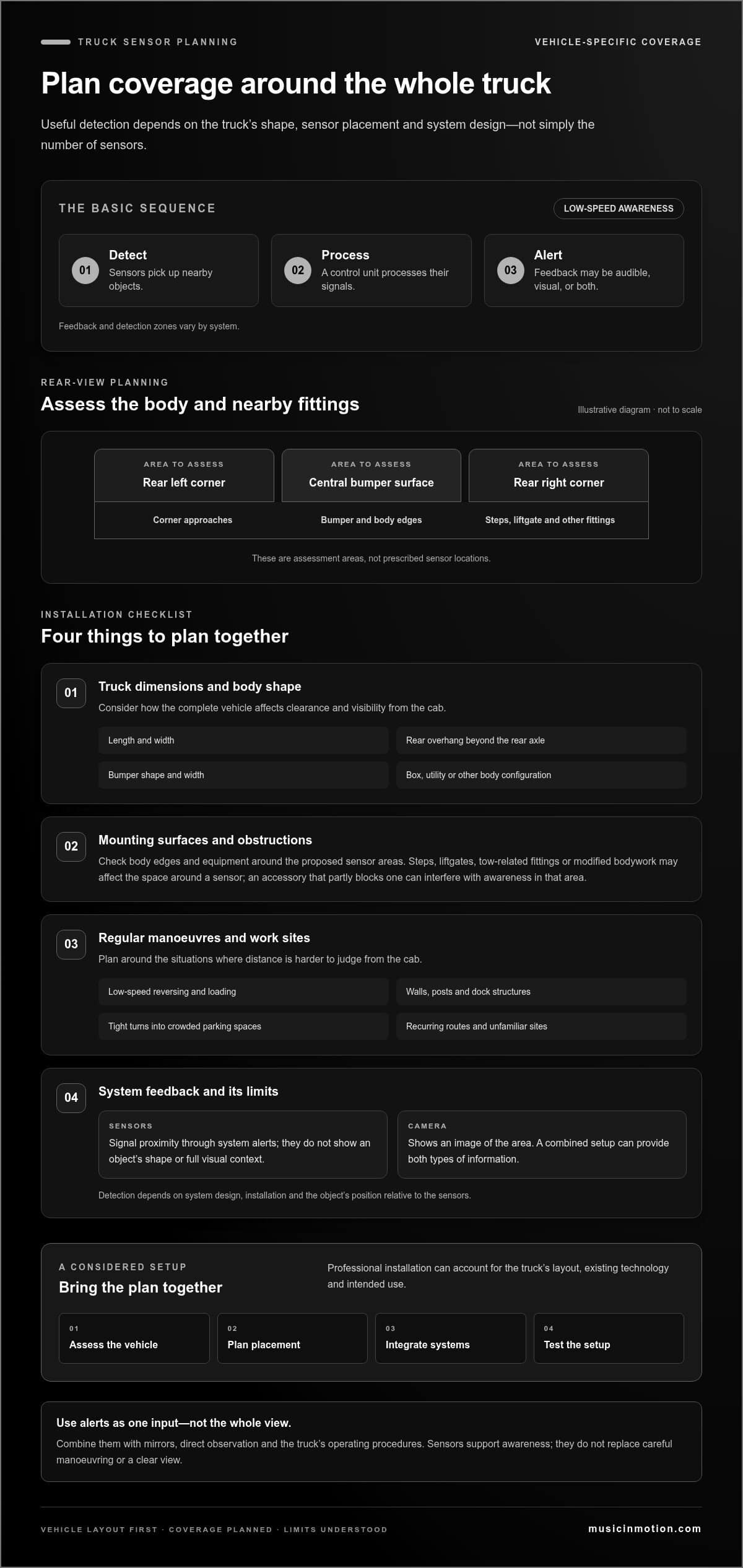
A parking sensor system follows a simple sequence: sensors detect nearby objects, a control unit processes their signals, and the system sends an alert to the driver. Depending on the system, that feedback may be audible, visual, or both. Detection zones and alerts vary, so the installation plan needs to match the truck’s body and intended use.
Sensor placement affects which nearby obstacles a system can detect. Adding more sensors doesn’t automatically create useful coverage. Their positions, the system design, and the surfaces around them all matter. For instance, an accessory that partly blocks a sensor may interfere with the awareness it is intended to provide in that area.
Illustrative rear-view planning diagram, not to scale:
Truck body: Rear left corner | Central bumper surface | Rear right corner
Areas to assess: Corner approaches | Bumper and body edges | Steps, liftgate, and other nearby fittings
This diagram shows areas for assessment, not prescribed sensor locations.
How sensor location interacts with truck body design
Bumper shape and width affect the available mounting surfaces, while rear overhang influences how far the body extends behind the cab and rear axle. A box body, utility body, or other configuration can create different edges and clearances to consider. Vehicle-specific surfaces matter: a layout that suits one truck may not suit another.
Accessories and body equipment add another layer. Steps, liftgates, tow-related fittings, and modified bodywork can occupy space or affect the area around a sensor. A sound installation plan considers these features together rather than choosing positions by a universal height or spacing rule. Mounting details should follow the selected system’s requirements and the truck’s actual design.
Understanding alerts, detection zones, and system limits
Some systems communicate proximity with audible alerts, while others may also use a visual display. These are possible forms of feedback, not features to assume on every setup. How an alert behaves depends on the system, and an obstacle’s position relative to the sensors can affect whether it’s detected. Surrounding surfaces and vehicle fittings matter, too.
After installation, learn the system in a controlled, safe setting. Observe how it responds to obstacles at different positions without treating the alerts as a substitute for mirrors or direct observation. Follow the truck’s safe operating procedures, and pause if the warning or view doesn’t give you enough confidence to continue.
Music In Motion’s custom truck sensor installation can be planned around the truck’s body and existing vehicle technology as part of a considered safety setup.
How to compare truck parking sensors, cameras, and combined systems
Choosing between sensors and a backup camera starts with the kind of information that helps during a manoeuvre. Sensors signal proximity; cameras show a view, subject to system design. One communicates that something is nearby; the other provides an image of the area covered by the camera. Neither guarantees complete visibility, so the right approach depends on the truck, its regular parking situations, and how the driver uses the available feedback.
| Setup | Feedback type | Useful context | Planning considerations |
|---|---|---|---|
| Parking sensors | Proximity alerts, with feedback dependent on the system | Can alert the driver as the truck approaches an obstacle | Sensor positions, system design, and how alerts reach the driver |
| Backup camera | Visual image on a display, depending on the setup | Shows the camera’s view of the area behind the truck | Camera position, display location, and the view the system provides |
| Combined system | Proximity alerts and camera images | Brings distance-related alerts together with visual context | How components integrate with the truck and work together for the driver |
When a truck may benefit from sensors, a camera, or both
Consider the truck’s routine. A driver who regularly backs toward loading areas may value proximity alerts, while a camera image may be useful when visual context behind the vehicle is a priority. Work patterns, existing visibility, and the truck’s body configuration all inform the decision. A combined setup can provide visual context alongside alerts, but it still doesn’t show every area or replace mirrors and direct observation.
For a wider look at how safety upgrades can work together, explore this vehicle safety systems guide. It provides broader context for considering parking aids as part of an integrated vehicle setup.
Which system details should shape the comparison?
Look beyond a feature label and consider how you’ll use the feedback from the driver’s seat. Audible alerts and visual displays are system-dependent, not universal features of every truck sensor setup. A display may need a practical position in the cab, while an alert-only arrangement has different interface needs. Installation complexity also depends on the selected system and the vehicle’s existing technology.
For parking sensor installation for trucks, compare the information each setup provides and how it fits the truck’s body and routine. Avoid choosing by sensor count alone or assuming a particular layout will suit every vehicle. A thoughtful comparison considers coverage, feedback, component placement, and integration as a whole. Sensors and cameras can complement each other, but neither replaces attentive driving.
What to expect during professional parking sensor installation for trucks
A well-planned installation starts with the truck, not a preselected sensor layout. Body style, bumper surfaces, accessories, intended use, and the driver’s needs all affect how the system should be integrated. Professional parking sensor installation for trucks brings those details into one process: assess the vehicle, plan sensor positions, integrate the components, and test the finished setup.
What happens during truck and system assessment?
The assessment considers the truck’s body and available mounting surfaces, including bumper shape and any steps, liftgates, or other accessories near the areas being monitored. The driver’s regular reversing situations help clarify what the system should support. Alert location matters, too. A visual display or other feedback should be considered from the driver’s seated position so it can be understood without distracting from the manoeuvre.
This stage helps determine how the selected system can work with the truck’s existing technology and brings practical installation choices into view before components are fitted. A setup for one truck shouldn’t be assumed to suit another with different bodywork or equipment.
How installation integration and final testing fit together
Once the plan is established, the sensors and related components are mounted and integrated with the vehicle. Wiring, mounting methods, and any display connections depend on both the truck and the chosen system. Drilling or modifying a bumper, as well as making power connections, calls for system-specific decisions. There isn’t one correct position or method for every truck.
Integration is about more than fitting components. It means considering how the safety technology works alongside existing vehicle electronics and how its feedback reaches the driver. A custom installation can account for the truck’s layout and intended use rather than treating the system as a separate add-on.
After installation, final checks should assess system response and whether alerts are clear in safe conditions. The driver should also get a practical introduction to how the installed system behaves, including what its alerts communicate and how to use them alongside mirrors and direct observation. This helps set realistic expectations before relying on the system during everyday manoeuvres.
- Assess: Consider body style, bumper surfaces, accessories, existing technology, and driver needs.
- Plan: Choose sensor and feedback positions around the vehicle and the driver’s view.
- Integrate: Mount and connect components according to the selected system and truck.
- Test: Check system response safely and explain its operation to the driver.
Music In Motion’s truck safety installations bring the system plan together with the truck’s existing technology.
Plan a truck parking sensor installation with Music In Motion
Parking sensor installation for trucks works best when the plan starts with the vehicle and the way you use it. Music In Motion combines custom installation with backup cameras and sensors to shape a practical safety setup around your truck’s configuration and existing technology. The focus is the finished integration: components and feedback considered as part of the vehicle, not as isolated add-ons.
A useful starting point is describing the challenge you want to address. Is the truck difficult to reverse near a loading area? Does its body configuration make it harder to judge the rear corners? Are you looking for proximity alerts, a camera view, or both? Those details help guide a solution suited to the truck and your daily driving.
What information helps shape an installation plan?
Share the truck type and body configuration, along with accessories or equipment near the areas you want to monitor. Describe where you park most often and what makes those manoeuvres challenging. If you have a preference for audible alerts, visual context, or a combined approach, include that as well. This gives the installation plan a clear starting point without assuming one system fits every vehicle.
- Truck type, body style, and any added equipment
- Typical parking conditions and recurring reversing challenges
- Preferred driver feedback, such as alerts, camera images, or both
- Existing vehicle technology to consider as part of integration
Why choose a custom mobile-electronics installation approach?
Vehicle electronics need to work with the truck’s real layout. A custom approach considers fit, component placement, and how the driver will use the system, rather than focusing only on the hardware. That can make the finished setup more straightforward to use from the cab while keeping the installation aligned with the vehicle’s existing technology.
At Music In Motion, we take a solutions-first approach to custom installations and vehicle safety technology. We bring the details together around your truck and your needs with a clear, collaborative process. The right system and specifications depend on the vehicle and selected setup, so the plan should be tailored rather than assumed in advance.
Bring the truck details, the parking situations you want to handle with greater awareness, and the kind of feedback that would be useful behind the wheel. Explore truck parking sensor installation with Music In Motion.
Make your next manoeuvre feel more considered
Turn a parking challenge into a clear installation brief. Note the truck’s body style, the spaces or work areas that feel difficult, and the kind of driver feedback that would be most useful. That gives a custom plan for parking sensor installation for trucks a practical starting point, shaped around your vehicle rather than a generic setup.
Music In Motion brings custom installations together with backup cameras and sensors, as well as broader Camera Safety Systems and vehicle safety systems. We focus on integrating technology with the truck and keeping the process straightforward, so the finished solution fits the way you drive.
A thoughtful plan can help you approach close manoeuvres with greater awareness while keeping mirrors, direct observation, and safe driving procedures part of the process.
Frequently Asked Questions
Can parking sensors detect pedestrians behind a truck?
They may detect a pedestrian within the system’s sensing area, but detection depends on the system and the person’s position. Don’t treat an alert system as a pedestrian-detection guarantee. Before reversing, check mirrors and surroundings, move slowly, and stop if the area isn’t clear. In busy loading areas, have a spotter assist if one is available and follow your workplace’s safe backing procedures.
Will truck parking sensors work with a trailer attached?
It depends on the sensor system and how the trailer and hitch interact with its sensing area. A trailer can extend beyond the truck or sit near sensors, which may change what the system detects or how it alerts. Don’t assume the truck’s normal sensor behaviour applies with a trailer connected. Use mirrors and direct checks, and follow the system’s instructions for trailer use.
Can rain, snow, or dirt affect parking sensor alerts?
Yes. Heavy rain or snow can affect some ultrasonic sensors, and dirt or grime covering a sensor may interfere with its operation. If alerts seem different after driving through slush or along a muddy road, park safely and inspect the sensor faces. Clean them gently according to the system or vehicle instructions. Until alerts behave normally, rely on careful observation rather than the sensors alone.
What should I do if truck parking sensors beep continuously?
Stop in a safe place and check whether an obstacle is close to the truck or a sensor face is covered with dirt, snow, or ice. A continuous alert can reflect an object near the sensing area, but the meaning varies by system. Clear away visible debris only as directed in the instructions, then reassess safely. If the warning continues with the area clear, have the system inspected before relying on it.
Do parking sensors detect low objects such as curbs?
They may detect some curbs, but very low objects can fall outside a system’s effective detection area. A curb’s height, position, and shape matter, so don’t assume an absent alert means the path is clear. In a tight parking space, check the area directly where safe, use mirrors or a camera view if available, and move slowly. Learn how your installed system responds before relying on it around low obstacles.
Are truck parking sensors a substitute for a backup camera?
No. Sensors provide proximity alerts, while a backup camera shows an image of the area within its view. A camera can help you identify what’s behind the truck, while alerts provide another cue as you approach an object. Neither provides complete visibility in every situation. For parking sensor installation for trucks, consider how the two forms of feedback could complement each other, and continue checking mirrors and surroundings.
What happens if a parking sensor is blocked or damaged?
A blocked sensor may give unreliable alerts or fail to detect an object in the area it normally monitors. Damage can also affect system behaviour, though the signs vary by setup. If a sensor looks cracked, loose, or obstructed, avoid relying on that system while manoeuvring. Check the vehicle or system instructions, keep the area clear when safe, and arrange an inspection if the sensor or alerts don’t return to normal.
Ready to plan a setup around your truck and the way you use it? Discuss parking sensor installation for trucks with Music In Motion.