A radar detector can warn you only when police radar signals reach its receiver. That’s the key to understanding how radar detectors work against police radar, and why a warning isn’t guaranteed. The device listens for radio-frequency signals; it doesn’t see an officer or predict when a radar unit will be switched on.
It’s reasonable to wonder whether a detector will give you enough time to respond, especially when alerts can come from other devices or arrive too late. The answer depends on the signal, the enforcement method, and what lies between the radar source and your vehicle. Instant-on radar can limit warning time, while a laser alert may come only after your speed has been measured.
This guide explains how detectors recognize radar bands, how terrain, weather, and traffic can affect detection, and how radar differs from laser. You’ll also learn what a detector can’t promise, so you can make a practical, responsible choice. If you’re considering a radar and laser detection system, professional integration can help it work with your vehicle’s existing technology without changing the technology’s limits.
Key Takeaways
- Understanding how radar detectors work against police radar starts with knowing which signal bands a detector can recognize. Capabilities vary by model.
- X, K, and Ka bands aren’t interchangeable. Knowing the basics can help you interpret alerts more thoughtfully.
- Radar detection, LiDAR, and jamming use different methods, so knowing the distinction helps set realistic expectations.
- Terrain, obstructions, nearby signals, and detector placement can affect reception, so no alert range is assured.
- Professional integration can fit detection electronics into existing vehicle technology while keeping the system’s limits clear.
How a Radar Detector Works Against Police Radar Signals
Understanding how radar detectors work against police radar starts with one distinction: a detector is a receiver, not a speed-measuring device. It scans for radio signals associated with police radar and alerts the driver when it recognizes a supported signal. The officer’s radar unit does the measuring. A detector doesn’t calculate your speed, identify the officer, or control your vehicle.
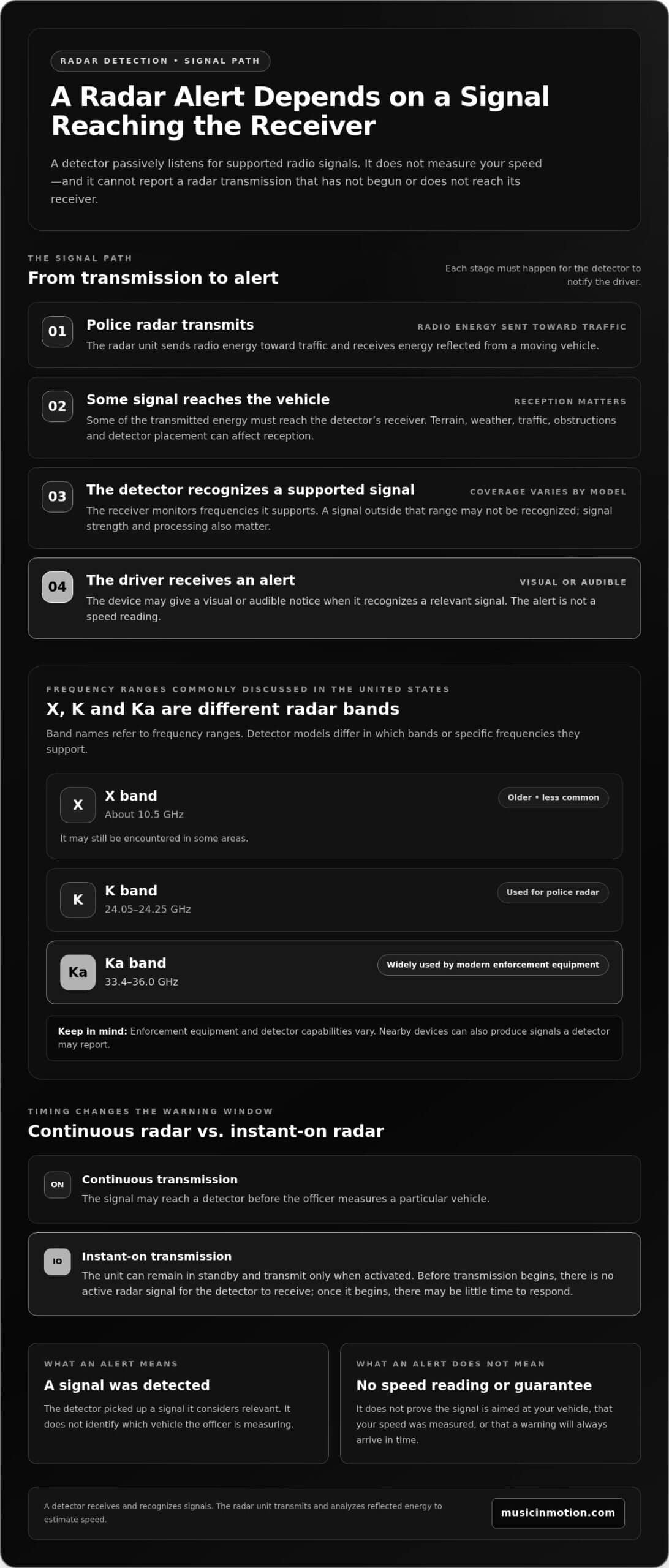
The process has four basic steps: police radar transmits radio energy, some of that energy reaches the vehicle, the detector recognizes a signal it can detect, and it alerts the driver. Whether the alert arrives in time depends on the signal reaching the receiver and being recognized. Detection is possible, but it doesn’t promise a warning or ticket avoidance. The how radar detectors work overview offers additional background on detector technology and related signals.
What happens when police radar transmits a signal?
Police radar sends radio energy toward traffic and receives energy reflected from a moving vehicle. The radar unit compares the outgoing and returning signals. Because motion changes the returning signal’s frequency, the unit can use that shift, known as the Doppler effect, to estimate the vehicle’s speed. A familiar analogy is the change in pitch you hear as a siren approaches and then moves away. The physics differs, but both involve a frequency shift associated with motion.
The roles are separate. The officer’s radar equipment transmits and analyzes reflected energy to estimate speed. A driver’s detector passively receives radio signals; it doesn’t send a signal back to police radar or perform the officer’s speed calculation. It may recognize a radar transmission nearby, but the alert alone can’t tell you which vehicle the officer is measuring.
How does the detector turn a signal into an alert?
A detector’s receiver monitors frequencies it supports. Models differ in which frequencies they cover and how they process incoming signals, so there isn’t one universal scanning method. When a signal reaches the receiver with characteristics the device recognizes, its electronics process it and may trigger a visual or audible alert, depending on the device.
Both signal strength and recognition matter. A weak signal may not produce the same response as a stronger one, while a signal outside the detector’s supported range may not be recognized. An alert means the detector has picked up a signal it considers relevant. It doesn’t prove that the signal is aimed at your vehicle, that your speed was measured, or that the source is a specific police unit.
- Transmission: The radar unit sends radio energy toward traffic.
- Reception: Some energy reaches the detector’s receiver.
- Recognition: The detector processes the signal against its supported frequencies.
- Alert: The driver receives notice of a detected signal, not a speed reading.
This distinction sets realistic expectations: a detector can report a signal it receives, while only the radar equipment measures speed.
Radar Bands, Instant-On Signals, and Why Detection Timing Varies
Band names describe ranges of radio frequencies, not different types of warning or guaranteed detection. In the United States, X, K, and Ka are commonly discussed police-radar bands, but enforcement equipment and detector capabilities vary. A detector can recognize only signals within the frequencies it supports, and detection depends on a signal reaching a compatible receiver.
What do X, K, and Ka bands mean?
The letter identifies a frequency range used by radar equipment. The ranges commonly cited for police radar are X band at about 10.5 GHz, K band at 24.05-24.25 GHz, and Ka band at 33.4-36.0 GHz. X band is older and less common, though it may still be encountered in some areas. K band is used for police radar, while Ka is widely used by modern enforcement equipment.
These bands don’t mean every agency uses every frequency. Detector models can differ in which bands or specific frequencies they support, and nearby devices can also produce signals a detector may report. Check the detector’s documentation to understand its stated coverage and settings. A radar detector can’t identify a signal outside its supported range simply because it’s called a radar detector.
Why can instant-on radar shorten warning time?
Some radar equipment transmits continuously, so its signal may reach a detector before the officer measures a particular vehicle. Instant-on radar works differently: the unit can remain in standby and transmit only when the officer activates it to measure speed. Until that transmission begins, there’s no active radar signal for a detector to receive.
Once the signal is active, an alert depends on it reaching the detector and being recognized. That may leave little time to respond. A detector might pick up a transmission associated with traffic ahead, but that depends on the signal path and circumstances. Traffic ahead won’t always create an early alert, and silence doesn’t prove that no radar equipment is nearby.
For example, a detector may alert when it receives an active signal from a supported band. If the radar unit hasn’t transmitted yet, the detector has nothing to report. When comparing options, focus on documented band support and how the system can be integrated into your vehicle, rather than treating any detector as a guarantee of advance notice. Music In Motion provides radar detection and custom integration for vehicle technology.
Police Radar Detection, Laser, and Jamming: What Each Technology Does
Radar, LiDAR, detection, and jamming describe different things. Radar and LiDAR are methods of measuring vehicle speed. A detector receives signals and may alert the driver. A jammer attempts to interfere with a measurement. Keeping these roles separate makes it easier to understand what a system can and can’t do.
| Technology | How it works | What its role is |
|---|---|---|
| Police radar | Uses radio waves and their reflections to estimate speed. | Measures vehicle speed. |
| LiDAR | Uses a focused beam of infrared light to measure speed. | Measures vehicle speed with a narrow beam. |
| Radar detection | Receives supported radio signals and can alert the driver. | Reports a detected signal; it doesn’t measure speed. |
| Radar jamming | Attempts to interfere with radar measurement. | Attempts to affect the measuring equipment rather than simply receive its signal. |
How is police radar different from LiDAR?
Radar uses radio energy; LiDAR, also called laser, uses light. Radar’s radio signal can spread and reflect from objects, while LiDAR’s beam is narrow and directed. A detector’s ability to receive radar signals isn’t the same as its ability to detect laser. A device needs laser-detection capability to respond to LiDAR, and even then an alert may come only after the speed measurement has been taken. It can’t promise advance notice.
This distinction matters when reading equipment descriptions: radar detection and laser detection refer to different signal types. The phrase “laser alert” doesn’t mean the system has prevented a measurement. To compare detection with equipment intended to interfere, see the article Radar Detector and Laser Jammer.
Is detecting radar the same as jamming it?
No. Detection means receiving a signal and notifying the driver. Jamming means attempting to disrupt a measurement. One is passive reception; the other involves interference. They aren’t interchangeable functions, and a radar detector isn’t a jammer simply because both relate to enforcement equipment.
Laws that apply to detection or interference can differ by jurisdiction and equipment type. Check current rules with the relevant official authorities before using any system, particularly one designed to transmit or interfere. Don’t rely on a detector’s alert, or its absence, as a legal or speed reading.
Understanding how radar detectors work against police radar means recognizing that the device receives radio signals, while police radar and LiDAR measure speed through different methods. Music In Motion’s Laser Detectors & Radar Detection integrate detection technology into a vehicle setup without changing what the technology can promise.
What Affects a Radar Detector’s Real-World Warning?
A detector’s alert depends on more than its ability to recognize a radar band. The signal has to reach the receiver, the device has to process it, and the driver has to interpret the alert. Hills, curves, buildings, nearby electronic signals, and the detector’s position inside the vehicle can all affect reception. There’s no fixed warning distance that applies to every road, vehicle, or situation.
Use this checklist to set practical expectations:
- Compatible bands: Check the device documentation to see which frequencies it supports.
- Signal path: Consider whether terrain or other obstructions may limit the signal reaching the receiver.
- Mounting position: Follow the device’s installation instructions. Vehicle design and placement can influence reception.
- Alert interpretation: Treat an alert as information about a detected signal, not proof of its source or target.
How can placement and surroundings change reception?
Radio signals can be blocked or weakened along the route between their source and the detector. A curve, hill, or structure may limit reception, and the vehicle’s design and the detector’s mounting position may also affect how signals reach it. There’s no single placement that guarantees the same performance in every vehicle. Follow the device’s installation and operating instructions, and don’t assume a quiet alert means the road ahead is clear.
Why might a detector give a false or late alert?
Other electronic sources, including some vehicle safety systems and automatic door openers, can use frequencies that may resemble monitored radar signals. Filtering can help manage unwanted alerts, but it can’t prove that every remaining alert is accurate or identify every signal source. A late alert can occur if transmission begins nearby or terrain and obstructions limit reception. Filtering can’t make a signal arrive sooner.
Knowing how radar detectors work against police radar helps explain why performance varies from one drive to the next. An alert is one input, not a speed reading or a reason to stop paying attention. Keep your focus on the road, follow posted speed limits, and drive according to conditions whether the detector alerts or stays silent.
For a setup tailored to your vehicle and its existing technology, explore professional radar detection integration with Music In Motion.
Choosing Radar Detection and Professional Integration for Your Vehicle
Choosing a system starts with how you use your vehicle and what you want the electronics to do. A daily driver, a vehicle used for long trips, and a vehicle with complex factory technology may call for different integration priorities. Focus on documented capabilities and fit, rather than assuming more alerts automatically mean better protection.
What should you consider before choosing a system?
Use these questions to clarify your priorities before selecting a setup. The answers can help you compare supported signals and alert styles with your driving routine and vehicle, while keeping the system’s limitations in view.
- What signals matter for your use? Compare the system’s documented radar-band and laser capabilities with the enforcement technologies you want it to detect.
- How should it fit the vehicle? Consider how the electronics will work alongside existing vehicle technology and where controls or alerts will make sense to you.
- What alerts suit your preferences? Think about how you want to receive and interpret alerts, including how you’ll distinguish useful notices from signals that may have another source.
- What can’t the system do? An alert provides information about a detected signal. It doesn’t guarantee advance warning, identify every source, or provide immunity from enforcement.
If laser detection is part of your research, the related Laser Defense System for Cars guide can help you explore that separate technology alongside radar detection. Keep the distinction clear: a system’s documented capabilities determine what it can receive, and no setup removes the need for attentive, responsible driving.
How can professional integration make the setup simpler?
Custom installation can bring advanced electronics together with a vehicle’s existing technology, with attention to how the finished setup works in the cabin. Rather than treating the detector as an isolated device, professional integration considers the vehicle and the driver’s needs as a whole. The goal is a straightforward, cohesive experience, not a promise that alerts will arrive in every situation.
At Music In Motion, we integrate technology through custom installations to support a practical, vehicle-specific setup. Understanding how radar detectors work against police radar helps set expectations before choosing a system: reception and alerting have limits, and the driver remains responsible for safe, lawful driving.
Ready to explore a setup for your vehicle? Explore our radar detection solutions.
Choose a Setup That Fits Your Driving
Knowing how radar detectors work against police radar gives you a grounded starting point, but the right next step depends on your vehicle, your preferences, and the role you want detection technology to play. Compare documented capabilities and consider how alerts will fit into your everyday driving. Keep safe habits at the center of the decision.
A well-planned setup should feel like part of the vehicle, not an afterthought. Music In Motion provides Laser Detectors & Radar Detection and integrates advanced electronics with existing vehicle technology through custom installations. The aim is a practical fit for the vehicle, with realistic expectations about what detection can and can’t do.
If you’re ready to explore options for your vehicle, explore our radar detection solutions. Make an informed choice, stay attentive on the road, and choose technology that supports a considered driving experience.
Frequently Asked Questions
Does a radar detector measure my vehicle’s speed?
No. A radar detector doesn’t calculate your vehicle’s speed; it receives certain radio signals and may alert you to them. Police radar equipment measures speed by transmitting a signal and processing its reflection. An alert isn’t a speed reading or confirmation that your vehicle was measured. Understanding how radar detectors work against police radar helps set expectations, but attentive driving and posted speed limits always matter.
Are radar detectors legal everywhere in the United States?
No, you shouldn’t assume radar detectors are legal in every situation. Rules may vary by jurisdiction and can depend on vehicle type or other circumstances. Before using a detector, check current guidance from the relevant official authorities, especially if your trip crosses state lines. General online information may not reflect the rules that apply to your situation, so this educational article isn’t a substitute for checking applicable requirements.
Can police detect that a driver is using a radar detector?
Some law-enforcement equipment is designed to detect emissions associated with radar detectors, which is different from a detector receiving police radar. Whether detection is possible depends on the equipment involved and the conditions. Don’t assume a detector is undetectable based on a general product description or claim. Review the specific device documentation and current local rules, since equipment capabilities and applicable regulations can vary.
Do radar detectors work the same way in every state?
Not necessarily. Enforcement equipment, frequency use, detector compatibility, and applicable laws may differ between jurisdictions. A detector that recognizes signals used in one state may not offer the same coverage in another. Before driving across state lines, review the device documentation and current official rules for each destination. A general online summary can’t establish whether a particular device is suitable or permitted for your trip.
Can a radar detector identify red-light cameras?
Not by default. A conventional radar detector receives supported radar signals, but that doesn’t mean it can identify every camera or traffic-enforcement system. Some devices may offer camera alerts through separate features or data sources, so check the documentation for the exact model rather than assuming this capability is included. A device alert isn’t a substitute for watching traffic signals and following local road rules.
Does a radar detector guarantee that I will avoid a speeding ticket?
No. A detector can’t guarantee an advance alert, recognize every enforcement situation, or prevent a ticket. Whether it alerts can depend on the signal, the device’s supported frequencies, reception conditions, and the enforcement method. Treat alerts as information, not permission to speed. Keep your attention on driving, obey posted limits, and adjust your speed to road and traffic conditions, whether the detector sounds or remains quiet.