The more adjustable crossover isn’t automatically the better fit. Choosing active vs passive crossovers for component speakers comes down to where the signal is divided: a passive network splits it after amplification, while an active crossover separates frequencies before amplification. Passive setups can run both drivers from one amplifier channel; active setups need a separate amplifier channel for each driver, but allow more control over tuning.
If you’re expecting active to mean better sound in every system, the key trade-off is flexibility versus complexity. Passive crossovers offer a more straightforward setup, while active bi-amping requires additional amplifier channels and installation work in exchange for independent control of each driver.
This guide explains how each setup handles the signal, what changes when you add amplification, and which equipment and installation considerations matter. You’ll be able to match the crossover approach to your goals, whether you want a simple upgrade or a system with room for careful tuning.
Key Takeaways
- Understand where each crossover divides the signal and how that affects what reaches the tweeter and woofer.
- See how bi-amping and tri-amping change amplifier-channel needs and give you more independent control.
- Weigh active tuning flexibility against the added equipment, installation work, and system costs it can involve.
- Use your sound goals and existing setup to decide whether a straightforward passive system or a more adjustable active design is the better fit.
What is an Active vs Passive Crossover in a Car Audio System?
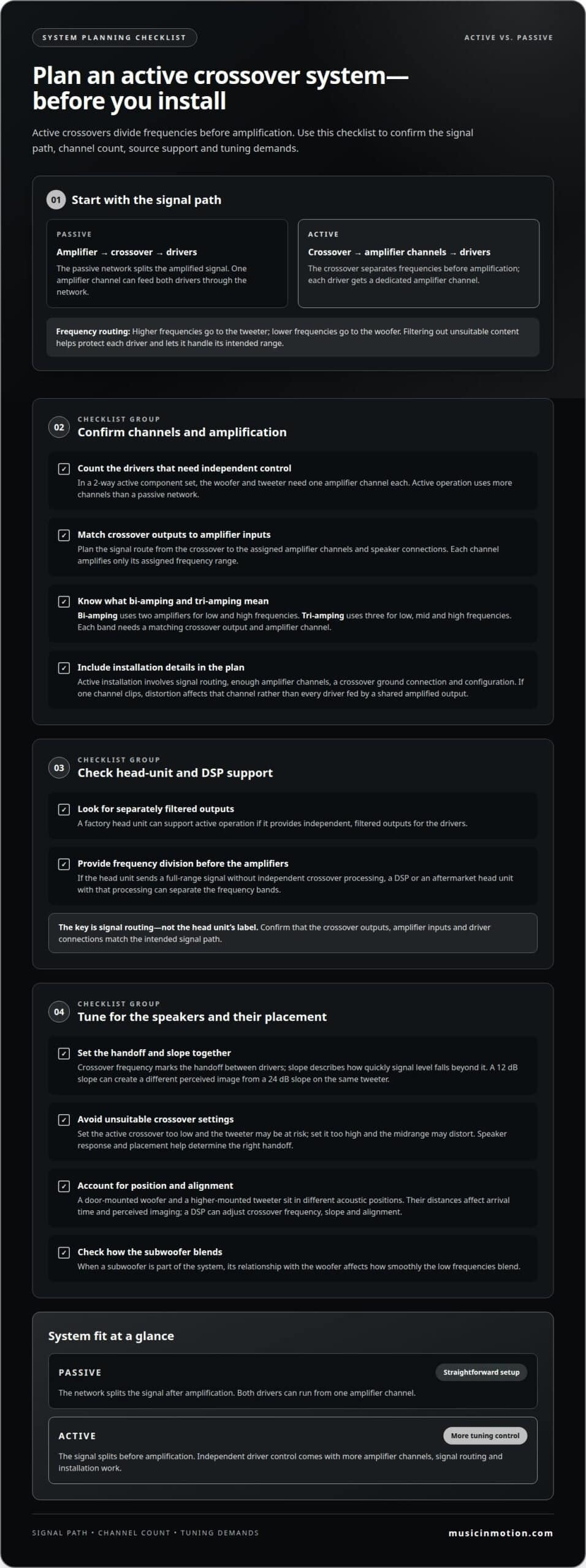
In a 2-way component speaker system, a crossover separates the audio signal for the woofer and tweeter. Passive crossovers do this after amplification; active crossovers divide the signal before it reaches the amplifiers.
Frequency Routing to Speakers and Drivers
A crossover routes higher frequencies to the tweeter and lower frequencies to the woofer, filtering out content each driver isn’t designed to reproduce. That separation matters: sending bass to a tweeter can damage it, while correct routing helps each speaker handle its intended part of the music.
Placement also shapes what you hear. A door-mounted woofer and a tweeter installed higher in the cabin sit in different acoustic positions, so their sound reaches the listener differently. A subwoofer adds another driver, and its relationship with the woofer affects how smoothly the low frequencies blend.
Crossover Frequency and Slope Setup
The crossover frequency marks the handoff between drivers, while the slope describes how quickly the signal level falls beyond that point. These settings affect both frequency response and imaging: a 12 dB slope can create a different perceived image from a 24 dB slope on the same tweeter.
Changing the crossover frequency changes which sounds each driver receives. Set an active crossover too low, and the tweeter may be at risk; set it too high, and the midrange may distort. Speaker response and placement help determine the right handoff, so aim for a smooth transition rather than choosing a setting in isolation.
Frequency Division Before Amplification
An active crossover divides the audio signal before amplification, sending separate frequency ranges to the amplifier channels connected to each driver. For example, the tweeter’s channel receives its high-frequency signal, while the woofer’s channel receives lower frequencies. This directly answers how active crossovers divide frequencies before amplification.
Because each channel amplifies only its assigned range, it doesn’t need to boost signals that won’t reach its connected speaker. A digital sound processor can also adjust crossover frequency, slope, and alignment. This makes tuning more flexible, but incorrect settings can affect speaker response or put a driver at risk.
Independent amplification and bi-amping or tri-amping
An active setup divides frequencies before amplification, so each driver needs its own amplifier channel. That channel count determines the equipment and signal routing the system requires.
Amplifier Channels for Individual Drivers
Each driver in an active system receives a dedicated amplifier channel carrying its assigned frequency range. In a 2-way component set, that means one channel for the woofer and another for the tweeter.
This separation gives each amplifier channel independent control, but uses more channels than a passive network, which splits one amplified output between drivers. The right setup depends on the number of drivers and available channels. Resistors in a passive network don’t replace the separate channels active operation requires.
Active Crossover Placement
An active crossover sits in the signal path before the amplifier, filtering the audio signal before amplification. Its outputs feed amplifier channels assigned to individual drivers, instead of sending one amplified signal through a passive crossover.
This order matters: the crossover determines which frequency range each amplifier channel boosts. If one channel clips, distortion affects that channel rather than every driver fed by a shared amplifier output. Plan the signal path first to match the crossover outputs to the amplifier inputs and speaker connections.
Bi-Amping and Tri-Amping
Bi-amping uses two amplifiers, one for low frequencies and one for high frequencies; tri-amping uses three for low, mid, and high frequencies. With an active crossover, each band is separated before amplification and routed to its corresponding amplifier channel.
For a 2-way component set, bi-amping can give the woofer and tweeter their own channels. Tri-amping applies when the system includes separate low-, mid-, and high-frequency drivers. Each added band requires the matching crossover output and amplifier channel.
Head Unit and DSP Support
A factory head unit can support an active crossover if it provides separately filtered outputs for the drivers. If it sends a full-range signal without independent crossover processing, a DSP or an aftermarket head unit with that processing can provide the required frequency division.
The key is signal routing, not the head unit’s label. For example, a DSP can separate frequency bands before they reach the amplifier, while a suitable head unit can perform that role directly. A car audio upgrade can account for those signal and channel requirements as part of the system design.
Active-system cost and installation complexity
Installing and tuning an active crossover in a car audio system means routing the signal through the crossover before amplification, connecting its outputs to the correct amplifier channels, and tuning the frequency handoffs and time alignment. A digital sound processor can provide those adjustments. Incorrect settings can send unsuitable frequencies to a driver, so setup involves more than connecting the equipment.
Active systems typically require more installation work than passive systems. The installer must plan signal routing, provide enough amplifier channels for individual drivers, connect the crossover’s ground wire, and configure its settings. A processor may also need adjustment for speaker placement: a door woofer and a higher-mounted tweeter are different distances from the listener. Those distances affect arrival time and perceived imaging.
Passive crossover installation is usually more straightforward. The network connects between an amplifier channel and the component speakers, dividing the amplified signal through components such as capacitors and inductors. Its location still matters: place it in a dry area away from vibration, and avoid running AC signal wiring near an inductor, as this can introduce noise. Correct placement and secure mounting help prevent installation problems.
Active-system cost depends on the equipment and work involved, including a DSP, additional amplifier channels, wiring, and tuning. The price depends on the case and is given after a quote request; those system requirements shape the project. Passive crossovers are generally less expensive and easier to install, making them a practical fit when extensive fine-tuning isn’t the goal.
During tuning, a high-resolution RTA can reveal whether the response stays smooth around the crossover frequency. The installer can then adjust crossover settings and time alignment to account for driver locations. A passive network offers fewer adjustment options, while an active system provides more control and requires careful configuration. That trade-off is central to choosing between a simpler installation and a more adjustable car audio system.
Active bi-amping compared with passive crossovers
Use the passive crossovers included with component speakers for a straightforward upgrade without extensive tuning. Active bi-amping suits systems designed for independent driver control and with enough amplifier channels.
Active Bi-Amping
Active bi-amping sends the signal through an active crossover, then gives the woofer and tweeter separate amplifier channels. Each driver receives its filtered signal from its own channel, without a passive network between amplifier and speaker. In car audio, this approach suits systems with enough channels and a goal of independent tuning. It requires additional equipment and careful setup, not just a crossover change.
Using Included Passive Crossovers
Use included passive crossovers when replacing speakers with a component set and keeping the existing amplifier-channel layout. The network splits one amplified channel between woofer and tweeter, so each driver doesn’t need a dedicated amplifier channel. This suits listeners who want the speaker system’s intended frequency division without extensive active tuning. Mount the network in a dry, vibration-free location, away from AC signal wiring near its inductors.
Passive networks need no external power, but their components can cause signal loss, which can reach 3 decibels. They also have wattage limits: excess power can overheat or damage the network and speakers. A passive setup may require an amplifier with twice the wattage needed for a bi-amped system to achieve the same sound pressure level.
Choose based on your system goals. For a basic component-speaker replacement, included passive networks keep channel demands lower. Choose active bi-amping when independent amplification and tuning are priorities and your system can support the required channels. If adding channels complicates the setup, passive crossovers remain the simpler fit.
For help planning a system around those trade-offs, discuss a custom car audio upgrade.
Music In Motion
Music In Motion helps drivers turn crossover choices into a well-matched car audio system. Through car audio upgrades and custom installations, the team can consider your speakers, amplifier channels, signal routing, and tuning needs together. The decision shouldn’t be made by looking at the crossover alone. A passive setup may suit a straightforward component-speaker replacement, while an active system can make sense when independent driver control is a priority and the equipment supports it.
If you’re weighing these trade-offs or planning a system around your listening goals, contact Music In Motion to discuss your setup.
Shape a System Around Your Listening Goals
Choosing active vs passive crossovers for component speakers is one part of creating a system that feels right in your vehicle. Consider how you listen, what equipment you already have, and how much control you want over the final sound. A balanced design brings those choices together rather than treating the crossover as an isolated part.
Music In Motion offers car audio upgrades and custom installations planned around the vehicle and your listening goals. Its marine audio systems extend that expertise beyond the road. Whether you’re refining an existing setup or planning a new build, a conversation can help clarify the direction that fits your priorities.
Contact Music In Motion for advice and take the next step toward a system that feels more like yours.
Frequently Asked Questions
How many amplifier channels do I need for a full active setup?
A stereo 2-way component setup needs four amplifier channels for full active operation: one woofer and one tweeter channel on each side. Count channels by drivers, not crossover boxes. If the system adds another actively amplified driver, such as a subwoofer, it needs its own channel too. The amplifier and processor must provide matching outputs for every assigned driver.
Will a passive crossover damage my speakers over time?
A passive crossover doesn’t inherently damage speakers over time. Damage can occur if the network receives more power than it can handle, overheats, or is connected incorrectly. Excessive power, for example, can harm the crossover or the drivers it feeds. A properly matched setup operating within the crossover’s power limits avoids treating normal use as a cause of inevitable speaker damage.
What is the difference between active and passive crossovers for component speakers?
The key difference in active vs passive crossovers for component speakers is where each system divides the audio signal. An active crossover works before amplification and requires a separate amplifier channel for each driver. A passive network works after amplification and lets one channel feed multiple component drivers. The choice affects the channel capacity and adjustment flexibility the system needs, not simply whether the speakers are high-end.
How do passive crossovers work with component speaker tweeters and woofers?
A passive network uses components such as capacitors and inductors to create filters for the tweeter and woofer. The high-pass path limits lower frequencies reaching the tweeter, while the low-pass path limits higher frequencies sent to the woofer. The crossover connects between an amplifier channel and both drivers, directing each part of the signal without requiring separate amplifier channels.
What are the sound-quality advantages and disadvantages of active versus passive crossovers?
An active system allows more direct adjustment of frequency, slope, and driver levels, which can help tune sound around speaker placement. Results depend on accurate settings and suitable amplification. A passive setup offers a simpler signal path and doesn’t require external crossover power, but its network offers less flexibility. Neither approach guarantees better sound on its own; the complete system and its tuning matter.
How many amplifier channels are needed for active component speakers versus passive?
For a stereo 2-way component system, active operation uses four channels, one per woofer and tweeter on each side. With passive crossovers, two channels can serve the same left-right speaker pair, because each crossover divides its channel’s output between that side’s drivers. This comparison applies to the component set; additional drivers using active filtering need their own amplifier channels.