The best battery for a car audio system may be AGM, not lithium. For systems under 1,500 watts, a direct-fit AGM upgrade is a practical starting point. Above 3,000 watts, multiple batteries or lithium may suit the greater power demand.
It’s easy to assume the most advanced battery is automatically the right choice. But the best battery for a car audio system depends on amplifier demand, the reserve power you need, and how well the setup maintains voltage when bass hits hard.
This guide compares AGM and lithium batteries for usable capacity and voltage stability, explains when AGM can work well, and outlines what changes as a system grows. You’ll also see how a second battery and supporting electrical upgrades fit into the decision, helping you choose a setup that supports your sound goals without oversizing by default.
Key Takeaways
- Compare AGM and lithium by usable capacity, charging needs, weight, and the power your system demands, not by battery type alone.
- Look beyond the battery: amplifier demand, voltage drop, wiring, and alternator capacity all shape how steady your system performs.
- AGM can be a practical fit for daily driving and mid-level audio builds, especially when you want a balance of durability and performance.
- Use the decision guide to weigh a single battery, a second battery, or a lithium setup against your system’s needs.
AGM versus lithium batteries
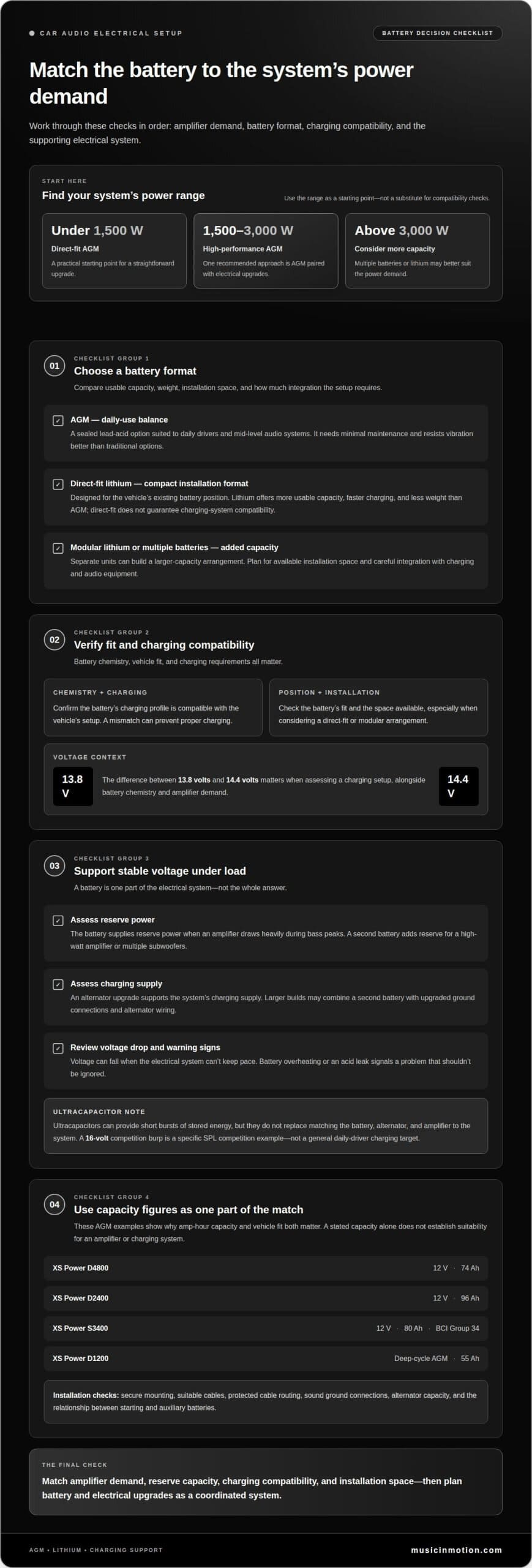
For systems under 1,500 watts, a direct-fit AGM upgrade is a practical starting point. Above 3,000 watts, multiple batteries or lithium may better suit the power demand.
AGM Batteries
An AGM battery is a sealed lead-acid option suited to daily drivers and mid-level audio systems. It balances durability and performance without the higher usable capacity, faster charging, and lighter weight associated with lithium. For a 1,500-3,000-watt system, a high-performance AGM battery paired with electrical upgrades is one recommended approach. Its fit and charging needs still matter.
Direct-Fit Lithium Batteries
A direct-fit lithium battery is designed to occupy the vehicle’s existing battery position rather than form part of a modular bank. Lithium batteries offer more usable capacity, faster charging, and less weight than AGM batteries, which can matter when space or vehicle weight is a concern. Direct-fit describes the installation format; it doesn’t guarantee compatibility with every vehicle’s charging system or audio demand.
Modular Lithium Batteries
A modular setup uses multiple lithium units to build a system around the vehicle’s power needs. Compared with a single direct-fit battery, separate modules allow a larger-capacity arrangement, but require thoughtful integration with the charging system and audio equipment. For builds above 3,000 watts, multiple batteries or lithium are options to consider. The right configuration depends on power demand and available installation space.
Lithium Battery Compatibility
Yes, a lithium battery can work with a car alternator and audio system when its charging requirements are compatible with the vehicle’s charging setup. Battery chemistry and charging profile matter: a mismatch can prevent proper charging. Lithium’s greater usable capacity and faster charging can support demanding audio use, but the battery alone doesn’t determine voltage stability. The alternator and the rest of the electrical system also affect performance.
| Option | Power fit | Key trade-off |
|---|---|---|
| AGM | Under 1,500 watts; also 1,500-3,000 watts with upgrades | Daily-use balance |
| Direct-fit lithium | Vehicle-specific installation | More usable capacity, less weight |
| Modular lithium | Expandable system configuration | More integration planning |
| Multiple batteries | Above 3,000 watts may call for added capacity | Needs supporting electrical work |
Choose based on amplifier demand, charging compatibility, installation space, and whether the system needs a straightforward AGM upgrade or additional capacity.
Battery power output and voltage stability
A battery supplies reserve power when an amplifier draws heavily during bass peaks. Voltage can fall if the electrical system can’t keep pace, affecting consistent output. The difference between 13.8 volts and 14.4 volts matters when assessing a charging setup, especially alongside battery chemistry and amplifier demand.
For a powerful system, a secondary battery and a high-output alternator serve different purposes. A second battery adds reserve for a high-watt amplifier or multiple subwoofers, while an alternator upgrade supports the system’s charging supply. Larger builds may combine a second battery with upgraded ground connections and alternator wiring.
Voltage drop can reduce performance during demanding playback. Battery overheating or an acid leak signals a problem that shouldn’t be ignored. Battery type matters for repeated high-demand listening, and maintenance needs vary by battery design.
Ultracapacitors, also called supercapacitors, can provide short bursts of stored energy. They aren’t a substitute for matching the battery, alternator, and amplifier to the system’s needs. In SPL competition, a supercapacitor may be charged to 16 volts for a competition burp. That example is specific to competition use, not a general charging target for a daily driver.
A practical setup review starts with amplifier demand, then considers reserve capacity and charging support. For example, multiple subwoofers may call for a second battery, while a larger build may also need alternator and ground-cable upgrades. Neither addition alone guarantees stable voltage; each addresses a different part of the electrical system.
For a system that needs coordinated battery and charging choices, a considered car audio upgrade can bring those components into one installation plan.
AGM batteries for car audio
AGM batteries are sealed lead-acid batteries that need minimal maintenance and resist vibration better than traditional options. They’re a practical choice for daily drivers and mid-level audio systems, balancing durability and performance. For systems rated at 1,500-3,000 watts, a high-performance AGM battery paired with electrical upgrades is a recommended approach.
Capacity and fit help distinguish AGM options. The XS Power D4800 is a 12-volt battery rated at 74 Ah, while the XS Power D2400 is a 12-volt model rated at 96 Ah. The XS Power S3400 is a 12-volt, 80 Ah AGM battery in BCI Group 34. These examples show why amp-hour capacity and vehicle fit both matter.
For audio use, the XS Power D1200 deep-cycle AGM battery has a 55 Ah capacity. A higher amp-hour figure indicates greater stated capacity, but it doesn’t by itself establish that a battery suits a specific amplifier or charging system. Match the battery’s fit and intended role to the build. A 13.8-volt charging system may also be a poor match for charging AGM batteries.
Safe auxiliary-battery installation and wiring require matching the battery chemistry to the charging system, secure mounting, suitable cables, and protected cable routing. Ground connections, alternator capacity, and the relationship between the starting and auxiliary batteries matter too.
Larger car audio builds often pair an additional battery with upgraded ground connections and alternator wiring. This coordinated approach addresses both reserve power and charging support. Choose AGM when its capacity, vehicle fit, and charging compatibility suit the system, rather than relying on amp-hour rating alone.
Popular car audio battery prices in the US
Battery prices vary by chemistry, capacity, physical size, and intended audio output. A compact AGM power cell and a high-capacity deep-cycle battery are designed for different builds, so their prices aren’t directly comparable. Compare fit and purpose first, then assess the cost of the configuration your system needs.
Model ratings offer a useful way to understand the range. The XS Power D3400 is rated for 4,000 watts, while the D2700 is rated for 4,500 watts. The Titan 8 RSV-23 LTO Group 34 lithium battery is rated for 5,000 watts. These ratings describe different products, not a guarantee of performance in every vehicle.
Configuration also affects the purchase decision. A standalone battery differs from a package with terminals, and a single unit differs from a multi-battery setup. A build that needs additional reserve, for example, may require more than the battery alone. Include compatible terminals, installation materials, and any supporting electrical upgrades in your comparison.
- AGM models: Compare battery size, capacity, and fit for your vehicle.
- Lithium models: Weigh the rated output and charging compatibility against your needs.
- Terminal packages: Note whether the selected configuration includes the connections your installation requires.
- Additional batteries: Account for the complete system layout, not just one unit’s cost.
For a practical comparison, shortlist models that suit your amplifier demand and charging system, then compare equivalent configurations. A higher watt rating alone doesn’t establish value if the battery doesn’t fit or match the electrical setup. Plan a car audio upgrade around the finished system, including its battery and supporting components.
Music In Motion
Music In Motion helps drivers plan car audio upgrades and custom installations around the complete system, not just the battery. If you’re comparing AGM and lithium, adding amplifier power, or considering a secondary battery, make sure the battery suits your vehicle’s charging system, wiring, and audio goals.
A coordinated setup helps you avoid choosing a battery by capacity or chemistry alone. Music In Motion tailors car audio installations to the build, including custom subwoofer enclosures when the design calls for them. The aim is a finished system that fits your vehicle and listening priorities.
Contact Music In Motion to discuss your car audio system and battery setup.
Build a system around the way you listen
Think beyond the battery itself. Consider how you use your vehicle, the listening experience you want, and whether you plan a complete installation or intend to build in stages. These priorities give the battery decision a clear purpose instead of making it a standalone parts choice. The best battery for a car audio system is the one that belongs in a well-matched setup.
Music In Motion offers car audio upgrades and custom installations to bring the full system together. Its marine audio systems also serve listeners outfitting boats. Whether you’re starting fresh or refining an existing setup, a thoughtful plan can connect the equipment to the experience you want on the road or on the water.
Ready to discuss your system? Contact Music In Motion and take the next step toward audio that fits your plans.
Frequently Asked Questions
What Makes the Best Car Audio Battery?
The best battery for a car audio system matches the amplifier’s demand, the vehicle’s charging system, and the available battery space. Treat audio and starting needs as connected but distinct: the battery must suit the vehicle while providing reserve for music playback. For example, a compact daily-driver system may prioritize direct fit, while a competition build may need a different electrical layout.
What battery types are best for car audio systems: AGM, lithium, or flooded lead-acid?
AGM suits many daily drivers, lithium fits high-demand builds, and flooded lead-acid is generally less convenient for repeated deep-cycle audio use. AGM batteries are sealed and need minimal maintenance; lithium offers greater usable capacity, faster charging, and less weight. Flooded lead-acid batteries require regular maintenance and aren’t designed for deep-cycle use, so consider how often the system draws power with the engine off.
How do I calculate the battery capacity and CCA needed for a car audio system?
Estimate audio capacity from the system’s current draw and intended listening time, then compare that demand with the battery’s amp-hour rating. CCA measures starting capability, so it can’t replace reserve-capacity planning. For instance, a system used with the engine off requires more attention to listening duration than one used mainly while driving. Also account for charging-system support.
What are the best car audio batteries for high-power systems in 2026?
To choose the best battery for a car audio system with high power demands, compare batteries or configurations against the system’s rated output. The XS Power Titan 8 RSV-23 LTO Group 34 lithium battery is rated for 5,000 watts; the XS Power D2700 is rated for 4,500 watts. Above 3,000 watts, multiple batteries or lithium are options. Fit and charging compatibility still shape the choice.
How can I maintain and test a car audio battery, and when should I replace it?
Keep battery terminals clean and secure, and inspect the case and connections during routine checks. A battery test can show whether it holds charge and supports the vehicle under demand. Slow starting, repeated voltage drops, or a battery that won’t retain charge are reasons to investigate its condition. Replace it when testing shows it can no longer meet the vehicle’s starting and audio needs.