The gauge number runs backward: 1/0 gauge is another name for 0 gauge, and both refer to a thicker wire than higher-numbered gauges. A power wire gauge for a car amplifier chart is a useful starting point, but the right size depends on current draw and cable length, not amplifier wattage alone.
It’s easy to focus on an amplifier’s wattage when choosing power wire. The missing piece is how much current the amp draws and how far that current has to travel. For example, an OFC sizing chart recommends 8 AWG for systems drawing up to 30 amps on runs up to 20 feet, while a 31-50-amp system with an 11-20-foot run calls for 4 AWG.
Learn how to use current and cable length to read a sizing chart, why wire material matters, and how amplifier type and listening habits affect estimated current draw. We’ll also connect amplifier wattage to practical wire choices, so you can understand what the chart recommends and why.
Key Takeaways
- Use current draw and the full cable run together to narrow down a suitable power-wire size.
- Choose true copper wire for dependable conductivity, and understand why copper-clad aluminum can change the sizing decision.
- Account for amplifier class and your listening habits when estimating current draw; rated wattage alone doesn’t tell the whole story.
- Match wire recommendations to the amplifier’s output and installation needs, then consider a custom installation for a clean, dependable setup.
Choosing amplifier wire gauge by current draw and cable length
Choose power wire based on the amplifier’s current demand and the full cable run. Wattage helps estimate demand, but it does not determine gauge on its own. A power wire gauge for car amplifier chart is a starting point for matching current and cable length to a suitable wire size.
Matching Current Draw to Cable Gauge
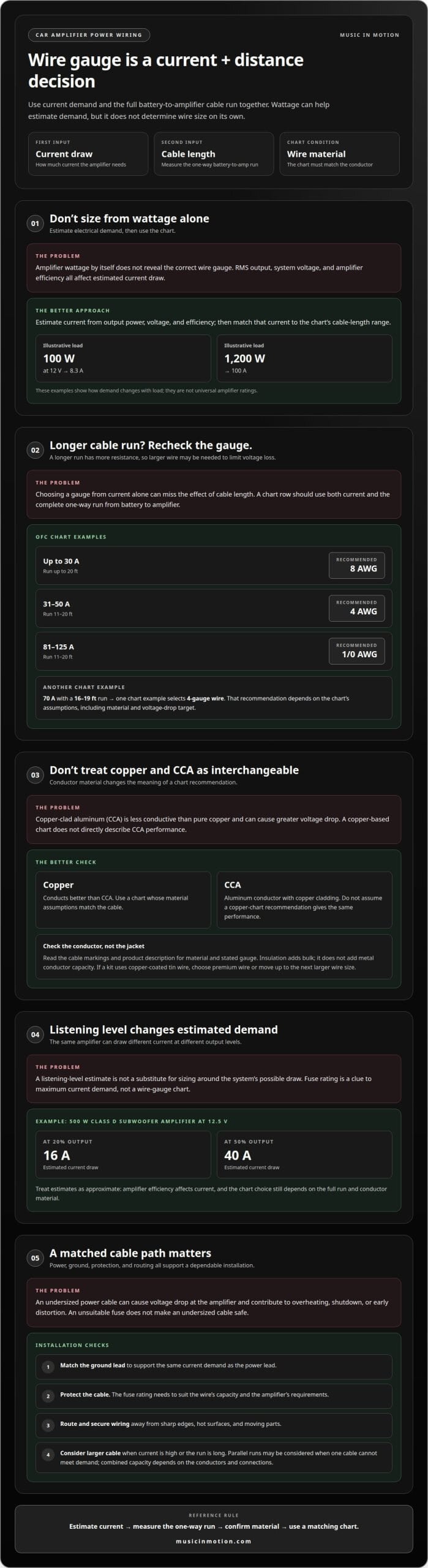
Current draw is the electrical current an amplifier needs, and it guides power-wire sizing. For an RMS-power estimate, account for amplifier efficiency and system voltage, then match the calculated amps to a chart. A 100-watt load at 12 volts draws 8.3 amps; a 1,200-watt load draws 100 amps. These examples illustrate how demand changes with load, not universal amplifier ratings.
Accounting for Cable Length
Cable length affects resistance: a longer run needs larger wire to limit voltage loss. For a 12V system, select a chart row using current and the one-way run from battery to amplifier. An OFC chart recommends 8 AWG for up to 30 amps on runs up to 20 feet, and 4 AWG for 31-50 amps over 11-20 feet. At 81-125 amps over 11-20 feet, it recommends 1/0 AWG.
For a 70-amp amplifier with a 16-19-foot run, one chart example selects 4-gauge wire. Treat that recommendation as tied to its assumptions, including material and voltage-drop target. A power wire gauge for car amplifier chart should match the cable type being installed.
Sizing Ground and Power Leads
Size the ground lead to support the same current demand as the power lead, keeping the return path appropriately matched. An undersized power cable can cause voltage drop at the amplifier and contribute to overheating, shutdown, or early distortion. Route and secure the wiring away from sharp edges, hot surfaces, and moving parts.
Considering Larger or Parallel Runs
A larger cable can provide more voltage-drop headroom when current is high or the battery-to-amplifier run is long. For example, an OFC chart calls for 1/0 AWG at 81-125 amps over 11-20 feet. Parallel runs may be considered when one cable cannot meet the installation’s demand, but their combined capacity depends on the conductors and connections. Choose using a chart suited to the material and complete run.
Copper, tinned copper, and copper-clad aluminum
Wire material affects how much current a cable can carry at a given size. Copper conducts better than copper-clad aluminum (CCA), so don’t apply a chart intended for copper wire to CCA as if the materials were interchangeable. CCA is less conductive than pure copper and can cause greater voltage drop. A chart’s recommendation is useful only when its assumptions match the cable material.
Check the cable’s printed markings and product description to identify its conductor material and stated gauge. Compare the conductor specification with the chart, rather than relying on the jacket thickness or outside diameter. Insulation adds bulk but doesn’t increase the metal available to carry current. If the cable is CCA, don’t assume a copper-based recommendation will provide the same electrical performance.
Amplifier installation kits can use conductor materials other than pure copper. This is different from CCA, which has an aluminum conductor with copper cladding. Don’t treat the descriptions as interchangeable. For a kit with copper-coated tin wire, choose premium wire or move up to the next larger wire size. This provides more cable capacity than relying on the label alone.
Material matters in both power and speaker wiring, but their current demands differ. A subwoofer amplifier’s power cable needs to match its current demand and run length; speaker wire carries the amplified audio signal to the speaker. When using a power-wire chart, first confirm whether it applies to copper. Then check the conductor material and actual gauge against the chart’s current range.
For a subwoofer build, conductor choice and enclosure design are separate decisions, but both shape the finished system. A custom subwoofer enclosure can be part of a tailored audio setup, while matching its power cable to the amplifier’s demand helps avoid a mismatch between components.
How amplifier type and listening habits affect estimated current draw
Estimate current draw from RMS output, supply voltage, and amplifier efficiency. A Class D amplifier’s current draw depends on its output and efficiency, so estimates should be treated as approximate. Amplifier current draw depends on efficiency, so equal output wattage can require different current. Equal output wattage can therefore mean different cable demand.
RMS output describes sustained audio power, while the amplifier’s efficiency indicates how much electrical input it needs to produce that output. A useful estimate divides output power by system voltage and efficiency. For example, a 500-watt Class D subwoofer amplifier at 12.5 volts is estimated to draw 16 amps at 20% output, or 40 amps at 50% output. Listening level changes average demand, but sizing should account for the system’s possible draw.
Use the amplifier’s fuse rating as a clue to its maximum current demand, not as a wire-gauge chart. Fuse size alone doesn’t determine the correct power-wire gauge or replace a current-and-length calculation. The fuse must also protect the cable, so its rating needs to suit the wire’s capacity and the amplifier’s requirements.
To use a chart, estimate current draw first, then match it to the current column and the full battery-to-amplifier cable length. The same amplifier may call for a different wire size if the installation requires a longer run. Also follow the chart’s material assumptions: a copper chart doesn’t directly apply to copper-clad aluminum.
Distinguish the conductor from its jacket. The jacket’s outside diameter doesn’t show the actual metal gauge or establish current capacity. Read the cable markings and use the conductor’s actual material and size when applying a chart. A mismatch between estimated demand, run length, and cable construction can make an otherwise plausible selection inadequate.
Wire gauge recommendations by amplifier wattage
Amplifier wattage is a starting point, not a wire-size answer by itself. Convert rated RMS output into estimated current using system voltage and amplifier efficiency, then match that current and cable distance to a copper-wire chart. At 12 volts, a 100-watt load draws 8.3 amps; a 1,200-watt load draws 100 amps. Those figures show why higher output can demand a thicker cable.
Amplifier design changes the estimate. At 75% efficiency, a 750-watt Class D amplifier is estimated to draw 72 amps, while a 1,200-watt Class D amplifier draws 116 amps. Use the amplifier’s RMS output and class rather than assuming two amplifiers with similar wattage have identical wiring needs. Ratings describe output, not the full electrical demand.
Apply the chart to the estimated current and the actual one-way power-wire distance from the battery. For example, a chart recommends 1/0 AWG for a 150-200-amp circuit with a 16-25-foot run. For a 250-300-amp circuit and a 20-25-foot run, it recommends 2/0 AWG. Longer distances can call for larger cable, even when amplifier wattage stays unchanged.
- Lower output: Calculate current from RMS power, voltage, and efficiency before selecting a gauge.
- Higher output: Use the relevant current range and cable-length column, rather than choosing by wattage alone.
- Multiple amplifiers: Base the wiring plan on their combined electrical demand and the run to each amplifier.
Both power and ground wiring need to support the system’s demand. A chart’s recommendation also depends on its assumptions, including copper conductor material and acceptable voltage drop. Don’t translate an amplifier’s watt rating directly into a wire gauge without considering these factors.
For car audio systems with higher output or longer cable distances, plan your amplifier wiring around the complete system demand, not a wattage label alone.
Music In Motion: Powersports Audio Systems
Music In Motion offers Powersports Audio Systems and Custom Installations for riders planning an audio setup around their vehicle. The right power cable depends on amplifier demand, wire length, and conductor material, while the installation must also suit the available space and routing path. A chart can help narrow down the gauge, but a complete system plan brings those details together with the amplifier and listening goals.
For car or marine audio, Music In Motion also offers Car Audio Upgrades and Marine Audio Systems. Choose a custom installation when you want the wiring and equipment planned as one cohesive setup instead of selecting components in isolation.
Contact Music In Motion to plan your audio installation.
Plan the next upgrade with confidence
Before choosing a cable, consider how the whole audio system should work together. A power wire gauge for car amplifier chart can guide your choice, while current demand, cable routing, and component plans shape the final setup. If you may add another amplifier or change the speaker arrangement later, include that in the plan now. Designing the system around your listening goals can make future decisions clearer and help keep the installation cohesive.
Planning matters in a car, boat, or powersports vehicle, where equipment and routing space differ. Music In Motion offers Car Audio Upgrades, Custom Installations, and Marine Audio Systems, bringing installation details into the broader audio plan. Share what you want the system to do, and start a conversation with Music In Motion about an approach suited to your vehicle.
Contact Music In Motion to discuss your audio plans and take the next step with confidence.
Frequently Asked Questions
Is 0 Gauge the Same as 1/0 Gauge?
Yes. In car-audio wiring, 1/0 gauge is another name for 0-gauge wire. Both labels refer to the same size, so they don’t indicate two different cable thicknesses. This naming can be confusing when comparing product listings. Check that the cable’s printed gauge and conductor material match the sizing chart you’re using, rather than treating “0” and “1/0” as separate choices.
What Comes After 1/0?
In the common large-wire size labels, 2/0 gauge comes after 1/0 gauge and is also called 00 gauge. The number of zeros increases as cable size increases: for example, 2/0 is larger than 1/0. This helps when comparing heavy-gauge cables, but the label alone doesn’t establish whether a cable suits your installation. Current demand, material, and run length still affect selection.
What Does AWG Mean?
AWG means American Wire Gauge, a system for identifying wire size. In this system, a smaller gauge number indicates a thicker conductor. That can feel backward at first: 4 AWG is thicker than 8 AWG, while 1/0 AWG is thicker than both. Use the AWG marking to identify conductor size, then interpret it alongside the cable material and the chart’s assumptions.
How do you calculate amplifier current draw from RMS wattage and efficiency?
Divide the amplifier’s RMS output power by the supply voltage multiplied by its efficiency as a decimal. For example, 1,000 watts ÷ (13.8 volts × 0.75) is about 97 amps for a Class D amplifier. Use the amplifier’s RMS output, not a peak-power figure, and make sure the efficiency and voltage assumptions match the estimate. The result helps determine which chart current range to use.
What is the difference between OFC and CCA car amplifier wire, and how does it affect gauge?
OFC is oxygen-free copper wire, while CCA has an aluminum conductor with copper cladding. They aren’t interchangeable in a copper-based sizing chart: CCA conducts less effectively and can produce greater voltage drop. Match the chart to the cable’s actual conductor material. When comparing cables, check the printed specifications, since the outer jacket alone doesn’t identify whether the conductor is copper or CCA.
How to install and route car amplifier power wire safely?
Route and secure the wire away from sharp edges, hot surfaces, and moving parts. Match the ground lead to the power lead’s current demand. For a high-current amplifier, ground directly to the battery’s negative terminal under the hood.