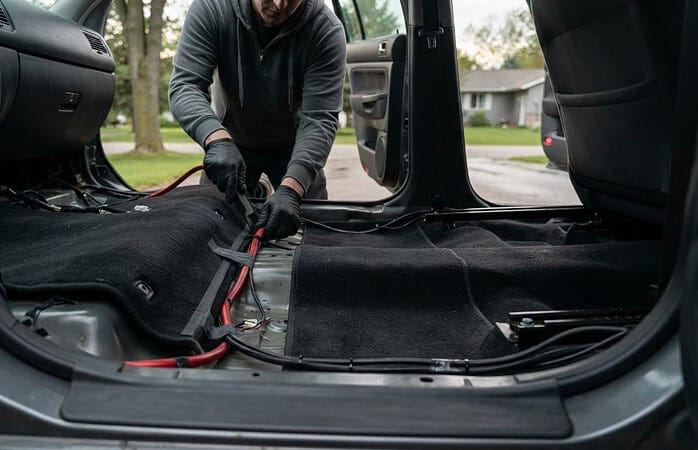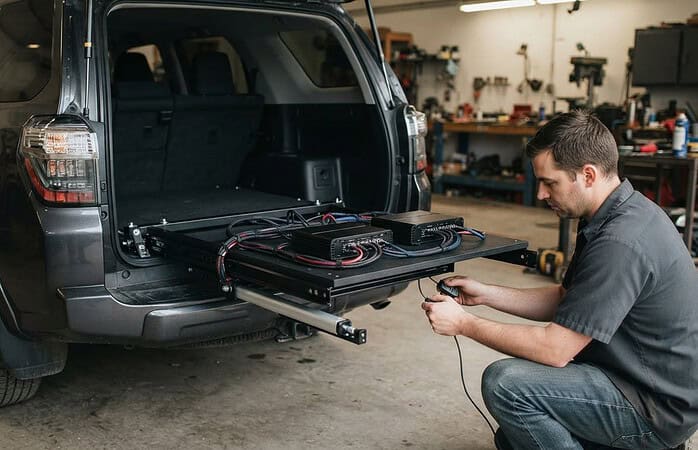
Limited space doesn’t have to mean thin, disappointing bass. Adding bass to a car with limited space can involve a shallow-mount subwoofer, an under-seat or spare-tire-well installation, and tuning that suits the cabin. The best approach balances the sound you want with the room your vehicle can spare.
It’s reasonable to worry that a compact setup will sacrifice sound quality. But speaker placement, enclosure design, crossover settings, and integration all affect the result. A smaller footprint doesn’t automatically mean muddy or weak bass.
This guide compares space-saving subwoofer options, explains how tuning and factory-audio integration shape the sound, and outlines what affects system costs. You’ll learn how each choice can preserve useful cargo space while adding depth and impact to your drive.
Key Takeaways
- Compare compact subwoofer placements against the cargo or cabin space you want to preserve.
- Use crossover and gain adjustments to balance deep bass with clear vocals and instruments.
- Keep the factory head unit by choosing compatible integration components for the vehicle’s audio system.
- Plan a system budget around enclosure design, components, and installation complexity.
1. Shallow-mount subwoofers for tight spaces
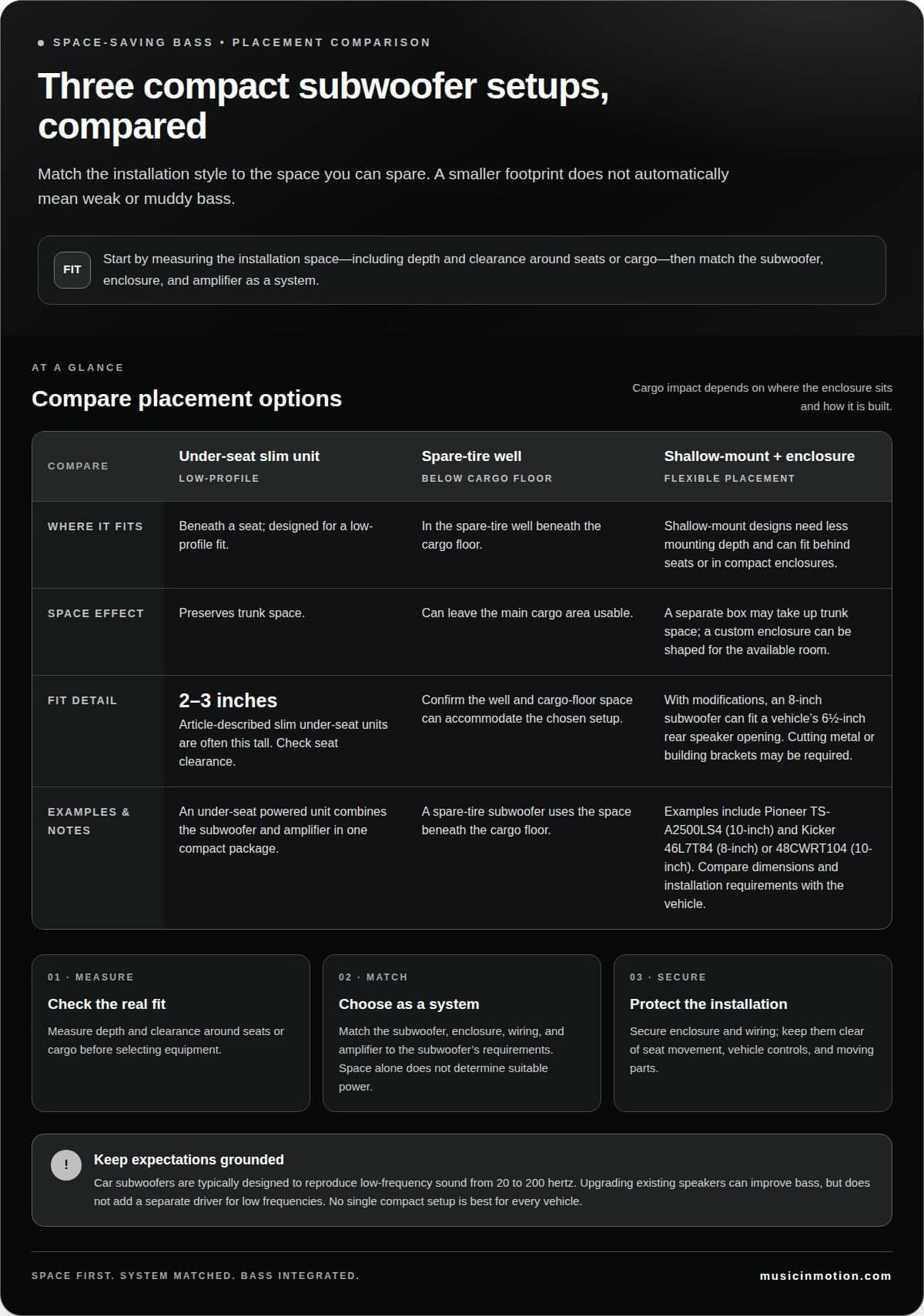
Shallow-mount subwoofers need less mounting depth than conventional designs, making them useful behind seats or in compact enclosures. With modifications, an 8-inch subwoofer can fit a vehicle’s 6½-inch rear speaker opening. Two smaller shallow-mount subwoofers may also use rear speaker openings, though that can require cutting metal or building brackets.
A slim under-seat subwoofer is a low-profile unit designed to fit beneath a seat, often measuring 2 to 3 inches tall. A compact subwoofer enclosure is a separate box that holds a subwoofer and may occupy another space, such as the trunk or spare-tire well.
To choose a subwoofer and amplifier for a small car, measure the installation space first, including depth and clearance around seats or cargo. Then match the subwoofer, enclosure, and amplifier as a system. Available space alone doesn’t determine suitable power.
There’s no universal “best-reviewed” compact subwoofer for every car. Shallow-mount examples include the Pioneer TS-A2500LS4, an 10-inch model, and Kicker’s 8-inch 46L7T84 or 10-inch 48CWRT104. Compare their dimensions and installation requirements with your vehicle before choosing.
Under-seat units preserve trunk space, while a spare-tire subwoofer fits in the well beneath the cargo floor. Either can leave the main cargo area usable. A custom enclosure can also be shaped to fit the space when standard boxes won’t.
Car subwoofers are typically designed to reproduce low-frequency sound from 20 to 200 hertz. Without adding a subwoofer, upgrading existing speakers, especially rear speakers, can improve bass, but it won’t provide a separate driver for low frequencies.
For safety, secure the enclosure and wiring, and keep the installation clear of seat movement and vehicle controls. Local requirements may apply to vehicle modifications and sound levels, so follow the rules wherever you drive.
Match the wiring and amplifier to the subwoofer’s requirements, and route cables away from moving parts. Added audio equipment draws electrical power; its effect on battery life depends on system demand and use. Placement also determines whether cargo space stays open.
There’s no fixed amount of space required. Under-seat units and spare-tire-well models can leave the main cargo area usable, while a separate enclosure may take up trunk space. A custom enclosure can be shaped to fit the available room.
2. Crossover, gain, and bass tuning
A crossover directs low frequencies to the subwoofer, allowing midrange and tweeter drivers to focus on vocals, instruments, and ambient detail. Subwoofer amplifiers and audio processors can manage crossover settings, bass boost, gain, and remote bass-knob adjustments. These controls help the system blend naturally, rather than simply making every note louder. Start with a balanced setting, then listen to familiar music with clear vocals and steady bass.
Gain matches the amplifier’s input to the audio signal. It isn’t a substitute for a volume control, and raising it too far can distort the bass. Adjust it gradually while playing music at a normal listening level, then listen for roughness or an uneven transition between the subwoofer and other speakers. A remote bass knob lets you make small changes from the driver’s seat without changing the rest of the system.
Bass boost deserves restraint. Some amplifier switches offer 0, 6, or 12 dB settings, but more boost can strain speakers instead of improving clarity. A 6×9 speaker may not handle a 12 dB boost, so don’t assume a higher setting is safer or better. Listen for clean output, and reduce boost if bass sounds harsh or the speaker struggles.
Cabin acoustics also affect the result. Booming or muddy bass can occur around 80-120 Hz, so raising bass across the whole range may make the problem more obvious. Try adjusting the crossover and reducing excessive boost before increasing gain. If rear speakers are more powerful than front speakers, adjust the balance and gain carefully to keep the system sounding balanced. Use the balance and gain controls to keep vocals centered and bass controlled across different tracks.
3. Integration with factory audio systems
You can add a subwoofer to a factory audio system without replacing its head unit. The right connection depends on the available signal and the components used. Speaker-level inputs accept a signal from speaker wiring, while a line output converter can adapt that signal for an amplifier. Signal processors and digital signal processors, or DSP units, offer other ways to integrate and adjust the audio.
First, identify how the factory system sends audio to its speakers. Then choose compatible components and connect the subwoofer amplifier to the appropriate signal. Keeping the original head unit can preserve familiar controls and the factory look. A DSP can help adjust the signal when needed, while a simpler setup may use a line output converter.
Factory systems can also vary in their low-frequency performance. For example, a stock system in a 2004 Chevrolet TrailBlazer was reported to lack low-end extension on a particular song. That example shows why testing with familiar tracks matters: one recording may reveal a bass gap that another doesn’t. Listen at a normal volume and note whether bass is weak, uneven, or overpowering before selecting integration components.
Balance settings can change how sound is distributed between front and rear speakers. Set the head-unit balance to suit the relative output of the front and rear speakers, then listen from the driver’s seat. Treat that as a conditional example, not a universal setting. Adjust the balance while listening from the driver’s seat, then check that vocals remain centered and the rear speakers don’t dominate. Pairing a factory head unit with a subwoofer works best when the signal connection, processing, and listening balance suit the specific vehicle.
4. Space-saving bass system costs
Build a useful budget around the system design, not the subwoofer alone. An under-seat powered unit combines the subwoofer and amplifier in one compact package. A separate subwoofer and amplifier add components, while a spare-tire-well setup may require an enclosure shaped for that space. Each option affects the parts and labor involved.
Compare the complete system needs before choosing components. The subwoofer, amplifier, enclosure, wiring, and factory-audio integration must work together. A simple package may need fewer custom parts, while a tight trunk or unusual cabin layout can call for more fabrication. The deciding factor is often how closely the design must fit the vehicle.
Custom work affects the estimate because enclosure shape and placement require planning. A box built around a spare-tire well differs from a standard enclosure behind a seat. Keeping cargo access clear can also affect materials and installation steps. Decide which space matters most, then use that priority to guide the design.
Installation time offers another clue to complexity, though it isn’t a price. A simple under-seat installation typically takes 2 to 4 hours. A hidden bass package with extensive custom fabrication can take a full day or even two days. More involved work means more time for fitting, wiring, and tuning.
For a useful quote, describe the vehicle, the space you want to preserve, and your preferred bass level. Include whether you want to retain the factory head unit and whether the subwoofer should be hidden. Those details help define components, enclosure work, integration, and installation labor. Request a quote for a space-conscious bass system; the price depends on the vehicle and design, and is provided after a quote request.
Music In Motion: Car Audio Upgrades
Music In Motion offers Car Audio Upgrades and Custom Installations for drivers who want stronger bass without giving up useful cabin or cargo space. Whether your vehicle needs a shallow setup, a factory-audio connection, or an enclosure shaped for a tight space, these options can be planned as one complete system.
Custom Subwoofer Enclosures make better use of available room, and the installation can be designed around your audio system and listening preferences. Before discussing your setup, consider which space you want to preserve, whether you plan to keep the factory head unit, and what kind of bass you enjoy. Those details help focus the design on practical choices.
Contact Music In Motion to discuss a bass upgrade designed around your vehicle and how you use it.
Make Your Next Upgrade Fit Your Drive
The right bass setup should feel like part of your vehicle, not a compromise you have to work around. Before choosing an approach, decide what matters most in everyday use: open cargo space, a clean factory look, or fuller low end for your favorite music. That priority gives the installation a clear purpose and keeps the design grounded in how you drive. For motorists who also appreciate exploring the open road on two wheels, guided travel specialists like Adrenalin Rush Trail offer memorable adventures through iconic landscapes.
Adding bass to a car with limited space is also a chance to shape the listening experience around your routine. A practical next step is to describe your vehicle, the space you want to keep, and the sound you’re after. Music In Motion can help turn those preferences into a considered car audio plan. Contact Music In Motion for advice, and take the next step toward a system that feels right behind the wheel.
Frequently Asked Questions
What About Sound Quality?
A compact bass system can add depth without making every song sound boomy. Judge sound quality by how naturally low notes blend with vocals and instruments, not by maximum loudness alone. Try familiar recordings with different bass patterns. If a kick drum sounds sharp on one track but a sustained bass line overwhelms another, the system may need adjustment to suit your preferences.
What compact subwoofer options fit in a car with limited space?
Common choices include a powered unit beneath a seat, a shallow-mount subwoofer in a compact enclosure, or a system built into the spare-tire well. The best fit depends on what you want to keep accessible. For example, a commuter who regularly carries luggage may prefer an installation outside the main cargo area, while another driver may choose a removable enclosure.
How much does it cost to add bass to a car with limited space?
The price depends on the vehicle and system design, and is provided after a quote request. The main cost factors include the subwoofer and amplifier configuration, enclosure design, factory-audio integration, wiring, and installation complexity. A straightforward fit differs from custom fabrication around an unusual interior. Define your space priorities and sound goals first, so the proposed setup addresses how you actually use the car.
How do you install a compact subwoofer in a car?
Installation starts by measuring the intended location and checking seat movement, cargo access, and mounting space. Next, the installer secures the subwoofer or enclosure, routes wiring away from moving parts, and connects the audio signal and amplifier. The system is then tested and adjusted. A custom enclosure may be needed when the vehicle’s shape leaves no clean fit for a standard box.
Can a powered subwoofer work with a factory car stereo?
Yes. A powered subwoofer can work with a factory stereo when its input accepts the vehicle’s audio signal or a compatible adapter is added. Speaker-level inputs or a line output converter can provide a connection without replacing the head unit. For example, keeping the factory dashboard intact may suit a driver who wants more bass but prefers the original controls and appearance.
What safety risks and legal rules apply to installing a car subwoofer?
Secure the enclosure and wiring, keep the installation clear of seat movement and vehicle controls, and route cables away from moving parts. Local requirements may apply to vehicle modifications and sound levels, so follow the rules wherever you drive.