Why does your expensive speaker upgrade still sound like the music is trapped under the floor mats? When you’re weighing the choice between a DSP vs equalizer car audio setup, it’s easy to assume that more volume or a few extra sliders will fix the problem. We’ve seen many enthusiasts spend thousands on high-end hardware only to end up with a muddy, off-center soundstage that feels completely disconnected from the driver’s seat. It’s a frustrating experience, but the good news is that your speakers likely aren’t the problem; it’s the complex acoustic environment of your vehicle.
We’re here to help you understand exactly which tool will solve your specific audio pains and deliver that crisp, balanced sound you’re after. Whether you’re considering a budget-friendly analog unit like the Clarion EQS755 or a powerhouse like the Helix DSP ULTRA S, choosing the right path is essential to avoid buyer’s remorse. We’ll show you how to distinguish between basic tone control and the advanced signal processing required for a true “live performance” feel. This guide breaks down the technical differences, compares the latest 2026 hardware trends, and explains why professional tuning is the secret to unlocking your system’s full potential.
Key Takeaways
- Understand the fundamental difference between basic frequency adjustments and the total acoustic control offered by a digital signal processor.
- Learn how to decide between a DSP vs equalizer car audio configuration by evaluating your vehicle’s factory integration and your desired soundstage quality.
- Discover how advanced features like time alignment and active crossovers solve common issues like muddy audio and off-center imaging.
- Identify when to use surgical parametric equalizers versus standard graphic sliders to correct specific acoustic reflections in your car’s interior.
- Recognize why professional tuning with specialized equipment is essential to transform high-end hardware into a cohesive, high-fidelity listening experience.
What Is the Difference Between a DSP and an Equalizer?
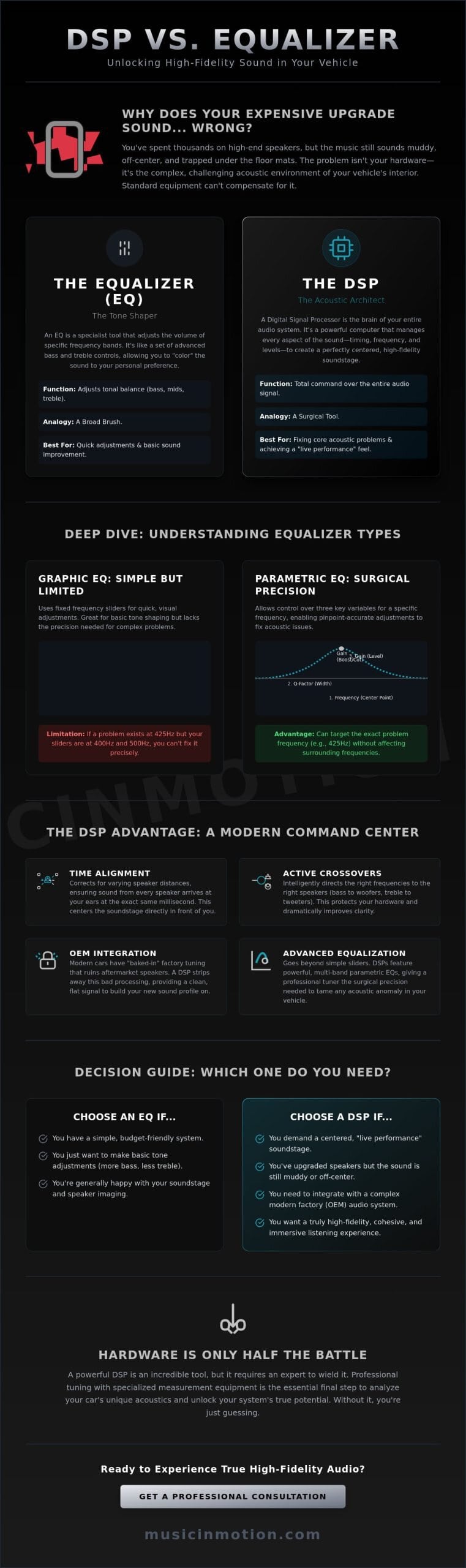
We often meet drivers who’ve replaced every speaker in their vehicle only to find the music still feels “off.” The confusion usually stems from the DSP vs equalizer car audio debate. While both tools aim to improve what you hear, they function in fundamentally different ways. An equalizer is a specialist; it focuses on one thing: adjusting the volume of specific frequency bands. A Digital Signal Processor (DSP), however, acts as the entire brain of the system. It manages the complex relationship between every speaker, the car’s interior materials, and your ears.
In 2026, the car audio market has shifted heavily toward digital solutions. Standalone analog equalizers are becoming rare in high-end builds because they simply cannot compete with the precision of software-driven processing. While an EQ strives for tonal balance, a DSP strives for a perfect soundstage. We want you to feel like the lead singer is standing on your dashboard, not hidden in your door panel. Achieving this requires more than just volume adjustments; it requires total control over the audio signal’s timing and path.
The Equalizer: Frequencies at Your Fingertips
An equalizer gives you control over the tonal balance of your music. If your system sounds too “tinny,” you cut the high frequencies. If the bass feels weak, you boost the low end. Most head units include basic bass and treble knobs, while standalone units offer more “bands” for finer control. However, an EQ is a blunt instrument in a vehicle. It can’t fix the fact that your left speaker is two feet from your head while the right is four feet away. It changes the color of the sound, but it doesn’t fix the acoustic architecture of the cabin. It’s a great tool for personal preference, but it’s limited by physics.
The DSP: The Modern Audio Command Center
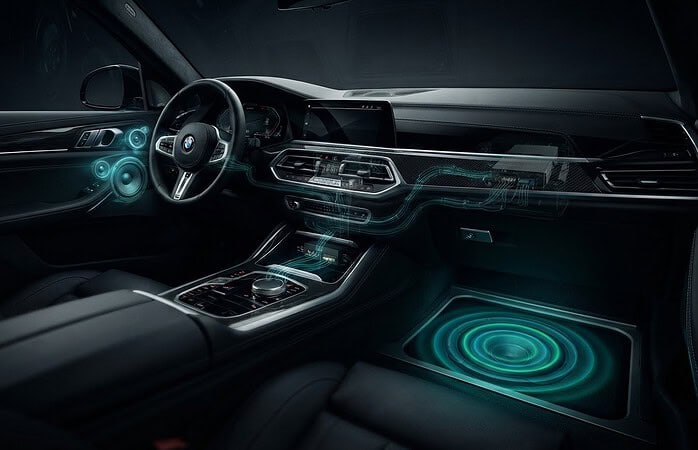
This is where the DSP takes over. Modern vehicles come with complex factory (OEM) systems that use “baked-in” tuning to make cheap speakers sound acceptable. When you upgrade those speakers, that factory tuning often ruins the new hardware’s performance. A DSP strips away that bad processing and replaces it with a custom map. It handles crossovers to protect your tweeters, adjusts levels for balance, and uses time alignment to ensure every note hits your ears at the exact same millisecond. A DSP is a multi-functional processor that optimizes every speaker for the listener’s ear. It provides the surgical precision needed to make a car’s interior sound like a professional recording studio.
Understanding Equalizer Types: Graphic vs. Parametric
Not all equalizers are created equal. When you’re comparing a DSP vs equalizer car audio setup, you’ll quickly realize that “EQ” is a broad term. Most people picture the rows of vertical sliders found on old home stereos or early car head units. That’s a graphic equalizer. It’s intuitive because you can see the visual curve you’re creating. In professional circles, a 31-band graphic EQ is considered the standard for basic tone shaping. It allows you to adjust 31 different fixed frequency points, usually spaced at one-third octave intervals, to balance the overall sound of your music.
However, the car’s interior is a difficult acoustic space. Sound bounces off glass and gets absorbed by upholstery. These reflections create peaks and dips at very specific frequencies that fixed sliders often can’t reach. This is why many modern audio equalizers by digital signal processing techniques have moved toward parametric control. A parametric EQ doesn’t use fixed points. Instead, it lets us choose the exact frequency, the amount of boost or cut, and the “Q” factor, which determines how wide or narrow the adjustment is.
Graphic EQs: Simple but Limited
Graphic EQs are excellent for quick, visual adjustments. They’re great for basic systems where the goal is simply to make the audio sound “better than stock” by boosting the bass or cleaning up the highs. The downside is their lack of flexibility. If your car has an annoying resonance at 425Hz, but your graphic EQ only has sliders for 400Hz and 500Hz, you’re stuck. You’ll end up cutting frequencies you actually wanted to keep just to try and hide the problem note. They’re a broad brush in a world that often needs a scalpel.
Parametric EQs: Precision Tuning
Parametric equalizers are the surgical tool of the audio world. By adjusting the Q factor, we can target a single “problem” frequency caused by cabin gain or panel vibration without affecting the notes around it. This is how we fix the boomy bass caused by car glass and plastic. Professional installers prefer parametric control for high-end custom car audio because it allows for a flat, natural response regardless of the vehicle’s shape. Most high-performance DSPs include a 31-band parametric EQ as just one of their many features. If you’re looking for this level of detail in your own ride, we recommend exploring our custom installations to see how precision tuning can transform your listening experience. Choosing the right path in the DSP vs equalizer car audio debate depends on whether you want a simple fix or a perfectly tailored soundstage.
The DSP Advantage: Why It Outperforms Standalone EQs
A car’s interior is perhaps the worst place to listen to music. You’re surrounded by hard glass, soft fabric, and asymmetrical seating that places you inches from one speaker and feet from another. While an equalizer can help you adjust the “flavor” of the sound, it can’t fix these physical hurdles. This is the heart of the DSP vs equalizer car audio comparison. A DSP provides the architectural fixes that an EQ simply cannot touch. At its core, Digital Signal Processing (DSP) allows us to manipulate audio data with surgical precision, correcting signals before they ever reach your speakers.
Modern factory radios also present a unique challenge. In 2026, most OEM systems use signal splitting and pre-set EQ curves to hide the flaws of cheap factory drivers. If you simply add an amplifier and speakers, you’re amplifying a “broken” signal. A DSP uses signal summing to take those separate pieces and stitch them back into a full-range, clean audio stream. It also manages phase correction, ensuring every speaker in your car pushes and pulls in perfect unison. This creates a physical impact you can feel, rather than a muddy mess of competing sound waves.
Time Alignment: Fixing the “Driver’s Seat Problem”
Physics is the enemy of great car audio. Because you sit on the left, the sound from your driver-side door reaches your ear faster than the sound from the passenger-side door. This ruins the stereo image. It makes the music feel like it’s coming from your knees. A DSP solves this by delaying the sound from the closest speakers by fractions of a millisecond. When every speaker reaches your ears at the exact same time, a “phantom center” appears. Suddenly, the singer is right in front of you on the dashboard. It’s a transformative experience that no standalone equalizer can replicate.
Crossover Control and Speaker Safety
Sending deep bass to a tiny tweeter will destroy it in seconds. Traditional systems use passive crossovers, which are bulky and inefficient. A DSP uses active digital crossovers to send only the specific frequencies each speaker was designed to handle. This protects your investment and allows each driver to play louder and cleaner. For a deeper look at how to set these parameters, check out our guide on Professional Car Audio Tuning: Dialing in Perfect Sound. By moving the processing into the digital world, we maximize efficiency and ensure your gear stays safe even at high volumes.
Decision Guide: Should You Buy an EQ or a DSP?
Choosing between a DSP vs equalizer car audio setup often comes down to your vehicle’s starting point. If you own an older truck with a simple aftermarket radio, an analog equalizer provides a tactile, budget-friendly way to boost your bass. However, if you’re driving a modern vehicle with a large integrated touchscreen, a simple slider box won’t solve your problems. Modern factory radios are tied into the car’s computer systems. You can’t just swap them out without losing climate controls or safety features. In these scenarios, a DSP is the only effective way to fix the factory signal before it reaches your new equipment.
We view the investment as a matter of long-term value. An equalizer is a functional tool that focuses on one specific task. It’s often a dead end for system growth. If you decide to add a custom subwoofer enclosure or high-end component speakers later, you’ll likely need to replace that EQ with something more capable. A DSP grows with your system. Because it’s software-driven, we can reprogram it whenever you change your hardware. It’s the definition of future-proofing. While the learning curve is steeper, the result is a system that stays relevant as your tastes evolve.
The technical demands of these units also differ significantly. An equalizer is easy to adjust on the fly while sitting at a stoplight. A DSP requires a laptop, specialized software, and a deep understanding of acoustic theory. If you enjoy the process of constant manual tweaking, an EQ might satisfy that itch. But if your goal is a finished result that sounds like a professional studio every time you turn the key, the processing power of a DSP is the superior choice. You can consult with our team to determine which hardware path aligns with your specific vehicle and listening goals.
Choose an Equalizer If…
- You have an older vehicle with a basic aftermarket radio and entry-level speakers.
- You only want to make quick, minor adjustments to the bass and treble while driving.
- You are working with a very strict budget and have no plans for future system expansion.
Choose a DSP If…
- You are keeping your factory radio but adding amplifiers and high-quality speakers.
- You want a “high-performance car audio” experience with a realistic, centered soundstage.
- You are investing in custom fabrication or high-end components that require surgical precision.
- You want to follow The Ultimate Guide to High-Performance Car Audio Upgrades for a truly elite result.
The Importance of Professional Tuning for DSP Systems
Buying the best hardware is only 50% of the battle. The other 50% is the tune. We often see enthusiasts invest in high-end processors only to be disappointed because the setup wasn’t optimized for their specific vehicle. A Digital Signal Processor is an incredibly powerful tool, but it’s also a complex one. Without the right calibration, even the most expensive DSP vs equalizer car audio comparison becomes irrelevant. The hardware provides the potential, but the tuning delivers the performance. At Music In Motion, our philosophy centers on providing a finished result, not just a box of electronics.
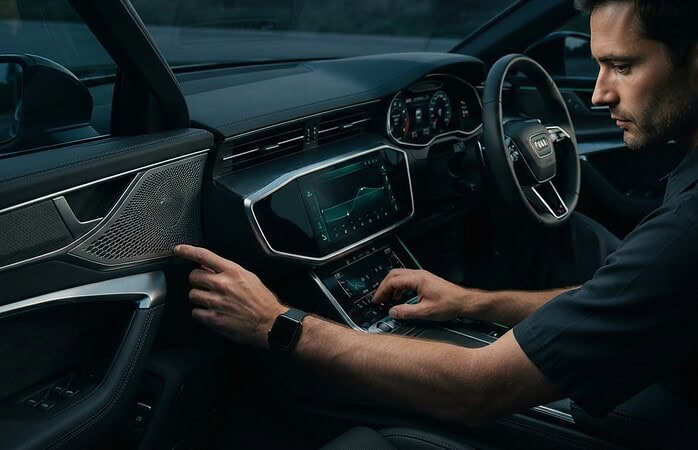
You might be tempted by “auto-tune” microphones that promise a perfect setup with the push of a button. In our experience, these automated systems often fall short of what a human ear and a professional Real Time Analyzer (RTA) can achieve. Microphones are great at measuring raw data, but they don’t understand the emotional texture of music or the way different materials in your cabin absorb sound. There is also a significant risk involved. Improperly setting your digital crossovers can blow expensive tweeters or mid-range drivers in seconds. Professional tuning ensures your system is not only beautiful to hear but also built to last.
The Professional Tuning Process
Our process is steady and organized. We begin by using an RTA to “see” the sound inside your vehicle. This allows us to identify the exact acoustic peaks and valleys caused by your car’s interior geometry. We then follow a strict iterative process:
- Crossover Calibration: We set precise digital filters to ensure each speaker only plays its safe, intended frequency range.
- Time Alignment: We delay each speaker by fractions of a millisecond to center the soundstage perfectly on the listener.
- Equalization: We use parametric filters to smooth out any remaining harshness or “boomy” frequencies.
We also create multiple presets for our clients. You might want a “Driver Focus” mode for your daily commute, an “All Seats” mode for family trips, and a “Show Mode” for when you want to impress a crowd with maximum output.
Why Custom Installation and Tuning Wins
One of the greatest benefits of a DSP is its universal application. We can adapt the same high-quality processing to a motorcycle, a boat, or a luxury SUV. This versatility allows us to push creative boundaries for complex custom projects while maintaining the safety and functionality of your vehicle’s standard systems. When you choose a professional installation, you gain the confidence that your gear is optimized for longevity. You aren’t just buying parts; you’re investing in a partner who understands the technical details of your property. Ready to transform your drive? Contact our experts for a custom audio consultation and let us build the soundstage you’ve been dreaming of.
Take the Next Step Toward Your Perfect Soundstage
Navigating the DSP vs equalizer car audio landscape doesn’t have to be overwhelming. You’ve learned that while a traditional equalizer offers simple tonal tweaks, a Digital Signal Processor provides the architectural fixes necessary for a true high-fidelity experience. Whether you’re dealing with complex factory integration or seeking the surgical precision of time alignment, the right hardware choice depends on your ultimate goals for your vehicle. It’s about more than just volume; it’s about creating a balanced environment where every instrument has its place.
We’ve specialized in advanced vehicle electronics integration and expert custom fabrication since 1994. Our team is passionate about delivering a finished, high-performance result that transforms your daily commute into a front-row concert experience. We don’t just sell components; we provide the specialized knowledge required to make them sing. If you’re ready to stop settling for muddy audio and start enjoying every note, we’re here to help. Upgrade Your Sound with a Professional DSP Installation and experience the difference that expert tuning makes in your ride. Let’s build something incredible together.
Frequently Asked Questions
Do I need a DSP if I already have an aftermarket head unit with a 13-band EQ?
Yes, you still benefit from a DSP because a head unit’s equalizer only addresses tonal balance. While 13 bands of EQ allow you to adjust the flavor of the music, they cannot fix the physical distance between your speakers and your ears. A processor adds time alignment and active crossover control, which are the real keys to creating a centered, realistic soundstage in your vehicle.
Can a DSP improve the sound of my factory speakers?
A DSP can make factory speakers sound better by removing the “baked-in” tuning curves that manufacturers use to hide speaker flaws. By adding time alignment and precise frequency control, we can wring every bit of potential out of the stock drivers. However, we usually recommend upgrading your speakers alongside a processor to fully realize the benefits of high-resolution digital signal processing.
How much does a professional DSP tuning session typically cost?
The cost of a tuning session depends entirely on the complexity of your audio system and the number of channels we need to calibrate. Because every vehicle and equipment list is unique, we provide custom quotes based on the time required to achieve a perfect result. This professional calibration is essential to protect your speakers and ensure your investment delivers the high-performance audio you expect.
Is it possible to install a DSP without an external amplifier?
Most standalone processors require an external amplifier to power your speakers because they only process the low-level signal. However, in 2026, many manufacturers offer “DSP-amps” that combine processing and amplification into a single, compact chassis. These all-in-one units are an excellent solution for modern vehicles where space is limited but high-quality sound is a priority.
What is the difference between an active and a passive car audio system?
An active system uses a processor to split the audio signal before it reaches the amplifiers, giving each speaker its own dedicated channel of power and tuning. A passive system relies on a physical crossover box to split the signal after the amplifier. Active systems are far more efficient and allow us to tune each individual driver for the best possible performance.
Can I use a DSP in a marine audio system or on a motorcycle?
We frequently use DSPs in motorcycle and marine audio systems to overcome wind, engine noise, and open-air environments. These applications are often more challenging than car interiors because there are no windows to contain the sound. A processor allows us to tune the system to cut through ambient noise while maintaining clarity and protecting the speakers from over-excursion at high volumes.
Will adding a DSP void my vehicle’s factory warranty?
Installing a DSP typically does not void your vehicle’s warranty. We use vehicle-specific integration harnesses that allow us to tap into the factory system without cutting or splicing the main wiring loom. Under federal law, a manufacturer cannot deny a warranty claim unless they can prove that the aftermarket equipment directly caused a specific failure in the vehicle.
What are the best DSP brands to look for in 2026?
Top-tier brands for 2026 include Helix, Brax, and Match by Audiotec Fischer, which offer some of the most advanced tuning software on the market. We also see excellent results from Goldhorn and Mosconi for high-resolution builds. When weighing the DSP vs equalizer car audio decision, choosing a reputable brand ensures you have the reliable hardware and software support needed for a long-lasting system.