If you think cranking up the volume is the only way to hear your music on the highway, you’re likely just making the distortion louder. We’ve all been there, gripping the bars at 75 mph while a favorite song becomes a muddy, screeching battle against wind and engine noise. It’s frustrating to invest in a bike only to have the factory speakers fail you the moment you leave the city limits. A proper motorcycle audio upgrade for loud clear sound isn’t about raw wattage alone. It’s about precision engineering that respects the physics of the open road.
We believe your soundtrack should be as sharp as your bike’s chrome, regardless of the weather or the RPMs. In this 2026 guide, we’ll show you how to build a system that balances high-efficiency drivers with dedicated amplification and environment-specific tuning. You’ll learn how to protect your battery, choose hardware with the right IP weatherproofing ratings, and use Digital Signal Processing to cut through the noise. We’re moving beyond the transaction of parts to deliver a finished result that changes how you experience every mile.
Key Takeaways
- Understand the “noise floor” and why factory speakers fail to compete with wind and engine rumble at highway speeds.
- Discover the engineering behind a motorcycle audio upgrade for loud clear sound, focusing on high-efficiency drivers and compact Class D amplification.
- Learn how to decode IP ratings and UV resistance standards to protect your electronics from water damage and sun exposure.
- Explore how custom fabrication and saddlebag speaker pods can expand your soundstage beyond the limitations of stock fairing locations.
- Learn why we prioritize an electrical system audit to ensure your bike’s charging system can handle high-performance audio without strain.
The Physics of Open-Road Audio: Why Stock Motorcycle Speakers Fail
We’ve all experienced that moment of excitement when a favorite track starts, only for it to disappear into a mess of wind and engine roar the second we hit the throttle. It’s a common frustration. Most riders assume they just need more volume. In reality, you’re fighting a complex battle against physics. Understanding how sound behaves on a moving bike is the first step toward a successful motorcycle audio upgrade for loud clear sound.
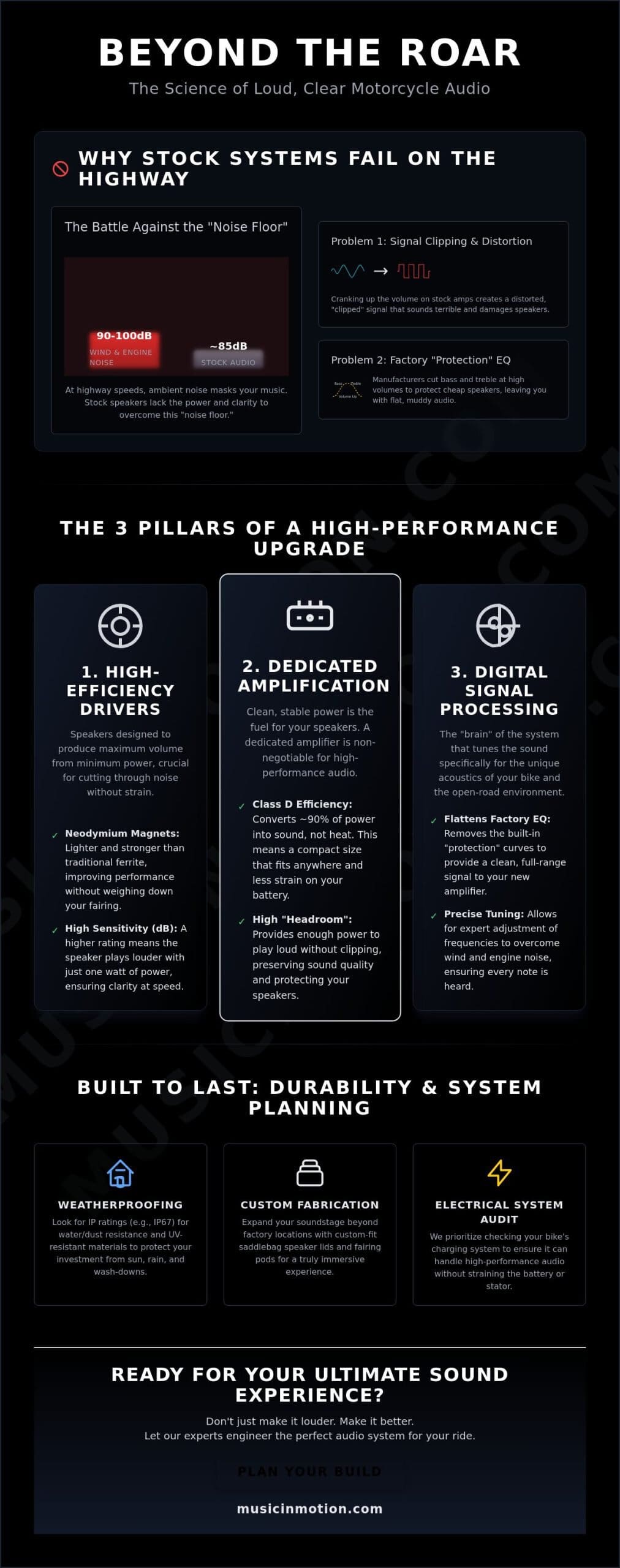
Stock systems fail because they aren’t built for the “noise floor” of the open road. This floor is the constant level of ambient sound created by your exhaust, tires, and the wind hitting your fairing. To hear your music, the audio must sit significantly above this floor. While a 50-watt system sounds plenty loud in the sealed cabin of a car, it’s virtually useless on a bike at 70 mph. The open-air environment allows sound energy to dissipate in every direction rather than reflecting back to your ears.
This environment directly impacts Loudspeaker acoustics and how we perceive different frequencies. High-frequency sounds have short wavelengths that are easily disrupted by wind shear. Low-frequency bass notes are often completely overwhelmed by the mechanical rumble of the engine. When you try to compensate by maxing out the volume on factory gear, you hit a “ceiling.” The low-voltage internal amplifiers in stock head units begin to clip the signal. This creates destructive distortion that sounds terrible and can physically melt your speaker’s voice coils.
Understanding the Noise Floor at Highway Speeds
As your speed increases, the decibel level of wind resistance rises exponentially. At highway speeds, the ambient noise can easily exceed 90 or 100 decibels. If your speakers can’t produce a clean 105 decibels or more, they’ll be “masked” by the environment. We find that riders usually lose the mid-bass and crisp highs first. This leaves only a tinny, distorted midrange that’s exhausting to listen to for more than a few minutes.
The Problem with Factory EQ Curves
Most modern bikes come with a pre-programmed “protection” curve. Manufacturers know their stock speakers are fragile, so they use the head unit to cut bass and treble as you turn up the volume. This keeps the cheap paper cones from popping, but it makes the music sound muddy and flat. If you simply swap in better speakers without addressing this signal, you’ll still have a compromised experience. We focus on flattening that factory signal first. This ensures your motorcycle audio upgrade for loud clear sound starts with a clean, full-range foundation before we ever add an amplifier.
The Three Pillars of a High-Performance Motorcycle Audio Upgrade
Achieving a motorcycle audio upgrade for loud clear sound isn’t about buying the most expensive box on the shelf. It’s about system architecture. We’ve seen why stock gear fails when the throttle opens; now we focus on the solution. A professional build relies on three critical pillars that must work in perfect harmony. If you miss one, the entire system suffers. We look at high-efficiency speakers, dedicated Class D amplification, and Digital Signal Processing (DSP) as the foundation for every project we undertake.
High-Efficiency Drivers and Neodymium Magnets
We use neodymium magnets because they offer incredible magnetic strength at a fraction of the weight of traditional ferrite magnets. This is vital for motorcycles where every ounce in the fairing matters. When selecting speakers, we prioritize “sensitivity” over peak wattage. Sensitivity, measured in decibels (dB), tells us how loud a speaker plays with a single watt of power. A pro-style high-output speaker with a high sensitivity rating will easily outperform a traditional coaxial speaker. It produces more volume with less strain on your equipment, ensuring your music stays crisp even as the wind picks up.
Amplification Designed for the Ride
Power is the fuel for your speakers, but motorcycles have limited space and electrical capacity. We utilize Class D amplifiers because they are incredibly efficient; they convert nearly 90% of their energy into sound rather than heat. This efficiency allows for a compact footprint that fits into tight fairing spaces or saddlebags without taxing your battery. These professional amps are built to handle the enclosed, high-vibration environment of a bike. They provide the “headroom” needed to play loud without the clipping or distortion that destroys cheaper components.
DSP: The Secret to Clarity at 70 MPH
The Digital Signal Processor is the brain of a modern motorcycle audio upgrade for loud clear sound. Most factory head units have “baked-in” EQ settings that make aftermarket speakers sound muddy or harsh. A DSP allows us to flatten that signal and start with a clean slate. We use it to set precise crossovers, correct frequency response, and even adjust time alignment so the sound from every speaker reaches your ears at the exact same moment. DSP is the tool that carves out space for music amidst wind noise. By fine-tuning the output to match your specific bike and riding style, we ensure the vocals stay front and center. We specialize in these custom motorcycle audio systems because we know that the right synergy between these three pillars is what makes the difference between a loud bike and a great-sounding one.
Weatherproofing and Durability: Protecting Your Audio Investment
You want the best sound, but you also want it to last. We’ve seen how physics challenges your volume; now we address how the environment challenges your hardware. A motorcycle audio upgrade for loud clear sound requires more than just power. It requires armor. We often see riders confused by marketing terms like “waterproof” or “marine grade.” Our team provides the clarity you need so your investment doesn’t fail after the first heavy wash or a sudden summer storm.
We use the official Ingress Protection (IP) rating system as our baseline for reliability. An IP65 rating is our minimum standard, as it ensures the device is dust-tight and protected against low-pressure water jets. For riders who live for long-distance touring, we recommend IP66 or IP67 components. An IP67 rating means the hardware can survive submersion in up to 1 meter of water for 30 minutes. While you aren’t riding a submarine, that level of sealing is vital when wind forces rain into your fairing at 70 mph.
Motorcycles face mechanical challenges that boats simply don’t. While marine gear handles salt and spray, it isn’t always designed for the high-frequency vibrations of a V-twin engine. We prioritize motorcycle-specific hardware with reinforced mounting points and UV-stable plastics. This prevents your speaker cones and fairing mounts from becoming brittle or cracking after a season of constant sun exposure. We focus on the finished result, ensuring your system is as durable as the bike it’s mounted on.
Material Science of High-End Moto Speakers
We choose carbon fiber or treated paper cones because they provide the rigidity needed for high output without absorbing moisture. These materials don’t warp or lose their shape when the humidity spikes. We pair these with Santoprene surrounds. This synthetic rubber doesn’t rot like traditional foam; it stays flexible through years of intense heat cycles. Our installers also take the extra step of sealing fairing gaps to create a protective barrier for your internal electronics.
Wiring and Connectivity for Harsh Environments
Corrosion is the silent killer of many custom projects. We only use Oxygen-Free Copper (OFC) wire because it resists the internal oxidation that eats away at standard copper alloys. Every connection we make is secured with heat-shrink connectors to lock out moisture and road salt. We wrap our wiring in tech-flex looming to prevent vibration from chafing the insulation against the frame. Whenever possible, we use plug-and-play harnesses. This avoids splicing into your factory loom, which protects your bike’s electrical integrity and makes future maintenance much simpler.
Custom Fabrication: When Off-the-Shelf Parts Aren’t Enough
Bolt-on kits are a great starting point, but they often restrict you to factory speaker sizes and locations. If you’re chasing a motorcycle audio upgrade for loud clear sound that truly stands out, custom fabrication is the path forward. Many bikes have fairings that only allow for small drivers. These simply can’t move enough air to provide impact at speed. We solve this by modifying the bike’s structure to house larger, more capable components. Air space dictates performance. Without a proper acoustic enclosure, the sound waves from the back of the cone cancel out the ones from the front. This results in weak, thin audio that disappears the moment you start the engine.
We engineer custom mounting rings and sealed chambers that optimize the air space for each specific driver. This attention to detail ensures that every watt of power translates into pure, undistorted music. We don’t just swap parts; we create an environment where high-end audio can actually thrive. By focusing on the physics of the enclosure, we deliver a finished result that maintains its clarity even when the volume is pushed to the limit.
Saddlebag Lid Conversions and Lower Fairing Pods
Adding rear-stage audio is one of the most effective ways to fill the soundstage. We specialize in saddlebag lid conversions that house high-output 6×9 drivers. This adds significant depth to your system without sacrificing all your valuable storage space. For those seeking even more punch, we install lower fairing pods. These locations sit closer to the rider and provide an excellent mounting point for mid-bass drivers that cut through road noise. Our background in custom car audio fabrication allows us to apply advanced enclosure theories to the unique challenges of a motorcycle frame.
The Craft of Custom Integration
We don’t believe a high-performance system should look like an afterthought. Our team uses CNC machining and 3D design to create perfectly fitted mounting rings. These parts look like they came from the factory. This precision allows us to fit larger magnets and deeper cones into tight spaces that would normally be off-limits. We take pride in merging sound and aesthetics by matching factory paint codes and textures. The result is a “factory-plus” finish that looks as good as it sounds. If you’re ready to push the boundaries of what your bike can do, let’s discuss a custom installation that fits your vision and your riding style.
Planning Your Build with Music In Motion: The Path to Audio Perfection
A successful motorcycle audio upgrade for loud clear sound doesn’t happen by accident. It starts with a conversation. We don’t just sell parts; we design experiences. Every rider has a different “noise floor” based on their helmet choice, exhaust setup, and typical cruising speed. We begin by matching your specific riding habits to the right combination of speakers and power. This initial consultation ensures we build a system that meets your expectations without over-engineering areas that don’t matter to you. We focus on the practical needs of the user to ensure the final result is both exciting and reliable.
Before we install a single wire, we perform a comprehensive electrical system audit. High-output amplifiers require a stable power source to function correctly. We test your stator’s output and your battery’s health to ensure your bike can handle the increased load. If your charging system is weak, even the best gear will sound distorted or, worse, leave you stranded on the side of the road. We prioritize the safety and functionality of your machine just as much as the quality of the audio. This grounded approach is why our customers trust us with their most complex custom projects.
Step-by-Step System Design
We help you identify the right path, whether that’s a “Stage 1” speaker swap or a “Stage 3” full custom build with saddlebag lids and DSP. We always prioritize the front stage first. This is where the most immediate impact happens for the rider. Understanding signal flow is vital for any project. Our guide on car audio upgrade for stock stereo covers foundational signal concepts that apply to motorcycles as well. We ensure your signal is clean before we ever try to make it loud.
The Tuning Difference
The installation is only half the battle. The tuning is what separates “good” from “legendary.” We use a Real-Time Analyzer (RTA) to map how sound interacts with your bike’s fairing and your specific seating position. We set precise crossovers to prevent speaker damage at high volumes, ensuring your equipment lasts for years of hard riding. Our process concludes with a final road test. We make sure the system performs at 70 mph, not just while sitting in our shop. This commitment to the finished result is a hallmark of our work.
Ready for a Sound Revolution?
We take pride in delivering a finished result that changes your daily life on the road. A professional installation isn’t just about the hardware; it’s about the peace of mind that comes with expert calibration and long-term support. Your bike is a major investment, and we treat it with the respect it deserves. We are a team of experts passionate about our craft, and we’re ready to enhance your ride. If you’re tired of music that fades into the wind, it’s time for a change. Schedule your motorcycle audio consultation with Music In Motion today and experience what high-fidelity sound feels like on the open road.
Transform Your Open-Road Experience
A motorcycle audio upgrade for loud clear sound is about engineering a system that works with your bike, not against it. We’ve covered how the synergy of high-efficiency drivers, Class D power, and DSP tuning overcomes the highway noise floor. By choosing hardware with proper IP ratings and investing in custom fabrication when needed, you protect your electronics while expanding your soundstage. We’ve been specialized in custom fabrication since 1994. Our team prioritizes a solution-oriented approach that delivers a finished result you can hear clearly at any speed.
We believe your bike should sound as good as it looks. Whether you’re interested in a simple fairing upgrade or a full custom build with saddlebag pods, we have the expertise to make it happen. Ready to leave the distortion behind? Upgrade Your Ride: Get a Custom Motorcycle Audio Quote. We look forward to helping you build the ultimate soundtrack for your next journey.
Frequently Asked Questions
Will a high-powered audio system drain my motorcycle battery?
A properly designed system won’t drain your battery while the engine is running. We use Class D amplifiers because they convert nearly 90% of their energy into sound rather than heat. This efficiency keeps the current draw low. Our team also checks your stator and battery health before any installation to ensure your bike’s charging system is up to the task.
Can I hear a motorcycle audio upgrade through a full-face helmet?
You absolutely can hear your music through a full-face helmet if the system is tuned correctly. A motorcycle audio upgrade for loud clear sound focuses on the mid-range and high-frequency bands that penetrate helmet foam. We use DSP to boost the specific frequencies that wind noise usually masks. This ensures your favorite tracks remain crisp even at 70 mph.
What is the best speaker size for a motorcycle fairing?
The 6.5-inch speaker is the ideal choice for most fairing applications. It provides enough cone surface area to produce punchy mid-bass without requiring massive custom modifications. Most 5.25-inch factory speakers lack the “throw” needed to overcome road noise. We often use custom adapter rings to fit these larger, more powerful drivers into stock locations for a factory-plus look.
Is it better to use 2-way or 3-way speakers on a bike?
We recommend high-quality 2-way speakers for almost every motorcycle project. 3-way speakers have too many small, delicate parts that can fail under heavy vibration. A 2-way design with a dedicated bridge-mounted tweeter is much more durable and efficient. This setup provides the clarity needed to cut through exhaust rumble while maintaining the structural integrity required for the road.
Will upgrading my motorcycle audio void the manufacturer warranty?
Upgrading your audio does not void your vehicle warranty. Under the Magnuson-Moss Warranty Act, a manufacturer must prove that an aftermarket part caused a specific failure to deny a claim. We utilize professional-grade, plug-and-play wiring harnesses. This approach prevents us from cutting your factory loom, which keeps your electrical system intact and your dealership service department happy.
How much power (wattage) do I actually need for highway cruising?
Real-world performance requires at least 75 to 100 watts RMS per channel. Don’t be fooled by “Peak” or “Max” power ratings on the box. Those numbers represent short bursts, not continuous play. For clear audio at highway speeds, you need steady, clean power that allows your speakers to play loudly without hitting the distortion ceiling or clipping the signal.
Do I need a new head unit to get better sound on my motorcycle?
You don’t need a new head unit to achieve professional results. We frequently integrate with factory radios by using a Digital Signal Processor (DSP) to “clean” the signal. This removes the factory’s protective EQ limiting and gives us a flat, full-range signal to amplify. It’s the best way to keep your handlebar controls and factory infotainment features while improving performance.
What is the difference between marine-grade and motorcycle speakers?
Motorcycle speakers are engineered for high-frequency vibration, while marine speakers focus primarily on salt and water. A motorcycle speaker must handle the intense mechanical rumble of a V-twin engine while remaining weather-resistant. We look for IP65 or IP67 ratings to ensure your gear survives rain and pressure washes without sacrificing the specialized tuning needed for an open-air environment.