That glowing red light on your amplifier isn’t a death sentence for your audio system. It’s actually a sophisticated guardian designed to save you from a costly hardware failure. We understand the total frustration of having your music cut out exactly when the bass should kick in. You’ve worked hard to customize your ride, so it’s natural to worry about blown speakers or a fried circuit board when things go silent. This guide will help you pinpoint why does my car amp keep going into protect mode so you can stop guessing and start listening again.
We’ve seen every electrical quirk imaginable since we started in 1994, and we’re ready to share that expertise with you. We’ll demystify confusing terms like clipping and impedance while walking you through a logical troubleshooting process. You’ll learn how to identify if the issue is a simple loose ground wire or a more complex thermal shutdown. By the end of this 2026 guide, you’ll know exactly how to restore your system’s reliability and when it’s best to seek out professional integration for a permanent fix. Let’s get your sound back on track with a setup that’s as reliable as it is powerful.
Key Takeaways
- Learn to interpret your amplifier’s indicator lights to distinguish between a minor wiring glitch and a critical thermal shutdown.
- Follow our step-by-step triage process to discover why does my car amp keep going into protect mode, helping you identify if the fix is a simple adjustment or requires expert care.
- We explain why standard vehicle alternators often struggle with high-output systems and how custom power upgrades can stabilize your audio performance.
- Discover how distorted signals and clipping create excessive heat; we share the tuning secrets that prevent hardware failure before it starts.
- Learn why professional system design focuses on headroom rather than just maximum output to ensure your music stays clear at any volume.
The Guardian Light: Understanding Amplifier Protect Mode
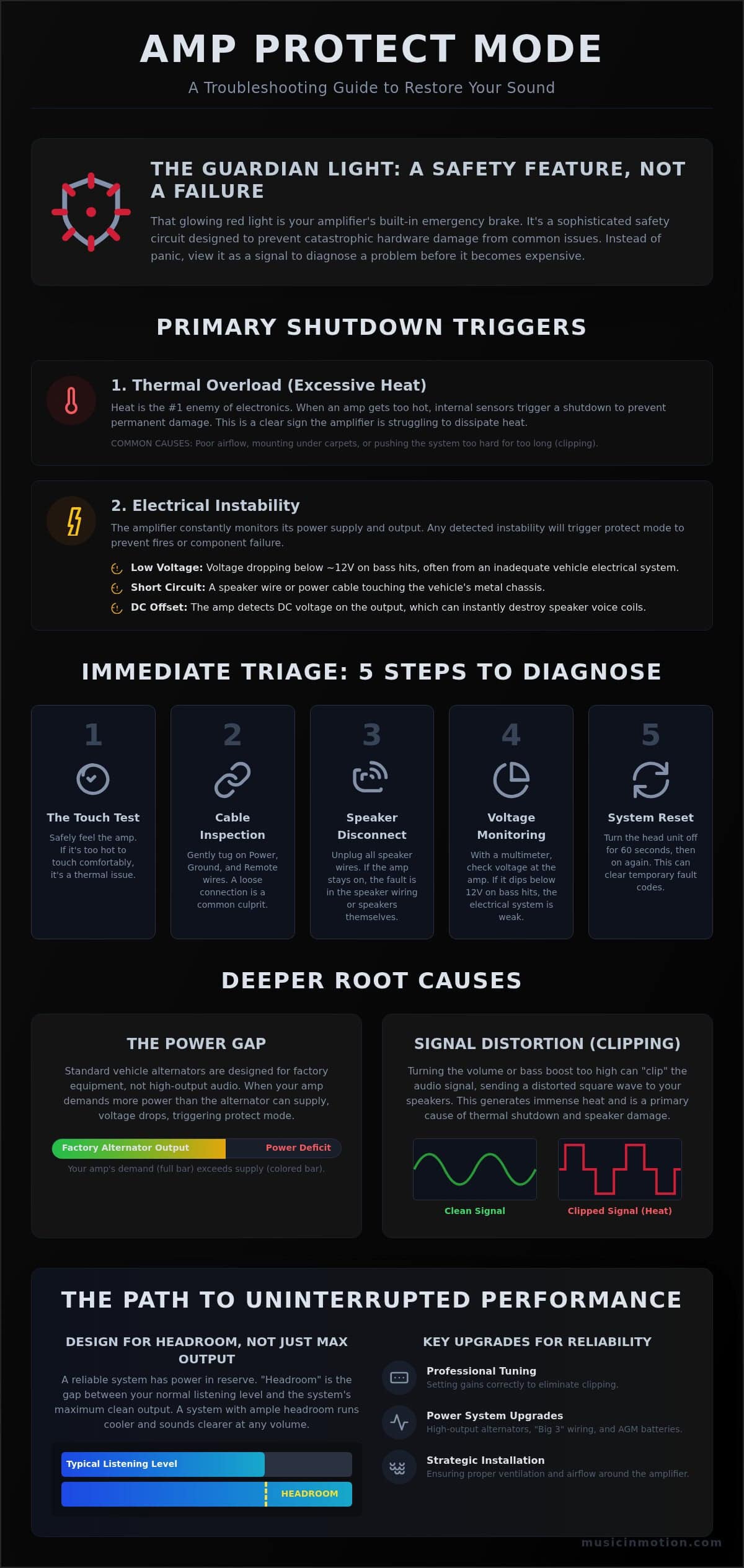
Think of protect mode as the emergency brake for your sound system. It isn’t a sign that your equipment has failed; rather, it’s a sophisticated safety circuit designed to prevent catastrophic hardware damage. We often see enthusiasts panic when they see that dreaded red light on the chassis. However, that light is actually a guardian. It’s your amplifier’s way of stepping in before a minor issue turns into a melted circuit board or a dead battery. Since we opened our doors in 1994, we’ve seen how these safety systems have evolved from simple fuses to high-speed digital monitors.
Modern amplifiers are far more sensitive than the analog units of the past. Today’s automotive electronic systems are tightly regulated and complex. High-performance amps now monitor every millisecond of power flow, looking for any sign of instability. If you’re wondering why does my car amp keep going into protect mode, it usually boils down to three main triggers: thermal overload, electrical instability, or internal component failure. Understanding these triggers is the first step toward a reliable, high-output listening experience that lasts for years.
Thermal Protection: When Heat Wins
Heat is the silent killer of mobile electronics. Every amplifier generates heat as it works, but excessive temperatures can lead to a state called thermal runaway. This is where the heat causes internal components to lose efficiency, generating even more heat until the hardware fails. To prevent this, the amplifiers we install utilize internal thermistors. These sensors measure the heat sink’s temperature and trigger a shutdown if it exceeds safe limits. A temporary shutdown might be frustrating during a long drive, but it’s much better than permanent heat damage that requires a full replacement of your gear.
Electrical Safeguards: Voltage and Impedance
Your amplifier is constantly checking the health of the power it receives and the load it’s driving. Electrical issues are the most frequent reason why does my car amp keep going into protect mode. If the voltage drops too low during a heavy bass hit, the amp shuts down to protect its internal power supply. This is a common symptom of a weak electrical foundation in the vehicle. Beyond voltage, the amp also guards against two other major electrical threats:
- Short Circuit Detection: A single stray wire strand touching the vehicle’s metal frame can create a short. The amp detects this path of least resistance immediately and cuts power to prevent a fire or circuit failure.
- DC Offset: Amps should only output Alternating Current (AC) to your speakers. If the internal circuitry detects Direct Current (DC), it enters protect mode. DC current can burn out a speaker voice coil in seconds; this safeguard is vital for protecting your speakers and custom subwoofer enclosures.
Immediate Triage: 5 Steps to Diagnose Your Amp Shutdown
When your music cuts out unexpectedly, a logical approach saves time and prevents you from replacing parts that aren’t actually broken. We recommend a “triage” method to separate simple parking lot fixes from deeper technical failures. Before you start unbolting your equipment, follow these five steps to narrow down why does my car amp keep going into protect mode.
- Step 1: The Touch Test. Safely feel the amplifier chassis. If it’s too hot to touch comfortably, the unit has likely entered thermal protection. This indicates a lack of airflow or a struggle to move heat away from internal components.
- Step 2: Cable Inspection. Tug gently on the power, ground, and remote turn-on wires. A connection that looks solid can still be loose enough to cause an intermittent arc, which triggers a safety shutdown.
- Step 3: The Speaker Swap. Disconnect all speaker and subwoofer wires from the amplifier terminals. If the amp stays on (green light) without the speakers connected, the problem is likely a short in your speaker wiring or a blown voice coil.
- Step 4: Voltage Monitoring. Use a multimeter at the amplifier’s power terminals while the music is playing. If the voltage drops below 12V during heavy bass hits, your electrical system can’t keep up with the demand.
- Step 5: Resetting the Circuit. Turn off the head unit, wait 60 seconds, and turn it back on. Some protection circuits require a full power cycle to clear the error code once the initial fault is gone.
Understanding the basics of how car amplifiers work can help you visualize these steps. If these quick checks don’t resolve the issue, it is time to look closer at the foundation of your installation.
The Ground Wire: The #1 Culprit
A loose ground is far more dangerous than no ground at all. When a ground connection is unstable, it creates high resistance and heat, which can eventually melt the wire insulation or damage the amplifier’s internal traces. This creates a bottleneck in your current return path, forcing the amp to work harder and eventually shut down. A star ground is the gold standard for noise-free audio because it connects all component grounds to a single point to eliminate potential loops. If you suspect your wiring is the issue, our team provides custom installations that prioritize electrical integrity from the start.
Fuse and Connection Integrity
Fuses can fail invisibly. While a blown fuse is obvious, an oxidized fuse holder or a loose tension spring can cause voltage drops that trigger protect mode without actually snapping the fuse element. We also frequently see issues with undersized power wire. If your wire is too thin for the current your amp demands, the voltage will sag, and the amp will shut down to protect itself. Finally, check your remote turn-on wire; if this signal is weak or erratic, the amplifier may flicker in and out of protect mode as it struggles to stay powered.
Deep Root Causes: Why Your Amp Fails When the Bass Hits
If your basic triage checks didn’t reveal a loose wire, we need to look at the physics of your system. Bass requires massive amounts of current. This is usually when the real answer to why does my car amp keep going into protect mode reveals itself. The relationship between your amplifier and your speakers is governed by electrical resistance. Any imbalance in this relationship leads to a shutdown to prevent the internal circuitry from melting under the pressure of high demand.
One factor many DIY enthusiasts overlook is the gain setting. We often see the gain knob treated like a volume control, but its actual job is to match the amplifier’s input sensitivity to the head unit’s output voltage. When the gain is cranked too high, the amplifier tries to produce more power than its internal components can safely handle. This results in clipping, where the smooth audio waves are chopped off into “square waves.” These distorted signals carry an immense amount of heat and are a primary reason why does my car amp keep going into protect mode during heavy tracks.
We also have to consider “box rise.” When your subwoofers move within a custom enclosure, the electrical resistance actually changes during playback. If your system is already wired right at the edge of the amplifier’s stability, these natural fluctuations in resistance can push the amp into a protection state. A system that works fine at low volumes might suddenly cut out during a deep bass drop because the enclosure and the woofer are interacting in a way that spikes the electrical demand.
Subwoofer Wiring and Ohms Law
The way you wire your subwoofers dictates the workload on your amplifier. Parallel wiring drops the total resistance, while series wiring increases it. If you wire a pair of dual voice coil subwoofers incorrectly, you might accidentally create a 0.5-ohm load. If your amplifier is only stable down to 1 ohm or 2 ohms, it will pull too much current and enter protect mode almost immediately. We also find that some budget-friendly subwoofers have inconsistent voice coil resistance, which creates an uneven load that modern, sensitive protection circuits won’t tolerate.
The Danger of Signal Clipping
A clipped signal is “dirty” power. It forces the amplifier to stay at its maximum rail voltage for longer periods than a clean signal would. This generates massive heat within the output transistors. While some people try to tune their systems by ear, this method is rarely accurate enough for high-performance builds. We use specialized tools like an oscilloscope to see the actual waveform and ensure the signal remains clean across the entire volume range. For more detail on this process, you can read our guide on Professional Car Audio Tuning: Dialing in Perfect Sound to see how we achieve maximum output without risking hardware failure.
The Power Gap: Why High-Performance Audio Demands Custom Fabrication
Modern vehicles are rolling computers. While a standard 2026 SUV might have an alternator rated between 150 and 220 amps, most of that power is already spoken for by safety sensors, large infotainment screens, and electric power steering. When you add a 1000W+ amplifier, you create a massive deficit. This “Power Gap” is a frequent reason why does my car amp keep going into protect mode. Your amp is trying to pull current that simply isn’t available, and it shuts down to prevent damaging its own internal power supply.
To solve this, we often recommend the “Big Three” upgrade. This involves replacing factory 8-gauge or 4-gauge wires with high-quality 0-gauge cabling in three critical areas: the alternator to the battery positive, the battery negative to the chassis, and the engine block to the chassis. Strengthening this foundation ensures that every bit of power your alternator produces actually reaches your audio system without resistance. In extreme cases, we move beyond the factory charging system entirely by installing high-output alternators that can provide 300 amps or more of dedicated current.
Bridging the Voltage Drop
Most high-end amplifiers are programmed to shut down the moment voltage dips below 11.5V. This is a safety measure to prevent the internal power supply from overheating while trying to compensate for the lack of juice. Standard cranking batteries are great for a quick burst to start the engine, but they aren’t designed for the constant, heavy draw of a high-performance system. We often integrate secondary deep-cycle power cells or dedicated battery banks, especially in complex marine or RV audio systems. These secondary cells act as a reservoir, keeping your voltage stable even when the bass hits hardest and preventing the dreaded red light.
Custom Fabrication for Cooling
If your electrical system is solid but the amp still shuts down after twenty minutes of play, the issue is likely thermal. Stealth installations look great, but hiding an amp under a seat or behind a panel without proper ventilation is a recipe for trouble. We use custom fabrication to build amp racks that feature active airflow management. By using “push-pull” fan configurations, we can move cool air across the heat sinks and exhaust the hot air out of the enclosure. This type of engineering is what separates a basic install from a professional integration.
Professional thermal management is essential for long-term reliability. You can explore our creative solutions for these challenges in our guide on Custom Car Audio Fabrication: The Art and Science of Superior Sound. If you are ready to bridge the power gap in your vehicle, we invite you to consult with us for custom high-output power solutions that keep the music playing without interruption.
Professional Solutions for Uninterrupted Performance
We believe a sound system should be a source of joy, not a constant troubleshooting project. While understanding why does my car amp keep going into protect mode is helpful for immediate fixes, preventing the issue requires a shift in how we design systems. We prioritize “headroom” over “max output.” This means choosing components that can handle your listening levels with ease, rather than pushing a smaller amp to its absolute breaking point. A professionally tuned 500W system almost always sounds better and lasts longer than a 1000W system struggling with a clipped signal. Our team focuses on the long-term health of your hardware, ensuring you never have to worry about that red light again.
Since 1994, we’ve evolved alongside the technology in your dashboard. We don’t just sell boxes; we deliver integrated solutions that respect the complex electrical architecture of your vehicle. Whether we are working on a daily driver or a high-end marine project, our goal is a finished result that prioritizes reliability. By matching the right power cables, enclosures, and amplifiers, we create a balanced ecosystem where every component has the breathing room it needs to perform at its peak.
Integrating with Modern Vehicle Tech
Today’s 2026 vehicles are equipped with sophisticated load-sensing head units and Active Noise Cancellation (ANC). These systems are designed to detect specific factory speaker loads. When you install an aftermarket amp without the right integration tools, the vehicle’s computer can get confused. This mismatch is a subtle but common reason why does my car amp keep going into protect mode. We use high-quality Digital Signal Processors (DSPs) to “handshake” with the factory system. Attempting to tap into modern data buses without these tools often leads to electrical “ghost” issues that can affect your entire vehicle’s stability.
The Value of Expert Calibration
Precision is our specialty. We use advanced diagnostic tools to find hidden shorts in custom speaker pods that a standard multimeter might miss. This level of detail is especially critical for marine audio systems and powersports builds. On the water or the trail, your gear faces extreme vibration and constant moisture. We ensure every connection is sealed and every component is secured to prevent the physical stresses that trigger protection circuits. Our approach ensures your investment delivers reliable performance in the harshest environments. Ready for a system that never quits? Consult with our experts today to build a setup that stays loud and clear.
Secure Your Sound: Beyond the Red Light
That glowing red light is a call to action for your vehicle’s electrical health. We’ve explored how proper grounding, impedance matching, and active thermal management prevent your equipment from shutting down when the bass hits hardest. Identifying why does my car amp keep going into protect mode is about more than just a quick fix; it’s about building a foundation that supports your passion for high-performance audio. Whether you’re cruising on land or navigating open water, your system deserves the stability that comes from expert custom fabrication and sophisticated tuning technology.
We’ve spent over 30 years perfecting mobile electronics since we opened in 1994. We use advanced diagnostics to ensure every install is reliable, powerful, and perfectly integrated into your vehicle’s data bus. If you’re tired of the silence and ready for a setup that stays loud, it’s time to Upgrade to a Professionally Integrated Sound System. Our team is here to help you move past the troubleshooting phase and into a superior listening experience. Let’s get your music back to the volume it deserves with a system that never quits.
Frequently Asked Questions
Can a blown speaker cause my amp to go into protect mode?
Yes, a blown speaker can trigger protect mode. If the voice coil is damaged, it can create an internal short or a drastic change in impedance. The amplifier detects this abnormal electrical load and shuts down to prevent its own internal circuits from frying. We recommend disconnecting the speakers one by one to see if the amp stays on, which confirms which specific driver is causing the fault.
How do I reset my car amplifier after it enters protect mode?
To reset your amplifier, turn off your vehicle and the head unit for at least sixty seconds. This allows the internal capacitors to discharge and the protection circuit to clear. If the fault that triggered the shutdown is gone, the amp should return to a normal green light state when you restart the system. Some modern digital amplifiers might require you to pull the main fuse for a few minutes to fully reset.
Is it safe to drive my car while the amp is in protect mode?
Yes, it is safe to drive your vehicle while the amplifier is in protect mode. The protection circuit is specifically designed to isolate the audio system from the rest of the vehicle’s electronics. While your music won’t play, the shutdown won’t affect your engine, lights, or safety systems. We suggest keeping the audio system turned off until you can address the root cause to prevent any potential damage to your battery.
Why does my amp only go into protect mode when I turn the volume up?
High volume demands more current from your electrical system and generates more internal heat. If you’re asking why does my car amp keep going into protect mode only when it’s loud, it’s usually due to voltage sag or thermal overload. The amp reaches its limit and shuts down to protect itself from the stress of the high-output demand. This often indicates you need better power wiring or more ventilation.
Will a bigger fuse stop my amp from going into protect mode?
No, installing a bigger fuse will not stop your amp from entering protect mode and can be extremely dangerous. Fuses are sized to protect your wiring from catching fire. If you use a fuse that’s too large, you risk melting your cables or causing an electrical fire before the fuse ever pops. You should always use the fuse rating recommended by the manufacturer in their official installation manual.
Can a bad ground wire cause my amp to overheat?
A bad ground wire is a frequent cause of overheating. High resistance at a loose or corroded ground point forces the amplifier to work much harder to pull current. This inefficiency creates excessive heat within the amplifier’s chassis, which eventually triggers a thermal protection shutdown. We always check ground points for bare metal contact because paint or rust can act as an insulator and cause these heat-related failures.
Do I need a second battery to prevent my amp from shutting down?
A second battery is often a great solution for high-wattage systems, but it’s not always the first step. You should first ensure your alternator and primary wiring are sufficient for the load. If your voltage still drops during heavy bass hits, a secondary battery or a high-output alternator can provide the necessary reservoir to prevent shutdowns. We can test your charging system to see which specific upgrade your vehicle needs.
How can I tell if my amplifier is actually ‘blown’ or just in protect mode?
You can distinguish between the two by checking the indicator lights and performing a simple reset. If the amp returns to a normal power light after a reset but has no sound, it might be blown. However, if you’re wondering why does my car amp keep going into protect mode repeatedly, the hardware is likely still functional but reacting to an external fault like a short or low voltage. A blown amp usually won’t turn on at all.