Great car audio isn’t built in the speaker pods; it’s built at the alternator and the ground points. We’ve all been there: you finally install that dream subwoofer, but the moment the bass hits, your headlights flicker like a strobe light and your amplifier cuts into protect mode. It’s frustrating to invest in high-end gear only to have your vehicle’s factory wiring hold you back. If you’re serious about sound, upgrading car electrical system for audio is the only way to move from a flickering mess to a rock-solid performance.
We understand the hesitation. You want the power, but you don’t want to risk a DIY electrical fire or fry your car’s sensitive ADAS sensors. Our 2026 guide shows you how to provide the raw current your system demands while keeping your modern electronics perfectly safe. We’ll walk you through the “Big Three” basics, the shift toward lithium batteries, and how the latest Right-to-Modify legislation affects your custom build. You’ll learn how to achieve consistent voltage and crystal-clear clarity without compromising your vehicle’s integrity. It’s about building a professional-grade foundation that lets your music truly breathe.
Key Takeaways
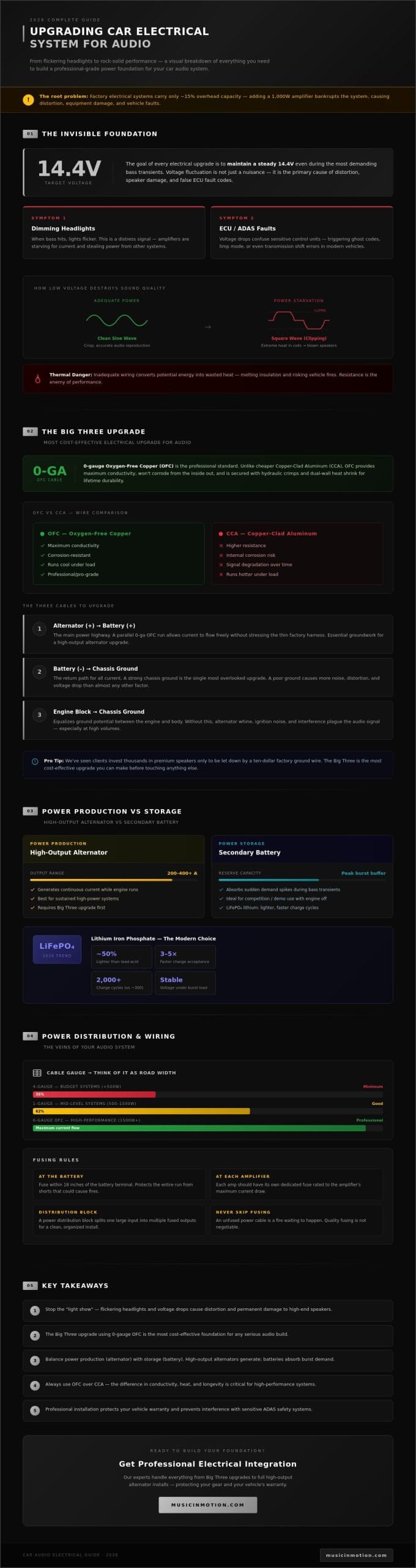
- Stop the “light show” by understanding how voltage drops cause distortion and permanent damage to your high-end speakers.
- Master the “Big Three” basics to maximize current flow using 0-gauge Oxygen-Free Copper for a rock-solid electrical foundation.
- Learn why upgrading car electrical system for audio requires a balance between high-output alternators for power production and batteries for storage.
- Differentiate between OFC and CCA wiring to prevent signal degradation and ensure your power infrastructure runs cool and efficiently.
- Secure your investment with professional installation techniques that protect your vehicle’s warranty and sensitive safety sensors.
The Invisible Foundation: Why Your Audio System is Only as Good as Your Electrical Supply
Think of your car’s electrical system as the lungs of your music. If the lungs can’t pull in enough air, the voice can’t scream. Most factory systems are built to handle the radio, some seat heaters, and the headlights. They usually offer a slim 15% overhead in current capacity. When you add a 1,000-watt amplifier, you aren’t just using that overhead; you’re bankrupting the system. This is why upgrading car electrical system for audio isn’t just an option for high-end builds; it’s a requirement for reliability.
The most common symptom we see is the “dimming headlight” dance. When the bass hits, the lights fade. This isn’t just a visual quirk. It’s a distress signal. Your amplifiers are starving for current. Even worse, modern vehicles rely on sensitive Electronic Control Units (ECUs). Sudden voltage drops can confuse these computers, leading to ghost codes or even triggering limp mode in advanced driver-assistance systems. We’ve seen cases where a struggling alternator caused transmission shift errors because the sensors weren’t receiving stable power.
This need for mechanical and electrical reliability is universal; in the nautical world, Compass Marine provides essential engine servicing and repairs to ensure that marine systems remain dependable even in the most demanding conditions.
Our goal when upgrading car electrical system for audio is simple: maintain a steady 14.4V. We want that needle to stay pinned even during the most demanding bass transients. This stability ensures your gear performs exactly how the engineers intended. It protects your equipment and keeps your vehicle’s factory electronics running without interference.
Understanding Voltage Drop and Its Impact on Sound
Low voltage is the primary cause of amplifier “clipping.” When an amp can’t get the current it needs, it “chops off” the top and bottom of the audio waveform. This creates a square wave that generates massive amounts of heat in your speaker coils. It turns a crisp, punchy kick drum into a muddy, distorted mess. Proper power delivery ensures your subwoofers move with precision and authority rather than struggling to keep up with the signal. Power starvation doesn’t just sound bad; it’s the fastest way to blow a brand-new set of speakers.
The Thermal Challenge: How Heat Kills Electronics
Resistance is the enemy of performance. Inadequate factory wiring acts like a bottleneck, turning potential energy into wasted heat. This heat doesn’t just lower efficiency; it can melt insulation and lead to catastrophic vehicle fires. We prioritize high-quality fusing and the correct cable gauge to keep resistance at a minimum. As the car audio system has evolved, the need for larger, high-strand-count power runs has become a safety requirement. Using thicker ground and power cables is like opening up a freeway, allowing current to flow freely without the friction that causes dangerous temperatures.
The Big Three Upgrade: Maximizing Your Vehicle’s Current Capacity
We often see clients invest thousands in premium speakers only to be let down by a ten-dollar factory ground wire. The Big Three upgrade is the most cost-effective solution for anyone upgrading car electrical system for audio. It involves reinforcing the three primary cables that manage your vehicle’s charging and grounding. For a professional result, we always use 0-gauge Oxygen-Free Copper (OFC). Unlike cheaper copper-clad aluminum alternatives, OFC provides maximum conductivity and won’t corrode from the inside out. We use hydraulic crimps and dual-wall heat shrink to ensure these connections last the life of the vehicle.
Factory wiring is designed for efficiency and cost, not for the massive swings in current that high-performance amplifiers demand. By adding these heavy-duty cables, you reduce the electrical resistance that causes heat and voltage drops. It’s the most reliable way to ensure your gear gets every watt it needs to perform. If you want a system that hits hard every time, our experts at Music In Motion can help you build this essential power foundation.
Step 1: Alternator Positive to Battery Positive
This cable is the main highway for your power. We add a parallel run from the alternator’s positive post to the battery’s positive terminal. This allows current to flow more easily without stressing the thin factory harness. If you eventually decide to install a high output alternator, this infrastructure is already prepared for the increased load. We always include an inline fuse on this run. It’s a critical safety step that protects your vehicle from shorts and potential fires.
Step 2: Engine Block to Chassis Ground
Every circuit needs a return path. Since your alternator is bolted to the engine block, that block must be securely grounded to the vehicle’s chassis to complete the loop. We identify solid, unpainted metal points to ensure the lowest possible resistance. A strong engine ground does more than just help your bass. It improves overall sensor accuracy and provides a more stable path for your ignition system. It’s a win for both your music and your engine’s performance.
Step 3: Battery Negative to Chassis Ground
This is often the weakest link in modern vehicle manufacturing. Manufacturers frequently use thin “pigtail” wires that struggle once you add an aftermarket amplifier. We supplement this connection with 0-gauge OFC, bolted directly to the frame. We scrape away factory paint to reach bare metal and apply conductive grease. This prevents future corrosion and ensures zero resistance, which is a vital part of upgrading car electrical system for audio properly. Proper grounding is the difference between a system that sounds thin and one that provides deep, authoritative punch.
Choosing Between High-Output Alternators and Secondary Batteries
One of the most frequent questions we hear involves the choice between adding a second battery or swapping the alternator. To make the right decision, you have to understand one fundamental rule: alternators produce power while batteries only store it. If your charging system can’t keep up with the total amperage your amplifiers demand, your batteries will eventually drain regardless of their size. A battery is a storage tank, but the alternator is the well that keeps it full. When upgrading car electrical system for audio, we always look at the source of the power first.
We often see people try to use large capacitors as a quick fix for dimming lights. In reality, a capacitor is a small storage device that can only provide power for a fraction of a second. It acts more like a band-aid than a solution. While The Big Three Upgrade provides the necessary plumbing to move current, you still need a pump that can keep up with the volume. For systems exceeding 1,000 watts RMS, you’ll likely need to move beyond factory equipment to maintain performance.
When to Invest in a High-Output Alternator
If your total system draw exceeds your factory alternator’s rated output, an upgrade is mandatory. Most modern vehicles use alternators rated between 100 and 150 amps. However, much of that is already reserved for the vehicle’s computers, lights, and climate control. We look for high-output units that provide strong “idle output.” You need power while sitting at a red light, not just when you’re cruising on the highway. For unique vehicle builds where a direct bolt-on isn’t available, professional car audio fabrication is often necessary to create secure, vibration-resistant mounting brackets. We’ve seen 300-amp to 370-amp units become the standard for serious enthusiasts in 2026.
The Role of Secondary Battery Banks
Secondary batteries are excellent for “key-off” listening at shows or for handling extreme peak demands that even a high-output alternator can’t satisfy instantly. In 2026, the choice usually comes down to AGM (Absorbent Glass Mat) or Lithium (LiFePO4). AGM batteries are a reliable, cost-effective choice for systems under 3,000 watts. If you’re pushing further, Lithium offers a longer lifespan and faster discharge rates. It’s critical that you don’t mix chemistries; connecting a standard lead-acid battery to a lithium bank can cause charging imbalances and safety risks. We always recommend using a high-quality battery isolator. This ensures your audio gear won’t accidentally drain your starting battery, leaving you stranded after a long listening session. It’s a vital part of a safe strategy for upgrading car electrical system for audio.
Power Distribution and Wiring: The Veins of Your Audio System
If the alternator is the heart of your setup, the wiring is the vascular system. We see many enthusiasts focus on the “Big Three” but then use cheap, restrictive wiring to reach their amplifiers. When upgrading car electrical system for audio, the material of your wire is just as important as the thickness. We exclusively recommend Oxygen-Free Copper (OFC). While Copper-Clad Aluminum (CCA) is cheaper, it has higher resistance and is prone to oxidation. Over time, CCA can literally turn to powder inside its jacket, leading to a massive drop in performance or a total system failure. OFC ensures that every amp of current reaches your gear without being lost to heat along the way.
High-strand OFC isn’t just about better conductivity; it’s about the flexibility required for a professional install. Vehicles are full of tight corners and sharp bends. Multi-strand wire allows for easier routing without kinking or breaking the internal conductors. This is especially relevant for a car audio upgrade for stock stereo. Even if you’re keeping the factory head unit, adding a modern DSP and multi-channel amplifier significantly increases the current demand on your vehicle. Using distribution blocks allows us to run one large 0-gauge power wire from the battery and safely split it into smaller 4-gauge runs for individual components while maintaining a clean, organized look.
Fusing and Circuit Protection Standards
Safety is our non-negotiable priority. We follow the “18-inch rule,” which means the main system fuse must be placed within 18 inches of the battery terminal. This protects the entire length of the cable from a potential short circuit. It’s a common mistake to match the fuse to the amplifier’s rating; you must actually match the fuse to the cable’s current-carrying capacity. For high-power systems, we prefer ANL fuses for their high surface area and secure bolting. For smaller, space-constrained builds, MANL (Mini-ANL) fuses provide the same reliability in a more compact footprint.
Grounding Strategies for Noise-Free Audio
A poor ground is the most frequent cause of “alternator whine,” that annoying high-pitched whistle that follows your engine RPMs. We utilize a “star ground” strategy whenever possible, bringing all audio components to a single, high-quality ground point. This eliminates ground loops and ensures a silent noise floor. We don’t guess when it comes to connections. Our team uses a digital multimeter to test for resistance between the ground point and the battery negative to ensure a perfect circuit. If you’re ready to experience a system with zero noise and maximum punch, contact our expert installation team to schedule your power infrastructure overhaul.
Professional Electrical Integration with Music In Motion
Electrical work is the most high-stakes phase of any custom build. While swapping speakers is relatively straightforward, upgrading car electrical system for audio involves tapping into the primary power source of your vehicle. A single loose connection or an improperly sized fuse doesn’t just cause poor sound; it can lead to catastrophic equipment failure or even a vehicle fire. We believe that your safety and the integrity of your car’s electronics are paramount. Our team approaches every power project with a focus on absolute reliability and technical precision.
This commitment to safety and precision is mirrored in other high-stakes automotive fields; for example, the complex 4×4 conversions and electrical upgrades performed by Auto Industries Factory LLC demonstrate how vital professional fabrication is for maintaining vehicle integrity under heavy loads.
Modern vehicles are essentially rolling computers. They’re packed with Advanced Driver-Assistance Systems (ADAS) and sensitive sensors that don’t tolerate voltage spikes or messy wiring. We use non-invasive integration techniques that ensure your high-performance audio doesn’t interfere with factory safety features. This professional approach provides the peace of mind that comes with knowing your modifications won’t void your factory warranty or compromise your car’s reliability. We treat your vehicle with the same respect we’d show our own, ensuring every circuit is protected and every wire is secured.
Custom Fabrication for Power Components
We don’t settle for zip-ties and loose wires. Our custom fabrication team builds dedicated battery racks and alternator mounts that look like they came from the factory. We ensure your high-output upgrades are mounted with vibration-resistant hardware that can handle the rigors of daily driving. Our integration process includes several professional standards:
- Professional Looming: We use tech-flex and heat-resistant looming to protect wiring from the elements and engine heat.
- Stealth Integration: We can hide secondary battery banks and distribution blocks in custom-built enclosures that preserve your trunk space.
- Real-Time Monitoring: We integrate sleek power management displays into the vehicle’s interior so you can monitor your voltage stability at a glance.
Why Experience Matters in Electrical Design
Our team prioritizes the delivery of a finished, reliable result over the mere transaction of goods. We’ve spent decades mastering high-draw environments in both land and marine applications. We know how to balance raw power with sophisticated protection. Every system we install is meticulously tuned and fused to handle the specific demands of your music and your vehicle. You aren’t just buying hardware; you’re investing in an infrastructure designed by specialists who are passionate about the craft. We take pride in solving the complex electrical puzzles that 2026 vehicles present. Ready to power your dream build? Contact the experts at Music In Motion.
Powering Your Sound into the Future
Your dream audio system deserves more than a struggling factory battery and thin wiring. We’ve shown that a rock-solid electrical foundation prevents distortion, protects your vehicle’s sensitive computers, and lets your amplifiers reach their absolute full potential. From the essential Big Three upgrade to the precision of high-output alternators and lithium storage, every detail in the power chain matters for long-term performance. A system is only as strong as its weakest link, and we’re here to ensure your power delivery is never the bottleneck.
At Music In Motion, we’ve been your trusted local experts since 1994. We specialize in custom fabrication and high-output systems, ensuring every connection meets national-standard installation practices for total reliability. Upgrading car electrical system for audio is a complex task that requires technical precision and a safety-first mindset. We take immense pride in delivering finished results that elevate your daily drive while keeping your vehicle’s warranty and safety sensors fully intact. Our goal is to provide the raw current you need without sacrificing the functionality of your modern vehicle.
Don’t let power starvation hold back your music or risk your vehicle’s health with insufficient power. Schedule your professional electrical consultation at Music In Motion today. We’re ready to build the powerful, reliable infrastructure your high-performance system demands. Let’s make every bass hit feel as solid as it sounds.
Frequently Asked Questions
Will upgrading my electrical system void my car’s warranty?
No, upgrading your electrical system shouldn’t void your factory warranty. Under the Magnuson-Moss Warranty Act, a dealer must prove that an aftermarket modification specifically caused a failure to deny a claim. We use non-invasive techniques to ensure your vehicle’s safety systems remain untouched. Professional installation provides a layer of protection that DIY work can’t match. We prioritize clean, reliable integration that keeps your vehicle’s electronic integrity intact.
What is the Big 3 upgrade and do I really need it?
The Big 3 upgrade is the process of reinforcing your vehicle’s primary charging and grounding cables. It’s essential if you’re installing a system that exceeds 1,000 watts RMS. By adding 0-gauge OFC cables in parallel with factory wiring, you reduce resistance and allow current to flow more freely. This simple step is often the most effective way to start upgrading car electrical system for audio before moving to more expensive components.
Can I just add a second battery to stop my lights from dimming?
Adding a second battery is rarely a permanent fix for dimming headlights. Batteries store energy; they don’t produce it. If your alternator is already struggling to keep up with your amplifiers, adding another battery just creates more load for the alternator to charge. You might see a temporary improvement, but the root cause is a lack of current production. A high-output alternator is usually the correct solution for consistent voltage.
How do I know if my alternator is powerful enough for my new amp?
You can determine your needs by calculating the total amperage draw of your audio gear. Use the formula: Amperage = Watts / Voltage. For a 1,000-watt system at 14.4V, you’re pulling roughly 70 amps at peak. Compare this to your factory alternator’s rating, keeping in mind that your car already needs 40 to 60 amps just to run the lights and computers. If the math doesn’t add up, it’s time for an upgrade.
Is a capacitor a good alternative to a high-output alternator?
A capacitor is not a substitute for a high-output alternator. Think of a capacitor as a small reservoir that can dump power quickly for a single bass hit. It cannot sustain that power over a long song or a high-volume listening session. While they can help with very minor voltage dips, they often place an additional strain on an already overworked charging system. We recommend focusing on the source of the power first.
What is the difference between OFC and CCA power wire?
OFC wire is made of 100% pure copper, while CCA is aluminum coated in a thin copper layer. OFC is significantly more conductive and can carry more current than the same size CCA wire. Aluminum also corrodes faster and is more brittle, which can lead to broken connections in a high-vibration automotive environment. We exclusively use OFC to ensure your system remains efficient and safe for years to come.
How much does a professional electrical upgrade typically cost?
The cost of an electrical upgrade depends on the complexity of your vehicle and the power requirements of your gear. Factors like the price of high-output alternators, the length of 0-gauge OFC wiring needed, and the labor for custom mounting brackets all play a role. While we can’t provide a flat rate without seeing your vehicle, we focus on providing a finished result that offers the best value for your specific customization goals.
Can a high-performance audio system drain my battery while driving?
Yes, a high-performance system can drain your battery while the engine is running if your alternator cannot keep up. This happens when the current draw from your amplifiers exceeds the alternator’s total output. In this scenario, the system starts pulling “reserve” power from the battery. If you’re upgrading car electrical system for audio, ensuring your alternator produces more than your total vehicle and audio load combined is the only way to prevent a dead battery.