What if the “digital” sound you’ve been warned about is actually a myth from a decade ago? For years, the choice between a class D vs class AB amplifier for sound quality seemed simple: you chose efficiency or you chose fidelity. We know that many enthusiasts still worry that switching to a compact, modern amp means losing that smooth, musical warmth they love. It’s a valid concern, especially when you’re building a high-end system in a confined space like a car cabin or a center console.
We’re here to show you that the audio landscape has changed. In this 2026 guide, you’ll discover how technologies like Gallium Nitride transistors have bridged the gap, allowing Class D units to rival the traditional sound of Class AB while staying cool and efficient. We will compare real-world performance, heat management, and power draw to help you decide which path leads to the best result for your vehicle. By the end, you’ll have the clarity needed to ensure your next investment delivers the audiophile-grade experience you deserve.
Key Takeaways
- Compare the traditional linear warmth of Class AB against the high-speed switching efficiency that defines modern Class D technology.
- Determine if the gap in class D vs class AB amplifier for sound quality has finally closed, and if modern “digital” audio can truly satisfy audiophile ears.
- See how superior efficiency reduces battery strain and heat, protecting your equipment during long days on the road or the water.
- Find out why smaller form factors are revolutionizing custom installations by allowing for powerful sound in hidden or tight locations.
- Get a clear recommendation on which amplifier class best aligns with your specific vehicle goals and listening preferences.
Understanding Class D and Class AB: The Core Differences in 2026
Choosing the right power source for your speakers is the foundation of any great audio build. Whether we are working on a custom car audio setup or a high-performance marine system, the debate over class D vs class AB amplifier for sound quality often comes down to how the hardware handles electricity. At its simplest, an amplifier takes a small signal and makes it large enough to move your speakers. The difference lies in the specific method used to achieve that gain.
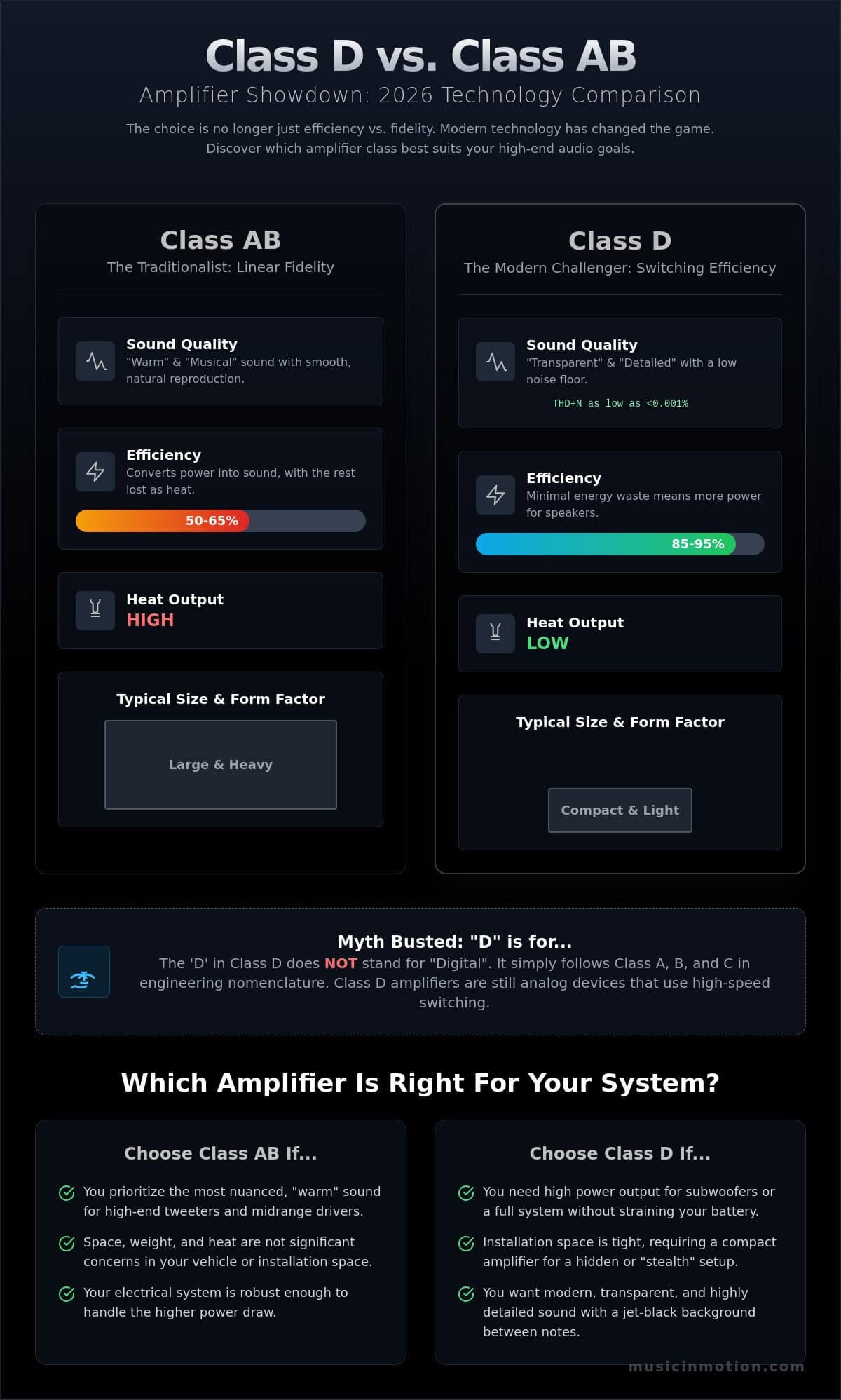
We often hear the myth that the “D” in Class D stands for “digital.” This is technically incorrect. While these amplifiers use a high-speed switching process, they remain analog in nature. The “D” was simply the next letter in the sequence of amplifier classes recognized by engineers. In 2026, however, the distinction is more about performance than labels. Modern MOSFETs and Gallium Nitride (GaN) transistors have pushed these units far beyond the limitations of the past, making the choice more exciting than ever for our clients.
The Traditional Linearity of Class AB
Class AB has long been the gold standard for pure, uncolored sound. It works by keeping a constant flow of current through the output transistors, which effectively eliminates the crossover distortion found in older designs. This linear approach results in a smooth, natural reproduction that many describe as “warm” or “musical.” It’s a fantastic choice for powering high-end tweeters and midrange drivers where every nuance matters to the listener.
There is a practical trade-off to this fidelity. Class AB amplifiers are notoriously inefficient compared to modern alternatives. They typically convert only 50% to 65% of their energy into sound; the rest is lost as pure heat. This requires large, heavy heat sinks to keep the internal components from failing. If you have plenty of space and a robust electrical system, the results are stunning. If your space is limited, the heat can become a real enemy to your equipment’s long-term reliability.
The High-Speed Evolution of Class D
Class D amplifiers operate like a high-speed light switch. They use Pulse Width Modulation (PWM) to turn the output transistors fully on or fully off thousands of times per second. Because the transistors aren’t “halfway” on, they don’t waste energy. This allows for incredible efficiency, often reaching 85% to 95%. This means more power goes to your speakers and less heat stays trapped in your vehicle or boat.
In the early 2000s, this switching could sometimes cause a grainy or harsh sound. Those days are gone. Modern output filters and faster switching frequencies have smoothed out the signal. By 2026, high-quality Class D units can achieve total harmonic distortion figures below 0.001%. They deliver punchy, clear, and reliable audio in a fraction of the size of a traditional amp. We find them perfect for subwoofers and stealthy under-seat installs where every inch of space counts.
Comparing Sound Quality: Does Class AB Still Have the “Musical” Edge?
We often find that the most heated discussions in our shop center on the perceived “musicality” of different systems. When analyzing class D vs class AB amplifier for sound quality, many purists still point to Class AB as the undisputed king of warmth. This warmth is often a subtle, pleasing coloration of the sound caused by even-order harmonics. It creates a smooth listening experience that feels natural to the human ear. However, the 2026 reality is that technical transparency has reached a point where these subjective differences are nearly impossible to detect in a moving vehicle.
Signal purity is no longer a compromise for efficient designs. Leading Class D amplifiers now achieve Total Harmonic Distortion (THD+N) figures below 0.001%, which is well below the threshold of human hearing. By utilizing modern Class D sound quality innovations, these units maintain a noise floor that is actually lower than many traditional designs. This results in a “blacker” background between notes. It allows the fine details of your favorite tracks to shine through without the hiss often associated with older mobile electronics.
Transparency and Detail in High Frequencies
Class AB maintains absolute linearity at the very top of the frequency spectrum. This is why we still recommend them for some high-end tweeter applications in quiet, controlled environments. But for most mobile and marine systems, high-speed clocking in modern Class D units has eliminated the digital grain of the past. If you are planning Car Audio Upgrades for a daily driver, the clarity provided by a high-quality Class D amp will likely exceed the resolution of your source material anyway.
Damping Factor and Speaker Control
One area where Class D often takes the lead is the damping factor. This is an amplifier’s ability to control the movement of the speaker cone. A high damping factor means the amp can stop the cone from ringing after a beat, resulting in tighter sound. Because Class D units typically have very low output impedance, they excel at controlling heavy subwoofers and mid-bass drivers. This translates to an accurate, punchy bass response that you can feel in your chest. It turns a muddy kick drum into a sharp, defined impact.
We believe that the best sound comes from matching the right technology to your specific goals. While the soul of music is subjective, the precision of modern engineering is undeniable. Whether you want the clinical accuracy of a switching amp or the classic character of a linear one, the results should always move you.
The Efficiency Factor: Why Power Management Matters in Your Vehicle
Many audio enthusiasts focus solely on the specs listed on the box. However, the physical environment of your car or boat changes the equation entirely. When comparing class D vs class AB amplifier for sound quality, efficiency is actually a critical performance metric. If an amplifier cannot manage heat, its internal components will drift. This causes distortion or triggers the “thermal protection” mode that cuts your music off entirely. This is where Class AB often struggles. Because it’s only about 50% to 65% efficient, it generates a massive amount of waste energy. In real-world testing, a Class AB unit can reach 140°F after just 30 minutes of play. In contrast, a modern Class D unit often stays around 102°F under the same conditions.
This temperature gap is a silent killer of audio fidelity. Excessive heat increases the electrical resistance within the internal circuitry. This can lead to a compressed, dull sound as the amplifier struggles to maintain its output. Class D amplifiers avoid this trap by converting nearly 90% of their power into actual sound. This allows them to maintain a consistent, high-fidelity signal even during long road trips or hot summer days on the lake. We’ve seen many custom builds where a Class AB amp sounded great for ten minutes but lost its “sparkle” once the heat sink became too hot to touch.
Heat Management in Custom Installations
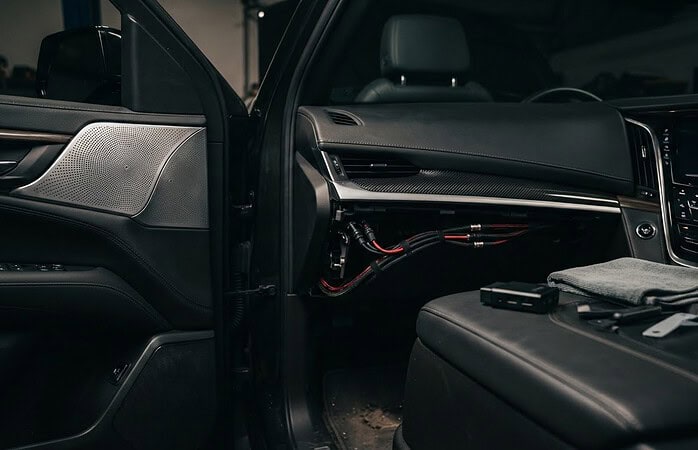
We often work with tight spaces under seats, behind panels, or inside dashboards. These areas have almost zero airflow. This makes custom car audio fabrication a delicate balancing act of power and cooling. Class D amplifiers are the clear winner for stealth builds. Their compact footprint means we can hide them away without fearing a fire hazard or a sudden shut-down. They run remarkably cool. This reliability ensures that your investment continues to sound as good as the day we finished the install.
Impact on Vehicle Electrical Systems
Your vehicle’s alternator has a finite capacity. A 1000-watt Class AB system draws significantly more current than a Class D equivalent. This extra load can cause voltage drops that dim your headlights and starve your audio system of the juice it needs for deep bass hits. This is especially critical for premium marine audio systems where you might be listening with the engine off. By choosing Class D, you reduce the strain on your battery and the need for expensive high-output alternators. It’s a smarter, more reliable way to power your passion without compromising your vehicle’s health.
Form Factor and Integration: Finding Space in Modern Interiors
We’ve seen a massive shift in how people want their systems to look. Gone are the days when a massive, glowing amplifier rack in the trunk was the primary goal for every enthusiast. Modern vehicle interiors are packed with technology, leaving very little room for traditional, bulky gear. When we weigh the choice of class D vs class AB amplifier for sound quality, we also have to weigh the physical footprint. A Class AB amplifier requires significant surface area for its heat sinks to breathe. If you hide it in a small cavity, it will overheat. Class D has changed the game by offering high output in a chassis that is often 60% to 70% smaller than its linear counterparts.
This size reduction isn’t just about saving space; it’s about versatility. We can now provide eight or more channels of power from a single, compact box. This allows us to power a complex, active front stage and a subwoofer without needing a wall of equipment. It simplifies the wiring and reduces the number of potential failure points in your system. Whether you are driving a compact sedan or a luxury SUV, we can find a spot for these units that won’t interfere with your daily life.
Stealth and Hidden Installations
Integrating high-power systems without sacrificing trunk or storage space is now the standard. We often mount these amplifiers under seats or behind factory panels where mounting depth is extremely limited. This compact placement also enables shorter cable runs. Shorter cables mean less resistance and a lower chance of picking up electrical noise from the vehicle’s computer systems. If you want a world-class listening experience that stays completely out of sight, our team specializes in Custom Installations that preserve your factory look.
Reliability in Harsh Environments
The physical design of modern Class D amps also makes them more durable. In vibration-heavy environments like motorcycles or powersports vehicles, the smaller internal components of a Class D circuit are often more resilient. Many of these units feature sealed designs that offer better protection against the dust and moisture found in marine applications. We prioritize these rugged designs because they handle the bumps and sprays of the real world without skipping a beat. Heat-related failures are far less common because the unit isn’t constantly fighting its own internal temperature.
Making the Choice: Which Amplifier Class Wins for Your System?
The debate over class D vs class AB amplifier for sound quality has reached a fascinating conclusion in 2026. For the vast majority of listeners, the technical gap between these two technologies has effectively vanished. While we still appreciate the engineering behind a massive linear heat sink, the reality is that modern Class D units provide a level of performance that was once impossible. The choice no longer hinges on whether one is “better” than the other. Instead, it depends on your specific vehicle, your listening habits, and your available space.
One factor that often gets overlooked is the role of Digital Signal Processing (DSP). In a modern high-performance build, we use DSP to neutralize any minor “color” an amplifier might add to the signal. This allows us to shape the frequency response and timing with surgical precision. When a system is tuned correctly, even a seasoned audiophile would struggle to identify the amplifier class in a blind test. The processor ensures the speakers receive exactly what they need, regardless of how the power was generated. This makes the hardware choice a matter of practical logic rather than purely subjective “soul.”
When to Stick with Class AB
We still recommend Class AB for specific, high-resolution critical listening systems. If you have an unlimited budget, a massive SUV with plenty of mounting space, and you are using high-resolution source material, the traditional linear design offers peace of mind. It is also a great choice for matching with “vintage-voiced” speakers that benefit from the subtle harmonic richness these amps provide. If your goal is to capture the last 1% of audiophile warmth and you aren’t worried about battery drain, Class AB remains a beautiful, time-tested option.
The Case for Modern Class D
For 95% of the high-performance builds we design, Class D is the superior choice. This is especially true for systems requiring 500W or more of total power. The efficiency keeps your lights from dimming and your equipment from overheating in tight spots. It is the mandatory standard for marine and motorcycle applications where every amp of current is precious. Most importantly, Class D is the ideal partner for systems where professional car audio tuning will be used. We can hide the hardware, maximize the power, and use the processor to deliver a finished result that sounds absolutely breathtaking.
Ultimately, the skill of the installer and the quality of the tune outweigh the class of the amplifier. A poorly installed Class AB system will always sound worse than a professionally tuned Class D setup. We focus on the finished result because that is what you experience every time you turn the key. Whether you choose the traditional warmth of linear power or the modern precision of switching technology, we are here to ensure your investment produces world-class results.
Ready to Build Your Ultimate Sound Stage?
The choice between a class D vs class AB amplifier for sound quality no longer requires you to sacrifice performance for efficiency. Whether you prioritize the classic linearity of Class AB or the modern, cool-running power of Class D, the success of your system depends on expert integration. We’ve seen how the right technology, when paired with precise digital tuning, can transform a standard commute into a front-row concert experience. Your vehicle or vessel deserves a system that handles the heat and vibration of the real world without losing its musical soul.
At Music In Motion, we’ve been refining our craft since 1994. Our team brings decades of custom fabrication expertise to every project, specializing in high-performance car, marine, and motorcycle audio. We take pride in integrating premium electronics for national clients who demand the best. We don’t just sell hardware; we deliver finished results that improve your daily life behind the wheel or on the water. Upgrade your sound with a professional consultation from Music In Motion. Let’s work together to create the perfect audio environment for your next journey.
Frequently Asked Questions
Is Class D better than Class AB for subwoofers?
Yes, Class D is the superior choice for subwoofers in almost every scenario. Subwoofers require massive amounts of current to move large speaker cones, and the high efficiency of Class D provides this power without straining your vehicle’s alternator. The high damping factor also ensures that the bass sounds tight and accurate rather than muddy or loose.
Can you really hear the difference between Class D and Class AB?
In most mobile environments, the audible difference in class D vs class AB amplifier for sound quality is negligible. While Class AB might offer a tiny edge in “warmth” in a silent listening room, the road noise and cabin acoustics of a vehicle usually mask these subtle nuances. Modern switching technology has reached a point where transparency is the standard across both classes.
Do Class D amplifiers get hot during long listening sessions?
Class D amplifiers run remarkably cool compared to traditional designs. Because they are roughly 90% efficient, very little energy is wasted as heat. In our experience, a Class D unit often stays around 102°F even after hours of heavy use, while a Class AB unit can easily climb to 140°F or higher under the same load conditions.
Why are Class AB amplifiers usually more expensive per watt?
The cost comes down to the physical materials needed to keep the amplifier stable. Class AB units require massive aluminum heat sinks and heavy internal components to handle the energy they waste as heat. These raw materials and the larger chassis sizes naturally increase the manufacturing and shipping costs compared to compact, efficient Class D designs.
Will a Class D amplifier interfere with my car’s FM radio?
High-quality modern Class D amplifiers include sophisticated shielding and output filters to prevent radio frequency interference. While early designs from decades ago sometimes caused static on FM stations, today’s premium electronics are engineered to play nice with your vehicle’s sensitive computer and radio systems. We prioritize brands that meet strict electromagnetic compatibility standards.
Can I mix Class AB and Class D amplifiers in the same system?
We frequently mix both classes in custom installations to get the best of both worlds. It’s a common strategy to use a high-efficiency Class D amp for the power-hungry subwoofers while using a Class AB amp for the delicate high-frequency tweeters. This allows us to maximize available space without compromising on the specific tonal characteristics you want for your front stage.
What is the “damping factor” and why does it matter for sound quality?
Damping factor measures how well the amplifier can control the speaker cone after a signal stops. A higher damping factor means the amp can “brake” the speaker quickly, which prevents the cone from vibrating unnecessarily. This results in punchy, defined sound that feels more life-like and responsive to the music, especially in the mid-bass and subwoofer frequencies.
Are Class D amplifiers “digital” amplifiers?
No, they are technically high-speed analog switching amplifiers. Class D refers to the switching method used by the transistors, which utilizes Pulse Width Modulation to vary the power. While the signal looks like a series of pulses, it remains an analog process from start to finish. The “D” was simply the next letter in the engineering sequence for amplifier classes.