Why does your favorite track sound like a masterpiece at home but lose its soul the moment you hit the highway? Most drivers accept muddy vocals and vibrating door panels as an unavoidable part of the commute. We believe your vehicle should be a sanctuary, not a compromise. Achieving a true immersive car audio experience setup is no longer about just adding more speakers; it’s about the precision of signal processing and creating a quiet canvas within your cabin.
We’ve seen the landscape shift rapidly in 2026, with spatial audio formats like Dolby Atmos and Audio Vivid moving from luxury options to standard expectations in over 150 car models. This guide explores how to transform your daily driver into a world-class listening room. We will break down the role of a Digital Signal Processor (DSP) as the brain of your system, the importance of custom fabrication for deep bass, and how to eliminate road noise so every detail shines through. It’s time to stop fighting your factory system and start enjoying a professional, integrated soundstage that makes every drive feel like a front-row performance.
Key Takeaways
- Learn how modern spatial audio codecs like Dolby Atmos transform your cabin from a simple stereo setup into a multi-dimensional soundstage.
- Understand why a Digital Signal Processor (DSP) is the essential “brain” required for any professional immersive car audio experience setup to correct acoustic reflections.
- Discover the importance of custom fabrication and strategic speaker placement to lift your music to eye level for crystal-clear imaging.
- See how creating a silent canvas through advanced sound deadening allows you to hear the micro-details and deep, controlled bass often lost to road noise.
- Get a roadmap for designing your custom system, starting with a professional acoustic audit tailored to your specific vehicle.
What Defines an Immersive Car Audio Experience in 2026?
Immersion isn’t just about volume; it’s about being completely surrounded by the performance. We define a true immersive car audio experience setup by its ability to transport you from the driver’s seat to the center of a recording studio. Traditional car audio relies on two channels, left and right. This setup often struggles in the cramped, asymmetrical space of a car cabin. Modern immersion uses spatial audio codecs like Dolby Atmos and Audio Vivid to place specific sounds in a three-dimensional space. You don’t just hear the music; you feel the height, depth, and movement of every instrument. This shift creates an emotional connection to your music that makes even a gridlocked commute feel like a private concert.
Stereo vs. Spatial: The Evolution of Sound
Traditional stereo systems were never designed for the chaotic acoustics of a vehicle. Sound bounces off glass and gets absorbed by upholstery, which creates a messy listening environment. For a comprehensive overview of car audio systems, you can see how components have evolved from simple radios to complex digital networks. Spatial audio changes the game by moving from channels to objects. Instead of sending sound to a specific speaker, the codec tells the system where a sound should exist in the air. As of April 2026, Dolby Atmos is already available in over 150 car models. With Google bringing Atmos to over 250 million Android Auto-compatible cars, this technology is finally accessible to everyone who wants a more visceral listening experience.
Why Factory Premium Systems Often Fall Short
You might have a premium badge on your factory door speakers, but these systems often prioritize weight savings and manufacturing costs over pure fidelity. Car makers use generic EQ curves to hide the flaws of cheap paper cones and plastic brackets. These presets are designed for the average listener, not the enthusiast. Real immersion requires high-performance aftermarket components that can handle the complex data of high-resolution files. We focus on replacing these weak links with dedicated hardware that offers the power and clarity factory systems simply cannot match. Achieving that world-class sound requires moving beyond the stock inventory and building a system that respects the physics of sound.
We’ve seen the impact of AI-based audio standards like Audio Vivid, which has already been implemented in over 1 million vehicles as of December 2025. These advancements prove that the future of the car cabin is centered on a multidimensional soundstage. By focusing on the internal experience of the listener, we can turn any vehicle into a sanctuary of sound. It’s about more than just equipment; it’s about the feeling of being behind the wheel when every note is perfectly placed.
The Brain of the System: Digital Signal Processing (DSP)
We often tell our customers that high-end speakers without a Digital Signal Processor (DSP) are like a supercar with a lawnmower engine. When building an immersive car audio experience setup, the DSP acts as the mission control for every sound wave in your cabin. Cars are built for safety and fuel economy, not for acoustics. Glass reflects high frequencies, while hard plastic surfaces cause harsh resonances that can ruin even the best recordings. A DSP allows us to manipulate the signal before it reaches the amplifier, fighting the laws of physics to deliver a clear, balanced sound.
Modern immersive audio is far more complex than traditional stereo. Instead of just two channels, we are now managing object-based audio where sounds move through a 3D space. Our team uses advanced techniques for creating immersive spatial audio to counteract the natural interference of the vehicle interior. This processing power ensures that when a sound is supposed to come from “above” or “behind” you, it actually does. We can route specific frequencies to specific speakers with surgical precision, creating a cohesive soundstage that feels much larger than the car itself.
Time Alignment: Placing the Listener in the Center
In a vehicle, you almost never sit in the middle of the speakers. This means the sound from the left door hits your ear several milliseconds before the sound from the right. We use the DSP to calculate and apply tiny delays to the closest speakers so that every note arrives at your ears at the exact same moment. This creates a “phantom center” where the vocalist sounds like they are standing right on your dashboard. Time alignment is the fundamental tool that locks spatial imaging into place.
Active Crossovers and Precise Equalization
We also use the DSP to set active crossovers, which protect your investment by sending only the correct frequencies to each driver. Deep bass goes to the subwoofers, while crisp highs are restricted to the tweeters. This prevents distortion and allows each component to play at its best. Professional car audio tuning is then used to smooth out frequency response peaks caused by your car’s unique geometry. We don’t just sell hardware; we deliver a finished acoustic result. If you want to experience this level of precision, our experts at Music in Motion can design a system tailored to your specific vehicle.

Strategic Speaker Placement and Custom Fabrication
We have established that the DSP is the brain of your system, but even the smartest brain needs high-quality tools to execute its commands. Factory speaker locations are chosen by manufacturers based on convenience, safety, and cost, which rarely aligns with high-fidelity sound. In most vehicles, mid-range speakers are buried in the lower door panels near your ankles. This creates a “smeared” soundstage that feels like it is dragging on the floor. To achieve a true immersive car audio experience setup, we must physically lift the music to eye level. This ensures that the vocals and lead instruments are positioned directly in front of you, just like they would be at a live concert.
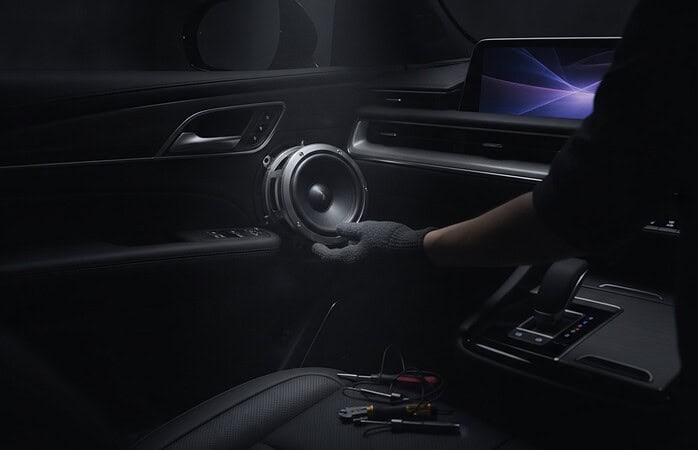
Custom fabrication allows us to place high-performance drivers in locations that factory designs simply don’t support. We often find that factory mounting points are too shallow or made of flimsy plastic that vibrates under load. By creating custom baffles and mounts, we can integrate larger, more capable drivers that provide the dynamic range needed for spatial audio. Our focus is always on the finished result. We want your system to sound world-class while maintaining a “factory-plus” aesthetic that respects the original design of your interior. This balance of art and science is what separates a standard upgrade from a professional installation.
A-Pillars and Kick Panels: Elevating the Soundstage
One of our most effective techniques involves building custom A-pillar pods. By housing tweeters and mid-range speakers in these pillars, we place the most critical frequencies on-axis with the listener. This physical alignment works in tandem with Digital Signal Processing in modern car audio to create a stable, focused center image. We also utilize kick panels to maximize path-length equality. This reduces the amount of digital correction needed and results in a more natural, effortless sound. Through custom car audio fabrication, we ensure these additions look like a seamless part of your cabin.
Custom Subwoofer Enclosures for Controlled Bass
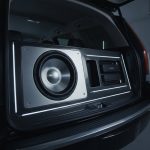
Immersion requires a full frequency spectrum, and that foundation starts with deep, controlled bass. Off-the-shelf subwoofer boxes are built for a generic space, which often results in boomy, muddy low-end that masks the micro-details of your music. We design custom subwoofer enclosures tailored to the specific air volume and cabin geometry of your vehicle. This precision ensures that the bass is tight and rhythmic. A properly designed enclosure allows the subwoofer to blend perfectly with the rest of the system, completing the 3D audio spectrum without overwhelming the delicate spatial cues of your favorite tracks.
Creating the Silent Canvas: Sound Deadening and Power
We often tell our clients that even the most expensive speakers can’t overcome the roar of a highway at 70 miles per hour. The foundation of any high-end immersive car audio experience setup is the environment it lives in. Car interiors are notoriously noisy, filled with wind resistance, tire hum, and mechanical vibrations. These external sounds act as a “noise floor” that masks the delicate micro-details of spatial audio. If you want to hear the subtle echoes and object positioning of a Dolby Atmos track, we have to start by creating a silent canvas. By reducing this interference, we allow the true dynamic range of your equipment to shine through.
Sound deadening does more than just improve the audio; it changes the entire feel of your vehicle. A properly treated cabin feels more solid, luxurious, and private. It effectively turns your car doors from thin, vibrating metal sheets into rigid, non-resonant speaker cabinets. This physical transformation is essential for preventing the “muddy” sound that occurs when your car’s body panels start singing along with the music. We focus on the finished result, ensuring that every layer of material serves a specific acoustic purpose.
Eliminating Road Noise and Mechanical Vibrations
We target high-vibration areas like the doors, trunk, and wheel wells to stop noise at its source. Our team uses a combination of materials to achieve total coverage. Butyl-based dampers are applied directly to the metal to stop structural vibrations. We then add layers of acoustic foam and mass-loaded vinyl to block airborne noise from entering the cabin. Sound deadening increases the perceived dynamic range of your system by significantly lowering the background noise floor. This ensures that the quietest parts of your music remain crystal clear, even during a busy commute.
Stable Power for Dynamic Audio Peaks
Immersive audio is demanding. Spatial soundscapes often feature sudden, powerful transitions that require massive bursts of energy from your amplifiers. A standard car battery and thin factory wiring often struggle to keep up, which leads to voltage drops and distorted sound. We ensure your system has a steady heart by using high-quality, large-gauge wiring and high-capacity capacitors. For extreme, multi-amp installations, we may even recommend upgrading the alternator to provide a consistent current. This stable power supply prevents “clipping” and ensures that your bass remains deep and controlled during every peak. If you are ready to build a system that never misses a beat, we invite you to explore our custom car audio upgrades at Music in Motion.
Designing Your Immersive Audio Roadmap
We believe every great project starts with a clear vision of the destination. What genre of music do you live for? A jazz enthusiast needs a different stage than a fan of orchestral scores or heavy electronic bass. Designing an immersive car audio experience setup is about matching the hardware to your personal taste. We don’t just sell parts; we build a roadmap that ensures your investment delivers the emotional impact you expect. This journey often begins with foundational upgrades and moves toward full spatial integration as your system evolves.
Many of our clients choose to phase their builds over time. You might start with sound deadening and a high-quality DSP to fix the factory flaws. Later, you can add custom-fabricated pillars or a dedicated subwoofer enclosure. This modular approach allows you to appreciate the improvement at every step. It also ensures that each new component is perfectly integrated into your existing immersive car audio experience setup without overwhelming your vehicle’s electrical system or your budget.
The Professional Consultation Process
We start by auditing your vehicle’s specific acoustics. Every cabin has obstacles; some are made of glass, others are hidden behind plastic panels. During a consultation, we measure these spaces to identify where sound might get trapped or distorted. This allows us to select components with frequency signatures that complement one another. Setting a realistic budget is a key part of this phase. It ensures we can build a world-class sound system for your car without cutting corners on the details that matter most.
Expert Integration and Final Tuning
The physical installation is only half the battle. The most critical hour of the entire build is the final tuning session using Real Time Analysis (RTA). We use calibrated microphones to see exactly how the sound behaves inside your car. We then adjust the DSP to flatten peaks and fill in dips, which ensures the result is natural and balanced. Our team takes pride in the “finished result” philosophy. We ensure that all factory controls, steering wheel buttons, and safety sensors remain fully functional. You get the benefit of cutting-edge technology without losing the convenience of your modern vehicle. If you’re ready to experience the difference, Contact Music In Motion for a custom audio consultation today.
Elevate Your Daily Drive to a New Standard
Transforming your vehicle into a world-class listening room is a journey that blends advanced technology with meticulous craftsmanship. We’ve explored how a powerful DSP acts as the brain of your system, while strategic speaker placement and custom fabrication lift the music to eye level. By creating a silent canvas through professional sound deadening, you ensure that every spatial detail is preserved. Achieving a true immersive car audio experience setup requires more than just high-end components; it requires a partner who prioritizes the finished result over a simple transaction.
At Music In Motion, we bring over 30 years of custom fabrication expertise to every project. As specialists in high-performance audio and vehicle safety, we’ve been locally owned and operated since 1994. We take pride in building systems that feel like a seamless part of your lifestyle and improve your daily experience behind the wheel. Ready to transform your drive? Consult with our experts at Music In Motion today. We look forward to helping you rediscover your favorite music through the power of spatial sound.
Frequently Asked Questions
What is the difference between a standard car audio upgrade and an immersive setup?
A standard upgrade usually focuses on replacing factory speakers with better ones for a louder or clearer stereo sound. An immersive car audio experience setup goes much further by using spatial audio codecs and digital processing to create a three-dimensional soundstage. Instead of just hearing sound from the left and right, immersion places specific instruments and vocals in a 3D space around the listener. This creates a “live performance” feel rather than just a traditional stereo broadcast.
Do I need to replace my factory head unit to get immersive sound?
No, you don’t always need to replace the factory head unit to achieve high-end sound. Modern Digital Signal Processors (DSPs) are designed to take the signal from your stock radio and clean it up for high-performance amplifiers and speakers. This allows us to keep your dashboard looking original while completely transforming the audio quality. We prioritize seamless integration with your vehicle’s existing controls and safety systems.
How many speakers are required for a Dolby Atmos car audio experience?
While there isn’t a single “magic number,” a basic Dolby Atmos setup usually starts with at least seven or nine channels, including dedicated height or surround speakers. The goal is to surround the listener with sound from multiple angles, including from above. We often use custom fabrication to add mid-range drivers and tweeters in the A-pillars to create the necessary spatial layers for a true 3D effect.
Will a custom audio setup drain my car battery?
A professionally installed system won’t drain your battery if the electrical system is properly designed for the load. We use high-efficiency amplifiers and stable power distribution components to manage the energy demands of your setup. For extreme systems, we might add a high-capacity capacitor to handle peak power draws. We always ensure the system shuts down completely when the ignition is off to protect your battery life.
Can I install an immersive audio system in an EV or hybrid vehicle?
Yes, we can definitely install immersive systems in electric and hybrid vehicles. Because EVs are so quiet, the benefits of a low noise floor are even more noticeable. We use specialized, high-efficiency components that provide massive sound quality without significantly impacting your vehicle’s driving range. Our team is trained to work safely with high-voltage electrical systems, which ensures a reliable and professional result.
What is the most important component for sound quality in a car?
The Digital Signal Processor (DSP) is the most critical component for achieving high-fidelity sound in the challenging environment of a car. It allows us to correct for the reflective surfaces like glass and plastic that cause acoustic issues. Without a DSP to handle time alignment and equalization, even the most expensive speakers will sound unbalanced. It’s the brain that makes a true immersive car audio experience setup possible.
Is professional sound deadening really necessary for a high-end system?
Yes, sound deadening is essential if you want to hear the micro-details of a high-end system. Without it, road noise and panel vibrations will drown out the subtle spatial cues that make the audio feel 3D. Treating the doors and floorboards lowers the background noise floor, which effectively increases the dynamic range and clarity of your speakers. It turns your cabin into a silent canvas for your music.
How long does a full custom immersive audio installation typically take?
A full custom installation can take anywhere from a few days to over a week, depending on the complexity of the fabrication. Projects involving custom A-pillar pods, subwoofer enclosures, and total vehicle sound deadening require precision and patience. We don’t rush our work; we focus on delivering a finished result that looks and sounds professional. We provide a clear timeline during your initial consultation so you know exactly what to expect.