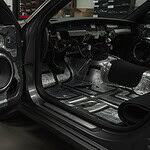
The most expensive speakers in the world will still sound like a tin can if they’re fighting against road noise and vibrating door panels. We’ve all felt that frustration. You turn up a favorite track only to have the bass drowned out by tire roar or interrupted by a buzzing piece of plastic trim. When you’re weighing the choice between professional vs DIY car sound deadening, it’s easy to think a few adhesive sheets from a generic kit will solve the problem. However, the reality of modern vehicle construction requires a much more strategic approach.
At Music In Motion, we believe your car should be a sanctuary of sound. In this guide, you’ll learn why a professional acoustic foundation is the essential starting point for any high-performance audio system and how it outperforms standard home-garage methods. We’ll explore the technical precision needed to handle complex 2026 vehicle electronics and show you how we eliminate mechanical rattles to create a luxury-car quiet cabin. It’s time to stop just hearing your music and start experiencing it without the interference.
Key Takeaways
- Understand how the “noise floor” acts as acoustic camouflage, masking the fine details and tonal nuances of your high-performance audio system.
- Discover why the debate of professional vs DIY car sound deadening favors expert installation when protecting complex 2026 vehicle electronics and safety sensors.
- Learn how professional-grade vibration damping converts kinetic energy into low-level heat to eliminate frustrating panel rattles during bass-heavy tracks.
- Identify the high-ROI areas of your vehicle, such as the front doors, that serve as the critical foundation for a rigid speaker enclosure and enhanced mid-bass.
- See how proper surface preparation and high-pressure rolling techniques ensure your acoustic treatment lasts the life of the vehicle without peeling or failing.
Understanding the Noise Floor: Why Your Car Audio Sounds ‘Muddy’
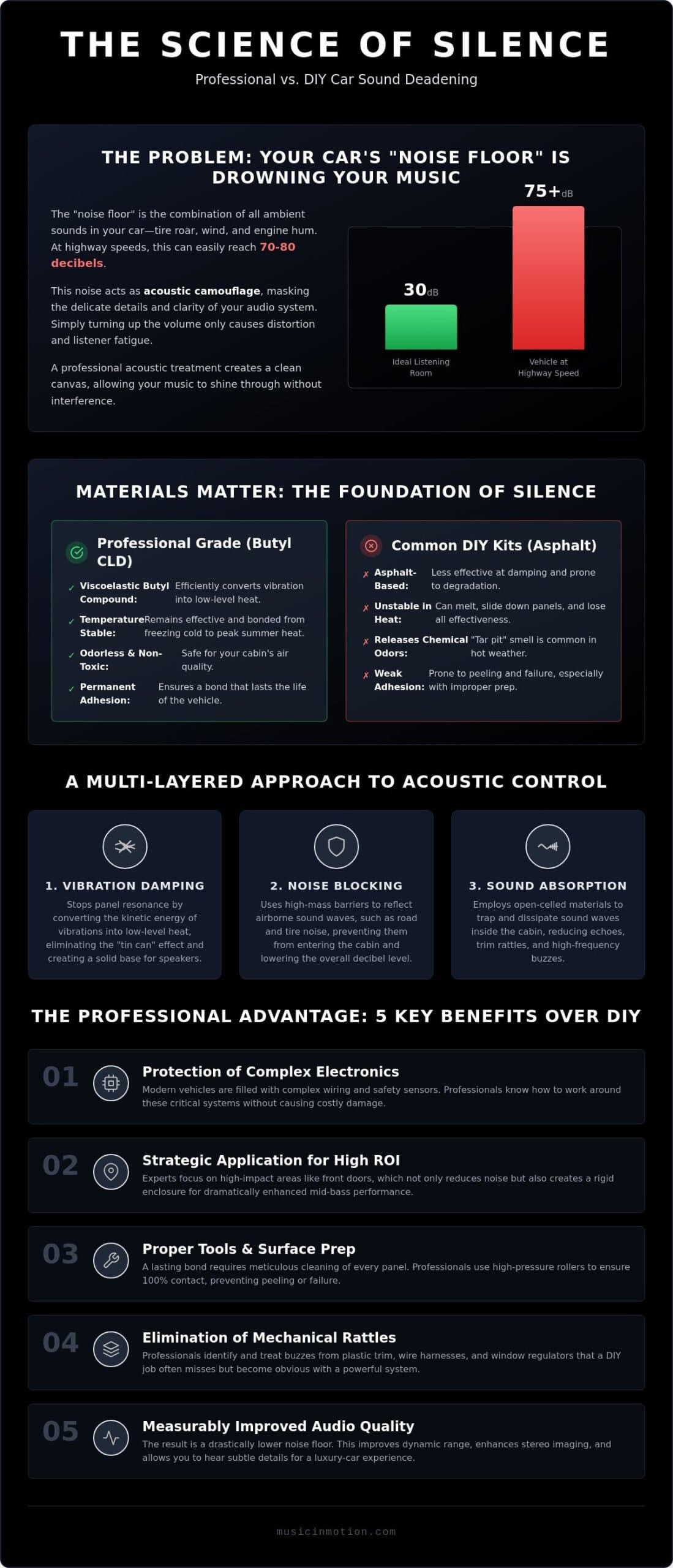
Think of your car’s interior as a canvas for your music. If that canvas is covered in gray static, you can’t see the vibrant colors of the paint. In the world of audio engineering, we call that static the “noise floor.” It’s the total sum of every tire roar, wind whistle, and engine hum that enters the cabin while you drive. When this floor is high, it physically occupies the same space as your music, creating a “muddy” sound that lacks clarity and punch. This is the primary hurdle we clear when debating professional vs DIY car sound deadening; it is about creating a clean slate for your speakers to perform.
These ambient sounds act as a form of acoustic camouflage. They don’t just exist alongside your music; they actively mask the delicate high-frequency details and the subtle textures of a vocal performance. You might notice that your system sounds incredible while parked in the driveway, yet loses its life the moment you hit the entrance ramp. This isn’t a fault of your speakers. It’s the environment working against them. When your music has to fight for space, the first things to disappear are the nuances you actually paid for in a premium system.
Many drivers try to solve this problem by simply turning up the volume. We’ve found this is usually a losing battle. Cranking the gain to “beat” the road noise often leads to listener fatigue and forces your equipment into a range where it starts to distort. A quiet cabin is nice for a conversation, but an acoustically optimized environment is something different entirely. It’s a space where every frequency has room to breathe without interference from the outside world.
The Battle Against Ambient Decibels
The numbers tell a clear story. An ideal home listening room usually sits around 30 decibels of background noise. At highway speeds, a standard vehicle cabin can easily spike to 70 or 80 decibels. That is a massive volume of “trash” sound your audio system must overcome. Low-frequency road drone is particularly aggressive because it sits in the same frequency range as your mid-bass. This results in phase interference that can literally cancel out the punch of your door speakers. By lowering this floor, we don’t just improve the music; we create a more relaxed driving experience that leaves you feeling less drained after a long trip.
Why Factory Insulation Often Fails
Vehicle manufacturers have different priorities than audio enthusiasts. For most brands, every ounce of weight and every penny of cost is scrutinized. This leads to the “tin can” effect where modern thin-gauge steel panels act like a drum, vibrating with every bump in the road. While many enthusiasts research Automotive soundproofing to fix these issues, factory insulation is typically limited to small, strategic patches designed to meet basic comfort standards rather than high-fidelity goals. We frequently find major weak spots in the outer door skins and wheel wells that are completely untreated, allowing resonance to bloom throughout the vehicle frame. When comparing professional vs DIY car sound deadening, the professional approach focuses on these structural vulnerabilities that generic factory solutions simply ignore.
The Science of Silence: How Professional Grade Materials Actually Work
Silence isn’t just the absence of sound. In a high-performance vehicle, it’s the result of managing energy. When we talk about professional vs DIY car sound deadening, we’re really discussing the application of thermodynamics and physics to your cabin. Sound is energy that travels through three different paths: vibration, airborne noise, and resonance. To stop it, we use three distinct tools: vibration damping, blocking, and absorption. Each serves a specific purpose in the acoustic environment, and using them correctly is what separates a truly quiet ride from a mediocre one.
Constrained Layer Damping (CLD) Explained
CLD is our first line of defense. These high-density butyl-based mats don’t just “add weight” to a panel. They use a viscoelastic layer to convert structural vibrations into low-level heat. If you tap a bare metal door, it rings like a bell. After we apply a professional-grade butyl layer, that same tap sounds like a solid thud. The ringing is gone because the metal can no longer resonate freely.
The choice of material matters. Many DIY kits rely on asphalt-based products because they’re cheap. However, asphalt is unstable; it smells like a tar pit in the summer and can lose its grip, sliding down inside your door panels. We use professional-grade butyl that remains stable across extreme temperature shifts. There’s also a common myth that you need 100% coverage for success. In reality, strategic placement on the flattest, most resonant parts of the panel yields the best results. Over-applying material just adds unnecessary weight without improving the sound. This nuance is a major factor in the professional vs DIY car sound deadening debate.
Decoupling and Barriers
Damping stops the metal from vibrating, but it doesn’t block the sound of a passing semi-truck. That’s where Mass Loaded Vinyl (MLV) comes in. MLV is a dense, limp material that acts as a physical wall against airborne noise. To work correctly, it needs to be “decoupled” from the vehicle’s frame. If the vinyl touches the metal directly, it can actually transfer vibrations rather than stopping them.
We use closed-cell foam (CCF) as a spacer. This prevents the MLV from rattling against the metal and stops plastic trim pieces from squeaking. This “sandwich” of damping, foam, and vinyl creates a professional-grade barrier that blocks exhaust and tire roar effectively. Understanding the science of acoustic materials is what allows us to achieve these results without turning your car into a heavy tank. If you’re ready to hear the difference this engineering makes, our team can help you design a custom installation tailored to your specific vehicle.
Professional vs DIY Car Sound Deadening: 5 Key Audio Benefits
We’ve explored the science behind acoustic energy, but the real value lies in the physical experience behind the wheel. When you weigh the options of professional vs DIY car sound deadening, the decision often comes down to the quality of the finished result. It’s not just about making the cabin quieter. It’s about engineering an environment where your audio system can finally perform at its full potential. By addressing the mechanical weaknesses of your vehicle, we unlock five specific benefits that transform your listening experience.
- Enhanced Mid-Bass Response: Most factory doors are essentially leaky, vibrating metal boxes. By treating the inner and outer skins, we transform that door into a rigid, sealed enclosure. This allows your mid-bass drivers to move air efficiently rather than vibrating the door panel, resulting in a punchier, more controlled low end.
- Improved Tonal Clarity: When you remove the interference of road noise, you finally hear the high-frequency nuances of your music. The subtle breath of a vocalist or the shimmer of a cymbal becomes audible because it’s no longer masked by tire roar.
- Elimination of Distracting Rattles: High-performance audio moves a significant amount of air. Without proper damping, that energy causes plastic trim and metal brackets to buzz and rattle. We identify these mechanical friction points and silence them, ensuring the only thing you hear is the music.
- Lower Distortion: Because the noise floor is lower, your speakers don’t have to work as hard to be heard. You can listen at lower volume levels with greater impact, which protects your equipment and reduces distortion at high volumes.
- Thermal Insulation: Professional materials also act as a heat barrier. This keeps your cabin cooler in the summer and warmer in the winter. This means your HVAC fan doesn’t have to run at full blast, further reducing ambient noise in the cabin.
Maximizing Your Speaker Investment
We often tell our clients that a mid-range set of speakers in a properly treated door will sound better than a top-tier set in an untreated one. This is a critical consideration when performing a car audio upgrade for stock stereo systems. Without treatment, “back-wave” energy from the rear of the speaker bounces off the outer door skin and returns to hit the speaker cone. This causes phase cancellation that destroys your bass. We use specialized materials to absorb this energy, protecting the investment you’ve made in your hardware.
The ‘Luxury Car’ Feel and Functionality
Strategic Application: Where to Install Deadening for Maximum Impact
Applying acoustic treatment isn’t just about sticking mats to every flat surface you can find. It’s about identifying the paths that noise and vibration take to reach your ears. While some generic guides suggest “covering the whole car” as a blanket solution, we focus on a prioritized strategy that delivers the best return on your investment. When you look at professional vs DIY car sound deadening, the biggest difference is often in the selection of treatment zones. We start where the noise is loudest and where your speakers are most vulnerable.
The hierarchy of treatment usually follows a logical path based on your specific goals. For most of our clients, that path looks like this:
- The Doors: This is the most critical area for audio quality. It’s where your primary speakers live and where the most resonant metal panels are located.
- The Floor and Firewall: These areas are the primary entry points for mechanical road noise, tire roar, and engine hum.
- The Trunk and Hatch: If you have a subwoofer, this area is prone to severe rattles and “drumming” from the rear tires.
- The Roof: Often overlooked, the roof is a massive, thin sheet of metal that creates significant wind noise and makes rain sound like it’s falling on a tin shed.
The Door: Your Speaker’s Cabinet
We treat your vehicle’s doors like a high-end speaker cabinet. A speaker moves back and forth to create sound, but it also creates “back-wave” energy that travels into the door cavity. If that cavity isn’t sealed and damped, the energy bounces back and cancels out your music. We apply damping to the outer skin to stop resonance and then seal the inner service holes to create a true “infinite baffle” setup. This forces all the speaker’s energy into the cabin. We also use specialized foam rings to bridge the gap between the speaker and the door panel, ensuring every bit of sound reaches your ears without leaking into the door trim.
The Trunk: Taming the Bass
High-performance subwoofers create immense pressure. In an untreated trunk, that pressure causes the trunk lid, license plate, and quarter panels to vibrate violently. This creates an external rattle that sounds cheap and ruins the internal bass response. We focus on damping the spare tire well and the trunk lid to turn that vibration back into punchy, clean bass. This approach perfectly complements a custom subwoofer enclosure by ensuring the vehicle doesn’t become the weakest link in your signal chain. If you want to see how we can transform your specific vehicle, contact us today for a custom installation plan tailored to your goals.
Professional Integration: Why Music In Motion Beats the DIY Approach
Achieving a truly silent cabin requires more than just high-quality materials. It demands a level of precision that only comes from decades of hands-on experience. When you’re making the choice between professional vs DIY car sound deadening, the difference often lies in the invisible details. We don’t just stick mats to metal. Our process starts with intensive surface preparation, using specialized cleaners to ensure a permanent chemical bond. We then use high-pressure rolling tools to eliminate every air pocket. Without this mechanical bond, the material will eventually peel or sag, especially in the high-heat environment of a car door during summer.
Modern vehicles are incredibly complex machines. A 2026 model year car is packed with sensitive electronics, blind-spot sensors, and side-impact airbags integrated directly into the door panels and pillars. One wrong move during a DIY install can trigger a dashboard error light or, worse, compromise a critical safety system. We treat every vehicle with the respect its engineering deserves. This attention to detail is why we integrate sound treatment into every car audio fabrication project we handle. We aren’t just selling you a box of butyl; we’re delivering a finished result that preserves the integrity of your property.
The Risks of DIY Disassembly
The most common issue we see with home installations isn’t the material choice, but the reassembly. Modern trim panels use one-time-use plastic clips that are designed to be installed once at the factory. If you don’t have the specialized tools and replacement hardware, you’ll likely end up with broken clips that cause new, permanent rattles. We maintain an extensive inventory of factory-spec fasteners to ensure your car goes back together exactly as it should. Our goal is a “factory-plus” installation that protects your vehicle’s resale value while ensuring that airbags, window regulators, and door locks remain fully functional and safe.
Ready to Hear the Difference?
Transform Your Daily Drive into a Private Concert
Your vehicle is more than just a way to get from point A to point B. It’s the place where you enjoy your favorite music and podcasts. By lowering the noise floor and eliminating structural rattles, we create the perfect stage for high-performance audio. When you consider the trade-offs of professional vs DIY car sound deadening, remember that a professional installation protects your investment in premium speakers and ensures your vehicle’s safety systems remain untouched. We focus on delivering a finished result that you can hear and feel every time you close the door.
Since 1994, we’ve built a national reputation as specialists in high-performance vehicle integration and expert custom fabrication. We understand the technical nuances of modern automotive engineering and use that knowledge to build a foundation for crystal-clear sound. You don’t have to settle for a noisy, vibrating cabin that masks the details of your music. Experience the difference of a professionally tuned, quiet cabin; contact Music In Motion today. We’re ready to help you rediscover the joy of being behind the wheel.
Frequently Asked Questions
Does sound deadening actually make my car speakers louder?
Sound deadening doesn’t technically increase the wattage of your speakers, but it significantly increases perceived volume by lowering the noise floor. When you remove competing road noise and panel vibrations, your ears can focus on the music rather than background interference. This allows you to hear more detail at lower volume settings, effectively increasing the dynamic range and clarity of your audio system.
How much weight does sound deadening add to a car?
A typical full-vehicle treatment adds between 20 and 80 pounds to your car, depending on the thickness of the materials used. While this might sound significant, it’s roughly equivalent to carrying a few bags of groceries or a small child. For most modern vehicles, this weight gain has a negligible impact on fuel economy or acceleration while providing a massive improvement in acoustic comfort.
Can I install sound deadening myself, or should I go to a professional?
While DIY kits are available, a professional installation is recommended for modern vehicles with complex electronics and safety sensors. The choice between professional vs DIY car sound deadening often comes down to the quality of the mechanical bond and the risk of damaging trim clips. We use high-pressure rolling and industrial cleaners to ensure the material never peels, which is a common failure in home installations.
What is the best sound deadening material for car audio in 2026?
The gold standard for 2026 remains a combination of high-density butyl rubber Constrained Layer Damping (CLD) and Mass Loaded Vinyl (MLV). Butyl rubber is superior to older asphalt-based products because it remains stable in extreme heat and doesn’t emit odors. We use these materials in a strategic layering process to address both structural vibrations and airborne road noise simultaneously for a total acoustic solution.
Is it worth doing sound deadening if I only have factory speakers?
Yes, even factory speakers benefit significantly from professional acoustic treatment. Most stock speakers are held back by the thin metal panels of the doors, which vibrate and cancel out bass response. By stabilizing these panels, we allow your factory system to produce cleaner, more accurate sound. It’s often the most cost-effective way to improve your current audio experience without the need to replace any hardware.
Do I need to cover 100% of the metal surface with deadening mats?
You don’t need 100% coverage with vibration damping mats to see significant results. For structural damping, covering 25% to 50% of the center of a flat panel is usually sufficient to stop resonance. However, for blocking airborne noise with materials like MLV, a seamless barrier is required. Our team uses a strategic approach to maximize performance without adding unnecessary weight or cost to your vehicle.
Will sound deadening help with the heat inside my car during summer?
Professional sound deadening materials provide excellent thermal insulation that keeps your cabin cooler in the summer and warmer in the winter. The aluminum layer on many damping mats reflects radiant heat, while the foam layers act as a barrier against outside temperatures. This reduces the workload on your HVAC system, which also helps lower the ambient fan noise inside the car during your drive.
How long does a professional sound deadening installation typically take?
A professional installation typically takes between one and three days depending on the scope of the project. Treating just the front doors can often be completed in a few hours, while a full-vehicle treatment requires more time for careful disassembly and reassembly. We focus on a meticulous process to ensure every panel fits perfectly and every electronic sensor is reconnected correctly before the vehicle leaves our shop.