Many enthusiasts believe a massive ported box is the only way to reach those bone-rattling sub-35Hz frequencies, but the truth is often found in the specific physics of your vehicle. We understand the frustration of investing in a new setup only to find the bass sounds boomy or muddy rather than hitting the clean, gut-punching notes you actually crave. It is a common struggle to balance limited trunk space with genuine low-frequency extension.
Deciding between a ported vs sealed subwoofer enclosure for deep bass isn’t just about picking a box from a shelf; it’s about matching acoustic science to your personal musical taste. We want to help you cut through the confusion and stop the fear of wasting money on a sloppy system. In this 2026 guide, we’ll demystify how tuning frequency and vehicle cabin gain interact to shape your final sound. You will learn why custom-fabricated enclosures consistently outperform generic prefab options and how to select the precise topology that transforms your daily drive into a front-row concert experience.
Key Takeaways
- Learn how enclosure physics and Helmholtz resonance dictate whether your system produces audible boom or genuine, sub-audible low-frequency extension.
- Discover how the choice of ported vs sealed subwoofer enclosure for deep bass is often decided by your vehicle’s natural cabin gain and its interaction with the box’s roll-off slope.
- Understand the distinct trade-offs between the tight, accurate transient response of sealed boxes and the high-efficiency output provided by tuned ported designs.
- Master the technical side of system design by using driver-specific Thiele/Small parameters and Efficiency Bandwidth Product (EBP) to select the perfect enclosure.
- See why custom-fabricated enclosures provide a superior, tailored result compared to generic prefabricated options that often compromise on low-end performance and trunk space.
Understanding Deep Bass: How Enclosure Physics Dictates Low-End Output
A raw subwoofer driver is essentially useless without a properly engineered loudspeaker enclosure. When the cone moves forward, it creates a high-pressure wave; simultaneously, the back of the cone creates a low-pressure wave. Without a solid barrier, these waves meet and cancel each other out, leaving you with virtually no output. True deep bass lives in the challenging 20Hz to 40Hz spectrum. These frequencies are often felt as much as they are heard. We design enclosures to act as that critical air barrier, regulating driver cone excursion to prevent mechanical failure while shaping the acoustic response.
The architecture of your box determines whether energy is trapped and dissipated internally or harnessed to reinforce frontal sound pressure. By adjusting the internal airspace volume, we directly alter the system’s fundamental resonant frequency. Larger volumes generally lower the resonance but offer less mechanical control, while smaller volumes raise it and tighten the response. Finding the right balance in the ported vs sealed subwoofer enclosure for deep bass debate starts with this basic relationship between air and driver movement.
The Physics of Sub-40Hz Sound Waves Inside a Vehicle
Generating sub-40Hz notes requires immense air displacement to register a physical, tactile impact. In the confined space of a car, these long acoustic wavelengths don’t have room to fully cycle. Instead, they interact heavily with cabin boundaries and internal reflections. This creates localized pressurization within the cockpit. Acoustic wave compression turns your vehicle into a pressurized chamber, which is why bass often sounds much louder inside a car than outside. We calculate how these boundaries affect your specific vehicle to ensure the low-end remains clean and powerful.
Sealed vs. Ported Enclosures: The Fundamental Operating Differences
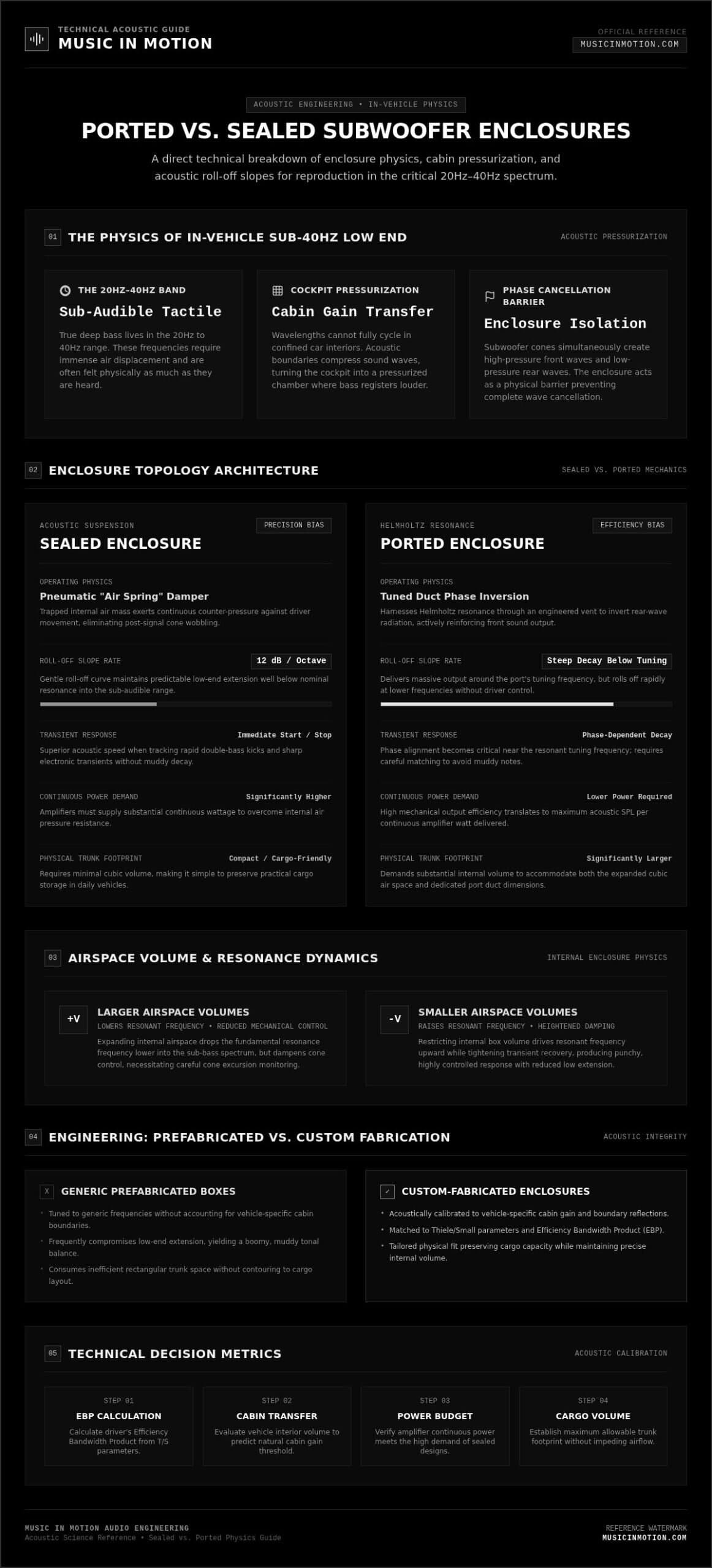
Sealed enclosures rely on acoustic suspension. The trapped air mass inside acts as a pneumatic spring, pushing back against the driver to provide exceptional control and accuracy. In contrast, ported designs utilize a tuned duct to harness the Helmholtz resonance principle. This port inverts the rear-wave radiation so it reinforces the frontal sound. Near the resonant frequency, phase alignment becomes a major factor. While a ported box provides more output, a sealed box typically offers a more natural phase transition. We evaluate these phase alignment differences to match the enclosure to your musical preferences.
Sealed Subwoofer Enclosures: Acoustic Suspension, Accuracy, and Flat Response
Sealed enclosures are the gold standard for listeners who value musicality and precision over sheer volume. By trapping a specific volume of air behind the driver, these boxes create what we call acoustic suspension. This design provides exceptional transient response because the internal air mass acts as a pneumatic damper, preventing the cone from wobbling after the signal stops. When debating a ported vs sealed subwoofer enclosure for deep bass, it’s vital to recognize that sealed boxes offer a compact physical footprint. They fit easily into modern vehicle cargo layouts where space is at a premium.
Acoustic Suspension and Transient Speed
The “air spring” inside a sealed box is incredibly effective at controlling driver movement. It prevents excessive cone overshoot during abrupt musical transients like rapid double-bass drum kicks or sharp electronic bass lines. Minimal phase shift ensures that nuanced bass notes remain clear without the muddy decay often found in poorly tuned systems. Transient response is the acoustic speed at which a driver initiates and terminates movement in direct response to an electrical signal. This speed is what gives sealed systems their characteristic tight, punchy sound.
Predictable Roll-Off Slopes and Power Requirements
One major advantage of a sealed design is its gentle 12dB per octave roll-off slope. While a ported box might play louder at its tuning frequency, a sealed box maintains predictable control much deeper into the sub-audible range. This shallow roll-off allows for clean extension well below the nominal enclosure resonance. However, these systems demand more from your equipment. Because the driver must fight against the internal air pressure, sealed designs require significantly higher continuous amplifier power to reach the same output levels as their ported counterparts. Understanding these loudspeaker electromechanical processes helps explain why premium amplification is necessary to keep heavy woofer voice coils fully controlled. Thermal power handling becomes the primary limiting factor here, making high-quality gear essential for peak performance.
Musical Genres That Excel in Sealed Designs
If your playlist is filled with jazz, metal, or acoustic recordings, a sealed enclosure is likely your best bet. Complex bass lines remain distinct, and articulate rhythm sections won’t mask the delicate details of midrange instruments. Audiophile recordings benefit from the lifelike timbre and natural string bass decay that only a sealed system can accurately reproduce. If you want a system that fits your lifestyle without sacrificing this level of musicality, we can design custom subwoofer enclosures tailored specifically to your vehicle and tastes.
Ported Subwoofer Enclosures: Helmholtz Resonance, Efficiency, and Output
Ported enclosures harness the Helmholtz resonator principle to amplify low frequencies far more efficiently than sealed designs. By using a tuned duct or vent, we allow the rear-wave energy of the woofer to reinforce the frontal output. This creates a significant acoustic gain, often 3dB or more, specifically around the resonance point. At this tuning frequency, the driver cone motion actually diminishes because the air in the port is doing most of the work. This protecting of the mechanical voice coil is a great benefit, but it comes with a trade-off. When weighing a ported vs sealed subwoofer enclosure for deep bass, you must account for the steep 24dB per octave roll-off below tuning. This creates severe distortion risks if the system isn’t managed correctly. We carefully balance box volume against vent length to find the ideal sweet spot for depth.
Port Tuning Frequency (Fb) and Infrasonic Extension
Tuning the enclosure between 28Hz and 32Hz produces authoritative deep sub-bass that you can feel in your chest. Many generic boxes are tuned much higher, around 45Hz, which sacrifices true low-end extension for a boomy, one-note sound. Proper tuning eliminates that annoying “mud” and ensures your system reproduces the lowest notes with authority. We focus on these lower tuning points to provide a smooth transition into the infrasonic range, giving you a much more refined listening experience than a standard prefabricated box.
The Crucial Role of Subsonic Filters and Vent Sizing
Unloaded woofers experience uncontrolled mechanical excursion when played below port tuning. To prevent this, we use subsonic infrasonic filters to eliminate destructive frequencies beneath the chosen enclosure resonance. We also prioritize generous port area in every build. If a port is too small, you’ll hear audible vent turbulence, often called “chuffing,” which sounds like a whistle or a puff of air. Correct sizing prevents this port compression and keeps the output clean even at high volumes. It’s a technical detail that makes a massive difference in real-world performance.
Enclosure Volume and Cargo Space Compromises
Vented designs typically require fifty to one hundred percent more internal volume than sealed boxes. Port displacement also consumes valuable cabinet volume that we must offset during construction. Your vehicle’s interior cargo constraints often dictate the maximum practical box dimensions. We work within these limits to ensure you don’t lose all your utility while still achieving a powerful low-end. Choosing a ported vs sealed subwoofer enclosure for deep bass often comes down to how much trunk space you’re willing to dedicate to your sound system.
Head-to-Head Comparison: Ported vs Sealed for Deep Low-End Extension
When we compare a ported vs sealed subwoofer enclosure for deep bass, we have to look past the laboratory spec sheets. A driver measured in a free-air anechoic chamber behaves very differently than one installed in a truck or hatchback. Inside a vehicle, the acoustic environment changes everything. Vehicle cabin gain naturally boosts frequencies below 50Hz by roughly 12dB per octave. This physical phenomenon acts as a natural equalizer, and understanding how to harness it is the secret to achieving truly deep low-end extension without sacrificing sound quality.
Sealed enclosures are often the unsung heroes of ultra-deep response. Because a sealed box has a natural roll-off that matches the 12dB cabin gain curve, the two often cancel each other out to create a remarkably flat response all the way down to 20Hz. Ported enclosures, while less linear, produce unmatched visceral SPL output around their designated tuning window. They’re designed to move massive amounts of air where it counts most, providing that physical impact that many listeners crave.
Cabin Gain: The Great Equalizer for In-Car Bass
Smaller vehicle interiors exhibit earlier and steeper acoustic cabin transfer boosts than large SUVs. In a compact car, a sealed box can achieve effortless 20Hz extension once cabin gain engages. However, ported boxes inside these same small cabins can develop exaggerated, overwhelming low-end humps if the tuning isn’t precise. We analyze your vehicle’s specific interior volume to ensure the enclosure topology complements these natural reflections rather than fighting them.
Group Delay, Phase Accuracy, and Sound Quality
Ported enclosures introduce higher group delay near their tuning frequency, which can slightly smear rapid transients and make the bass feel “slow.” Sealed boxes keep group delay negligible across the entire audible frequency spectrum, preserving the rhythm and pace of the music. We bridge the gap between these two designs by using advanced digital sound processors to align phase differences. This ensures your subwoofer system blends seamlessly with your front stage speakers for a cohesive soundstage.
Direct Performance Metrics: Efficiency, Power, and Footprint
Efficiency is where ported designs shine, as they require less continuous wattage to reach high sound pressure levels. The trade-off is the physical cargo space sacrifice demanded by long internal vent geometries. Sealed boxes are much easier to integrate into daily-use vehicles but demand more robust amplification to overcome internal air resistance. Choosing the clear engineering winner depends on your specific acoustic and lifestyle goals. If you want a system tailored to your specific vehicle and musical tastes, explore our custom installations to see what’s possible.
Designing Your System: Matching Enclosure Architecture to Your Vehicle
We don’t believe in guesswork when it comes to low-end performance. Selecting the right ported vs sealed subwoofer enclosure for deep bass requires a deep dive into the driver’s electromechanical DNA. A subwoofer isn’t a universal component; it’s a precision instrument that must be matched to its environment. We start by reviewing the Thiele/Small parameters to ensure the driver is physically capable of performing in your chosen box architecture. This technical foundation prevents the muddy, sloppy response that plagues so many entry-level systems.
Using Thiele/Small Parameters and EBP Calculation
The Efficiency Bandwidth Product (EBP) is our primary roadmap. We calculate this by dividing the driver’s free-air resonance (Fs) by its electrical Q factor (Qes). This simple math reveals the woofer’s mechanical preference. Values below 50 indicate a driver specialized for sealed enclosures, where the air spring provides necessary control. Values above 90 demand a vented enclosure to breathe properly. Many modern drivers carry moderate EBP ratings between 50 and 90. These versatile woofers can operate comfortably in either enclosure style, provided we apply careful engineering to the final design.
Prefabricated Universal Boxes vs. Precision Custom Fabrication
Cheap prefabricated enclosures are the most common cause of disappointing bass. These boxes often use thin particleboard that flexes under pressure, leading to air leaks and mismatched tuning frequencies. We’ve seen how these compromises steal energy from your music. In contrast, our custom fabrications utilize thick, braced MDF or fiberglass contoured specifically to your vehicle’s geometry. Custom car audio fabrication allows us to maximize internal airspace without sacrificing your usable cargo utility. It’s the difference between a box that just sits in your trunk and a system that’s part of your vehicle. Drivers exploring upgraded vehicle sound and multimedia systems can learn more about B-A-S-S to see how dedicated equipment and integration make a noticeable difference.
The best enclosure in the world still needs proper calibration to shine. We typically set low-pass crossover points between 60Hz and 80Hz to ensure the subwoofer blends seamlessly with your front-stage speakers. Using steep 24dB Linkwitz-Riley slopes prevents the “pulling” effect where you can hear exactly where the subwoofer is located. We integrate heavy-gauge power feeds and digital sound processors to maintain peak dynamics even during demanding musical passages. If you’re ready to stop compromising on your sound, schedule a consultation for tailored enclosure engineering at Music In Motion. We’ll help you build a system that hits exactly as deep as you’ve always imagined.
Transform Your Vehicle’s Acoustic Signature
Selecting the right ported vs sealed subwoofer enclosure for deep bass is the final step in creating a system that truly moves you. We’ve explored how vehicle cabin gain acts as a natural equalizer and why your driver’s electromechanical parameters dictate the box architecture. Whether you prioritize the surgical precision of acoustic suspension or the visceral impact of a tuned port, the finished result depends on structural rigidity and mathematical accuracy. Generic boxes simply can’t compete with a solution engineered for your specific cockpit.
Since 1994, we’ve mastered the craft of custom acoustic enclosure fabrication. We combine precision digital acoustic modeling with full-spectrum integration; this includes professional amplification, DSP tuning, and advanced sound deadening. We don’t just sell hardware. We deliver a tailored listening environment designed specifically for your vehicle’s unique acoustics. You deserve a system that hits every note with clarity and authority without sacrificing your trunk’s utility.
Explore tailored vehicle audio and custom enclosure fabrication at Music In Motion to start your journey toward perfect low-end performance. We’re ready to help you push creative boundaries and improve every moment you spend behind the wheel.
Frequently Asked Questions
Does a ported or sealed subwoofer enclosure play lower frequencies?
Sealed enclosures typically maintain audible output at lower frequencies inside a vehicle because of their shallow 12dB per octave roll-off. While a ported box is louder at its specific tuning point, it loses control quickly below that resonance. We often find that a ported vs sealed subwoofer enclosure for deep bass comparison favors sealed designs for infrasonic extension, provided you have enough amplifier power to drive the system effectively.
Why do sealed subwoofer boxes sound tighter and more accurate?
Sealed boxes utilize acoustic suspension, which uses the trapped air mass inside the cabinet as a pneumatic spring. This pressure forces the driver cone to return to its center position immediately after a signal ends, preventing the wobble that causes muddy sound. We prioritize this design for listeners who value transient speed and rhythmic precision. It’s the best choice for complex recordings where every kick drum beat needs to remain distinct and punchy.
Can a ported subwoofer box damage my subwoofer driver?
Yes, a ported enclosure can lead to mechanical failure if you play frequencies significantly below the port’s tuning frequency. Without the resistance of trapped air, the woofer cone can move beyond its physical limits, a phenomenon known as unloading. We prevent this by integrating subsonic filters into our custom installations. These digital safeguards cut off dangerous infrasonic signals, ensuring your investment stays safe while still delivering massive output within its intended operating range.
How does vehicle cabin gain affect deep bass output?
Vehicle cabin gain is an acoustic boost that naturally amplifies low frequencies as they interact with the interior boundaries of your car. In most vehicles, this boost begins around 50Hz and increases at 12dB per octave as frequencies drop. We use this physics to our advantage by matching enclosure roll-off to the cabin’s transfer function. This synergy is how a relatively small subwoofer can produce deep, chest-thumping bass that sounds much larger than the physical hardware suggests.
What is the Efficiency Bandwidth Product (EBP) formula?
The EBP formula is calculated by dividing the driver’s free-air resonance (Fs) by its electrical Q factor (Qes). This number tells us which enclosure topology suits the driver’s motor strength. An EBP under 50 suggests the driver is optimized for sealed applications, while a result over 90 points toward a ported design. We use these precise calculations during our design process to ensure the ported vs sealed subwoofer enclosure for deep bass choice matches your specific driver’s capabilities.
Are prefabricated subwoofer boxes good enough for deep bass?
Prefabricated boxes usually fall short because they are built with thin, unbraced materials that flex and vibrate. This structural weakness absorbs energy that should be reaching your ears, resulting in weak low-end extension. We build custom enclosures using thick, high-density materials tailored to your vehicle’s specific air volume. Our custom car audio fabrication eliminates air leaks and mismatched tuning, providing a level of depth and clarity that universal one-size-fits-all boxes simply cannot achieve.
Do ported subwoofer enclosures always sound boomy?
Ported enclosures only sound boomy if they are tuned too high or built with insufficient port area. Many off-the-shelf boxes are tuned to 45Hz to create a loud hump in volume, which sounds sloppy. We engineer our ported systems with lower tuning frequencies, typically between 28Hz and 32Hz, and use generous vent sizing to prevent turbulence. This approach delivers high-output bass that remains clean, controlled, and musical without that annoying, ringing one-note characteristic common in cheap setups.