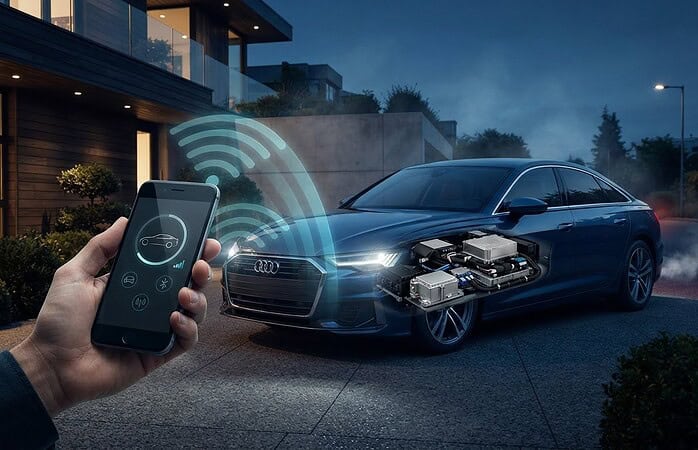
Have you ever pressed your remote-start button and wondered whether your car actually started? That uncertainty is the gap a two-way remote helps close. The benefits of a 2-way remote start system go beyond starting your vehicle from a distance: the remote receives feedback, such as a light, beep, or screen message, so you can tell whether the system responded to your command.
It’s easy to confuse confirmation with range, smartphone control, or security features. They aren’t the same. A longer-range remote may reach a vehicle parked farther away, while an app offers phone-based control and may include other features. Two-way feedback answers a more immediate question: did the system respond to the start command? That reassurance can be useful when your vehicle is out of sight.
In this article, we’ll explain how two-way confirmation works in everyday use and compare it with one-way remotes and app-based control. We’ll also cover practical trade-offs, including when feedback may suit your routine and why vehicle compatibility and professional integration matter. Music In Motion installs remote start systems with attention to your vehicle’s existing electronics, helping you choose controls and features that fit how you drive.
Key Takeaways
- Understand how a two-way remote receives a response from your vehicle, unlike a one-way remote that sends a command without comparable confirmation.
- Explore the benefits of a 2-way remote start system and consider when feedback could be useful in your daily routine.
- Compare one-way and two-way remotes by command transmission, confirmation, and control preferences.
- Use a simple decision path to weigh your parking habits, how much you value confirmation, and your vehicle’s compatibility.
- Learn how professional installation can integrate a remote start system with your vehicle’s electronics and help you understand its controls.
What Makes a 2-Way Remote Start System Different?
The difference is the return message. A one-way remote sends a start command to the vehicle, but typically doesn’t send comparable confirmation back to the remote. A two-way system adds a response: the remote transmits a command, and the installed system can send a signal back. That feedback helps distinguish a command sent from a command acknowledged.
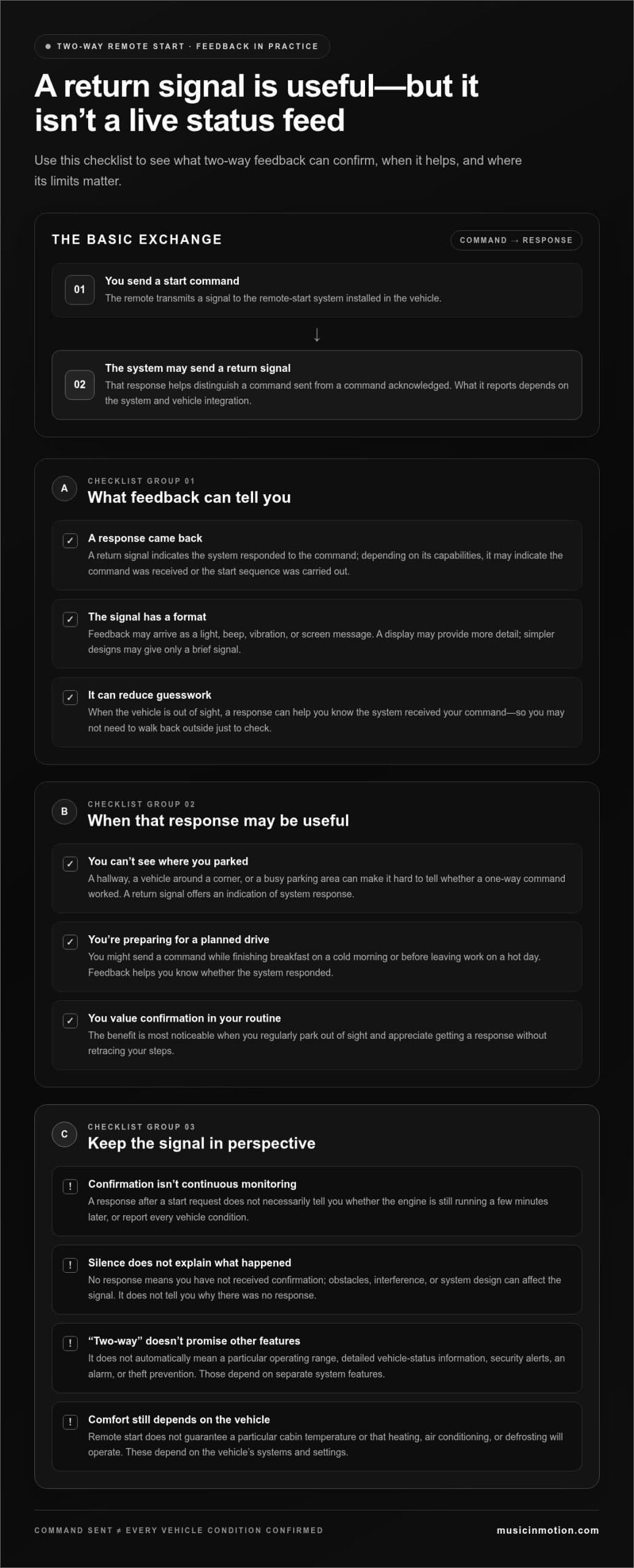
A two-way remote start system sends a command to the vehicle and receives a return signal. That signal confirms a system response, but doesn’t necessarily prove the engine is still running or report every vehicle condition. The distinction matters. The benefits of a 2-way remote start system depend on what the system communicates, not simply on the “two-way” label.
How does two-way communication work?
When you press the remote’s start button, it transmits a signal to the remote-start system installed in the vehicle. If the system receives and processes the command, it may send a return signal. Depending on its features and integration with the vehicle, the response may indicate that the command was received or that the start sequence was carried out.
Think of it as a delivery receipt, not a live camera feed. A response can tell you something happened when you sent the command, but it isn’t automatically a continuous report. For example, confirmation after a start request doesn’t necessarily tell you whether the engine is still running a few minutes later. The details depend on the system’s capabilities and how it works with the vehicle’s electronics. For a general foundation on how remote starting operates, see this overview of remote starter technology.
What might the remote show or signal?
Feedback varies by system. A remote might use a visual indicator, an audible beep, a vibration, or a screen message. Some remotes have a display that provides more detail, while simpler designs may give a brief signal. These are possible formats, not features included with every two-way remote.
Interpret the feedback as a specific message, not an all-purpose vehicle report. A light or beep may acknowledge the command without explaining why a start attempt didn’t complete. A screen could provide a clearer indication, but its information still depends on the system and vehicle integration. Don’t assume two-way communication always includes:
- A particular operating range.
- Continuous confirmation that the engine is running.
- Detailed vehicle-status information or security alerts.
Those functions depend on the system’s features. Separating the return signal from optional range and status capabilities makes it easier to compare systems and set realistic expectations. Music In Motion professionally integrates remote start systems with vehicle electronics and driver preferences.
Everyday Benefits of a 2-Way Remote Start System
The practical value of two-way feedback shows up in ordinary moments: you’re inside a building, your vehicle is parked around a corner, or you’re getting ready to leave but can’t see the car. A one-way remote may send the start command without telling you what happened. With a two-way system, a return signal can confirm a response, so you’re less likely to wonder whether the command worked or walk back outside just to check.
More confidence when the vehicle is out of sight
Imagine sending a start command from a hallway or a busy parking area where you can’t see your vehicle. If the remote responds, you have an indication that the system received the command. If there’s no response, you haven’t received confirmation, but silence alone doesn’t tell you why. Obstacles, interference, or the system’s design can affect the signal. Two-way feedback makes the interaction clearer, but it can’t guarantee communication from every location.
That distinction helps set expectations. The remote reports a response from the system; it doesn’t remove every uncertainty or replace checking the vehicle when you need direct confirmation. The benefits of a 2-way remote start system are most noticeable if you regularly park out of sight and value getting a response without retracing your steps.
Comfort without unnecessary guesswork
Remote starting can help prepare a vehicle before a planned drive. On a cold morning, you might start it while finishing breakfast; on a hot day, you could send the command before leaving work. A two-way remote adds feedback to that routine, helping you know whether the system responded rather than leaving you to wonder as you approach the vehicle.
Comfort still depends on the vehicle. Heating, air conditioning, and defrosting are part of the vehicle’s own systems and settings. Remote start doesn’t guarantee a particular cabin temperature or that a specific function will operate. Consider your usual weather, parking situation, and how much you value knowing a command received a response. These details help you decide whether the feature will be useful in your routine.
Keep comfort and security in separate categories, too. Two-way feedback alone doesn’t add an alarm, prevent theft, or make a vehicle impossible to steal. Some systems may offer security features, but those are distinct capabilities, not an automatic result of communication in both directions. Consider the functions you want separately: remote start for convenience, and security features for their specific alerts or protections.
For a system that fits your vehicle and routine, professional integration matters. Music In Motion installs remote start systems with attention to existing vehicle electronics and driver preferences. Explore remote start installation as a practical way to bring suitable controls and feedback into your daily drive.
Two-Way vs. One-Way Remote Start: What Does the Extra Feedback Add?
Both remote types can send a start command. The difference is what happens next: a one-way remote generally doesn’t provide comparable confirmation, while a two-way remote can receive a response from the vehicle system. That added feedback is useful if you want to know whether the system responded, but it isn’t essential for every driver. The right choice depends on where you park and how much reassurance you want in your routine.
Feature | One-way remote | Two-way remote
Command transmission | Sends a command to the vehicle system | Sends a command to the vehicle system
Return feedback | Typically no comparable confirmation to the remote | Can return a signal indicating a system response, depending on features
Typical experience | Simple control when the vehicle is nearby or visible | Added reassurance when you want a response from a vehicle out of sight
Don’t judge either type by feedback alone. A one-way remote can suit someone who parks close to home or work, can see the vehicle, and mainly wants a straightforward way to send the command. Its lack of return confirmation doesn’t make it unreliable; it means the remote offers less information about what happened after you pressed the button.
When is a one-way remote enough?
Consider how often you’d use confirmation. If your vehicle is usually in view and you’re comfortable checking it directly when needed, basic command transmission may meet your needs. If it’s often in a garage, across a large lot, or around a corner, knowing that the system responded may be more valuable. The benefits of a 2-way remote start system matter most when that information would change what you do next.
How is a two-way remote different from app control?
A two-way fob and a smartphone app are different control methods. A fob communicates with the installed vehicle system through its remote connection; an app uses a phone and the connectivity supported by that system. App functions and connectivity requirements vary, and some setups may rely on cellular service. Neither an app nor a fob guarantees a particular range: performance depends on the system and conditions.
Separate the control method from the feedback itself. An app may offer remote commands or vehicle information, but those features depend on the system. A two-way fob focuses on returning a response to the remote. When comparing options, identify the controls you want, the feedback each provides, and any connectivity it requires.
For a setup aligned with your vehicle and preferences, remote-start system installation can bring the controls and feedback together with the vehicle’s existing electronics.
How to Decide Whether a 2-Way Remote Start Fits Your Needs
A two-way remote is most useful when its feedback answers a question you regularly have. If your vehicle is usually in view and you use remote start occasionally, basic command transmission may be enough. If you use remote start often or park where you can’t see the vehicle, confirmation may add reassurance. Use this four-step check to decide what fits your routine.
- Assess your routine. Think about where you park at home, work, and during errands. Is the vehicle often beyond direct view, behind an obstruction, or in a busy parking area? Consider how often you’d use remote start and whether you’d otherwise walk back to check.
- Decide how much feedback matters. Would a signal after sending a command help you continue getting ready or heading out with more confidence? If you’d rarely look or listen for a response, the added feedback may not provide much daily value.
- Review vehicle fit. Compatibility and integration depend on the vehicle’s year, make, model, and configuration. Assessing its existing electronics helps determine how a remote-start system can work with the vehicle and which functions are appropriate.
- Choose your preferred controls. Consider whether you’d rather use a dedicated fob, a smartphone app, or another control method supported by the system. Think about where you’ll keep the control, how you’ll notice feedback, and which features you’ll actually use.
Match the system to your routine
Frequency matters. Someone who sends a start command most mornings from a place where the vehicle is out of sight may value confirmation more than someone who uses remote start occasionally from nearby. Your parking situation can change, too: a fob’s response may be helpful in one spot, while obstructions or signal conditions affect communication in another. Two-way isn’t automatically the better fit for every driver. It’s a practical upgrade when you expect to use its feedback.
Decision rule: Choose two-way feedback if confirmation would regularly change your next step. Keep the setup simpler if you’d rarely use the response or don’t need it.
Check vehicle integration and preferred controls
Before selecting features, assess the vehicle’s electronics. Consider a system in the context of the specific vehicle, not just the remote’s advertised functions. Then compare the feel of a fob with the convenience of app-based control. Communication methods, feedback, and connectivity requirements differ by system, so don’t assume an app includes the same responses as a two-way fob, or vice versa.
Music In Motion professionally installs remote-start systems and integrates them with vehicle electronics. Explore remote-start system installation to match the system’s controls and feedback to your vehicle and routine.
Get the Benefits of Two-Way Remote Start with Professional Installation
A two-way remote’s usefulness depends on more than the fob. The system needs to work with the vehicle’s existing electronics and deliver feedback in a way that makes sense for the driver. Professional installation brings these details together: how you use remote start, what response you want, and how the system fits the vehicle. A well-integrated setup is also easier to understand and use day to day.
A tailored installation can follow a clear sequence:
- Discuss your needs. Talk through when and where you use remote start, whether you prefer a fob or app-based control, and what kind of feedback would be useful.
- Assess vehicle fit. Review the vehicle’s year, make, model, and configuration to guide system selection and integration.
- Integrate the system. Connect the selected remote-start system with the vehicle’s electronics, accounting for the specific installation requirements.
- Explain the controls. Go over how to send commands, interpret available alerts, and understand what the feedback can and can’t tell you.
What to expect from a tailored installation
Vehicle compatibility, preferred controls, and the desired feedback experience all shape the installation. Integration details vary by vehicle and selected system, so two setups may not operate or communicate in exactly the same way. The goal is to align the system with the vehicle and driver rather than assume every feature works universally.
A useful handoff matters, too. Understand what the remote’s indicators mean, what response to expect after a command, and where its limits are. For example, a confirmation signal can indicate a system response without providing a continuous report of vehicle status. Knowing that distinction helps you use the feature with realistic expectations.
Explore a system that fits your vehicle
Music In Motion professionally installs remote-start systems and integrates mobile electronics across multiple vehicle types. The process starts with the vehicle, the controls you prefer, and whether added feedback will be useful in your routine. The benefits of a 2-way remote start system are clearest when the system’s operation matches what you need.
Explore remote-start solutions with Music In Motion to take the next step toward a system tailored to your vehicle and preferences.
Choose the Feedback That Makes Your Drive Easier
Before choosing a system, picture a typical day rather than an ideal one. Where is your vehicle parked? When would knowing the command received a response make your routine easier? If that reassurance would help you move on with confidence, two-way feedback may be a worthwhile part of your setup. If you’d rarely rely on it, a simpler option may suit you just as well. The benefits of a 2-way remote start system come down to how naturally its feedback fits your habits.
Your next step is to choose features that work with your vehicle and routine. Music In Motion can connect your priorities with remote-start controls and vehicle-electronics integration, so the technology feels useful and straightforward.
Explore remote-start solutions with Music In Motion and take a practical step toward a setup that feels right for your drive.
Frequently Asked Questions
Can a 2-way remote start system work if my vehicle is out of range?
Not always. A direct fob signal may not reach a vehicle beyond the system’s effective range, and the benefits of a 2-way remote start system depend partly on receiving a usable response. Buildings, terrain, interference, and where the vehicle is parked can affect communication. App-based control may use a different connection, but it also relies on the system and available connectivity. Treat range claims as specific to that setup, not as a guarantee in every location.
Will a remote start work if my car has a push-button start?
It can, but push-button ignition doesn’t by itself establish compatibility. The vehicle’s year, make, model, and electronics affect how an aftermarket system can be integrated with its starting and security functions. Two vehicles from the same model year may still have different configurations. A professional assessment of your specific vehicle is a sensible first step before selecting a system, rather than assuming a setup that works in one car will work the same way in another.
Does a 2-way remote start drain the car battery?
An installed electronic system may use some power while the vehicle is off, but the effect varies with the equipment, installation, vehicle condition, and how long the car sits unused. A vehicle parked for an extended period may have different needs than one driven regularly. Battery age and general condition also matter. A properly matched installation and a healthy vehicle battery help set realistic expectations, but no single standby-power assumption applies to every system.
Can I add a 2-way remote start to my factory key fob?
Sometimes, depending on the vehicle and selected system. Some installations use a separate two-way remote, while other control options may be available for particular vehicle configurations. Using a factory fob doesn’t automatically mean you’ll receive two-way confirmation through it. The system’s features and the vehicle’s electronics determine which controls and feedback are supported, so consider both how you want to start the vehicle and where you want the response to appear.
Is a 2-way remote start system the same as a car alarm?
No. “Two-way” describes communication between the remote and the vehicle system, while an alarm is a security function designed to detect or signal certain events. A system may combine remote start and security features, but feedback alone doesn’t mean an alarm is installed or that theft is prevented. Before relying on a security function, understand which features the chosen setup includes and what alerts it provides.
Can I remote start my car inside a closed garage?
No. Never run a vehicle’s engine in a closed or poorly ventilated garage. Exhaust can build up and create a life-threatening carbon monoxide hazard, even if the garage door is partly open. Move the vehicle outdoors before using remote start, and follow the vehicle and system instructions. Convenience doesn’t make an enclosed space safe for running an engine. If the vehicle is parked inside, wait until it’s outside before starting it.
Will the engine keep running after I unlock the vehicle?
That depends on the vehicle, system, and security configuration. Some setups use a handoff procedure before you can drive, while others may shut the engine off when a door opens or another condition occurs. Don’t rely on behavior you’ve seen in a different vehicle. After installation, learn the correct sequence from the system instructions and your vehicle’s owner information, including what to do if the engine stops when you unlock the doors.