A powerful car audio system can outgrow the factory charging system before the music does. The benefits of a high output alternator for car audio become especially relevant above about 1,000 watts RMS, and systems above 3,000 watts require a high-output alternator. If voltage drops while you’re driving, the alternator may not be keeping up; adding a battery can delay the drop without addressing the underlying power shortfall.
Amplifier wattage matters when planning an upgrade, but it is only part of the picture. Total RMS power, the vehicle’s electrical load, and alternator output at idle all affect whether the system can maintain stable voltage when the music hits.
This guide explains how to spot when your charging system may need more capacity, how amplifier RMS wattage informs alternator sizing, and why extra headroom matters. You’ll see how requirements vary, from a moderate system that may work with the factory setup to a high-demand build that needs stronger charging support. The aim is a system that plays reliably, with its electrical foundation planned alongside the audio.
Key Takeaways
- Spot the difference between a charging-system shortfall and a battery that only masks it temporarily.
- Use total amplifier RMS power alongside the vehicle’s electrical demand to guide alternator sizing.
- Learn how steadier voltage supports reliable audio performance under heavy load.
- See how higher-power builds change the supporting electrical equipment they need.
Do I need a high output alternator for car audio?
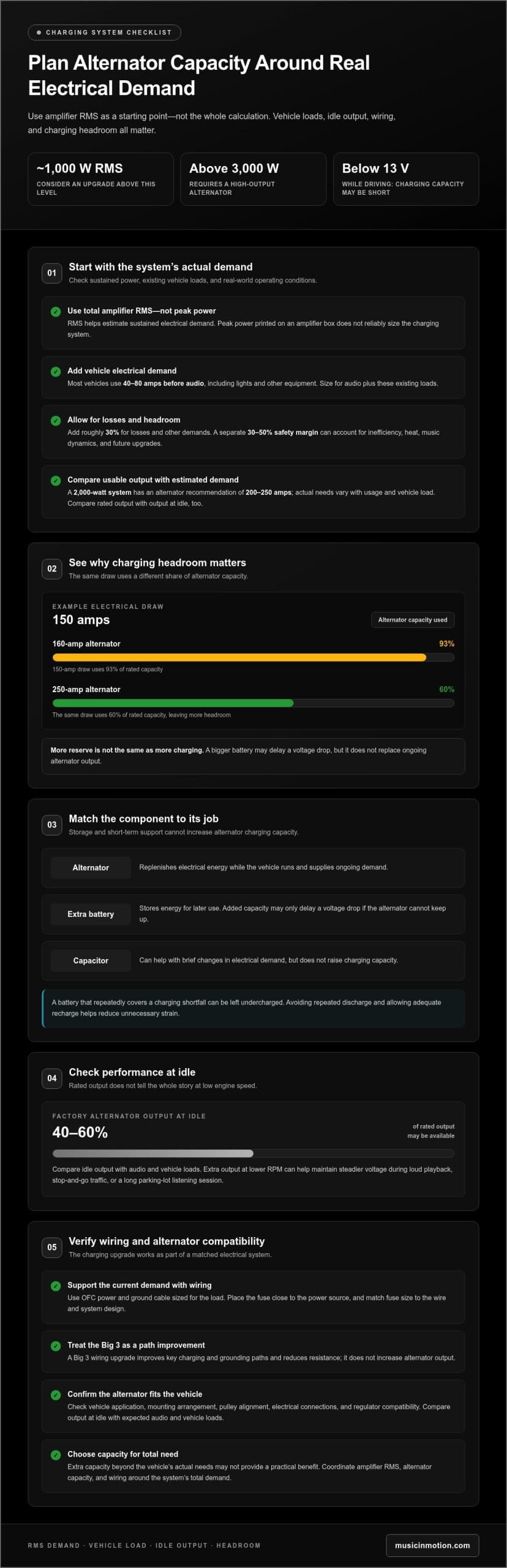
Consider an alternator upgrade if audio demand exceeds charging capacity, especially above 1,000 watts RMS. The benefits of a high output alternator for car audio include added charging headroom for demanding systems.
Protecting Battery and Amplifier Lifespan
Alternator support helps maintain the electrical supply that a battery and amplifier depend on. If voltage drops below 13 volts while driving, the charging system may need more capacity. Repeatedly relying on a battery to cover that shortfall can leave it undercharged. A steadier supply helps the amplifier operate consistently during demanding passages, instead of contending with voltage sag. That matters when you want dependable playback over time.
Alternators Versus Extra Batteries
An alternator replenishes electrical energy while the vehicle runs; an extra battery stores energy for later use. That difference matters during extended listening, because added battery capacity may only delay a voltage drop when the alternator cannot keep up. For example, a 150-amp draw uses 93% of a 160-amp alternator’s capacity, compared with 60% of a 250-amp alternator’s capacity. A bigger reserve doesn’t replace ongoing charging.
Battery and Capacitor Support
A battery stores energy, while a capacitor can help with brief changes in electrical demand. Neither increases the alternator’s charging capacity, so both are supporting components, not substitutes for an upgrade. One benefit of a high-output alternator for car audio is its ability to supply ongoing demand while those components support the system. Match battery capacity and other supporting components to the audio system’s actual load.
Battery Life Considerations
Battery life depends partly on how often the battery supplies more power than the charging system replaces. An alternator operating at 60% of rated output has more headroom than one operating at 95%. Lower alternator load can support lower operating temperatures and longer service life. For the battery, avoiding repeated discharge and allowing adequate recharge helps reduce unnecessary strain during regular listening.
Alternator sizing by amplifier RMS wattage
Size the charging system based on total amplifier RMS output, the vehicle’s electrical load, and alternator output at idle. Choose a compatible unit by matching its fit and electrical characteristics to the vehicle, then compare its usable output with the system’s estimated demand.
Matching Alternator Size to RMS Wattage
RMS wattage helps estimate an amplifier’s sustained electrical demand; peak power printed on a box doesn’t size the system reliably. An amplifier’s current draw depends on its electrical demand and operating conditions. Add roughly 30% for losses and other demands, then account for the vehicle’s existing electrical needs. A 2,000-watt system’s alternator recommendation is 200-250 amps, with actual needs shaped by usage and vehicle load.
Sizing for the Actual Electrical Load
Alternator sizing should cover audio demand plus the vehicle’s other electrical loads, not amplifier wattage alone. Most vehicles use 40-80 amps before audio, including demands from lights and other equipment. A 30-50% safety margin can account for inefficiency, heat, music dynamics, and future upgrades. Also compare rated output with output at idle, since peak ratings don’t describe charging capacity during slow driving.
Wiring must support that electrical load. Use OFC power and ground cable sized for current demand, and place the fuse close to the power source. Match fuse size to the wire and system design. A Big 3 wiring upgrade improves key charging and grounding paths, reducing resistance without increasing alternator output.
Choosing a Compatible Alternator
Compatibility involves more than amperage. Check the vehicle application, mounting arrangement, pulley alignment, electrical connections, and regulator compatibility. Compare the alternator’s output at idle with expected audio and vehicle loads. Extra capacity beyond the vehicle’s actual needs may not provide a practical benefit, so base your choice on total demand.
A planned custom car audio installation can bring amplifier RMS, alternator capacity, and wiring into one coordinated system.
Benefits of stable voltage under heavy audio load
A high-output alternator supplies more charging current to support the audio system and other vehicle electronics. Its additional output at lower RPM can help maintain steadier voltage during loud playback at idle or in stop-and-go traffic.
Voltage Effects on Amplifier Performance
Stable voltage gives an amplifier a consistent electrical supply as music demand changes. That matters during bass-heavy passages, when sudden demand can expose limited charging capacity. With steadier input, the amplifier can perform more consistently across changing volume peaks. At idle, factory alternators may produce only 40-60% of rated output. That shortfall can affect audio while lights and vehicle electronics still need current. Idle output matters during a long parking-lot listening session.
Maintaining Stable Audio Performance
Stable audio performance means the system behaves more consistently as listening demand rises and falls. A high-output alternator is designed to deliver more amperage at lower RPM, which can matter in stop-and-go traffic when the engine repeatedly runs at low speed. Bass-heavy music can change amplifier demand quickly, and available charging current helps meet that demand alongside the vehicle’s other electrical loads. The result can be a steadier electrical supply as loud peaks alternate with quieter passages.
High-Output Alternator Role in the Audio System
A high-output alternator provides greater charging capacity for the audio system and other vehicle electronics. It supports electrical delivery, but it does not change the amplifier’s RMS rating or the recorded signal. The alternator supplies current; the amplifier and speakers shape playback. For example, loud music while idling puts demand on a lower-speed charging system. An alternator designed for stronger output at low RPM can help meet that demand and support more consistent voltage.
Audio system power thresholds
Audio power changes the charging plan as amplifier demand rises. Systems span roughly 500-5,000 watts or more, so one alternator size won’t suit every build. Use the amplifier’s total RMS rating, the vehicle’s existing electrical demands, and the alternator’s output at operating speed. Those factors show when factory charging capacity gives way to a high-output setup.
At 1,000 watts RMS, a system may warrant an alternator upgrade, especially with sustained heavy use. At 2,000 watts, recommendations rise to a 200-250-amp high-output alternator. By 3,000 watts, amplifier current can reach approximately 250-300 amps, depending on efficiency. A high-output alternator rated at 300 amps or more is recommended at this level. These are planning ranges, not substitutes for calculating the vehicle’s total electrical load.
Above 3,000 watts, a high-output alternator becomes essential to the charging plan. A 4,000-watt amplifier can draw 300-350 amps, depending on efficiency, with a 350-amp-or-higher alternator recommended. This level also calls for attention to wiring, grounding, and fusing. Big 3 wiring and 1/0 wiring are recommended alongside the alternator for systems above 3,000 watts.
A 5,000-watt system can draw over 400 amps at full load. The recommendation is a 400-amp-or-higher alternator, plus an upgraded battery or secondary battery bank. Properly sized power and ground wiring and fuses matter at this demand level. The engine’s charging system must support audio and the vehicle’s existing electrical needs together.
The practical takeaway: don’t choose an alternator from amplifier wattage alone. A 3,000-watt build and a 5,000-watt build place different demands on charging, batteries, and wiring. For a system above 3,000 watts RMS, plan a custom car audio installation around the complete electrical setup.
Music In Motion: Car Audio Upgrades
Music In Motion helps drivers plan car audio upgrades and custom installations around the complete system, including amplifier demand, charging capacity, and supporting wiring. For a high-powered build, this coordinated approach connects your audio goals with the electrical support your vehicle needs. Custom subwoofer enclosures can also be part of a system tailored to your sound goals. Music In Motion also creates tailored marine audio systems. Contact Music In Motion to discuss your car audio project and plan the components as a complete system.
Plan the Next Upgrade With Confidence
Treat your next audio upgrade as a complete system choice, not an isolated parts swap. The benefits of a high-output alternator for car audio matter most when the charging setup, amplifier demand, and intended listening use are considered together. Planning these elements together can help you avoid mismatched components and keep the project focused on the sound you want.
Before moving ahead, think about how you use your vehicle, what you want to change, and how the finished audio should feel on the road. Music In Motion can help you turn those priorities into a considered plan. Contact Music In Motion for audio advice and take the next step toward a system built around your goals.
Frequently Asked Questions
What size alternator do I need for a 3000 watt amp?
For a 3,000-watt car audio amplifier, consider a high-output alternator rated at 300 amps or more. The amplifier can draw approximately 250-300 amps, depending on efficiency, while the vehicle also needs electrical current. Treat the recommendation as a starting point, not a standalone calculation. Include the vehicle’s load, expected listening use, and alternator output at idle when planning the system.
Can I run two alternators on one vehicle for extra power?
Some vehicles can be configured with two alternators, but this is not a universal bolt-on upgrade. The engine bay needs suitable mounting and belt-drive arrangements, and both units must integrate safely with the vehicle’s electrical system. For many builds, a properly matched high-output alternator is the simpler approach. The right setup depends on the vehicle and its total electrical demand.
Do I need a bigger alternator if I only added a subwoofer, not a new amp?
Not necessarily; the deciding factor is whether the subwoofer adds amplifier demand. A passive subwoofer powered by an existing amplifier doesn’t add a separate electrical load by itself, but replacing or adding an amplifier can increase total RMS demand. Consider the amplifier’s actual power rating and how the system behaves during use. If voltage drops below 13 volts while driving, charging capacity may need attention.
How Big of an Alternator Do I Need for 5000 Watts?
A 5,000-watt car audio system calls for an alternator rated at 400 amps or higher. At full load, that system can draw over 400 amps, so the alternator is only part of the electrical plan. An upgraded battery or secondary battery bank is also recommended. Properly sized power and ground wiring, plus fuses matched to the wire and system design, support the installation.
Is a second battery a substitute for a bigger alternator?
No. A second battery stores electrical energy, while the alternator replenishes it as the vehicle runs. Extra battery capacity can support demand temporarily, but it does not increase charging-system output. If audio use repeatedly draws more power than the alternator replaces, the additional battery can also become depleted. Treat a battery bank as support, not a fix for inadequate charging capacity.
When Should I Upgrade My Alternator?
Consider an alternator upgrade if voltage falls below 13 volts while driving or your audio system exceeds about 1,000 watts RMS. Those signs point to a possible mismatch between charging capacity and electrical demand. Also consider your driving pattern: a system played loudly while idling needs adequate low-RPM output. Base the decision on total amplifier RMS power, vehicle loads, and intended listening use.