An amplifier’s signal-to-noise ratio tells you how far the wanted audio sits above background noise, measured in decibels. To understand what signal-to-noise ratio means in car audio, compare the signal and noise levels: a signal at -30 dB and noise at -90 dB produce a 60 dB SNR. A higher figure means more separation, but the measurement reference matters.
That’s why amplifier noise ratings can be confusing. A measurement taken at full power can look very different from one taken at one watt, even when the amplifiers have the same output rating. Power-supply noise may also occur outside the audible frequency range, so a number alone doesn’t tell the whole story.
This article explains what creates amplifier noise, how frequency range affects what you hear, and how to interpret SNR calculations without comparing unlike measurements. You’ll see why test conditions matter and what an amplifier’s rating can, and can’t, tell you about listening in your car.
Key Takeaways
- Use the SNR calculation to understand how strongly the wanted audio stands above the noise, and compare ratings only when their measurement conditions match.
- Look beyond the headline rating: CTA-2006-B measures amplifier noise at a defined output and load, giving you a clearer basis for comparisons.
- Consider where noise could be heard in your system. Speaker sensitivity, listening distance, and whether the amp drives midrange or high-frequency speakers all matter.
- Use the measurements as a guide, not the whole story. A well-matched car audio upgrade or custom installation also depends on how the components work together in your vehicle.
Audible frequency range and power-supply noise
An amplifier’s noise rating needs context: the measurement frequency range, output level, and reference point all affect how to interpret it. A clean-looking number may describe noise outside the frequencies you can hear.
Full-Power and One-Watt Noise Ratings
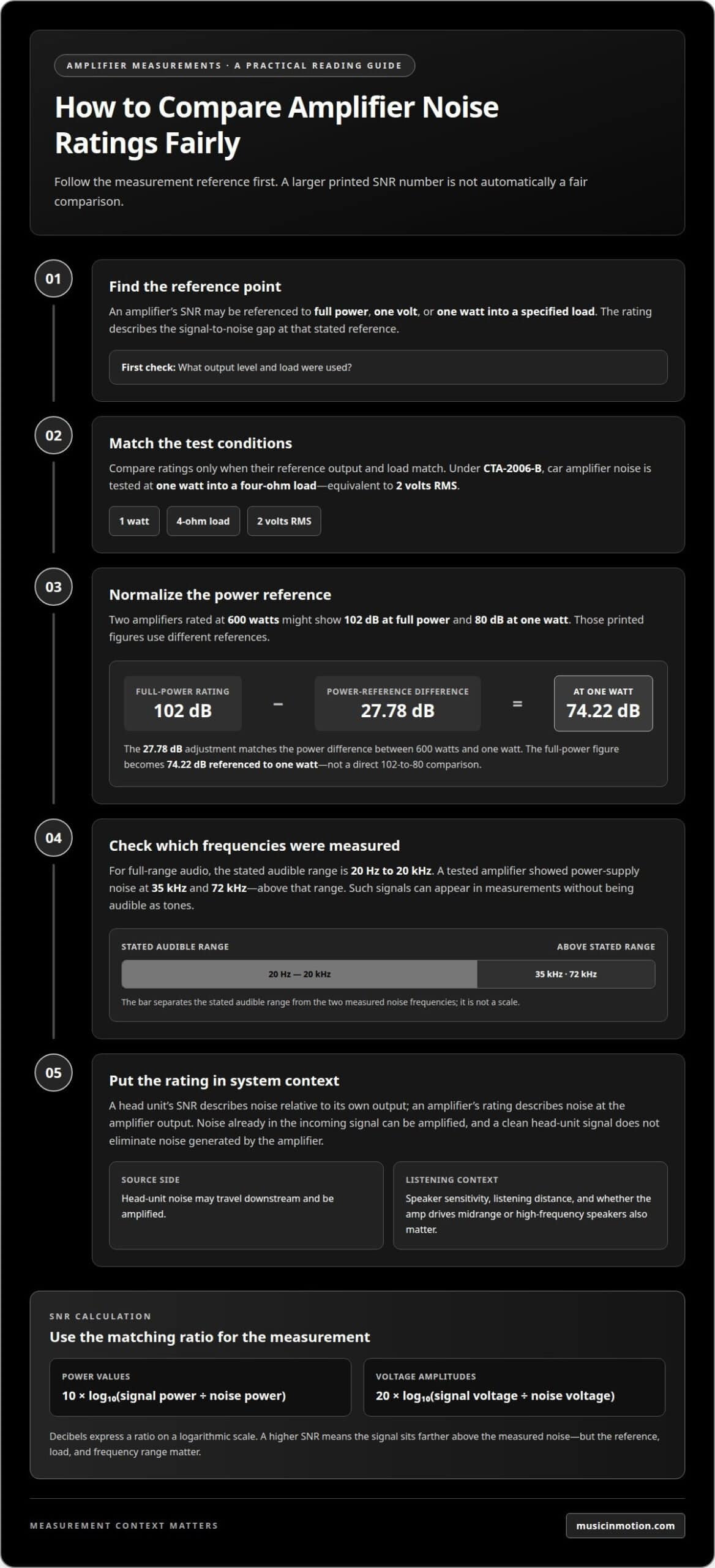
An SNR rating compares a reference signal with background noise at a stated output level. Full-power and one-watt ratings can look far apart because the reference signal changes. For example, two amplifiers rated at 600 watts might show 102 dB at full power and 80 dB at one watt. The first figure adjusts to 74.22 dB referenced to one watt, so comparing the printed numbers directly misleads.
The adjustment is 27.78 dB, matching the power difference between 600 watts and one watt. Always identify the reference before comparing amplifier ratings.
Head Unit and Amplifier SNR Ratings
A head unit’s SNR describes noise relative to its own audio output, while an amplifier’s rating describes noise at the amplifier’s output. The amplifier rating is most relevant when judging noise from the amplifier itself. Head-unit noise can also travel downstream and be amplified.
For a meaningful system comparison, consider both ratings and their test conditions. A quieter amplifier can’t remove noise already present in the incoming signal, and a clean head-unit signal doesn’t eliminate noise generated by the amplifier.
Frequency response matters, too. An amplifier intended for full-range audio should produce rated power from 20 Hz through 20 kHz, or to its design’s upper frequency limit. A tested amplifier showed power-supply noise at 35 and 72 kHz, above the stated audible range of 20 Hz to 20 kHz. Those signals can appear in measurements without being audible as tones.
SNR uses logarithmic ratios: power-based SNR is 10 times the base-10 logarithm of signal power divided by noise power. With voltage amplitudes, use 20 times the base-10 logarithm of signal voltage divided by noise voltage.
More power doesn’t translate into an equal jump in perceived volume. Doubling amplifier power raises output by 3 dB; moving from 300 watts to 305 watts adds just 0.07 decibels. The reference, frequency range, and actual listening level help put amplifier calculations in context.
What Is Signal-to-Noise Ratio And How It Work?
SNR compares an audio signal with background noise. Its value depends on both levels and the measurement conditions.
Recommended SNR Levels
Recommended SNR levels are comparison points, not guarantees of sound quality. An 80 dB rating is considered good enough for most electronic audio components, while a system SNR should not fall below 70 dB. High-fidelity speakers are described as needing more than 110 dB, but speaker SNR figures require care because speakers aren’t usually rated like powered electronics.
Treat these figures as context, not a universal equipment ranking. A high specification doesn’t guarantee better sound in a car: installation, speaker sensitivity, and noise elsewhere in the signal chain also affect what you hear.
Signal and Noise Reference Levels
A reference level is the signal output used as a benchmark when measuring noise. Amplifier SNR may be referenced to full power, one volt, or one watt into a specified load, so two figures aren’t directly comparable unless their reference points match.
The noise level is measured against the chosen signal reference. For example, a rating tied to one output level describes the gap at that level, not necessarily at every listening level. Check the stated reference before deciding which component has the quieter output.
Car Audio Measurement and Decibels
Decibels express a ratio on a logarithmic scale, making them useful for comparing a signal with noise across a wide range of levels. Under CTA-2006-B, car amplifier noise is tested at one watt into a four-ohm load. This standard condition gives a consistent basis for reading amplifier measurements.
The Centers for Disease Control and Prevention explains that noise is measured in decibels (dB). A higher SNR means the signal is farther above the measured noise, but the figure is meaningful only alongside its test conditions.
Reducing Noise and Improving SNR
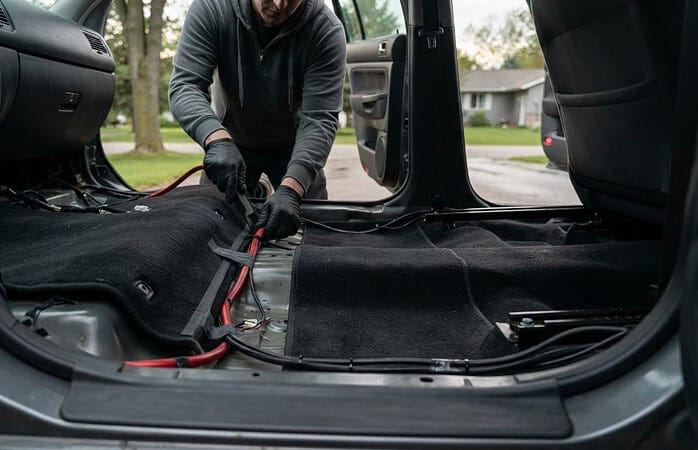
To reduce noise, find where unwanted sound enters the signal chain and address it there. In a car system, installation checks include secure grounds, clean connections, sensible cable routing, and appropriate amplifier gain. These steps can help prevent interference and avoid amplifying noise already present in the source.
To reduce noise and improve SNR, trace whether it follows the source, cables, or amplifier, then correct the relevant connection or gain setting. A careful car audio upgrade can bring component matching and installation details together.
Amplifier signal-to-noise ratio calculations
Calculating an amplifier’s SNR means comparing its wanted output with residual noise under stated test conditions. A 50 dB gap between a reference tone and a quieter tone represents their measured separation, not a promise about every listening setup.
A test-tone example uses a 250 Hz reference recorded at 0 dBfs, followed by a quieter tone. If the tones differ by 50 dB, that difference illustrates the SNR calculation. For voltage measurements, compare signal voltage with noise voltage using the logarithmic ratio; both measurements must use the same reference basis.
Manufacturers measure car-audio SNR under defined conditions so ratings can be compared meaningfully. CTA-2006-B specifies testing amplifier noise at one watt into a four-ohm load, equivalent to 2 volts rms. The measured noise is interpreted against that reference output. Without matching the output level and load, two published figures may describe different tests.
For example, a tested two-channel electronic amplifier had background noise of -120.43 dBV with its inputs shorted, while its manufacturer rated its SNR at -88 dB. Those figures describe different measurement details, so they shouldn’t be treated as directly interchangeable without matching references and test conditions.
Output level also affects an estimated rating. An amplifier’s estimated SNR can vary with output level, assuming no additional noise is added. At its full 300-watt capability, the estimate is about -116.7 dB. These calculations show why the reference output must accompany an SNR value.
To interpret a spec, identify the standard, load, output reference, and whether the value comes from measurement or estimation. A number such as -88 dB alone doesn’t explain the entire test; CTA-2006-B conditions supply essential context.
How is car audio SNR measured, and what does dB mean?
Car-audio SNR testing compares a controlled signal with unwanted noise measured from an amplifier. The result is expressed in decibels, or dB, and depends on the test conditions as well as the equipment.
The Consumer Technology Association’s CTA-2006-B standard specifies car-amplifier power and SNR measurements. For its noise test, the amplifier produces 1 watt into a 4-ohm load, equivalent to 2 volts rms. Power measurements use a 14.4-volt supply and allow no more than 1 percent total harmonic distortion and noise. These details make ratings easier to interpret on consistent terms.
A decibel is a logarithmic way to express a ratio, not a direct measure of sound intensity. For power, the calculation is 10 times the base-10 logarithm of signal power divided by noise power. For voltage amplitudes, it’s 20 times the base-10 logarithm of signal voltage divided by noise voltage. The appropriate formula depends on what the test measures.
Test results can also show where distortion appears. In one amplifier measurement, a 1 kHz signal registered 6.03 dBV, while a third-harmonic spike at 3 kHz sat 91.9 dB below the test signal. That difference describes a specific component in the measurement, not every sound the system produces.
Read an SNR figure alongside its standard, reference output, load, and test signal. A rating without those conditions can’t show whether another amplifier was measured on equal terms. CTA-2006-C was expected to add more detail about amplifier-noise measurement, while CTA-2006-B provides the stated test basis here.
If you want your system’s components and installation evaluated together, explore a car audio upgrade tailored to your vehicle and listening goals.
Music In Motion
Music In Motion helps drivers turn amplifier specifications into a car audio system designed around their listening goals. If hiss, unclear ratings, or mismatched components have you questioning an upgrade, a custom installation can bring the source, amplifier, speakers, and wiring together as one system.
We focus on the finished result, not a single specification in isolation. A rating can guide component choices, while equipment matching and installation shape how the system performs in your vehicle. Car audio upgrades and custom subwoofer enclosures can also help tailor a setup to your preferred balance of detail and bass.
If you’re planning a system change or want to discuss your audio setup, contact Music In Motion.
Build a Quieter, Better-Matched Listening Experience
Knowing what signal-to-noise ratio in car audio means gives you a stronger starting point for choosing a sound system. The next step is connecting specifications to your priorities. Consider what you want to hear clearly, whether hiss stands out during quiet passages, and how the system should sound during everyday listening. Those details turn a technical rating into a more useful design decision.
Music In Motion can help translate those priorities into a coordinated setup, with Car Audio Upgrades and Custom Installations for vehicles, as well as Marine Audio Systems for time on the water. Note which sources or listening moments make an issue noticeable, and whether it affects vocals, detail, or bass. That context can guide decisions about component matching and the sound you want from the finished system.
When you’re ready to explore options for your vehicle or boat, contact Music In Motion for help. Your listening goals are a great place to begin.
Frequently Asked Questions
What Causes Noise in an Amplifier?
Amplifier noise can come from its power supply, internal electronic components, or interference entering through connected wiring. A faint hiss with the audio source paused may indicate noise within the signal chain. A buzz that changes when another electrical device is switched on can point to interference entering the system. Gain settings matter too: excessive gain can make existing source noise more noticeable.
What does signal-to-noise ratio (SNR) mean in car audio?
Signal-to-noise ratio describes how much louder the intended audio signal is than unwanted background noise. To understand what signal-to-noise ratio in car audio means, picture music playing over a quiet hiss: a greater separation gives details more room to stand out. The rating describes a measured relationship, not a guarantee that every component or recording will sound equally clean.
What is a good SNR rating for a car stereo, amplifier, or DAC?
There isn’t one useful SNR cutoff for every car stereo, amplifier, or DAC. Compare ratings only when the reference level and test method match. Otherwise, a larger printed figure may reflect different conditions rather than quieter performance. For a DAC, consider its output in the context of the components it feeds. The audible result also depends on how the system’s parts work together.
How does SNR affect audible hiss, hum, and music clarity in a car?
SNR affects how easily background noise competes with music, especially during quiet passages or between tracks. Hiss can mask soft vocal details, while a low hum may become obvious when playback pauses. If noise is audible with the stereo muted, turning up the music won’t remove its source. The noise’s tone and timing can help distinguish a system issue from recorded sound.
What is the difference between SNR, dynamic range, and total harmonic distortion?
SNR compares a wanted signal with background noise; dynamic range describes the span between the quietest and loudest usable levels. Total harmonic distortion, or THD, measures added harmonic components relative to the original signal. These measures describe different performance traits. A component can have a strong SNR figure yet still introduce distortion, so one specification can’t replace the others.
What causes noise in car audio systems, such as alternator whine and ground loops?
Alternator whine can occur when electrical interference reaches the audio signal, while a ground loop can arise from unwanted current between components with different ground potentials. Poor connections and signal cables routed alongside power wiring can also contribute to noise. Whine that changes with engine speed suggests an electrical source; a steady hum may point to grounding or another connection in the system.