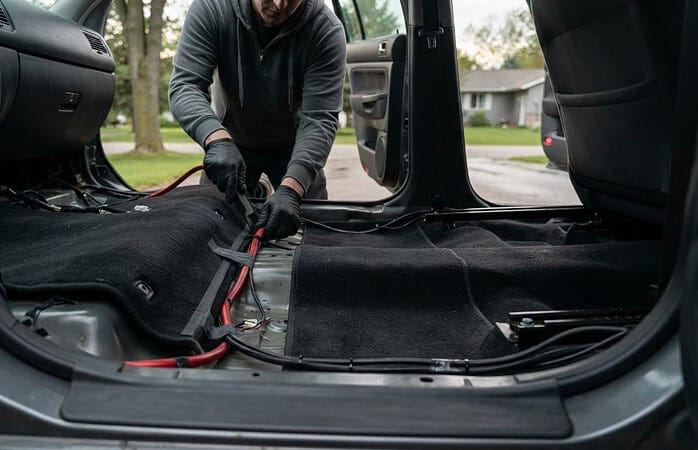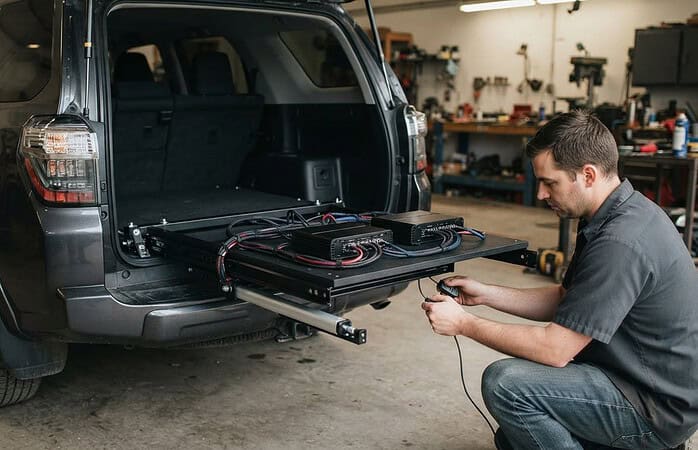
A bigger battery isn’t automatically the right fix for a bigger stereo. Whether you need a second battery for your car stereo depends first on system wattage: below 1,500 watts, an AGM upgrade may be enough; from 1,500 to 3,000 watts, consider a high-performance AGM battery and electrical upgrades; at 3,000 watts or more, multiple batteries or lithium may be appropriate. The alternator still has to keep up.
If you’re asking, “Do I need a second battery for my car stereo?”, consider how and where you listen. Extra stored power can help during extended listening with the engine off, but it can’t create charging current or fix every voltage-drop issue. This guide explains how a secondary battery, alternator capacity, power distribution, and system wattage affect performance, so you can decide whether another battery suits your setup.
Key Takeaways
- Use system wattage as a starting point, then weigh whether the alternator can keep up with the added electrical demand.
- Battery placement should support the amplifiers while allowing safe, practical power and cable routing.
- Voltage-drop checks can help pinpoint whether the issue lies in the positive or ground path, rather than a lack of battery capacity.
- Match the battery to how the system is used, especially its power demands and how often the stereo plays with the engine off.
Alternator output and charging limitations
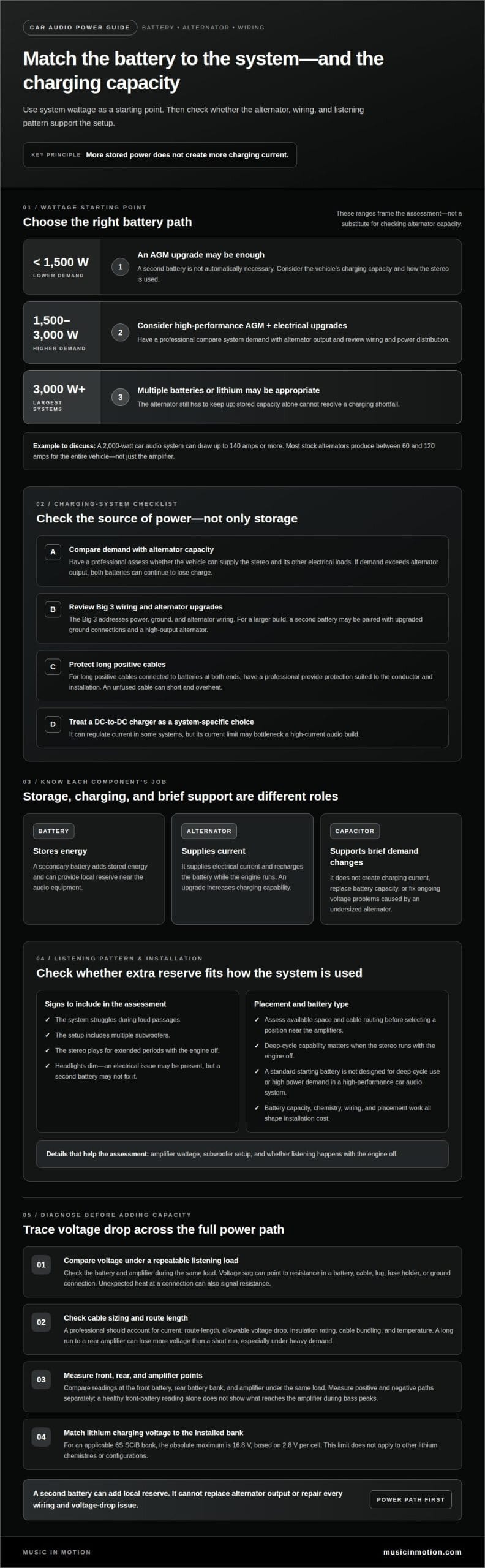
Have a professional assess charging capacity before adding a second battery. If the vehicle and amplifier demand more current than the alternator supplies, both batteries can continue to lose charge.
1. Identify Battery, Alternator, and Capacitor Roles
Understand what each component does. The battery stores energy, while the alternator supplies electrical current and recharges the battery as the engine runs. A capacitor can support brief changes in demand, but it doesn’t create charging current or replace battery capacity. For example, it won’t fix ongoing voltage problems caused by an alternator that can’t meet the system’s demand.
2. Assess Stock Alternator Capacity
Have the professional compare the stereo’s demand with the vehicle’s available alternator output. Most stock car alternators produce between 60 and 120 amps for the entire vehicle, not just the amplifier. A high-powered stereo can place a substantial demand on the vehicle’s charging system alongside other electrical loads. That comparison helps show why adding stored capacity alone may not solve a charging shortfall.
3. Review Big 3 Wiring and Alternator Upgrades
Ask the installer to assess the Big 3 wiring alongside alternator capacity. This upgrade addresses power, ground, and alternator wiring, improving the paths that carry current through the electrical system. For a larger audio build, a second battery may be paired with upgraded ground connections and a high-output alternator. The alternator upgrade increases charging capability; the extra battery stores energy. Neither should be treated as a substitute for the other.
Have a professional review protection for long positive cables connected to batteries at both ends. Each energy source needs protection suited to the conductor and installation. An unfused cable can short and overheat. A DC-to-DC charger can regulate current in some systems, but its current limit may bottleneck a high-current audio build.
Where will a professional install a secondary lithium car audio battery?
A professional assesses system demand, listening habits, and available space before choosing a battery position. This helps distinguish a need for extra reserve from a charging or wiring issue.
- Look for signs of electrical strain. Consider whether the audio system struggles during loud passages, includes multiple subwoofers, or plays for extended periods with the engine off. Those demands can make extra stored energy useful. Headlights that dim can also signal an electrical issue, but a second battery may not fix dimming when another problem is present.
- Match the assessment to system demand. A 2,000-watt car audio system can draw up to 140 amps or more. At 3,000 watts or more, multiple batteries or lithium batteries may be appropriate. These wattage ranges help frame the discussion, but the professional also considers the alternator and how the vehicle is used.
- Choose a practical location near the amplifiers. A secondary battery can provide a local current source and stored energy close to the audio equipment. The installer evaluates available vehicle space and cable routing before selecting a position. Placement should support the power-distribution plan, rather than simply adding a battery wherever it fits.
- Specify a battery for the listening pattern. Deep-cycle capability matters when the stereo runs with the engine off, because that use draws stored energy over time. A standard starting battery isn’t designed for deep-cycle use or high power demand in a high-performance car audio system. Battery capacity and chemistry also shape the installation’s cost, along with the required wiring and placement work.
Share the amplifier wattage, subwoofer setup, and whether you listen with the engine off. These details help a professional assess battery placement and the electrical plan for your specific car audio system.
Voltage drop and power distribution
Have a professional assess voltage at key points while the amplifier is under load. A second battery can add local reserve, but cable resistance or a charging mismatch can still limit performance.
-
1. Check Voltage Sag and Internal Resistance
Compare voltage at the battery and amplifier during a repeatable listening load. Voltage sag can point to resistance in a battery, cable, lug, fuse holder, or ground connection. A one-second pulse-current test doesn’t show whether a battery can sustain five or ten seconds of heavy bass. Unexpected heat at a connection can also signal resistance.
-
2. Have a Professional Size Cables to Limit Voltage Drop
Have a professional size each cable for current, route length, and allowable voltage drop. The assessment should also account for insulation rating, cable bundling, and temperature. A long cable run from the vehicle battery to a rear amplifier can lose more voltage than a short run, especially under heavy demand. Correct cable sizing and sound connections help deliver power, but a second battery won’t fix every wiring issue.
-
3. Have a Professional Test Voltage Under Load
Request readings at the front battery, rear battery bank, and amplifier under the same repeatable load. Comparing all three points helps locate where voltage drops across the installation. A professional measures the positive and negative paths separately, since resistance can occur on either side of the circuit. A healthy reading at the front battery alone doesn’t show what reaches the amplifier during bass peaks.
-
4. Confirm SCiB LTO Charging Voltage
For an applicable 6S SCiB bank, the absolute maximum is 16.8 V, based on 2.8 V per cell. The charging setup must respect that battery-specific limit. Don’t apply this figure to other lithium chemistries or configurations. The professional matches charging voltage to the installed bank, then assesses the full power path to the amplifier.
How a professional matches a car audio battery to system wattage
A professional uses amplifier wattage as a starting point, then considers battery capacity, listening habits, and charging support. Wattage informs the decision, but it doesn’t determine by itself how long the system can play.
- Match the system to a starting range. For a car audio system under 1,500 watts, an AGM battery upgrade that fits directly may suit the build. From 1,500 to 3,000 watts, the recommendation is a high-performance AGM battery alongside electrical upgrades. At 3,000 watts or more, multiple batteries or lithium may be appropriate. These ranges offer a practical starting point, not a substitute for assessing the whole vehicle.
- Account for how the engine is used. If the stereo plays with the engine off, the battery supplies energy without the alternator replenishing it during listening. Deep-cycle capability becomes especially important for that use. A system played mainly while driving has a different pattern, so the professional compares expected listening time with charging support and amplifier demand.
- Use capacity to estimate runtime. A basic estimate multiplies battery capacity in amp-hours by 10, then divides by load watts. For example, a 75Ah battery powering a 500W amplifier is estimated to run for 1.5 hours using that formula. Treat this as a planning estimate, not a promise of actual play time; listening level and system conditions affect energy use.
- Choose the complete electrical plan. Adding battery capacity doesn’t increase the alternator’s charging output. The professional weighs the battery, alternator, wiring, and how the vehicle is driven as one system. A larger build may call for multiple batteries or a lithium setup, while a smaller one may need a different upgrade. The aim is a matched setup, not simply the largest battery.
For a wattage-based assessment and a professionally planned car audio battery installation, share your amplifier power and listening habits.
Music In Motion
Music In Motion helps drivers turn battery questions into a complete car audio plan. A professional can assess system wattage, listening habits, alternator capacity, and voltage readings together to determine whether you need a battery upgrade, a second battery, or other electrical changes. This system-wide view matters because adding battery capacity alone won’t resolve every charging or wiring limitation.
A custom installation plan also considers battery placement, cable routing, and how power reaches the amplifiers. If your setup includes a custom subwoofer enclosure or a broader audio upgrade, these details can be part of the overall build.
Contact Music In Motion to discuss your car audio system and the battery setup you’re considering.
Plan Your Next Upgrade with Confidence
Whether your car stereo needs a second battery depends on more than the amplifier’s power rating. The next step is a complete plan suited to your vehicle, listening habits, and preferred sound. A well-matched system is about making every component work together, not simply adding hardware.
Music In Motion can help shape that plan with car audio upgrades and custom installations. Its marine audio work also reflects the need to tailor sound systems to different vehicles and uses. Share your system goals and listening habits to explore an approach designed for your setup.
Discuss your car audio plans with Music In Motion and take the next step toward a system that fits your drive.
Frequently Asked Questions
Do Big Car Stereos Need Extra Batteries?
To decide whether you need a second battery for your car stereo, compare audio demand with the vehicle’s charging system and how you use the car. Several amplifiers and long parked listening sessions place different demands on a battery than a modest system used while driving. High wattage is a reason to assess the whole electrical system, not an automatic reason to add another battery.
How can a professional estimate how long your battery will last with the engine off?
A professional can estimate runtime by multiplying battery capacity in amp-hours by 10, then dividing by the audio system’s load in watts. For example, a 75Ah battery powering a 500W amplifier gives an estimated 1.5 hours using that calculation. Treat this as a planning estimate, since actual listening demand can vary with volume and music.
How much current does my amplifier draw?
Current draw depends on amplifier power demand and system operating voltage. A professional uses those figures to estimate current, then considers playback conditions. A steady passage and a demanding bass section may draw different amounts. The vehicle’s other electrical loads also affect how much capacity remains for audio, so amplifier wattage is only one part of the assessment.
Will a second battery stop headlights dimming?
A second battery can add reserve, but it won’t necessarily stop headlights from dimming. The cause may be charging capacity, cable resistance, or another part of the vehicle’s electrical system. A professional can compare voltage at the battery and amplifier during a repeatable audio load to identify whether the issue is power delivery rather than stored battery capacity.
When does a car stereo need a second battery?
A professional can determine whether you need a second battery for your car stereo by considering how you use the vehicle, not wattage alone. Extended listening with the engine off or high amplifier demand can make extra reserve useful. The assessment should also consider whether the charging system can replenish energy while driving. If it can’t keep up, adding battery capacity alone won’t solve the mismatch.
How much power does a car stereo amplifier draw?
An amplifier’s power demand varies with its output and how the system is played. Its rated wattage helps a professional estimate electrical needs, but doesn’t describe every listening moment. Speakers, typical volume, and whether the engine is running also affect demand. Sharing those details makes the assessment more useful than relying on amplifier rating alone.