What if the most expensive component in your vehicle’s sound system isn’t the speakers, but the dashboard you are afraid to touch? Most drivers settle for muddy, distorted audio because they don’t want to lose their steering wheel controls or factory navigation. With 68% of new vehicles now featuring complex touchscreen infotainment units, the idea of a car audio upgrade for stock stereo feels like a gamble. We understand that fear. You shouldn’t have to sacrifice your car’s brain just to fix its voice.
At Music In Motion, we don’t just sell products; we sell solutions that bring your music to life. We specialize in seamless OEM integration that transforms your factory system from flat to phenomenal without losing a single dashboard feature. Whether you want a mild improvement or a crazy custom build, our team is here to help you navigate the latest 2026 technology and standards like IEC 63479-3. This guide provides a clear roadmap for upgrading your sound in stages. You will learn how to achieve crystal clear audio at any volume while keeping your tech and warranty perfectly intact.
Key Takeaways
- Understand why cost-efficient factory paper cones and low-wattage head units are the primary causes of distorted, “flat” audio.
- Discover how a car audio upgrade for stock stereo uses OEM integration to maintain your factory dashboard features while delivering high-fidelity performance.
- Learn why a Digital Signal Processor (DSP) is the essential “brain” required to fix factory tuning limitations and create a perfect soundstage.
- Follow a logical roadmap for improvement, starting with acoustic treatment to lower the noise floor of your vehicle’s cabin.
- Explore how tailored solutions can range from mild speaker swaps to crazy custom builds for anything that moves.
Why Factory Stock Stereos Fail the Driving Experience
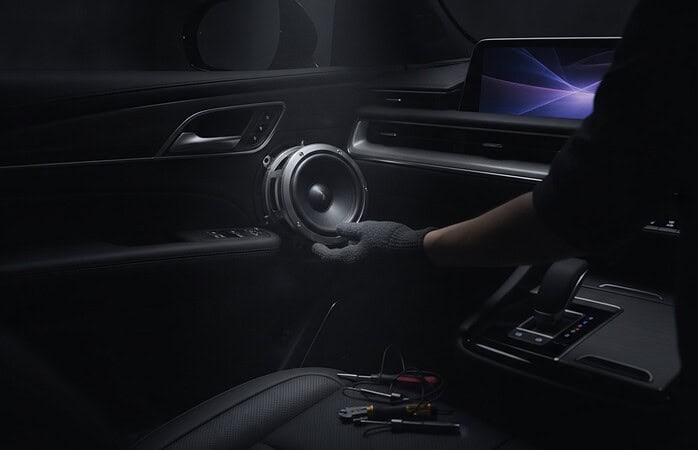
Most factory systems are designed to satisfy a balance sheet, not an audiophile. When you peel back the door panel of a brand-new vehicle, you often find speakers made of thin paper and tiny magnets. These components are built for cost-efficiency and lightweight shipping, not for acoustic fidelity. Because paper absorbs moisture and lacks rigidity, it flexes and distorts when you try to push it. This is why your favorite track sounds muddy the moment you turn the dial past halfway. Historical developments in vehicle audio systems have made dashboards more complex, but the actual speakers remain the weakest link in the chain.
We believe there is a massive difference between simply hearing your music and actually experiencing it. A car audio upgrade for stock stereo bridges that gap by replacing flimsy factory parts with high-performance materials like silk, carbon fiber, or treated hemp. These materials respond faster and more accurately to the signal, ensuring you hear every breath from the vocalist and every snap of the snare drum.
The Weakest Link in Your Factory System
The primary bottleneck in your car is usually a combination of poor speakers and power starvation. Most factory head units only produce about 10 to 15 watts of clean power. When you try to overcome road noise at highway speeds, you turn up the volume and force the tiny internal amplifier to its limit. This causes clipping, a form of distortion that sounds like harsh static and can actually destroy your speakers. Even systems with premium branding often use the same low-grade amplification, relying on digital tricks rather than actual hardware quality. We don’t just sell products; we sell solutions that provide the muscle your music needs to stay clear at any speed.
The Physics of Better Sound
Manufacturers use aggressive pre-set EQ curves to protect their cheap speakers. As you turn the volume up, the factory system automatically rolls off the bass to prevent the paper cones from tearing. This leaves you with a thin, hollow sound exactly when you want it to feel full. Additionally, factory speaker placement often ignores the importance of sound staging. With woofers buried in the lower doors, the music feels like it is coming from your shins rather than the stage in front of you. A professional car audio upgrade for stock stereo fixes these physical limitations through strategic placement and signal correction. Acoustic transparency is the ability of a sound system to reproduce an audio signal without adding any coloration or distortion from the equipment itself. We aim for this level of clarity in every installation, whether it is a mild speaker swap or a crazy custom build for anything that moves.
Essential Components for a High-Performance Audio Upgrade
Building a high-performance system is about creating synergy between parts. Many retailers treat speakers and amplifiers as separate items, but we see them as a unified team working to overcome your car’s acoustic challenges. A successful car audio upgrade for stock stereo requires a balanced approach where every component supports the next. You can Improve Your Sound Without Replacing Your Factory Radio by focusing on the four pillars of acoustic performance: speakers, amplification, low-frequency support, and environmental control. When these elements work in harmony, the driving experience changes from a chore into a luxury.
Component speakers are the gold standard for creating a “live” soundstage. By separating the tweeter from the woofer, we can mount the high-frequency drivers higher on the dash or A-pillars. This lifts the music from your floorboards to your eye level, mimicking the feel of a front-row concert. While component sets offer the best imaging, coaxial speakers remain a reliable and efficient choice for rear fill or space-constrained locations. To ensure that new detail isn’t lost, we recommend sound deadening. This is the “silent” upgrade. It uses specialized damping materials to reduce panel vibration and block external road noise, effectively lowering your vehicle’s noise floor.
Low-frequency support is the final piece of the foundational puzzle. According to industry data, 63% of aftermarket consumers choose to add a subwoofer to their systems. Factory speakers are too small to move the air required for deep bass. Adding a dedicated subwoofer, even a compact one, provides the rhythmic impact that makes music feel complete. If you are curious about how these parts fit into your specific vehicle, our team specializes in custom installations tailored to your needs.
Choosing the Right Speakers for Your Cabin
Your cabin’s layout and your personal taste dictate the best speaker materials. Silk dome tweeters offer a warm, lovely sound that is perfect for long commutes. In contrast, metal domes provide a brighter, more aggressive “bite” that helps music cut through wind noise in convertibles or motorcycles. For those researching specific hardware, bassjunkies.com features a helpful breakdown of the best car speakers for bass and sound quality. We always match speaker sensitivity to your power source to ensure your system performs efficiently without straining the hardware.
Amplification: More Than Just Volume
Amplifiers provide the muscle needed for clarity. At highway speeds, cabin noise often exceeds 70 decibels. A multi-channel amplifier provides the “headroom” necessary to keep your music crisp above that roar without clipping or distorting. Modern Class D amplifiers are incredibly efficient and small enough to hide under a seat, while Class AB options offer a traditional warmth for purists. We help you find the perfect balance on our “mild to crazy” scale to ensure your power matches your performance goals.
OEM Integration: Keeping Your Dashboard, Improving Your Sound
Many traditional guides suggest that replacing the radio is the first step toward better sound. In 2026, that advice is often outdated. Modern vehicles are built with 68% of new models featuring deeply integrated touchscreen infotainment units. These screens control your climate settings, vehicle diagnostics, and safety features. Removing them is usually impossible or creates more problems than it solves. A professional car audio upgrade for stock stereo focuses on OEM integration instead. This process allows us to keep your factory dashboard exactly as it is while building a high-performance audio foundation behind the scenes.
We use specialized tools like Line Output Converters (LOC) to bridge the gap between your factory wiring and high-end aftermarket amplifiers. These devices take the high-level signal meant for your stock speakers and transform it into a clean, low-level signal that an amplifier can use. This ensures you retain 100% functionality of your steering wheel controls, backup cameras, and the Bluetooth systems found in 76% of today’s vehicles. We don’t just sell products; we sell solutions that respect the integrity of your vehicle’s interior.
The Power of Digital Signal Processing (DSP)
A Digital Signal Processor is the ultimate brain for your audio system. Factory radios come with “hardcoded” EQ curves designed to make cheap speakers sound acceptable, which often means they lack real detail. A DSP flattens this signal, removing the factory’s artificial processing to give us a blank canvas. We then use time alignment to ensure the sound from every speaker reaches your ears at the exact same microsecond. This makes the driver’s seat feel like the center of a private concert. A DSP uses sophisticated algorithms to restore the low-end frequencies that factory systems suppress as volume increases.
Seamless Integration Solutions
Upgrading your sound shouldn’t mean hacking into your car’s brain. We utilize vehicle-specific plug-and-play harnesses that allow for a car audio upgrade for stock stereo without cutting a single factory wire. This is vital for modern vehicles that rely on complex data buses to communicate between components. By using smart interfaces, we ensure that your safety chimes, parking sensors, and navigation prompts continue to work in perfect harmony with your new speakers. Whether your goal is a mild enhancement or a crazy custom layout, professional integration protects your investment. We take pride in being masters of these technical details, ensuring your driving experience is improved without any loss of factory convenience. Beyond audio, many of our clients also explore our essential aftermarket vehicle safety systems upgrades for 2026 to further enhance their road awareness and protection alongside their new sound setup.
The Roadmap to a Perfect Car Audio Upgrade
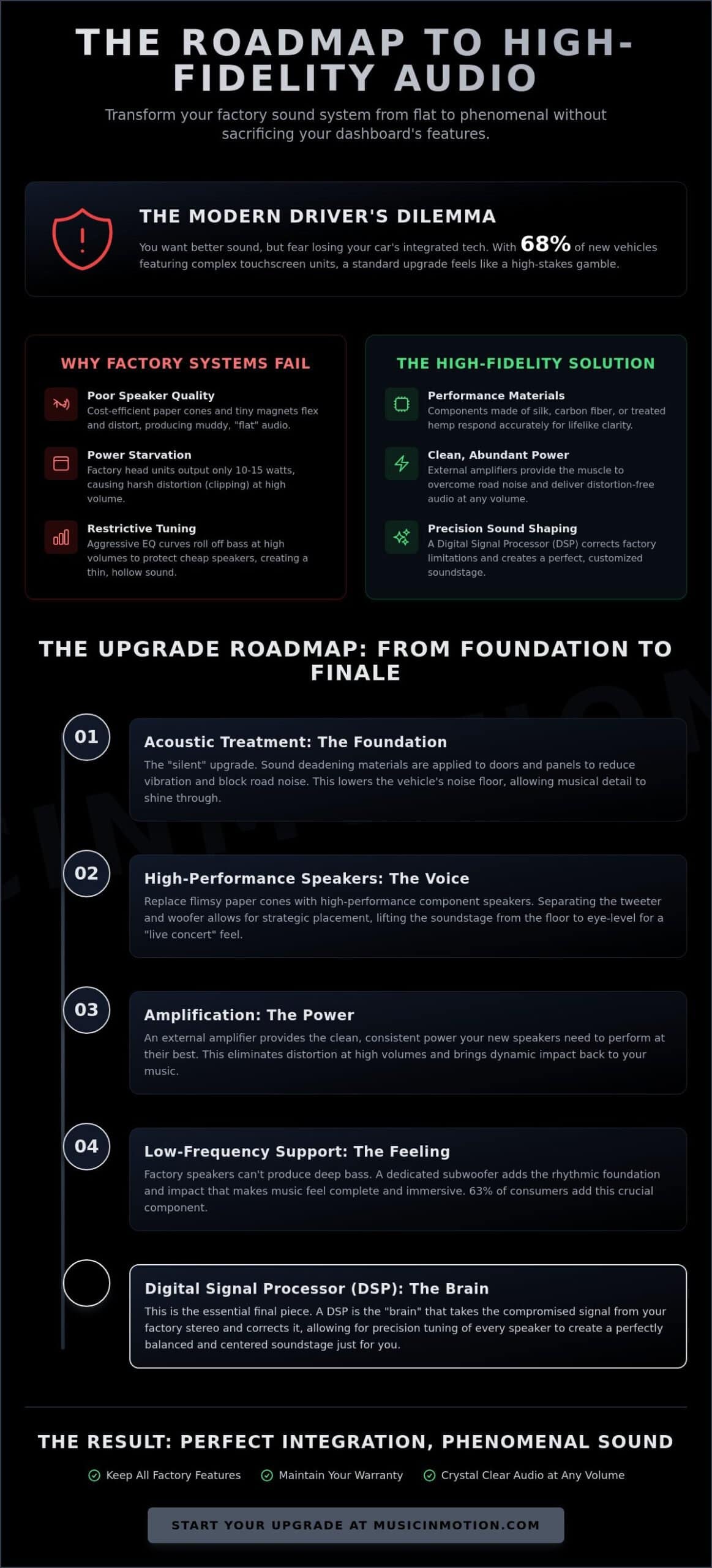
A successful project starts with a logical plan. Many drivers rush into buying hardware without a clear strategy, leading to mismatched components and wasted effort. We recommend a phased approach to your car audio upgrade for stock stereo to ensure every dollar spent translates into a tangible improvement in luxury and clarity. By following a proven roadmap, you can transform your vehicle’s cabin into a high-fidelity sanctuary in a way that fits your schedule and budget. Before diving into hardware purchases, it helps to work through a structured sound system for my car planning and component checklist so every decision is intentional and budget-aligned. We don’t just sell products; we sell solutions that evolve with your needs.
- Step 1: Acoustic Treatment. We start by applying specialized damping materials to the door skins and floor. This lowers the noise floor, allowing you to hear subtle details in your music that were previously drowned out by road noise. A professional sound deadening installation is the critical first step that makes every subsequent upgrade perform at its best.
- Step 2: Speaker Replacement. We swap those factory paper cones for premium materials like silk and carbon fiber. This is the most immediate way to improve tonal accuracy.
- Step 3: Power and Processing. Adding a multi-channel amplifier and a DSP provides the muscle and intelligence needed to drive your new speakers to their full potential.
- Step 4: Low-End Extension. We integrate a subwoofer to handle the deep frequencies your door speakers simply cannot reach.
- Step 5: Professional Tuning. Our experts use calibrated microphones to adjust the EQ and time alignment, creating perfect harmony in your listening position.
Custom Fabrication for a Factory Look
Sometimes a simple “bolt-on” solution isn’t enough to achieve the results you desire. Our team excels at car audio fabrication that blends seamlessly with your interior. We build custom speaker pods to optimize imaging and fabricate custom subwoofer enclosures that maximize your trunk space without sacrificing bass impact. Stealth installations are a specialty of ours; we can hide high-performance hardware in factory locations, keeping your car’s aesthetic completely stock while the sound is anything but.
Planning Your Build: Mild to Crazy
We believe every driver deserves a better experience, regardless of the scale of the project. We use a “mild to crazy” scale to help you identify your goals. A Stage 1 “Daily Driver” upgrade focuses on clarity and comfort for your morning commute. Moving to Stage 2 creates an “Audiophile” setup for those who demand critical listening and breathtaking detail. For those who want to push boundaries, our Stage 3 “Full Custom” builds offer maximum output and show-quality aesthetics for anything that moves. No matter where you land on the scale, we remain focused on the safety and functionality of your vehicle.
Why Music In Motion is the Solution for Your Car Audio
Choosing the right partner for your car audio upgrade for stock stereo is about more than just finding a shop with the right parts. It is about finding a team that understands the delicate balance between high-end technology and factory reliability. At Music In Motion, we bring over 30 years of expertise in custom fabrication and OEM integration to every project. We don’t just sell products; we sell solutions. This philosophy has guided our evolution from a small local shop into a large retail facility capable of handling national-scale projects with the same personal touch we provided on day one.
Our team focuses on simplicity and reliability. We know that your vehicle is a vital part of your daily life. Whether you need a standard navigation system for safety or a crazy custom build for competition, we treat every detail with the same level of care. We aim for perfect harmony in every installation, ensuring that your new audio components work seamlessly with your existing tech. Our solution-oriented style is designed to reassure you that your vehicle is in expert hands.
The Music In Motion Difference
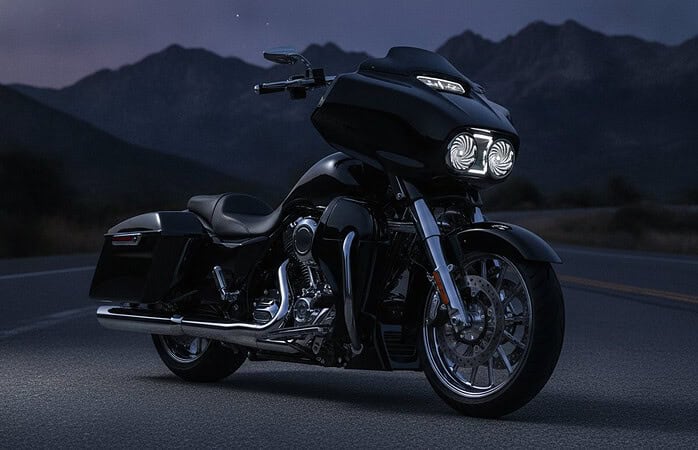
What sets us apart is our universal expertise in mobile electronics. We are “masters of all trades” within this niche. This means we bring the same level of enthusiasm and technical precision to a luxury sedan as we do to a rugged powersports vehicle, a boat, or a custom motorcycle. Our collaborative approach ensures that the system we design fits your specific lifestyle and driving habits. We identify your needs and immediately provide a corresponding service as the answer. From mild speaker replacements to the most complex signal processing, we have the specialized knowledge to enhance anything that moves. For drivers who want a truly bespoke result, our custom car audio fabrication services transform standard interiors into precision-tuned acoustic environments using advanced materials and modern engineering.
We take pride in our ability to solve problems that others avoid. Modern vehicles with complex data buses require a deep understanding of electrical architecture. Because we stay at the cutting edge of industry standards, we can perform a car audio upgrade for stock stereo that maintains every factory safety feature and sensor. Your car remains as reliable as the day you bought it, but with a soundstage that finally does your music justice.
Start Your Transformation Today
The path to better sound begins with a conversation. When you consult with our team, we don’t just point at a wall of speakers. We listen to your goals and design a tailored audio solution that respects your vehicle’s integrity. During our professional installation process, you can expect a steady, organized, and reassuring experience. We handle the technical hurdles of modern integration so you can simply enjoy the results.
Your vehicle’s cabin should be a place of luxury and excitement, not frustration over muddy sound. Transform your driving experience with a custom audio solution from Music In Motion. Let us help you unlock the hidden potential of your factory system today.
Take the First Step Toward Perfect Harmony
Your vehicle’s dashboard is a masterpiece of modern engineering, but its factory speakers are often a major compromise. We’ve discussed how swapping paper cones for premium materials and adding a DSP can fix muddy sound while keeping your steering wheel controls and safety chimes active. Since 1994, our team has specialized in stealth OEM integration that respects your car’s interior. We are masters of “anything that moves,” providing over 30 years of custom experience for cars, boats, and motorcycles alike.
Choosing a professional car audio upgrade for stock stereo is the most reliable way to unlock the detail and impact your music is currently missing. Whether you want a mild improvement for your commute or a crazy custom build, we focus on solutions that fit your life. Discover the perfect audio solution for your vehicle at Music In Motion. Don’t settle for flat audio when a phenomenal driving experience is just one consultation away. We are here to help you find your perfect sound.
Frequently Asked Questions
Will upgrading my car audio void my vehicle warranty?
No, the Magnuson-Moss Warranty Act of 1975 protects your right to use aftermarket parts. A dealer cannot void your warranty simply because you installed new equipment. They must prove that the aftermarket part specifically caused a failure. We use vehicle-specific harnesses to ensure our work is non-destructive and respects your car’s electrical integrity.
Can I keep my factory touchscreen and steering wheel controls?
Yes, we specialize in OEM integration that retains every factory feature you currently enjoy. A professional car audio upgrade for stock stereo uses smart interfaces to bridge the gap between your dashboard and new hardware. This ensures you keep 100% functionality of your steering wheel buttons, backup cameras, and safety chimes while enjoying significantly better sound.
What is the difference between a 2-way and 3-way component system?
A 2-way system uses a woofer and a tweeter, while a 3-way system adds a dedicated midrange driver. Adding that third speaker fills the acoustic gap between high and low frequencies. This results in a more detailed and lifelike soundstage. It is particularly effective for vocals and instruments that live in the midrange frequencies.
Do I really need an amplifier if I am only replacing the speakers?
While new speakers will improve clarity, an amplifier is necessary to unlock their full potential. Factory head units typically provide only 10 to 15 watts of power. High-quality aftermarket speakers often require 50 to 100 watts to move the cone accurately. Without enough power, you will experience distortion and a lack of impact at highway speeds.
What is sound deadening and why is it important for car audio?
Sound deadening involves applying vibration-damping materials to your vehicle’s metal panels. It is essential because it lowers the noise floor of your cabin by reducing road and wind noise. By stopping the metal from vibrating, it allows your speakers to perform more efficiently. This results in tighter bass and clearer mids without the distraction of rattles. Our comprehensive sound deadening installation guide for 2026 covers every zone of your vehicle and the specific materials needed to achieve a truly quiet, high-fidelity cabin environment.
How long does a professional car audio installation typically take?
Installation times range from 2 to 4 hours for a simple speaker swap to several days for a “crazy” custom build. A standard car audio upgrade for stock stereo involving an amplifier and signal processing usually takes a full workday. We prioritize quality and safety, ensuring every wire is loomed and every panel is perfectly reassembled.
Can I upgrade my audio system in stages or do I have to do it all at once?
You can absolutely upgrade in stages to fit your budget and long-term goals. We often recommend starting with acoustic treatment or a front speaker replacement as the first phase. This provides an immediate improvement while allowing you to add amplifiers or subwoofers later. We design our solutions to be expandable and future-proof for anything that moves, ensuring you can enjoy high-quality sound even if you eventually sell an older vehicle to cashforjunkcarsmichigan.com and start fresh with a new project.
What is a Digital Signal Processor (DSP) and do I need one?
A DSP is a specialized computer that corrects the audio signal coming from your factory radio. It is highly recommended because it flattens factory EQ curves and allows for precise time alignment. This ensures the sound from every speaker reaches your ears at the exact same microsecond. It transforms a basic system into a high-fidelity experience tailored to your cabin.