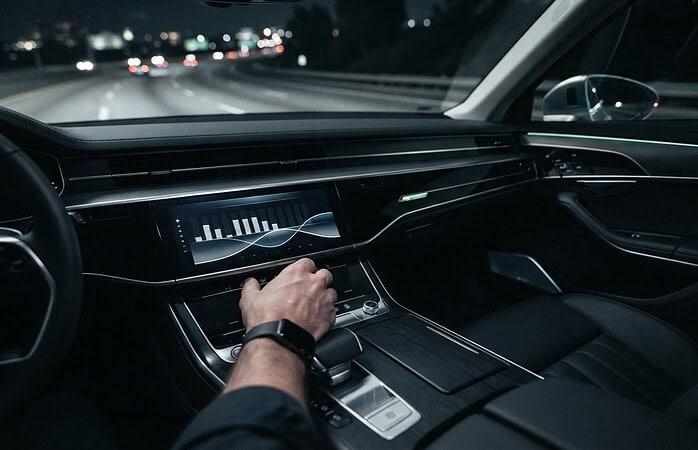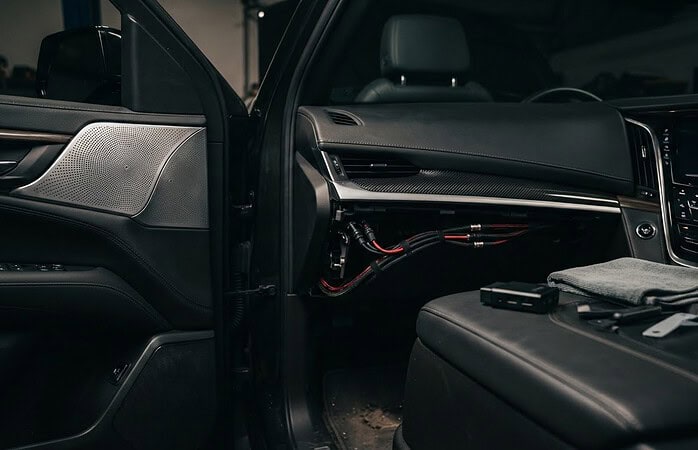
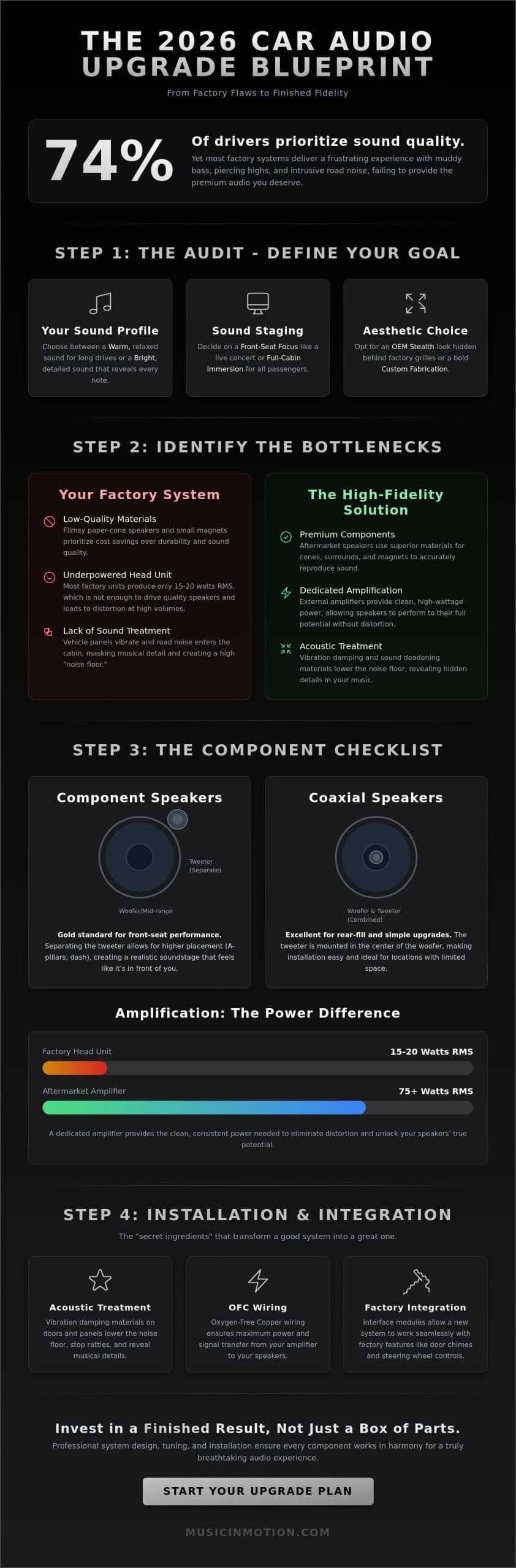
Recent surveys show that 74% of drivers prioritize sound quality above almost any other cabin feature, yet most of us are still squinting our ears through muddy factory bass and piercing highs. We’ve all been there; you turn up your favorite track only to have road noise drown out the melody or a tinny tweeter ruin the vibe. It’s frustrating when the sound system for my car feels like an afterthought from the manufacturer rather than a premium experience. You deserve a setup that matches the thrill of the drive, whether you’re cruising in a silent new EV or a classic powerhouse.
We believe that a truly great audio experience is a finished result, not just a transaction of parts. That’s why we’ve put together this expert-vetted 2026 planning and component checklist. You’ll learn how to navigate the technical jargon between coaxial and component systems, integrate the latest iOS 26 “Liquid Glass” features, and choose the right processing to achieve concert-quality staging. We’re going to walk you through every stage of a total upgrade, from sound deadening to high-resolution digital signal processing, so your vehicle finally sounds the way it was meant to.
Key Takeaways
- Identify the specific bottlenecks in your factory setup to determine if your primary goal is crystal-clear highs, massive volume, or deep bass impact.
- Navigate the selection of speakers and dedicated amplifiers to plan a sound system for my car that provides high-fidelity power beyond what any stock head unit can offer.
- Learn why vibration damping and acoustic treatment are the secret ingredients to lowering your vehicle’s noise floor and revealing hidden musical details.
- Master the technical requirements for a reliable installation, including the use of oxygen-free copper wiring and interface modules for seamless factory tech integration.
- Understand the difference between simply buying components and investing in a finished result through professional system design and custom subwoofer enclosures.
The Audit: Assessing Your Goals and Factory Limitations
Building a great sound system for my car begins long before we turn a single screwdriver. It starts with an honest audit of what you have and what you actually want to hear. We see many drivers jump straight into buying hardware without a plan, only to find that their new speakers don’t play well with their existing electronics. A successful upgrade is about the finished result, not just a collection of boxes. We want to help you identify the specific “bottleneck” in your current setup so every dollar you spend makes a measurable difference in your daily drive.
First, decide if you’re looking for a single-phase overhaul or a multi-stage build. A single-phase project replaces everything at once for immediate gratification. A multi-stage approach allows us to prioritize the most impactful changes first, such as front speakers and sound deadening, while leaving room for dedicated amplification or custom subwoofer enclosures later. This roadmap keeps your project organized and ensures that each new component complements the last.
Defining Your Sound Profile
Your musical taste dictates the hardware we choose. We use a simple checklist to help you narrow down your preferences:
- Warm vs. Bright: Do you prefer a smooth, relaxed sound that’s easy on the ears for long trips, or a bright, clinical sound that reveals every crisp detail in a recording?
- Sound Staging: Are you looking for a front-seat focus that mimics a live concert on your dashboard, or do you want full-cabin immersion for every passenger?
- Aesthetic Choice: Do you want an OEM-integrated stealth look that hides behind factory grilles, or are you excited about the bold look of custom fabrication?
The Factory System Audit
Modern vehicles are more integrated than ever. We have to look past the “premium” badge on your door panels to see what’s really happening. Most modern factory “premium” audio packages fail to deliver true high-fidelity because manufacturers prioritize weight reduction and bottom-line margins over high-quality magnet structures and durable cone materials. We often find flimsy paper-cone speakers even in luxury trim levels.
Analyzing vehicle audio systems reveals that your car’s brain does more than just play music. It handles door chimes, backup sensor alerts, and Bluetooth hands-free systems. We must identify these integrated features early. If we replace the head unit, we use specific interface modules to preserve those safety alerts. If we keep the factory radio to maintain the dash’s look, we focus on cleaning up the signal before it ever reaches your new amplifiers. This ensures your technology works seamlessly while your music sounds better than ever.
The Component Checklist: What Every System Needs
Think of your audio components as a balanced ecosystem rather than a simple shopping list. When we design a sound system for my car, we focus on how each part supports the others to create a cohesive result. Selecting the most expensive speakers won’t matter if they don’t have enough power to move, just as a powerful amplifier is wasted on a factory radio that outputs a distorted signal. We want to help you build a chain where every link is strong, ensuring your investment delivers the clarity and impact you expect.
Speakers: Coaxial vs. Component
Your speakers are the most visible part of the upgrade, but the type you choose depends on your vehicle’s layout. Component speakers are the gold standard for front-seat performance. These sets separate the tweeter from the mid-range driver, which allows us to mount the tweeters higher up on the dash or A-pillars. This physical separation creates a realistic soundstage where the music feels like it’s coming from in front of you rather than from your feet. Coaxial speakers, which house the tweeter and woofer in a single unit, are fantastic for rear-fill or installations where space is limited.
We always look at speaker sensitivity when matching them to a power source. If you’re running speakers off a head unit, you need high-sensitivity models (usually 90dB or higher) to get the most volume. However, high-end component sets often have lower sensitivity, meaning they require the steady, clean power of a dedicated amplifier to truly perform. Our team can help you navigate these car audio upgrades to ensure your speakers and power source are perfectly matched. Before finalizing your speaker selection, it’s also worth reviewing the best car audio brands of 2026 to understand which manufacturers consistently deliver the performance and reliability your system demands.
Amplification and Processing
Most factory head units only produce about 15 to 20 watts of RMS power per channel. This is the primary reason music sounds thin or distorts when you turn it up. Dedicated amplification provides the “headroom” necessary for dynamic peaks in your music. We frequently utilize Class D amplifiers because they are incredibly efficient and compact, making them easy to hide under seats or behind panels. While some purists still enjoy the traditional warmth of Class AB designs, modern Class D technology has evolved to offer stunning high-fidelity sound with much less heat.
Beyond raw power, Understanding Car Audio Systems in the modern era requires a Digital Signal Processor (DSP). We consider the DSP the brain of the system. It allows us to use time alignment so the sound from every speaker reaches your ears at the exact same moment. It also provides multi-band equalization to correct the acoustic reflections caused by glass and plastic interior surfaces. To fully unlock the potential of your DSP and amplification, investing in professional car audio tuning ensures every frequency is precisely calibrated to your cabin’s unique acoustic environment.
Finally, don’t forget the subwoofer. Most factory speakers can’t play notes below 60Hz, which means you’re missing the entire bottom octave of your music. A subwoofer doesn’t have to be about waking up the neighbors; it’s about providing the full-range frequency response that makes a kick drum feel real and a bass guitar sound rich. We often recommend a 5-channel amplifier as a smart way to power your entire cabin and a subwoofer from a single, space-saving unit.
Acoustic Treatment: Managing the Noise Floor
The most overlooked part of any audio project is the vehicle itself. You can buy the finest components available, but if you install them in a vibrating metal box, they will never reach their full potential. High-performance speakers create air pressure. That pressure moves your door panels, creating structural rattles and muddy mid-bass that mask fine musical details. We focus on managing the “noise floor,” which is the collective sound of road roar, wind, and engine vibration. Lowering this floor is like cleaning a dirty window; suddenly, you can see every detail of the landscape without distraction.
When we plan a sound system for my car, we treat the vehicle cabin as the speaker cabinet. If the cabinet is flimsy or resonant, the sound is compromised. Acoustic treatment turns your cabin into a quiet sanctuary where your music doesn’t have to compete with the outside world. This isn’t just about blocking external noise. It’s about controlling the energy your new speakers produce so that every note remains crisp and impactful.
The Sound Deadening Checklist
We recommend a systematic approach to treatment. You don’t always need to cover every square inch of the vehicle, but you must hit the high-vibration areas. You can find these spots with a simple “tap test.” Walk around your vehicle and knock on the center of the door panels and trunk lid. If you hear a hollow, metallic ring, that panel needs damping. If it sounds like a dull thud, it’s already fairly stable. We use Sound deadening materials to solve these issues. Our process typically involves two distinct layers:
- Butyl-based sheets: These add mass to metal panels to stop structural vibrations and “ringing.”
- Closed-cell foam: This layer acts as a decoupler, preventing plastic trim panels from rubbing against the metal and creating annoying squeaks.
Focus your efforts on the doors first, as they house your primary speakers. Follow this with the trunk and floorboards to eliminate tire roar. For a deeper dive into the technical process, check out our sound deadening installation guide.
Optimizing Speaker Placement
Factory speaker locations are rarely ideal for high-fidelity listening. They are often placed low in the doors or hidden behind thick, restrictive plastic grilles. We use custom baffle plates to decouple the speaker from the metal door skin, which prevents energy from leaking into the door cavity. This simple step tightens up bass response significantly. In more advanced projects, car audio fabrication allows us to build custom pods. These pods angle the speakers toward the listener, solving off-axis response issues and lifting the soundstage from your floor mats up to your dashboard. The goal is a finished result where the speakers and the vehicle work in total harmony.
The Installation and Integration Checklist
Installation is the bridge between a pile of high-end gear and a high-performance sound system for my car. Modern vehicles rely on complex data networks, often referred to as CAN-bus systems, which control everything from your steering wheel buttons to your backup camera. We don’t just splice wires anymore. We use sophisticated interface modules and vehicle-specific harnesses to ensure the car’s computer stays happy while your new audio system thrives. This level of technical integration is what separates a reliable daily driver from a project plagued by electrical gremlins.
We treat every installation as a long-term commitment to your vehicle’s health. This means using high-quality materials that stand up to the heat and vibration of the automotive environment. From the way we route cables to the type of connectors we choose, our goal is a finished result that looks and performs like it belongs there. If you’re ready to move from planning to performance, explore our professional custom installations to see how we bring these complex systems to life.
Power and Signal Integrity
We prioritize signal integrity by using high-strand oxygen-free copper (OFC) cables. Unlike cheaper copper-clad aluminum (CCA), OFC wiring provides superior conductivity and resists corrosion over time. This is vital for maintaining the steady voltage your amplifiers need during high-demand musical peaks. Use this checklist for your power and signal runs:
- Gauge size: Match your wire thickness to the total current draw of all your amplifiers combined.
- Grounding: Use a solid, paint-free grounding point on the vehicle’s chassis to avoid the dreaded alternator whine.
- Shielding: Route shielded RCA cables on the opposite side of the cabin from your main power lines to prevent electromagnetic interference.
Professional Tuning and Validation
Even the best speakers sound poor without proper calibration. We use calibrated microphones and Real-Time Analyzer (RTA) software to measure how the sound interacts with your cabin’s unique shape. This data allows us to correct for the reflective glass and absorbent upholstery that can ruin your frequency response. Our professional car audio tuning process uses a 5-point checklist to ensure every component is working in harmony:
- Gain setting: Matching input sensitivity to prevent signal clipping and distortion.
- Crossovers: Directing the right frequencies to the right speakers to prevent damage.
- Equalization: Smoothing out peaks and dips for a natural, balanced sound.
- Time delay: Aligning the sound so the notes from every speaker hit your ears at the exact same moment.
- Phase: Ensuring all speaker cones move in the same direction simultaneously.
We also perform a final validation of your vehicle safety systems post-install. We verify that your backup cameras, blind-spot sensors, and dash cameras remain fully functional. If your vehicle is equipped with remote start systems, we ensure the new audio integration doesn’t interfere with your ability to warm up the car on a cold morning. This holistic approach ensures your upgrade improves your life behind the wheel without compromising safety or convenience.
Executing Your Plan: From Vision to Finished Result
The difference between a collection of parts and a true high-performance sound system for my car lies in the execution. You can spend weeks researching the latest Class D amplifiers and component speakers, but the final integration determines whether you get a concert on wheels or a frustrating electrical headache. We believe in delivering a finished result that exceeds your expectations. While a DIY attempt might seem like a way to save money, a professional system design often saves you more in the long run by avoiding the “buy it twice” trap. We ensure every component is perfectly matched to your vehicle’s power capacity and cabin acoustics from the very beginning.
One of the most significant advantages of working with a specialized retailer is access to custom subwoofer enclosures. Off-the-shelf boxes are designed for a generic space, often sacrificing precious cargo room and failing to provide the specific internal air volume your subwoofer requires. We build enclosures that fit the unique contours of your trunk or under-seat area. This precision ensures you get deep, impactful bass without losing the utility of your vehicle. It’s about making the technology work for your lifestyle, not against it.
The Consultation Checklist
Before you step into a shop, prepare for a collaborative partnership. We don’t just want to sell you inventory; we want to understand your daily commute. If you are starting with a factory radio, check out our guide on a car audio upgrade for stock stereo to see what’s possible without a full dash replacement. Use this checklist to make the most of your consultation:
- Bring your favorite music: Use high-resolution files or high-quality streaming services to test the system’s range during the design phase.
- Know your vehicle: Have your owner’s manual handy to help us identify integrated data features and safety systems.
- Define your limits: Be clear about whether you want a stealthy installation that preserves the factory look or a bold, custom fabrication.
- Ask about the future: Ensure your wiring and amplification can handle future upgrades, like adding a secondary amplifier later.
Your Next Steps to Better Sound
Your journey to better sound doesn’t have to be a solo mission. We take pride in our evolution as specialists who can handle everything from standard utility upgrades to complex, multi-stage custom builds. Our steady, organized process moves from your initial vision into a roadmap for total coverage. We treat your vehicle with the same respect we give our own, ensuring that every detail is in safe hands.
Ready to move beyond factory limitations? We are here to help you push creative boundaries and deliver the internal experience you’ve been dreaming of. Contact us today to start your custom sound system design and let’s turn your vision into a finished result that makes every drive a destination in itself.
Take the Next Step Toward Concert-Quality Sound
Planning a high-performance sound system for my car is about more than just matching specs; it’s about crafting an environment that moves you. We’ve explored how a thorough audit of your factory limitations sets the stage for a successful build. By prioritizing acoustic treatment and choosing high-strand OFC wiring, you ensure your high-end components perform exactly as they were designed. Remember that a professional tune is the final touch that aligns every frequency to your ears, turning a standard cabin into a private concert hall.
At Music In Motion, we’ve spent over 30 years perfecting this craft. Since our founding in 1994, our team has specialized in the custom fabrication and high-end integration required for world-class results. Our expertise spans across cars, boats, and powersports, ensuring that no matter how you travel, we have the specialized knowledge to enhance your experience. We don’t just sell parts; we deliver the finished result that improves your daily life and the feeling of being behind the wheel. Your perfect listening experience is within reach, and we’re ready to help you build it.
Start Your Custom Audio Journey with Music In Motion
Frequently Asked Questions
How much does a good sound system for my car cost?
The investment required for a high-quality setup depends entirely on your specific goals for clarity, volume, and bass. While a basic speaker upgrade is a great starting point, a comprehensive sound system for my car that includes dedicated amplification and acoustic treatment represents a more significant project. We focus on creating a phased roadmap so you can build your ideal system at a pace that works for your budget.
Can I upgrade my car sound system while keeping the factory radio?
You can absolutely keep your factory radio while achieving professional-grade audio performance. We utilize advanced integration modules and digital signal processors to clean up the factory signal before it reaches your new components. This approach allows you to maintain your vehicle’s original dash appearance and all integrated technology while enjoying a massive improvement in sound quality.
What is the most important component in a car audio system?
The Digital Signal Processor (DSP) is arguably the most critical component because it serves as the brain of the entire system. Even the finest speakers will struggle in a vehicle’s harsh acoustic environment without proper tuning. A DSP allows us to correct for speaker placement and cabin reflections, ensuring that every note reaches your ears with perfect timing and balance.
Do I really need an amplifier if I only buy better speakers?
Better speakers almost always require a dedicated amplifier to perform as they were designed. Factory head units typically produce very low power, which leads to signal clipping and distortion when you try to turn up the volume. Adding an amplifier provides the clean headroom necessary to move high-quality speaker cones effectively, resulting in much richer and more detailed sound.
Will a new sound system drain my car battery?
A properly designed and installed system will not drain your battery during normal vehicle operation. We use high-efficiency Class D amplifiers and match the wire gauge to your total system current to ensure your charging system isn’t overwhelmed. If you enjoy listening to your sound system for my car while the engine is off, we can recommend specific power management solutions to protect your battery.
How long does a full car audio installation typically take?
Installation timelines vary based on the complexity of the system and the level of custom work required. A standard upgrade involving speakers and a single amplifier might take one to two days. More intricate projects involving custom subwoofer enclosures or extensive sound deadening can take a week or more to ensure every detail meets our standards for safety and finish.
What is the difference between coaxial and component speakers?
Coaxial speakers combine the tweeter and woofer into a single unit, making them ideal for simple replacements in tight spaces. Component speakers separate these parts, allowing us to mount the tweeters higher in the cabin for a more realistic soundstage. Component sets also include external crossovers that provide superior signal management for each individual driver.
Is sound deadening really necessary for a car audio upgrade?
Sound deadening is the secret to making a good system sound great. It works by stopping metal panels from vibrating and creating their own noise, which can muddy your mid-bass and hide fine details. By lowering the vehicle’s internal noise floor, sound deadening allows your speakers to play more accurately without having to fight against road roar and engine vibration.