What if your car didn’t just get you from point A to point B, but actually served as your favorite private listening room? We know the frustration of a great track being drowned out by intrusive tire hum or the annoying rattle of a door panel when the bass hits. You shouldn’t have to crank the volume just to compete with the road. It’s a common struggle, but a professional sound deadening installation can turn that chaotic cabin into a serene, high-fidelity environment.
We believe that your vehicle’s interior should be a sanctuary of sound and comfort. In this 2026 guide, we’ll show you how modern acoustic treatments do more than just quiet the ride; they unlock the true dynamic range of your audio system. Research shows that combining vibration damping with noise barriers can reduce cabin noise by over 50 percent. We will walk you through the specific zones to target, the latest lightweight composite materials, and the critical difference between damping vibrations and blocking airborne noise. By the end, you’ll understand exactly how we transform standard transport into a luxury listening experience.
Key Takeaways
- Learn why lowering your vehicle’s noise floor is the essential first step to hearing the hidden details in your car audio upgrades.
- Understand the specific roles of vibration-damping butyl and noise-blocking vinyl in a professional sound deadening installation.
- Identify which critical zones to prioritize, such as treating doors to create a rigid acoustic enclosure for your mid-range speakers.
- Discover why expert disassembly and surface preparation are vital for maintaining vehicle safety and ensuring permanent material adhesion.
- Explore the lifestyle benefits of a quiet cabin, including improved Bluetooth call clarity and more accurate voice command responses.
The Physics of Cabin Noise: Why Sound Deadening Installation is the Foundation of Great Audio
Every vehicle leaves the factory with a specific acoustic signature. Unfortunately, for most drivers, that signature includes a mix of tire roar, wind whistling, and vibrating metal. We view your car as a massive speaker cabinet on wheels. If that cabinet is thin, hollow, and resonant, even the most expensive speakers will sound muddy and distorted. A professional sound deadening installation addresses these structural flaws at the source, creating a controlled environment where your audio system can finally perform as intended.
Automotive manufacturers face a constant battle with Noise, Vibration, and Harshness (NVH). To keep costs down and fuel efficiency up, they often use the thinnest metal panels possible. While these panels are safe, they act like drumheads. They pick up energy from the road and the engine, vibrating at frequencies that clash with your music. We categorize this as structure-borne noise. It’s different from airborne noise, like wind rushing past a window, because it travels through the very frame of the vehicle. Without treatment, your car’s floor and doors essentially become unwanted speakers that play nothing but static and hum.
Understanding Structural Resonance and Rattles
Thin sheet metal is incredibly efficient at vibrating. When your mid-bass speakers kick, they move air, but they also transfer energy into the door skin. This creates structural resonance. If you’ve ever closed your car door and heard a hollow “clang” instead of a heavy, dampened “thud,” you’ve heard this resonance in action. These vibrations don’t just sound cheap; they create physical rattles. Loose clips, wiring harnesses, and plastic trim panels all join the chorus of noise. We focus on stopping these vibrations before they start by adding mass and stability to the metal surfaces.
Lowering the Noise Floor for Dynamic Range
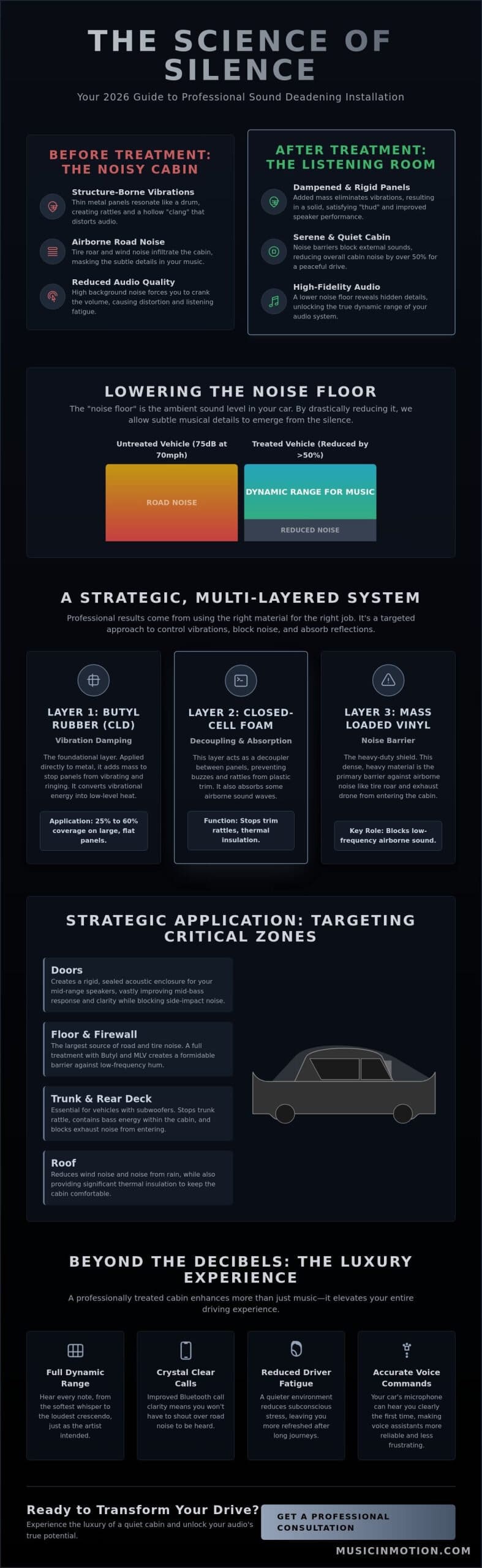
The noise floor is the level of ambient sound present in your cabin while driving. If you’re cruising at 70mph and your cabin noise is 75 decibels, your music has to be significantly louder than that just to be audible. This forces your amplifier to work harder and eats up your “headroom,” which is the power reserved for musical peaks. By lowering the noise floor, we allow subtle musical details to emerge that were previously buried. You’ll hear the light touch of a piano key or the natural decay of a cymbal. Beyond the music, a quieter cabin significantly reduces driver fatigue. Your brain doesn’t have to work as hard to filter out the constant drone of the road, leaving you more refreshed after a long trip.
Decoding the Layers: Butyl, Foam, and Mass Loaded Vinyl
We don’t believe in the “one size fits all” marketing of many basic all-in-one mats. A high-performance sound deadening installation is a strategic, multi-layered process. Each material we select has a specific job to do, and we treat your vehicle as a unique acoustic project. We start by identifying whether we are stopping a vibration, blocking an external sound, or absorbing an internal reflection. This targeted approach is what separates a professional result from a simple DIY attempt.
The foundation of our work usually begins with Constrained Layer Damping (CLD). These are the dense butyl rubber mats you see applied directly to the metal. Their job isn’t to block noise, but to add mass to thin panels to stop them from ringing like a bell. According to a recent Acoustic Analysis of Soundproofing Materials, the effectiveness of these treatments depends heavily on the material’s ability to convert vibrational energy into low-grade heat. Once the metal is stable, we move to the next layers of protection.
Vibration Damping with Butyl Rubber
We prioritize high-quality butyl rubber because it remains stable across extreme temperature swings. Cheap asphalt-based alternatives often emit a foul odor in the summer and can peel away when the adhesive fails. You don’t actually need to cover every square inch of a panel to stop it from vibrating. We follow the “25% to 60% rule,” placing material in the center of the largest, flattest areas of metal. This is enough to shift the resonant frequency and eliminate that hollow “clanging” sound. If you’re planning custom installations for your doors or trunk, this is the essential first step.
Blocking and Absorbing: Foam and Vinyl
While butyl stops vibrations, Mass Loaded Vinyl (MLV) is the heavy-duty shield that blocks airborne noise. It’s a dense, flexible barrier that acts like a wall between you and the road. To be effective, MLV must be applied as a continuous “blanket” with 100% coverage. Even a small gap can let in a significant amount of tire roar. We use closed-cell foam (CCF) as a “decoupler” between the MLV and the metal. This prevents the layers from rubbing together and creates a gasket that stops plastic interior panels from squeaking. In our custom subwoofer enclosures, we also utilize specialized acoustic absorbers to manage internal air reflections, ensuring your bass stays tight and accurate. This combination can reduce cabin noise by 10+ decibels, which feels like cutting the noise level in half.
There’s a hidden benefit to this layered sound deadening installation: thermal insulation. These materials don’t just stop sound; they create a barrier against outside temperatures. This means your air conditioning works more efficiently in the peak of summer, and your cabin stays warmer during the winter months. It’s a luxury experience that improves your daily drive in more ways than one, and if you want to bring this level of efficiency to your home, you can visit Third Coast Spray Foam.
Strategic Application: Targeting the Critical Vehicle Zones
We’ve discussed the science of materials; now we focus on where they do the most work. While a complete vehicle teardown is impressive, we prioritize strategic zones based on your specific goals. If you want better music, we start with the doors. If you want a quieter highway cruise, we target the floor. This targeted approach ensures your sound deadening installation provides the maximum benefit without unnecessary weight or expense. We treat every vehicle as a unique project, identifying the specific paths where noise enters the cabin.
The floor and firewall are the primary entry points for tire roar and engine drone. These areas require a dense barrier to block high-frequency road hiss. We focus on the wheel wells and the area under the front seats to create a shield against the pavement. This is often the most labor-intensive part of the process, but it offers the biggest luxury payoff for daily commuters. By sealing these large surface areas, we significantly reduce the intrusive hum that leads to driver fatigue.
The Door Treatment: Creating an Acoustic Enclosure
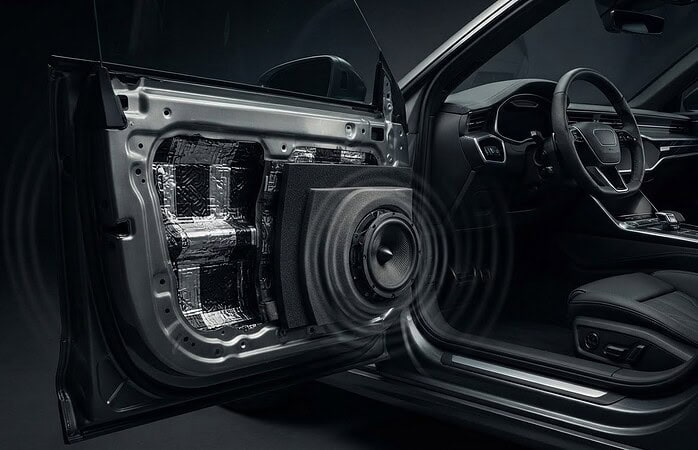
Your car doors are effectively the cabinets for your mid-range speakers. Factory doors are full of large access holes and thin metal that creates an “acoustic short circuit,” where the sound from the back of the speaker cancels out the sound from the front. We seal these gaps and treat both the inner and outer metal skins. This transforms a flimsy door into a rigid, non-resonant enclosure. You’ll immediately notice tighter mid-bass punch and much clearer vocals. Understanding how sound deadening works in these cavities is the key to unlocking high-end audio performance.
The Trunk: Managing Subwoofer Energy
The trunk is a major source of low-frequency resonance, especially in vehicles with high-power subwoofers. High SPL (Sound Pressure Level) systems can cause the trunk lid and license plate to rattle violently. We treat the spare tire well and the trunk floor to stop the metal from acting like a second, out-of-tune subwoofer. We often integrate these treatments with our custom subwoofer enclosures to ensure every watt of bass energy stays inside the cabin. This prevents energy loss and keeps your low end tight and accurate.
The Roof: Eliminating External Elements
The roof is often overlooked until it rains. Without treatment, rain sounds like pebbles hitting a tin can. We apply lightweight damping mats to the roof skin to eliminate this effect and reduce wind whistle at high speeds. This final step completes the “silent cell” feel of a truly treated vehicle. Whether it’s a sudden downpour or a gusty day on the interstate, a treated roof ensures your interior remains a quiet sanctuary. A professional sound deadening installation isn’t just about the floor; it’s about covering every angle where the outside world tries to get in.
The Professional Edge: Why Precision Installation Outperforms DIY
While peel-and-stick kits make the process look simple in videos, a truly effective sound deadening installation requires more than just a weekend and a basic roller. We often see DIY projects that fall short because the installer didn’t account for the sheer complexity of modern vehicle architecture. We treat every car with a high level of technical respect. Our team ensures that the final result is both acoustically superior and mechanically sound, protecting the integrity of your interior while we work.
Modern vehicles are packed with sensitive technology. Side-impact airbags, intricate wire harnesses, and delicate fiber-optic cables are hidden behind almost every panel. We use specialized, non-marring tools to remove leather and plastic trim without causing the scratches or broken clips common in home garage attempts. It’s vital that your vehicle safety systems, including blind-spot sensors and airbag deployment paths, remain completely unobstructed and fully functional after reassembly.
The Art of the Roll
Adhesion is the most critical part of the process. If an air pocket exists between the butyl and the metal, the material cannot damp vibrations effectively. These gaps are more than just an acoustic failure; they can trap moisture and lead to hidden corrosion over time. We spend hours physically rolling every square inch of the material to achieve 100% bonding. This requires significant physical effort, especially when reaching into tight cavities like A-pillars or the deep recesses of door skins. Precision here is the difference between a permanent solution and a mat that peels away after one hot summer.
Managing Weight and Balance
We also carefully manage weight distribution. Adding excessive material can negatively affect vehicle handling and fuel economy. This is particularly important for electric vehicles, where every pound matters for maintaining driving range. We utilize the latest lightweight composite materials, which were valued as part of a 5.63 billion dollar global market in 2026, to maximize quietness without compromising efficiency. Our goal is to provide the “thud” of a luxury door without the unnecessary bulk of outdated products.
Our philosophy centers on delivering a finished result that feels like it came from the factory. When we’re done, your car looks exactly as it did when it arrived, but it performs like a completely different class of vehicle. If you want to transform your driving experience without the risks of a DIY project, reach out to our specialist team to schedule your professional consultation.
Beyond the Decibels: The Luxury Experience of a Treated Cabin
The immediate benefit of a professional sound deadening installation is often felt before you even turn the key. We call it the “thud factor.” When you close a door treated with high-quality damping material, the hollow, metallic “clang” is replaced by a heavy, reassuring “thud.” This shift in sound quality fundamentally changes how you perceive your vehicle. It feels more substantial, better built, and more expensive. This tactile and auditory feedback signals a level of craftsmanship that factory-standard commuter cars simply lack.
Beyond the psychological impact, there are practical daily benefits to a treated cabin. The multi-layered barriers we install act as high-performance thermal insulators. By blocking the transfer of radiant heat from the road and the sun, your HVAC system doesn’t have to work as hard. You’ll stay cooler during those humid summer afternoons and retain heat much better in the winter. This efficiency translates to a more comfortable environment and less strain on your vehicle’s climate control components.
Communication and Convenience
We find that many clients are most surprised by the improvement in communication. In a noisy cabin, your Bluetooth microphone has to fight against tire roar and wind whistle. This often results in muddy call quality for the person on the other end. Once we lower the noise floor, your hands-free calls become crystal clear. You won’t have to shout to be heard by your passengers at highway speeds; your vehicle’s factory-installed smart assistants will also respond with much higher accuracy because they aren’t competing with ambient interference.
The Final Result: A Personalized Sanctuary
A professional sound deadening installation is the ultimate foundation for any high-end audio project. If you are considering a car audio upgrade for stock stereo, this treatment ensures you actually hear the improvement in hardware. Pairing your treated cabin with components from the best car audio brands of 2026 ensures your investment in both acoustics and equipment delivers the full performance each was designed to provide. Before you finalize your component selections, reviewing a comprehensive sound system for my car planning and component checklist can help you make informed decisions that pair perfectly with your newly treated acoustic environment. We view this process as a mandatory step for true audiophiles. It’s about protecting your investment from the constant interference of road vibration and heat. It allows the subtle nuances of your favorite tracks to shine through without distraction.
We take pride in helping you transform a standard commuter into a personalized sanctuary. Whether you’re navigating a busy morning commute or a cross-country road trip, the quietness of a treated interior makes every mile less stressful. We focus on the finished result, ensuring that every detail of your property is enhanced for your daily life. It is not just about making the car quiet; it’s about making the time you spend behind the wheel more enjoyable and focused.
Elevate Your Drive with Precision Acoustic Treatment
You’ve seen how the right combination of butyl damping and noise barriers can turn a noisy commute into a high-fidelity experience. By lowering the noise floor, you unlock the hidden potential of your audio system and rediscover the joy of a truly quiet ride. A professional sound deadening installation is the foundational upgrade that makes every other modification perform at its peak. It’s about more than just hardware; it’s about the feeling of quality every time you step inside your vehicle.
At Music In Motion, we’ve been specialists in expert custom fabrication and high-performance integration since 1994. We focus on the finished result, ensuring your vehicle’s interior is a masterpiece of both sound and comfort. Ready to transform your driving experience? Contact Music In Motion for a professional acoustic consultation. We look forward to helping you create the perfect sanctuary on wheels.
Frequently Asked Questions
Does sound deadening installation really make a difference in car audio?
Yes, it’s often the single most impactful upgrade you can make to a car audio system. By stabilizing the metal panels around your speakers, we prevent the “acoustic short circuits” that drain your mid-bass and muddy your vocals. A professional sound deadening installation transforms your thin car doors into rigid, sealed enclosures that allow high-performance speakers to play with much greater accuracy and impact.
How much weight does sound deadening add to my vehicle?
A typical installation adds between 50 and 100 pounds for a comprehensive full-vehicle treatment. While this might sound significant, modern composite materials are engineered to provide maximum damping with minimal mass. For most drivers, the slight increase in weight is a small trade-off for the massive improvement in cabin quietness and the luxury feel of the ride.
Can I install sound deadening over existing factory insulation?
No, we always recommend applying damping materials directly to the clean, bare metal of the vehicle. Factory insulation is often made of porous fibers or loose foam that won’t allow a damping mat to bond properly. If you apply material over these layers, you lose the vibration-stopping benefits and risk trapping moisture, which can lead to hidden corrosion over time.
How long does a professional sound deadening installation typically take?
A focused project like treating the doors and trunk usually takes one full business day. If you’re looking for a complete road noise treatment that includes the floor, firewall, and roof, the process typically requires three to five days. This timeframe allows our team to carefully disassemble the interior, prep all surfaces, and ensure every inch of material is perfectly bonded.
Does sound deadening help with car heat and insulation?
Yes, the dense barriers we use provide excellent thermal insulation alongside their acoustic benefits. Materials like Mass Loaded Vinyl and closed-cell foam create a shield that blocks radiant heat from the engine and the hot pavement. This helps your air conditioning maintain a comfortable temperature more easily, which is a major benefit during peak summer months.
What is the best material for car sound deadening in 2026?
The industry standard remains a multi-layer approach using high-purity butyl rubber mats and dense barriers. As of 2026, products like Dynamat Xtreme, SoundSkins Pro Plus, and Second Skin Damplifier Pro are top-tier choices for their stability and performance. We select specific materials based on your vehicle’s needs, often using lightweight composites to maintain efficiency in electric vehicles.
Is it worth doing just the doors, or do I need the whole car treated?
Treating just the doors offers the best return on investment if your primary goal is better music quality. However, if your main frustration is tire roar and highway drone, you’ll need to address the floor and wheel wells. We often help clients prioritize specific zones based on their budget and the specific types of noise they want to eliminate.
Will adding sound deadening void my vehicle’s manufacturer warranty?
Generally, no; adding sound deadening is considered an aftermarket enhancement and is protected by consumer rights laws. A manufacturer cannot void your entire warranty unless they can prove the installation directly caused a specific mechanical or electrical failure. We take great care to ensure all factory wire harnesses, sensors, and safety systems remain completely unobstructed and functional.