You are three miles offshore, the sun is dipping below the horizon, and after a perfect afternoon of high-output music, you turn the key only to hear a hollow, metallic click. We have seen this scenario play out too many times, and it is exactly why many boaters hesitate to push their sound systems to the limit. You want the deep bass and crisp highs of a custom installation, but you also need the absolute certainty that your engine will fire up when it is time to head home.
We understand that the technical side of a marine audio battery setup can feel overwhelming, especially with the rapid shift toward Lithium Iron Phosphate (LFP) and new solid-state technologies. This guide is designed to cut through the confusion and show you how to build a reliable power architecture. We will show you how to isolate your cranking and house loads using the latest 2026 standards, ensuring your amplifiers get the steady voltage they need to prevent clipping while keeping your starting battery protected. From navigating the ABYC E-13 safety guidelines to choosing between traditional AGM and modern 245 Wh/kg high-density cells, we are here to help you power your passion with confidence.
Key Takeaways
- Separate house loads from starting power using automatic charging relays to keep your music playing without draining your engine’s ability to crank.
- Calculate the exact battery capacity your amplifiers require by converting total RMS wattage into real-world amperage draw.
- Implement a proper marine audio battery setup using tinned copper wire and heat-shrink connectors to prevent the infrastructure failure caused by salt-air corrosion.
- Protect your equipment with custom-fabricated mounting solutions designed to handle the vibration and impact of harsh marine environments.
- Reduce the risk of amplifier clipping and hardware damage by maintaining steady voltage through high-current distribution blocks and proper fuse protection.
Beyond the Crank: Why Marine Audio Demands Dedicated Power
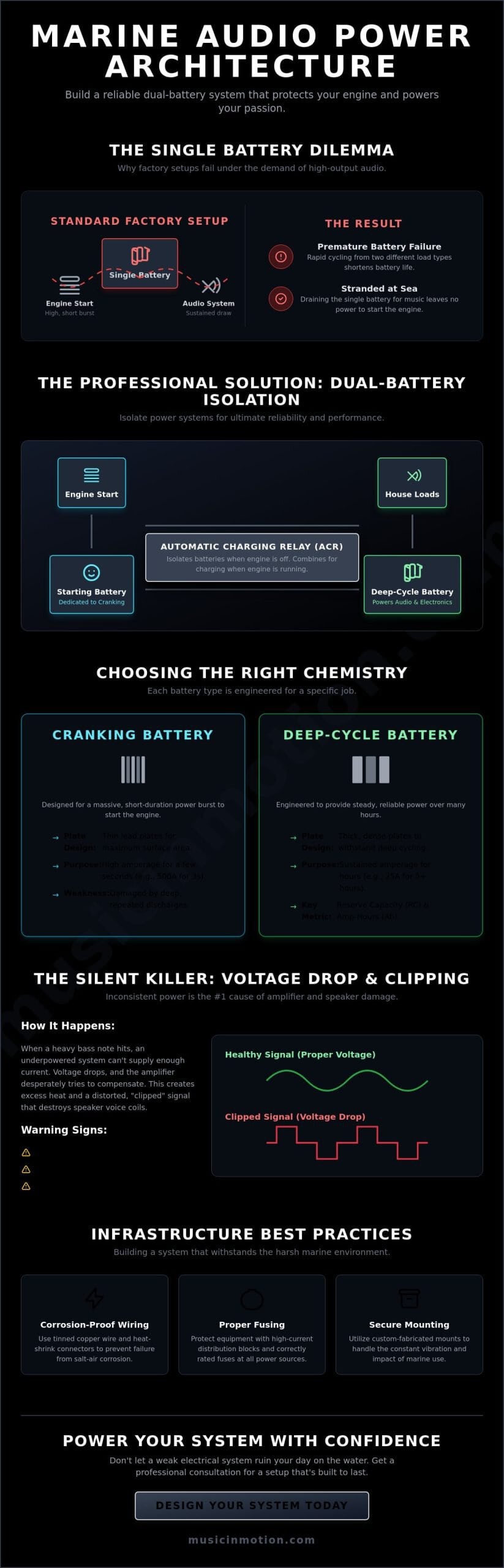
Most boats leave the factory with a single battery designed for one job: starting the engine. While this works for basic navigation lights and a factory head unit, it fails the moment we introduce high-output amplifiers. A proper marine audio battery setup requires recognizing that cranking and listening are two distinct electrical events. Cranking requires hundreds of amps for just a few seconds to turn the flywheel. High-end audio requires a consistent, sustained draw for hours while you are anchored. When a single battery tries to do both, it suffers from rapid cycling that leads to premature failure and, eventually, a boat that won’t start.
We see factory single-battery systems as the primary cause of marine electronics failure. It isn’t just about the battery dying; it is about the inconsistent power delivery. In 2026, the industry has moved away from “dual-purpose” batteries that try to do everything poorly. Instead, we advocate for specialized banks. This separation ensures that your engine always has the burst power it needs while your audio system enjoys a steady, deep reservoir of energy. The result is a sensory experience where the music stays crisp and the bass remains punchy, even after a full afternoon on the water.
Cranking vs. Deep Cycle: Choosing the Right Chemistry
The difference lies in the internal construction of the lead plates. Starting batteries use thin plates to maximize surface area for that initial burst of energy. In contrast, a deep-cycle battery features much thicker plates designed to survive repeated, deep discharges without warping or shedding active material. High-output amplifiers demand this sustained discharge. When we plan a system, we prioritize Reserve Capacity (RC). This metric tells us exactly how many minutes a battery can provide a steady flow of power before falling below a functional voltage level. For modern marine audio, high RC is the only way to ensure your system doesn’t cut out just as the day gets started.
The Danger of Voltage Drop in Marine Environments
Low voltage is the silent killer of modern Class D amplifiers. When your marine audio battery setup struggles to keep up with a heavy bass hit, the voltage drops. The amplifier tries to compensate by drawing more current to maintain its output, which generates excessive heat. This heat eventually triggers “protection mode” or, worse, causes “clipping.” This squared-off signal can quickly destroy even the best marine subwoofers by overheating the voice coils. You can identify an underpowered system through a few clear signs:
- Interior or underwater lights dimming in time with the music.
- Bass that sounds “muddy” or lacks a sharp, percussive hit.
- Amplifiers that feel hot to the touch or shut down during high-volume playback.
Consistent voltage is the foundation of high-fidelity sound. By isolating your audio power, we eliminate these risks and protect your investment in high-end hardware.
The Dual-Battery Architecture: Separating House Loads from Starting Power
We believe a reliable boat starts with a smart electrical layout. At its core, a dual-battery architecture is the gold standard for any high-performance marine audio battery setup. This design uses an isolator or a relay to keep your engine’s cranking battery and your audio’s “house” battery completely independent. By separating these loads, we ensure that your amplifiers, LED lighting, and bilge pumps never pull current from the battery you need to get home. It is a simple concept that provides total peace of mind when you are miles from the dock.
The “House Bank” concept is where we get creative. Instead of relying on a single power source, we dedicate specific deep-cycle batteries to handle the heavy lifting of premium marine audio systems. This allows you to enjoy full-volume playback for hours while at anchor without ever touching your starting reserve. Many boaters rely on manual 1-2-Both switches, but using the “Both” setting is often a recipe for disaster. It links your batteries in parallel, meaning a heavy audio draw will drain both banks simultaneously, leaving you with two dead batteries instead of one. For those looking for a foolproof solution, installing a dual-battery setup with automated components is the only way to guarantee reliability.
The Role of the Automatic Charging Relay (ACR)
An ACR acts as the intelligent gatekeeper of your power system. When the engine is running and the alternator is producing a charge, the ACR senses the rising voltage and combines the batteries so they both receive power. Once the engine stops, the ACR instantly separates them. The Automatic Charging Relay is the automated brain of your power system that protects your ability to start the engine by isolating discharge to the house bank. This “set it and forget it” management is perfect for owners who want to focus on the music rather than a voltmeter. If you are planning a complex project, our team can help you integrate these components into a seamless custom installation that handles all the logic for you.
Emergency Parallel Circuits
Even with the best planning, redundancy is vital. We always recommend wiring an emergency parallel circuit into your marine audio battery setup. This involves a dedicated heavy-duty switch that allows you to manually “jump” your engine from the house bank if the starting battery ever fails. Safety is paramount here; these bridge connections must include high-amp fuses to handle the massive current of a cold crank. We position these switches in accessible locations that you can reach even in rough water, ensuring you are never truly stranded.
Calculating Battery Capacity: How Many Amp-Hours Does Your Sound System Need?
We don’t believe in guessing when it comes to your power reserve. To build a reliable marine audio battery setup, you need to move past “gut feelings” and look at the math. The process starts by identifying the total RMS wattage of your system. If you have two 500W amps, you are working with 1000W of potential draw. To find the amperage, we use a simple formula: Watts divided by 12.6V equals Amps. In this case, a 1000W system pulls about 79 amps at full theoretical output.
However, music is dynamic. You aren’t pulling 79 amps every second. We estimate a “Duty Cycle” based on your listening habits. For most boaters, an average volume level represents about a 30 percent draw, while “sandbar mode” might push that to 50 percent. If you want four hours of key-off listening time at 50 percent draw, you need to account for that total consumption before applying a safety buffer. We recommend a 50 percent buffer for AGM batteries to prevent permanent cell damage. For Lithium, you can safely use up to 80 percent of the rated capacity.
AGM vs. Lithium (LiFePO4) for Marine Audio
Lithium Iron Phosphate (LiFePO4) is quickly becoming the 2026 standard for high-end projects, especially in a pontoon boat audio installation where weight distribution matters. A 100Ah Lithium battery can weigh as little as 30 pounds, while a comparable AGM unit often exceeds 60 pounds. The real advantage is usable capacity. While an AGM battery shouldn’t be discharged past 50 percent, Lithium maintains steady voltage until it is nearly empty. This means 100Ah of Lithium effectively provides double the playtime of a 100Ah AGM. Just remember that Lithium requires a specialized marine charger with a specific profile to ensure the cells balance correctly and stay healthy over hundreds of cycles.
Real-World Reference Table
The size of your marine audio amplifier directly dictates your battery needs. Below is a general guide for estimated playtimes at 75 percent volume using a single dedicated house battery.
- 500W System: A Group 24 AGM (approx. 75Ah) provides roughly 3 to 4 hours of safe playtime.
- 1000W System: A Group 31 AGM (approx. 100Ah) offers about 2 to 3 hours. Switching to a 100Ah Lithium extends this to 5 or 6 hours.
- 2500W System: This requires a multi-battery bank. We typically recommend at least 300Ah of Lithium to sustain this load for a full afternoon.
By matching your capacity to your specific hardware, we ensure your marine audio battery setup delivers the performance you expect without the anxiety of a failing system.
Marine Electrical Infrastructure: Isolators, ACRs, and High-Current Wiring
A high-quality marine audio battery setup is only as strong as its weakest connection. While it is tempting to use standard automotive wiring kits, the marine environment is far too unforgiving for bare copper. We strictly use tinned copper wire because salt air and moisture trigger electrolysis. This process causes standard copper to oxidize and turn green or black, which increases resistance and creates heat. Tinned copper wire resists this corrosion, ensuring your system maintains peak performance for years rather than just one season.
Safety is our primary focus when designing these systems. We follow the industry best practice of placing main circuit protection within 7 inches of the battery post. This prevents a potential fire if a cable is pinched or chafed against the hull. Grounding is equally critical, especially in aluminum or fiberglass boats. We avoid using the hull as a ground; instead, we run dedicated ground cables back to a central busbar. This strategy eliminates ground loops and prevents the annoying “alternator whine” that can ruin your listening experience.
Wire Gauge Selection for High-Current Banks
We rely on the American Boat and Yacht Council (ABYC) standards to determine the correct wire sizing for every project. Calculating voltage drop is essential, particularly when batteries are in the stern and amplifiers are mounted in the bow. Even a 3 percent drop in voltage can significantly reduce the output of your amplifiers. To ensure a permanent connection, we use hydraulic crimping for all battery terminal lugs. This creates a solid, gas-tight bond that is far superior to standard hand-crimped connectors, which often vibrate loose in heavy chop.
Battery Management Panels
We take pride in turning a “nest” of wires into a clean, organized battery management panel. By using high-quality busbars and power distribution blocks, we organize every circuit for easy access. This level of organization makes future upgrades simple and troubleshooting nearly instant. Modern systems also allow us to integrate digital monitoring. You can now track your state-of-charge, battery temperature, and real-time amperage draw through smartphone apps or dashboard displays. If you want a system that is as beautiful as it is functional, our team specializes in custom installations that bring professional-grade organization to your boat’s electrical heart.
The Professional Edge: Integrating Power with Custom Marine Fabrication
A superior marine audio battery setup requires more than just high-quality components; it demands a physical architecture that can withstand the open sea. When you are hitting heavy chop at thirty knots, your batteries become heavy projectiles if they aren’t secured correctly. We don’t just “drop in” batteries. We design custom trays and enclosures that lock every cell in place. This level of detail is what separates a DIY project from a professional installation. We prioritize a solution-oriented approach that looks at your boat as a complete ecosystem rather than a collection of separate parts.
Calibration is the final, invisible step of a professional setup. We don’t just wire it up and hope for the best. We use precision tools to set the charging profiles on your ACR and configure your amplifiers to match the specific voltage curve of your battery bank. This ensures your investment lasts for years, not just one season. When your system is perfectly tuned, your batteries stay in their “happy” voltage range, preventing the deep-cycle fatigue that kills cheaper setups. This transition from transactional parts buying to a dedicated electrical design is the core of our philosophy.
Custom Fabrication for Battery Banks
Space is a luxury on any vessel. We often use car audio fabrication techniques adapted for the marine environment to maximize every square inch. This might involve building custom brackets to stack batteries or creating vented enclosures for high-output charging systems. Proper venting is crucial; high-capacity banks generate heat during rapid charging cycles. By utilizing custom-molded plastics or powder-coated aluminum, we add the necessary power without sacrificing your storage lockers or bilge access. Our goal is always to deliver a finished result that looks like it came from the factory, only better.
The Final Result: Peace of Mind on the Water
Investing in a professional marine audio battery setup is about more than just louder music. It is about the confidence to drop anchor and enjoy your favorite playlist without eyeing the voltmeter every five minutes. You gain a system that offers unmatched reliability, superior sound clarity, and the safety of knowing your engine will always fire up. We invite you to view your boat as a high-performance vehicle that deserves a power grid to match its potential.
Reliability and safety are the foundations of every project we touch. Whether you are building a simple two-speaker system or a massive multi-amplifier array, the infrastructure must be flawless. If you are ready to stop worrying about your power and start enjoying your time on the water, contact our team for a professional consultation on your next marine audio project. We are here to help you build the ultimate soundtrack for your life on the water.
Power Your Sound with Absolute Confidence
Building a high-performance marine audio battery setup is about creating a resilient foundation for your time on the water. We’ve explored how the right architecture separates your engine’s cranking needs from your system’s house loads. By using tinned copper wiring and calculating your amp-hour requirements accurately, you protect your equipment from voltage drop and corrosion. These technical details ensure your music sounds as clear as the day it was installed. We believe your boat deserves an electrical system that works as hard as your amplifiers do.
We specialize in turning these complex requirements into a seamless, factory-look reality. Our team brings professional ABYC-compliant installations and expertise in high-voltage Lithium integration to every project. Whether you need custom-fabricated battery solutions or a complete electrical redesign, we focus on the finished result rather than just the parts. Let our experts design your perfect marine audio power system so you can focus on the horizon. Your boat is ready for a soundtrack that never quits.
Frequently Asked Questions
Can I run my marine stereo off my starting battery if I only play it for an hour?
You can, but we strongly advise against it. Starting batteries are designed for short, high-current bursts rather than sustained draws. Even sixty minutes of music can deplete the reserve capacity enough to leave you stranded. We always suggest a dedicated house bank to keep your engine’s cranking power protected and your day on the water stress-free.
What is the difference between a battery isolator and an Automatic Charging Relay (ACR)?
A battery isolator uses diodes that cause a significant voltage drop, while an ACR is a relay that connects batteries without loss. ACRs are the modern standard because they allow your alternator to charge both banks at full voltage. They automatically combine the batteries when a charge is detected and separate them when the engine stops. This prevents your stereo from ever draining your starting battery.
How long will a 100Ah deep cycle battery power a 1000-watt marine amp?
You can expect about two to three hours of playtime at high volume with an AGM battery. Since you shouldn’t discharge an AGM past 50 percent, you only have 50 usable amp-hours. A 1000-watt system pulls considerable current during heavy bass hits. If you want to double your time at the sandbar, switching to a Lithium bank is the most effective upgrade for your marine audio battery setup.
Do I need to upgrade my boat alternator for a high-end audio setup?
Most boaters find that adding battery capacity is more effective than installing a larger alternator. Standard alternators often produce limited current at low RPMs while you are anchored or idling. If your system exceeds 2000 watts, we might look at a high-output alternator. However, a smart charging relay and a larger deep-cycle bank usually solve power issues for most high-end marine audio systems.
Is it safe to mix battery types, like an AGM starting battery and a Lithium house battery?
It is safe as long as you use the correct management hardware. Mixing chemistries requires a DC-to-DC charger to handle the different voltage requirements of AGM and Lithium. This device acts as a bridge, taking the alternator’s output and converting it to the specific profile your Lithium house bank needs. It ensures both batteries stay healthy and fully charged without any risk of damage.
Why does my boat stereo cut out when I turn the volume up high?
Your amplifier is likely entering protection mode due to a sudden voltage drop. When you turn the volume up, the demand for current spikes. If your batteries are weak or your wire gauge is too thin, the voltage falls below the amplifier’s operating threshold. This is a common symptom of an underpowered marine audio battery setup that lacks the necessary current to sustain high-output peaks.
How do I know if my batteries are charging correctly while the engine is running?
You can verify your charging status by checking a digital voltmeter while the engine is running. A healthy charging system should read between 13.8 and 14.4 volts. If the number stays near 12.6, your alternator or relay isn’t sending power to the batteries. We often install Bluetooth monitors that send this data directly to your phone, giving you a clear view of your system’s health.
What gauge wire should I use for a dual battery setup on a 20-foot boat?
We recommend using at least 2-gauge or 0-gauge tinned copper wire for the primary connections. On a 20-foot boat, the distance between the batteries and your amplifiers can lead to significant voltage loss if the wire is too small. Thicker wire reduces resistance and heat. This ensures that every bit of power from your battery bank actually reaches your speakers instead of being lost in the cables.