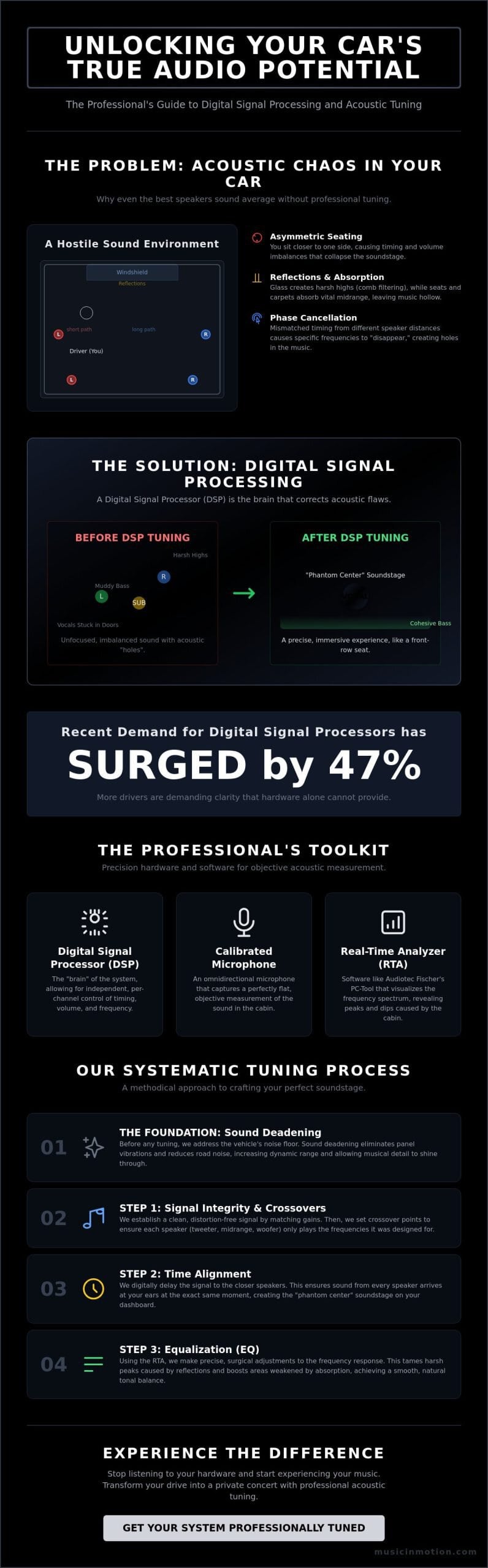
Did you know that the demand for Digital Signal Processors has surged by 47 percent recently? This spike happens because more drivers are realizing that even the most expensive speakers cannot overcome the acoustic chaos of a car interior on their own. We understand the frustration of investing in premium components only to hear muddy bass or highs that feel painfully harsh. It’s disappointing when your favorite tracks feel trapped in the lower door panels instead of floating across your dashboard.
We’re here to show you how professional car audio tuning transforms that hardware into a precise, immersive experience. We want to help you unlock the true potential of your system so it rivals the clarity of a high-end home theater. In this guide, we’ll walk you through the systematic process we use to calibrate every frequency, using advanced software like Audiotec Fischer’s PC-Tool 5.00.02. You’ll learn how we build a crisp phantom center soundstage and ensure your music remains distortion-free at any volume, making every minute behind the wheel feel like a front-row performance.
Key Takeaways
- Learn why factory interiors create acoustic chaos and how professional car audio tuning corrects reflections and asymmetric seating issues.
- Discover the essential tools we use, like Digital Signal Processors and calibrated microphones, to build a studio-grade environment.
- Understand the technical steps required to match gains and set crossover points for a clean, noise-free signal.
- See how we use time alignment to create a “phantom center” that places the performer directly on your dashboard.
- Explore our philosophy of delivering a finished acoustic result that transforms your experience behind the wheel.
Why Your High-End Gear Sounds Average: The Vehicle Acoustic Problem
Most enthusiasts believe that buying top-tier speakers is the finish line. In reality, it is only the starting block. A car’s interior is a hostile environment for high-fidelity sound. We see it every day; clients bring in premium components that sound thin, harsh, or completely lifeless. The problem isn’t the hardware. It is the physics of the cabin itself. When you install high-end gear into a space filled with glass, plastic, and leather, you are fighting an uphill battle against acoustic chaos.
The primary issue is your seating position. In a home theater, you sit centered between speakers. In a car, you are shoved into a corner. Because you sit closer to the driver-side speakers, that sound reaches your ears several milliseconds before the passenger-side signal. While vehicle audio systems have evolved significantly over the decades, this fundamental geometry remains a challenge. These path-length differences cause phase cancellation. This physical phenomenon effectively “kills” specific frequencies, creating “holes” in your music that no amount of volume can fill.
The Impact of Reflective and Absorptive Surfaces
Your windshield acts as a massive acoustic mirror. When high-frequency waves hit that glass, they bounce back and collide with the direct sound from your speakers. This creates “comb filtering,” which makes cymbals and vocals sound brittle or piercing. Meanwhile, your seat upholstery and carpeting act as sponges. They soak up critical mid-range energy, which leaves your music feeling hollow and disconnected. We also have to contend with factory speaker locations. Most doors place woofers near your ankles, which is the worst possible spot for creating a realistic soundstage. This is exactly why professional car audio tuning is so vital; it is the only tool capable of digitally correcting these physical environment flaws.
Acoustic Treatment as a Tuning Prerequisite
Before we ever open a laptop for professional car audio tuning, we must address the “noise floor.” You cannot use an equalizer to fix a vibrating door panel or a rattling plastic clip. If the metal in your car is ringing, it is adding its own unwanted frequencies to your music. Ambient road noise also masks the low-level details that make a recording feel “live.” We always suggest a high-quality sound deadening installation as the foundation of any project. By quieting the cabin, we increase the dynamic range of your system. This allows the subtle nuances of a performance to shine through without being buried by tire roar or exhaust drone.
The Professional Toolkit: Calibration Gear and Software
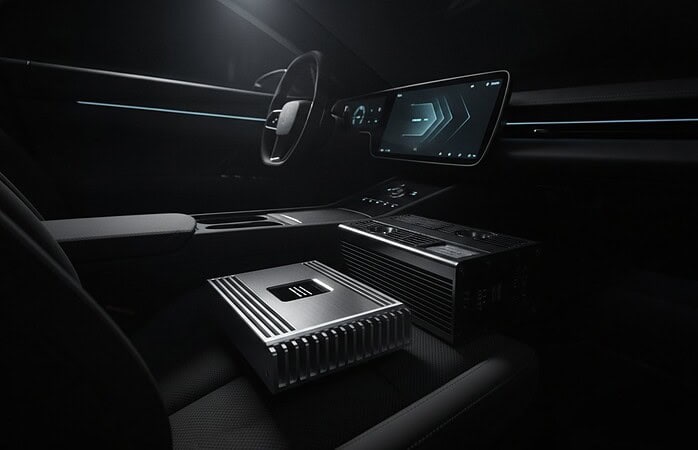
To solve the complex acoustic issues we discussed, we don’t rely on guesswork or simple intuition. We measure. Professional car audio tuning requires a sophisticated suite of hardware and software designed to see what the human ear might miss. It starts with the Digital Signal Processor (DSP), which acts as the central nervous system of the entire system. Without this “brain,” even the most expensive speakers are just drivers without a conductor. We pair these processors with calibrated omnidirectional microphones and pink noise generators to create a consistent, flat reference signal for every measurement we take.
Digital Signal Processing (DSP) Essentials
A dedicated DSP is a world apart from the basic bass and treble knobs on a factory head unit. While a standard stereo might offer a simple equalizer, a professional DSP allows for independent, per-channel control. This means we can adjust the volume, crossover points, and timing for a left tweeter without affecting the right one. When we design a system, we prioritize the best car audio brands that offer high-resolution processing and stable software interfaces. This granular control is mandatory if you want a soundstage that feels like it’s floating on your dashboard rather than being stuck in your door panels.
RTA Software and Measurement Logic
A Real-Time Analyzer (RTA) is our primary window into the frequency spectrum. Using software like Room EQ Wizard (REW) or Audiotec Fischer’s PC-Tool, we can identify exactly which frequencies are spiking or disappearing due to cabin reflections. We typically use 1/24 octave resolution for high-precision surgical adjustments, while 1/3 octave resolution helps us manage the overall tonal balance of the car.
We don’t just place a microphone in one spot and call it a day. Our technicians use “spatial averaging,” which involves moving the microphone through the driver’s listening area to capture a representative sample of what you actually hear. This prevents us from over-correcting for a tiny acoustic anomaly that only exists in one square inch of space. The RTA provides the objective data, but our ears remain the final judge of musicality and emotional impact. If you want to see how this precision gear can transform your vehicle, our team is always ready to discuss custom installations tailored to your specific goals.
Step 1: Establishing Signal Integrity and Crossover Points
Once we have our calibration tools ready, the actual work of professional car audio tuning begins with the signal itself. You cannot fix a distorted signal later in the process, so we start at the source unit to find its maximum unclipped volume. We use an oscilloscope to look at the sine wave coming from your head unit. If the top of that wave is flat, the signal is clipping. We identify the exact point where distortion starts and set that as our system’s “ceiling.” This ensures every bit of data entering the Digital Signal Processor is clean and accurate.
Next, we match the amplifier gains to the DSP output. Many people treat a gain knob like a volume control, but it is actually a sensitivity adjustment. We want to set these levels so that the system reaches full output just before the components start to stress. This keeps the noise floor as low as possible. We want you to hear the subtle breath of a singer or the tail of a reverb, not the “hiss” of the electronics working too hard. We also verify phase consistency across every driver. If one speaker is pushing while another is pulling, they cancel each other out, which effectively kills your mid-bass before we even touch an equalizer.
Gain Overlap and Distortion Management
We use specialized distortion detectors to find the safe operating range of your specific gear. Clipping is the number one killer of high-end audio components because it generates excessive heat. When an amplifier clips, it sends a squared-off signal that forces the speaker to stay at its maximum extension for too long. We prioritize the longevity of your investment over raw, distorted volume. We’ve found that “more gain” rarely results in a better experience. Instead, it leads to ear fatigue and potential hardware failure. Our team focuses on finding the sweet spot where the system sounds effortless and powerful without crossing into the danger zone.
Choosing the Right Crossover Slopes
Crossovers act as the traffic controllers for your speakers. They ensure that your tweeters only handle high frequencies while your woofers focus on the mid-bass. We typically utilize Linkwitz-Riley slopes because they maintain excellent phase alignment at the crossover point, which helps the speakers blend together seamlessly. While a shallow 12dB slope might sound more “open” in some environments, we often prefer steeper 24dB or even 48dB slopes for better component protection. We also pay close attention to the difference between the electrical crossover we set in the software and the actual acoustic crossover. Because your car’s interior changes how sound behaves, we often have to set the software differently than the “textbook” numbers to achieve the perfect final response in the cabin.
Step 2: Perfecting the Soundstage via Time Alignment and EQ
With a clean signal established, we shift our focus to the spatial experience. This is where professional car audio tuning becomes an art form. We want to trick your brain into believing the sound is coming from a stage in front of you, not from the speakers at your feet. This phenomenon is called the “phantom center.” When achieved, the lead vocalist appears to be standing directly in the center of your dashboard; the drums and guitars fill the space around them with pinpoint accuracy. It’s the difference between hearing a recording and feeling a performance.
We don’t just aim for clarity; we aim for realism. In a car, the speakers are never the same distance from your head. This asymmetry is the enemy of a good soundstage. By using a Digital Signal Processor, we can manipulate time itself to ensure that every note from every speaker reaches your ears at the exact same moment. This creates a cohesive, unified sound that feels like it’s coming from a single, high-quality source rather than multiple separate drivers.
The Science of Time Alignment
We start by measuring the physical distance from your ears to every speaker in the vehicle. We measure right to the dust cap of the driver. Because you sit closer to the left side, that sound arrives first, which pulls the soundstage toward the door. We use the DSP to delay the closer speakers by fractions of a millisecond. Even a tiny adjustment of 0.01ms can be the difference between a blurry image and a razor-sharp stage. This ensures every wave reaches your head at the exact same moment, which locks the phase and creates that immersive bubble of sound.
Equalization: Carving Out the Mud
Equalization is our next step, but we don’t use it to add what’s missing. We use it to remove what’s wrong. Every car cabin has a “boomy” resonance between 200Hz and 400Hz that makes music sound muddy. We identify these peaks with our RTA and cut them. We almost always prefer cutting frequencies over boosting them; boosting can introduce distortion and eat up your amplifier’s power. We also apply per-channel EQ. Since the left and right sides of your car have different reflections, they need different corrections to sound balanced.
Finally, we smooth out the response to follow a “House Curve.” A perfectly flat line on a graph usually sounds thin and fatiguing in a car. We prefer a gentle slope that provides a warm, powerful low end and a smooth high-frequency response that doesn’t hurt your ears at high volumes. If you’re ready to stop listening to your doors and start listening to the music, check out our Car Audio Upgrades to see how we can transform your commute.
The Music In Motion Philosophy: Delivering the Finished Result
At Music In Motion, we operate on a simple but powerful philosophy: we prioritize the delivery of a finished result over the mere transaction of goods. A box of high-end speakers is just potential; it only becomes a performance once it’s properly integrated into your vehicle. Our “Spectrum of Sound” approach means we bring the same level of expertise to every project, whether we’re working on a compact car, a luxury SUV, or a marine vessel. We don’t consider a job done when the last wire is connected. It’s done when the acoustic environment is perfectly balanced and ready for your ears.
The final stage of our professional car audio tuning involves creating specific user presets tailored to how you use your vehicle. Most of our clients spend their time driving alone, so we build a “Driver Only” tune that optimizes the soundstage for the pilot’s seat. However, we also create “All Seats” presets that use different time alignment and EQ settings to ensure your passengers enjoy a balanced experience too. This flexibility ensures that your system remains functional and enjoyable regardless of who is in the car.
The Human Element of Calibration
While we rely on advanced RTAs and microphones, they are only part of the story. The human ear is still the ultimate judge of musicality. We conclude every project with a period of critical listening using reference tracks we have heard thousands of times. This allows us to catch subtle anomalies that a graph might miss. We also tailor the final output to your specific musical preferences. A client who loves the intricate textures of Jazz requires a different tonal balance than someone who listens primarily to high-energy EDM. We aren’t satisfied until the system passes the “smile test,” ensuring it evokes a genuine emotional response every time you hit play.
Your Journey to Perfect Sound
Achieving studio-quality audio is a journey that starts with the right plan. If you are currently researching the best sound system for my car, remember that tuning is the most critical component on your checklist. Even a modest car audio upgrade for stock stereo can be transformed into something extraordinary with the right calibration. We are here to act as your partners in this process, pushing creative boundaries to improve your daily life behind the wheel. If you’re ready to experience the full potential of your hardware, schedule a professional tuning consultation with Music In Motion today. We look forward to showing you what your system can really do.
Unlock the Full Potential of Your Sound System
Your journey to studio-quality audio doesn’t end with the installation of premium speakers; it begins with the calibration. We’ve explored how the right signal integrity, precise crossover points, and meticulous time alignment work together to defeat the acoustic challenges of your vehicle’s interior. Whether you’re behind the wheel of a car, steering a boat, or riding a motorcycle, the goal remains the same: a finished result that moves you.
With over 30 years of custom audio expertise, our team uses specialized RTA and DSP calibration technology to ensure your system sounds exactly as the artist intended. We take pride in transforming standard utility into a personalized sanctuary of sound. It’s time to stop settling for average performance from your high-end gear. We invite you to see what your components are truly capable of delivering.
Experience the Difference: Book Your Professional Tuning Session
We look forward to helping you discover the immersive, distortion-free experience that only professional car audio tuning can provide. Let’s make every drive your favorite concert.
Frequently Asked Questions
How long does a professional car audio tuning session take?
A standard session typically takes between two and four hours to complete properly. Complex custom projects with multiple amplifiers and active speaker sets can sometimes require a full day of calibration. We spend the first hour purely on physical measurements and signal verification. This ensures that when we begin the software adjustments, we are working with an accurate picture of your vehicle’s unique acoustic environment.
Do I really need a Digital Signal Processor (DSP) for my car?
If you want a studio-grade experience, a DSP is a mandatory tool for success. Without one, you cannot correct the physical limitations of a vehicle cabin, such as the asymmetric seating that ruins your soundstage. A DSP acts as the central brain of your system. It allows us to control every speaker individually, which is the only way to overcome the reflections and cancellations inherent in automotive interiors.
Can I tune my car audio system myself with an app?
You can make basic tonal changes, but phone apps cannot replace the precision of professional hardware. Mobile phone microphones are not calibrated for full-spectrum acoustic measurement and often ignore critical low-frequency data. Professional car audio tuning relies on omnidirectional microphones and high-resolution software to see acoustic problems that a phone simply misses. We provide the specialized knowledge and tools required to achieve a truly balanced result.
What is a “House Curve” in car audio tuning?
A House Curve is a target frequency response that is specifically designed to sound natural and pleasing in a car. In the small, reflective space of a vehicle, a perfectly flat response often sounds thin or brittle. We tune your system to a curve that usually features a smooth bass boost and a gentle high-frequency roll-off. This creates a warm, powerful, and non-fatiguing sound that remains comfortable even at higher volumes.
Will professional tuning prevent my speakers from blowing?
It significantly reduces the risk of hardware failure by establishing safe operating limits. We use specialized tools to find the exact point where your head unit and amplifiers begin to distort. By setting crossovers and gains correctly, we ensure your speakers never receive the clipped signals that cause overheating. This process protects your investment while allowing your system to play at its maximum safe potential without stress.
Does professional tuning work with a factory head unit?
It absolutely does, and it is often the most effective way to improve a stock stereo. We use advanced processors to take the signal from your factory radio and strip away any pre-set equalization that the manufacturer included. This gives us a clean slate to build upon. You get to keep your original dashboard look and steering wheel controls while enjoying an audio experience that rivals high-end aftermarket systems.
How much does professional car audio tuning typically cost?
The cost of tuning depends on the complexity of your specific system and the number of channels we need to calibrate. A simple four-channel setup requires less time than a fully active three-way front stage with a dedicated subwoofer. We recommend a consultation so we can evaluate your hardware and provide an accurate quote. We focus on delivering a finished result where the improvement in sound quality far exceeds the investment.
What is the difference between active and passive tuning?
Passive tuning uses fixed hardware components to split frequencies, while active tuning uses a DSP to control each speaker independently. Active tuning is the gold standard for modern vehicles because it allows us to adjust time delay and EQ for every single driver. This level of granular control is what makes it possible to create a “phantom center” and a perfectly focused soundstage that passive systems simply cannot replicate.