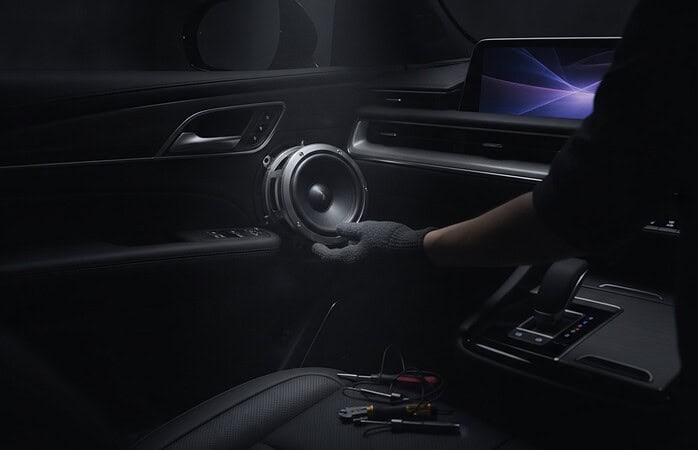
Did you know the average driver spends over 200 hours in their car every year? That is a lot of time to settle for muddy bass that rattles your door panels or harsh high frequencies that grate on your ears at high volumes. We believe your daily commute should feel like a private concert, not a constant battle against engine noise and road vibration. In this guide, we will show you exactly how to improve car audio sound quality by treating your vehicle cabin like a precision listening environment rather than just a way to get from point A to point B.
We understand the frustration of a factory system that leaves your favorite tracks feeling flat and buried at your feet. You want crystal clear vocals and a soundstage that feels like it is positioned right in front of you on the dashboard. This 2026 guide covers the professional hardware upgrades and tuning secrets we use to transform standard systems into high-fidelity masterpieces. We will walk you through the essential hierarchy of upgrades, from the foundational importance of sound deadening to the incredible control of modern Digital Signal Processors (DSPs). It’s time to stop just listening to your music and start experiencing it.
Key Takeaways
- Start at the source by using high-resolution audio files to prevent signal degradation before the music even reaches your speakers.
- Stop panel vibrations and road noise with acoustic treatments that allow your hardware to perform without environmental interference.
- Master how to improve car audio sound quality by pairing component speakers with an external amplifier for the power and clarity factory units cannot provide.
- Use a Digital Signal Processor to correct the acoustic flaws of your cabin and create a perfectly centered soundstage for the driver.
- Learn why professional integration is essential for modern vehicles to protect complex data networks while achieving a custom, high-end finish.
The Foundation of Fidelity: Source Material and Signal Integrity
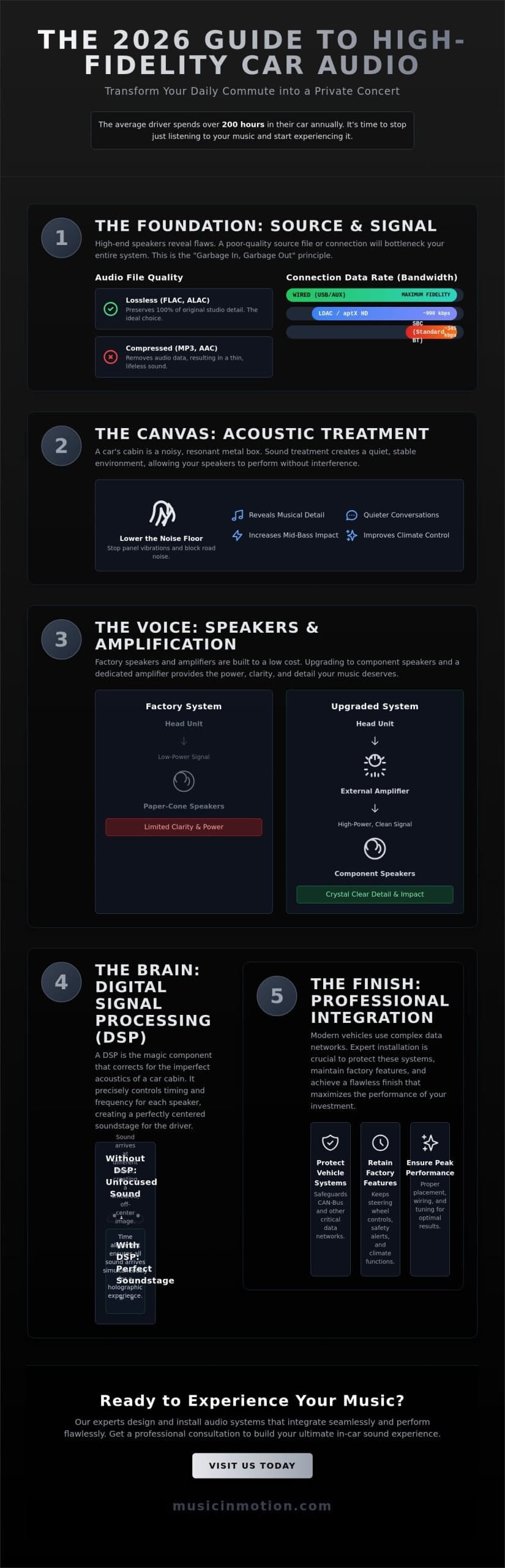
We often see enthusiasts invest in premium components only to find the sound remains thin and lifeless. This happens because of a simple rule: “Garbage In, Garbage Out.” If your source file is compressed or your signal is distorted at the head unit, even the most expensive speakers cannot fix it. Understanding Vehicle audio systems requires looking past the hardware to the data itself. High-end speakers are incredibly revealing. They will highlight the flaws in a low-bitrate MP3 rather than masking them, which is why your digital library is the first place to look when learning how to improve car audio sound quality.
The Digital-to-Analog Converter (DAC) is a silent hero in this process. It translates your digital files into the electrical signals your speakers understand. Most factory systems use budget-friendly DACs that strip away the nuances of a recording. When we design a system, we ensure the signal remains pure from the moment you press play. Bluetooth adds another layer of complexity. While modern codecs like LDAC can reach bitrates of 990 kbps and aptX Lossless offers true CD-quality audio, many older devices default to the standard SBC codec. This mandatory codec caps out at 345 kbps, which significantly reduces dynamic range. For the best experience, we recommend a wired connection or high-resolution USB playback to avoid this wireless bottleneck.
Optimizing Your Digital Music Library
Your music library is the fuel for your system. About 70% of consumers now prioritize audio quality when choosing a music service, and for good reason. We suggest switching from standard MP3s to lossless formats like FLAC or ALAC. These formats preserve every detail of the original studio recording. If you prefer streaming, dive into your app settings. Services like Spotify or Tidal often default to “Normal” or “Data Saver” modes. Manually selecting “Very High” or “Max” quality ensures you are feeding your system the best possible data. Physical media or high-res USB playback still beats wireless streaming for pure, uninterrupted detail.
Bypassing the Factory Head Unit Limitations
With 80% of new car buyers considering smartphone integration essential, we know you don’t want to lose your factory interface. However, these factory units often have built-in Equalization (EQ) curves designed to protect cheap, paper-cone speakers. This results in a “flat” sound that lacks punch. We solve this by using Line Output Converters (LOC) to capture a clean signal before it reaches the factory amplifier. This allows for a professional car audio upgrade for stock stereo without losing your dash features. We prioritize keeping your steering wheel controls and factory safety alerts fully functional. Our goal is to enhance your daily drive while maintaining the reliability of your vehicle’s original systems.
Eliminating the Enemy: Sound Deadening and Acoustic Treatment
The interior of a vehicle is a hostile environment for high-fidelity sound. Most cars are essentially large, resonant metal boxes that vibrate as you drive. These vibrations create a high noise floor that masks the subtle details of your music. When your door panels ring like a bell, they produce frequencies that actually cancel out your speaker’s output. This is especially true for mid-bass. Learning how to improve car audio sound quality starts with silencing the vehicle itself. By treating the cabin, we create a controlled space where your speakers can perform without competing against road noise and structural resonance—a principle also used by experts in Remote Podcast Recording and Production to ensure pristine audio capture in any setting.
Lowering the noise floor does more than just help your music. It transforms the entire driving experience. A treated cabin stays quieter at highway speeds, making it easier to hold conversations or take hands-free calls. These materials also act as thermal insulators. They help your climate control system maintain temperatures more efficiently, keeping you cooler in the summer and warmer in the winter. While electronic tuning is vital, physical treatment provides the baseline. Once the physical environment is quieted, electronic tools like those found in a Car Audio DSP Buying Guide can truly shine by refining the signal in a stable room.
Vibration Damping vs. Sound Barriers
We use a two-stage approach to acoustic treatment. First, we apply butyl-based damping sheets directly to the metal panels. This adds mass and stops the “ringing” effect of thin sheet metal. We focus on high-impact areas like the doors, trunk, and wheel wells to get the best return on investment. Second, we use closed-cell foam to decouple plastic trim panels. This prevents the annoying rattles that occur when deep bass notes hit. This combination ensures that the only thing you hear is your music, not your car’s interior parts rubbing together.
The ‘Enclosure’ Effect for Door Speakers
A speaker is only as good as its enclosure. Unfortunately, a car door is full of holes and air leaks. We treat the door as a sealed speaker cabinet to maximize mid-bass punch and clarity. We use specialized “fast rings” to bridge the gap between the speaker and the door card. This directs 100% of the sound energy into the cabin rather than letting it get lost inside the door cavity. Our expertise in custom car audio fabrication allows us to create the perfect mounting environment for any driver. If you want to hear the difference professional treatment makes, we invite you to explore our custom installation services for your vehicle.
The Hardware Path: Choosing Components for Your Cabin
Once you have quieted the cabin with acoustic treatment, it is time to select the gear that will breathe life into your music. Many enthusiasts make the mistake of simply swapping factory speakers for aftermarket coaxials and stopping there. While this offers a slight bump in clarity, it rarely achieves the high-fidelity concert experience we aim for. If you want to know how to improve car audio sound quality, you must understand the “System Approach.” This involves balancing power and frequency response across your entire cabin rather than just replacing parts in isolation.
We always recommend component speakers for the front stage. Unlike coaxial speakers, which have the tweeter mounted in the center of the woofer, component systems separate these drivers. This allows us to place the tweeters higher up on the dash or A-pillars, pulling the soundstage up from your feet to ear level. Small door speakers naturally struggle to reproduce the bottom octaves of music. This is where subwoofers become essential. They don’t just provide “loud bass”; they fill in the foundation of the music, allowing your smaller speakers to focus on the mid-range and high frequencies where they perform best.
The Power of External Amplification
An external amplifier is mandatory for high-performance audio. Most factory head units only produce about 10 to 15 watts of actual RMS power, which is the continuous power a speaker can handle safely. Aftermarket speakers often require 50 to 100 watts RMS to move their stiffer cones accurately. Without enough power, your music will sound thin and distorted at high volumes. We guide our clients through the choice between Class D and Class AB amplifiers. Class D units are incredibly efficient and compact, making them perfect for modern vehicles with limited space. Class AB amplifiers are larger and less efficient but are often prized for their traditional warmth and signal purity. We also ensure your vehicle’s electrical system can handle this increased current demand to maintain long-term reliability.
Subwoofer Integration for Musicality
Subwoofers should be felt and heard, but never localized. A well-integrated sub blends seamlessly with your door speakers. We offer several enclosure styles depending on your goals:
- Sealed Enclosures: These provide the most accurate, “tight” bass response. They are ideal for listeners who prioritize musicality and speed.
- Ported Enclosures: These use a tuned vent to increase output. They are perfect for those who want maximum volume and deep, booming lows.
- Space-Saving Solutions: For drivers who need their trunk space, we utilize under-seat active subs or custom-fit enclosures that tuck into the side panels of the cargo area.
A small, 8-inch or 10-inch subwoofer in a precision-built enclosure often outperforms a massive 15-inch driver in a poor-quality box. It is about the quality of the air movement, not just the size of the cone.
The Magic of Tuning: DSP and Calibration
If your speakers are the muscle of your system, the Digital Signal Processor (DSP) is the brain. Even the most expensive components will sound mediocre without proper calibration. In a car, you are never sitting in the middle of the speakers. This off-center position causes the sound from the driver-side speaker to reach your ears before the passenger-side audio. A DSP corrects this through Time Alignment, delaying the signal to the closer speakers by milliseconds so every note hits your ears at the exact same moment. This is a fundamental step in how to improve car audio sound quality and create a soundstage that feels like it is floating right on your dashboard.
We use a Real-Time Analyzer (RTA) to visualize the acoustic response of your cabin. Your car’s interior is full of reflective glass and absorbent upholstery that create “peaks” and “valleys” in the sound. An RTA allows us to see these frequency spikes and flatten them out with surgical precision. We also perform Level Matching. This ensures that every speaker, from the tiny tweeter to the heavy-hitting subwoofer, reaches your ear at a balanced volume. This prevents one driver from overpowering the rest and maintains the musicality of the track exactly as the artist intended.
How to Set Up Your Soundstage
Building a soundstage starts with physical measurements. We measure the distance from each speaker to the driver’s head to calculate precise delay settings. Next, we adjust crossovers. This acts as a traffic cop for your audio, ensuring your tweeters don’t try to play deep bass and your woofers don’t struggle with high frequencies. Setting amplifier gains is the final critical step. We follow a strict process to avoid “clipping,” which is the primary cause of speaker failure. We never “tune by ear” for gain; we use dedicated tools to find the exact point where your amplifier provides maximum clean power without distortion.
Fine-Tuning the Frequency Response
Every vehicle cabin has a unique acoustic signature. We use parametric EQ to smooth out harshness caused by sound bouncing off the windshield. We also pay close attention to Phase Correction. If your speakers are “out of phase,” they will actually work against each other, destroying your bass impact. Once the baseline is perfect, we can create multiple “tunes” or presets. You might want one profile for a driver-focused experience and another for when the whole family is in the car. If you are ready to experience this level of precision, contact our team for a professional audio calibration today.
Professional Integration: Why Expert Installation Wins
Modern vehicles are more than just mechanical transport; they are rolling data networks. Integrating high-performance audio into a car equipped with a Controller Area Network (CAN-bus) requires specialized knowledge. One wrong connection can trigger dash error codes or even disable vital functions. We prioritize non-destructive installation techniques to protect your investment. This means using vehicle-specific wiring harnesses and factory-matched mounting brackets. You get the elite sound you want without compromising the integrity of your factory electronics or your vehicle’s warranty.
Custom fabrication is where our artistry meets your vehicle’s interior. We don’t just “bolt in” speakers and hope for the best. We create custom baffles and mounting plates that ensure a rigid, airtight seal. This makes high-end gear look like it came from the factory while performing at its peak. Finally, there is the value of a professional ear. While we rely on advanced RTA tools for the heavy lifting, the human element of final calibration is what makes a system feel alive. We listen for the nuances that software might miss, ensuring the final result is perfectly balanced for your specific musical tastes. This level of detail is the final piece of the puzzle when learning how to improve car audio sound quality.
Safety and Technology Integration
Your audio system must coexist with modern vehicle safety systems like backup sensors and lane-departure warnings. We ensure these alerts remain audible and clear after your upgrade. We also take electrical safety seriously. This involves calculating the correct wire gauge for your total current demand and using high-quality fusing near the battery. This creates a stable power grid for your audio while allowing us to hardwire additional technology like dash cameras or radar detectors into the system with total reliability.
The Music In Motion Difference
We believe a successful project is defined by the finished result, not just a hardware transaction. Our team brings decades of experience across land, water, and powersports applications. This versatility allows us to solve complex integration challenges that others might avoid. We also understand that comfort and sound go together. This is why professional remote start installation is a frequent companion to our audio work. Stepping into a pre-conditioned cabin with a world-class sound system is the ultimate way to improve your daily life behind the wheel. We are here to be your expert partners in every customization project you can imagine.
Elevate Your Daily Drive with Precision Audio
Transforming your vehicle from a noisy environment into a high-fidelity soundstage is a rewarding investment in your daily happiness. We have walked through the essential layers of how to improve car audio sound quality, emphasizing that the best results come from a balanced approach to source material, acoustic treatment, and precision tuning. Success isn’t just about finding the loudest speakers; it’s about creating a controlled environment where every note can shine without interference from road noise or structural vibration.
Since 1994, we have dedicated ourselves to expert custom fabrication and high-end vehicle integration. As a nationwide authority on mobile electronics, we don’t just sell hardware. We provide the specialized knowledge required to integrate advanced technology into your vehicle safely and seamlessly. We take pride in our evolution and remain grounded in our commitment to providing reliable, breathtaking audio solutions for every type of transport. We are ready to help you turn your cabin into a private concert hall.
Ready for a concert-grade experience? Contact Music In Motion for a custom audio consultation.
We look forward to helping you rediscover your favorite music on the open road. Your next great listening experience is just a professional tune away.
Frequently Asked Questions
Can I improve my car’s sound quality without replacing the head unit?
Yes, you can certainly keep your factory dash interface. We use advanced integration tools like Line Output Converters or Digital Signal Processors to capture the original signal and clean up any factory-set equalization. This allows you to add high-performance amplifiers and speakers while retaining all your original steering wheel controls and safety alerts. It is a perfect solution for modern vehicles with complex, integrated screens.
What is the single most effective upgrade for better car audio?
Adding a Digital Signal Processor (DSP) is the single most effective way to see a total transformation. While new speakers help, a DSP allows us to correct the acoustic flaws inherent in your vehicle’s cabin. This is the most professional method for those asking how to improve car audio sound quality because it fixes timing and frequency issues that hardware alone cannot solve.
Is sound deadening really worth the cost for a daily driver?
Sound deadening is one of the most underrated upgrades for a daily driver. By applying butyl-based damping sheets to your doors and floor, we lower the noise floor of your cabin. This means you can hear the subtle details in your music at lower volumes without competing against wind and tire noise. It also makes your car feel more solid and improves climate control efficiency.
How much power (RMS) do I actually need for my car speakers?
Most aftermarket speakers perform best with between 50 and 100 watts of RMS power. RMS represents the continuous power a speaker can handle, which is more important than the “Peak” or “Max” ratings found on boxes. Providing your speakers with adequate power ensures they move accurately, preventing the distortion that usually occurs when a weak factory head unit is pushed too hard. It provides necessary headroom for dynamic tracks.
What is the difference between an active and passive car audio system?
A passive system uses a single amplifier channel to power both a tweeter and a woofer through a physical crossover box. An active system gives each individual driver its own dedicated amplifier channel. This setup, controlled by a DSP, allows for precise adjustments to the volume, timing, and frequency of every speaker. This results in a much more accurate and immersive soundstage compared to traditional passive setups.
Why does my car audio sound worse when the engine is running?
Electrical interference is usually the culprit when audio quality drops while the engine is running. This often manifests as a high-pitched alternator whine that changes with your RPMs. We solve this by ensuring your system has a rock-solid ground connection and by using high-quality shielded signal cables. These steps keep engine noise away from your music and ensure a clean, quiet signal path through the vehicle.
Can I install a high-end audio system in a leased vehicle?
You can definitely upgrade the audio in a leased vehicle. We use non-destructive installation techniques, such as vehicle-specific wiring harnesses and custom-made brackets that utilize factory mounting points. This allows us to return the car to its original condition before you turn it back in at the end of your lease term. You get to enjoy premium sound without worrying about lease-end penalties or permanent modifications.
How do I know if I need a high-output alternator for my sound system?
You likely need a high-output alternator if you notice your headlights dimming during heavy bass notes or if your vehicle’s voltage drops significantly under load. Most modern systems under 1,000 watts RMS operate safely on factory charging systems. However, for high-current custom builds, we evaluate your electrical system to ensure it can handle the increased demand without straining your battery or damaging sensitive electronics.