The most expensive speakers in the world will still sound like a muddy mess if they are fighting against your car’s interior physics. Many enthusiasts believe that simply swapping factory drivers for high-end components is the finish line, but true high-fidelity sound requires a much deeper strategy. We know the frustration of dealing with harsh highs and boomy, undefined bass that ruins your favorite tracks. This is why a professional approach to audiophile car audio system design is the only way to achieve a listening experience that rivals a professional studio instead of one that gets drowned out by road noise.
In this guide, we will show you how to transform your vehicle into a world-class listening room. We believe in delivering a finished result that prioritizes your internal experience over a mere list of hardware. You will learn how to use digital signal processing to fix timing issues, why custom fabrication is the key to a wide soundstage, and how to ensure your system sounds crystal clear at any volume level. From precision tuning to advanced integration, we are here to help you master the technical details and improve your daily life behind the wheel. It is time to stop settling for standard sound and start enjoying the possibilities of customization.
Key Takeaways
- Understand why the Digital Signal Processor (DSP) is the most critical component for correcting factory limitations and creating a perfect tuning baseline.
- Learn how custom fabrication and 3-way speaker layouts achieve a precise, wide soundstage that brings your music to life on the dashboard.
- Discover the essential phases of audiophile car audio system design, beginning with a professional consultation to define your unique acoustic goals.
- Explore why high-quality power management and acoustic treatments are more vital than raw wattage for maintaining clarity at any volume level.
- Shift your perspective from simply purchasing hardware to investing in a finished result that prioritizes your internal experience behind the wheel.
What Defines Audiophile Car Audio System Design?
We often see customers who equate high-end audio with raw volume. While power is certainly part of the equation, true audiophile car audio system design focuses on accuracy, transparency, and imaging. It is about creating a space where the equipment disappears, leaving only the music. Many factory “premium” systems, even those with luxury branding, fall short because they are built to meet strict weight targets and mass-production budgets. They often rely on inexpensive paper cones and aggressive digital processing to hide hardware flaws. Our goal is to move past these limitations and provide a finished result that prioritizes the listener’s experience.
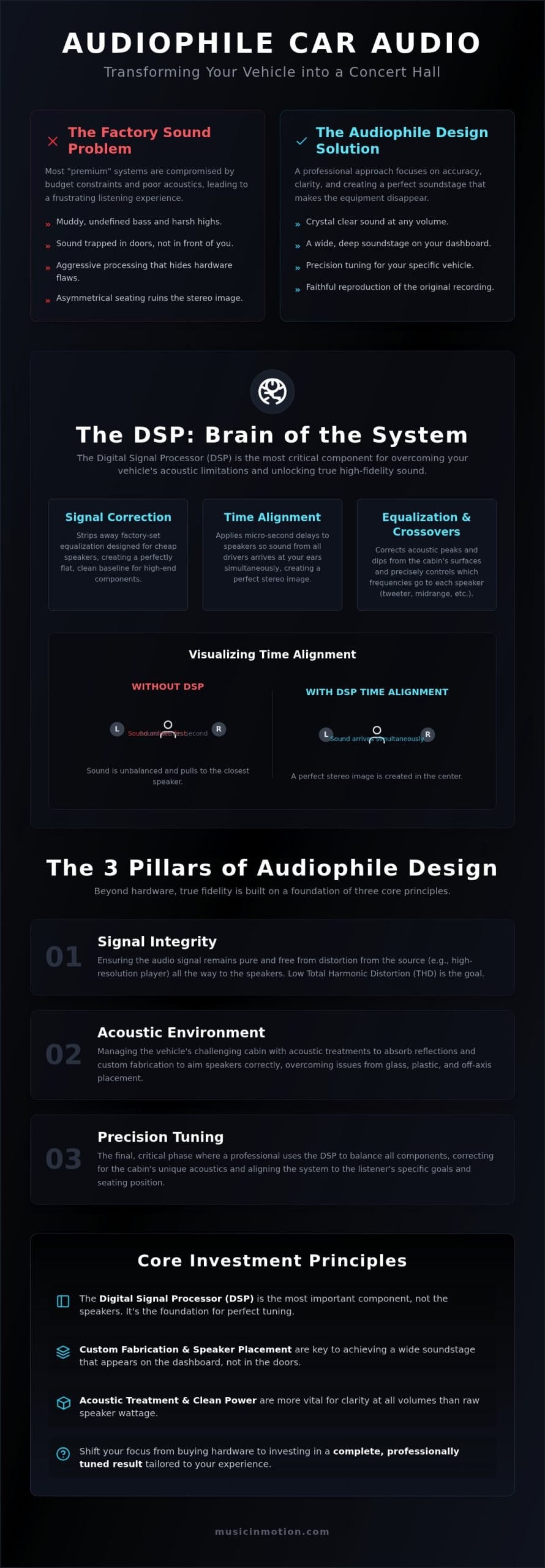
To understand What Defines Audiophile Car Audio, we look at three specific pillars that form the foundation of audiophile car audio system design. First is signal integrity, ensuring the music stays clean from the source to the speakers. Second is acoustic treatment, which manages the vibrations of the car itself. Finally, precision tuning brings everything into balance. A faithful system reproduces the recording exactly as the artist intended; a loud system simply pushes air without regard for detail.
Accuracy vs. Volume: The Audiophile Objective
We aim to minimize Total Harmonic Distortion (THD) across the entire frequency spectrum. When distortion is low, you can hear the subtle breath of a vocalist or the trailing ring of a cymbal. High-resolution source material is your starting point here. If the source is compressed, even the best system cannot recover that lost data. We prioritize components that handle these delicate signals with care, ensuring every note remains crisp and defined at any volume level.
Overcoming the Acoustic Challenges of the Car Cabin
Cars are terrible acoustic environments. You have hard glass surfaces causing reflections and speakers placed in doors that fire at your ankles. This off-axis placement and the asymmetrical seating position ruin traditional stereo imaging. Without proper design, the sound feels trapped in the door panels rather than floating across your dashboard. Spectral balance in a vehicle is the achievement of a uniform frequency response where no single range dominates or disappears despite the chaotic acoustic environment of the cabin. We use custom fabrication and advanced processing to overcome these physical hurdles, placing the “stage” right in front of you. This specialized knowledge allows us to enhance any medium of transport, from a daily driver to a complex custom build.
The Digital Signal Processor (DSP): The Brain of Your System
If your speakers are the voice of your vehicle, the Digital Signal Processor (DSP) is the brain. In modern audiophile car audio system design, the DSP is the most critical component we install. Most factory head units come with “baked-in” equalization curves designed to protect cheap paper speakers from failing. These curves often suck the life out of high-end components. We use a DSP to strip away those factory colorations, achieving a perfectly flat baseline that allows your new equipment to perform as intended.
Beyond cleaning the signal, the DSP manages active crossovers for every driver in the system. Unlike traditional passive crossovers that sit inside a door and offer no flexibility, an active setup gives us total control over where one speaker stops and the next begins. This precision ensures your tweeters stay crisp and your midbass stays punchy without overlapping or causing phase issues. It is this level of control that transforms a simple equipment swap into a cohesive, world-class listening environment.
Time Alignment and the Virtual Soundstage
We use the DSP to solve the biggest problem in car audio: you are sitting in the wrong place. Because you are closer to the driver’s side speakers, that sound hits your ears first, destroying the stereo image. We apply millisecond delays to the nearest speakers so that every note from every driver reaches your ears at the exact same time. This creates a “phantom center” where the vocalist appears to be standing directly in the center of your dashboard. We focus on achieving width and depth that extends well beyond the physical pillars of your car, giving you a sense of space that factory systems cannot replicate.
Equalization and Room Correction
Every vehicle cabin has unique acoustic peaks and dips caused by seats, glass, and plastic panels. We use 31-band parametric equalization combined with Real Time Analysis (RTA) to smooth out these imperfections. This process of Professional Car Audio Tuning: Dialing in Perfect Sound ensures that no frequency is too harsh or too quiet. If you want to experience this level of clarity in your own vehicle, our experts at Music In Motion are ready to start your custom design journey today. We prioritize the finished result over the mere transaction of goods, ensuring your system is tuned to your specific ears and vehicle acoustics.
Selecting Drivers and Custom Fabrication for Perfect Imaging
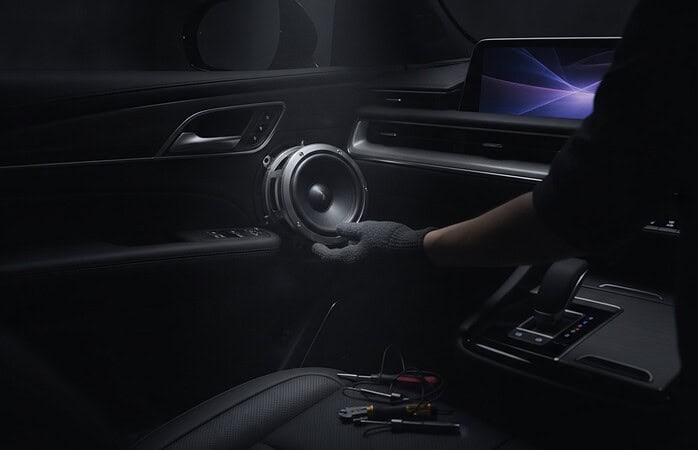
Selecting the right speakers is only half the battle. We often see enthusiasts invest heavily in premium brands only to be disappointed by the results because the drivers are fighting poor factory locations. In audiophile car audio system design, we choose drivers based on their mechanical properties and off-axis response. A speaker that sounds great in a showroom might lose its detail when tucked behind a thick plastic door panel or aimed at your knees. We prioritize drivers that maintain their clarity even when the installation environment is less than ideal.
We advocate for 3-way front stages whenever possible. By splitting the signal between a tweeter, a midrange, and a midbass driver, we minimize the workload for each component. This approach lifts the vocals from your floorboards to your eye level, creating a more natural and immersive listening experience. It allows us to keep the most critical frequencies on the dashboard while the larger midbass drivers handle the heavy lifting in the doors. This separation is key to achieving the transparency that high-fidelity listeners crave.
Custom A-Pillar and Kick Panel Pods
High frequencies are highly directional. If your tweeters fire into your shins, you lose the crisp detail of the recording. We use custom car audio fabrication to build A-pillar or kick panel pods that aim the drivers directly at your ears. This on-axis positioning reduces early reflections from side windows and dashboard plastic, which usually cause smearing in the soundstage. Our custom pods integrate seamlessly with your interior aesthetics, ensuring your vehicle looks as refined as it sounds.
The Midbass Foundation and Door Treatment
The midbass region, typically between 60Hz and 250Hz, is where the kick of a drum or the snap of a bass guitar lives. It is also the hardest range to get right in a car. Most doors are leaky, vibrating shells that swallow this energy. We create rigid, sealed baffles for midbass drivers to prevent energy loss and ensure every note hits with authority. This is a foundational step in audiophile car audio system design that many DIY installers skip. We also apply professional-grade acoustic treatments to the door skin. This stops the metal from dancing along with the music, allowing you to feel the impact without the distraction of rattling door panels.
Power Management and Acoustic Treatment Fundamentals
A world-class listening room is only as good as its foundation. In audiophile car audio system design, we view the vehicle as an acoustic obstacle that must be tamed before the equipment can shine. High wattage means nothing if your speakers are fighting against road noise or inconsistent voltage. We prioritize clean, stable power and a silent environment to ensure that every micro-detail in your music remains audible. This approach shifts the focus from raw volume to the internal experience of the listener, delivering a finished result that feels effortless and refined.
Consistent voltage is the lifeblood of high-performance electronics. We often implement higher voltage electrical systems, ranging from 14.8 to 15.5 volts, along with lithium batteries to ensure your amplifiers never starve for current. Dedicated power and ground runs are mandatory for any high-fidelity build. This isolated path prevents electrical noise from your vehicle’s alternators or computers from bleeding into the audio signal. When your amplifiers have a rock-solid foundation, they can reproduce transients and bass notes with the speed and precision the artist intended.
Multi-Stage Sound Deadening
We use a systematic approach to lower the noise floor of your cabin. Constrained layer damping (CLD) is our first step; we apply these specialized sheets to stop metal panels from vibrating like a bell. Once the vibrations are controlled, we use mass-loaded vinyl (MLV) as a heavy, flexible shield to block external road and wind noise. Finally, we place acoustic foam inside door cavities to absorb high-frequency reflections. This multi-stage treatment transforms your car into a quiet sanctuary, allowing you to hear the subtle textures of a recording without having to fight the sound of your tires.
Audiophile-Grade Amplification
Amplifier quality is measured by transparency, not just a number on a box. By 2026, Class D technology is projected to capture 41.3% of the market share, largely because modern designs have finally matched the warmth of traditional Class AB while offering superior efficiency. We look for a high signal-to-noise ratio to ensure a completely silent background. In an active system design, we use multiple amplifier channels to provide dedicated power to each individual driver. This level of control allows for the perfect integration of premium electronics. If you are ready to see how these components come together in a real-world build, explore our custom installations to see our philosophy in action.
Step-by-Step: Designing Your Custom Audiophile Build
We believe the most important tool in our shop isn’t a router or a tuning microphone; it’s the plan we create with you. A successful audiophile car audio system design isn’t an accident. It is the result of a deliberate, phased approach that balances your specific listening goals with the physical realities of your vehicle. We don’t just sell you a box of parts. We partner with you to build a roadmap that ensures the final result exceeds your expectations and improves your daily life behind the wheel.
The Design Consultation
The journey begins with a deep dive into your preferences. We start by identifying your preferred sound signature. Some listeners crave a clinical, hyper-accurate response that reveals every flaw in a recording, while others prefer the smooth warmth of a vintage home hi-fi system. During this session, we also assess your vehicle for custom fabrication opportunities. We look for the ideal placement for midranges and tweeters to ensure the soundstage is wide and high. This map acts as the blueprint for your audiophile car audio system design, ensuring signal flow and power requirements are perfectly matched from the start.
Once the design is set, we follow a steady, organized execution process:
- System Audit: We analyze the factory signal to determine if we can bypass the original amplifier or if we need to clean up the signal using a DSP.
- Phased Installation: We execute the build in logical steps, starting with the power foundation and acoustic treatments before moving to custom fabrication and driver mounting.
- Calibration: We spend hours behind a laptop, using RTA equipment to fine-tune every crossover point and EQ band.
- The Hand-Off: We sit with you for a final listening session, explaining the system’s capabilities and ensuring the sound matches your original vision.
Long-Term Scalability and Integration
We design our systems with the future in mind. Whether you want a subtle upgrade or a ground-up custom masterpiece, we ensure the installation is scalable. This means using high-quality wiring and mounting solutions that allow for future component swaps or even a full transfer to a new vehicle down the road. We also prioritize the safety and functionality of your car. Your backup cameras, steering wheel controls, and blind-spot sensors will remain fully integrated and functional. We are here to push creative boundaries for your project while keeping your property in safe hands. Schedule your custom system design consultation with Music In Motion today and let’s start building your world-class listening room.
Elevate Your In-Car Listening Experience
Your vehicle shouldn’t be a compromise for your music. Achieving true high-fidelity sound requires moving beyond simple speaker swaps and embracing a comprehensive audiophile car audio system design. We use digital signal processing to fix factory flaws and create a perfect baseline. We employ custom fabrication and multi-stage sound deadening to transform your car into a silent sanctuary. This approach shifts the focus from the hardware to your internal experience behind the wheel, ensuring every note is reproduced with absolute transparency.
At Music In Motion, we’ve been high-performance audio specialists since 1994. We prioritize the finished result over the mere transaction of goods. Our team of custom fabrication experts ensures that every build features professional DSP tuning for a precise, wide soundstage. It’s time to stop settling for muddy bass and harsh highs. Whether you’re upgrading a daily driver or a complex custom project, we have the specialized knowledge to enhance it and improve your daily life on the road.
Start your journey to perfect sound with a custom system design at Music In Motion. We’re ready to help you rediscover your favorite tracks with the clarity and impact they deserve.
Frequently Asked Questions
Can I achieve audiophile sound while keeping my factory head unit?
You can absolutely keep your factory head unit while achieving world-class sound. We use a Digital Signal Processor to intercept the signal before it reaches your speakers. This allows us to strip away the factory-programmed EQ curves that usually muddy the audio. By cleaning this signal, we create a perfect baseline for your audiophile car audio system design without changing the look or functionality of your dashboard.
What is the most important component in an audiophile car audio system?
While every part matters, the Digital Signal Processor is the most critical component. It acts as the brain of the entire system. Without it, you are simply listening to speakers fighting against the car’s poor acoustics. The DSP allows us to correct timing, smooth out frequency peaks, and ensure that every driver works in perfect harmony. It is the foundation of any high-fidelity build.
Why do I need a DSP if my amplifier already has crossovers?
Amplifier crossovers are basic filters that only block certain frequencies. A DSP provides much deeper control, including time alignment and 31-band parametric equalization. This precision allows us to move the soundstage from your floorboards to your dashboard. We use these tools to fix the specific acoustic problems of your vehicle’s cabin, something a standard amplifier crossover simply cannot do.
How much does a custom audiophile car audio system design cost?
The investment for a custom build varies significantly based on your specific listening goals and the complexity of the fabrication required. We focus on delivering a finished result rather than just selling hardware. Your total will depend on the choice of premium electronics, the amount of sound deadening needed, and the labor involved in professional tuning. We recommend a design consultation to define a budget that fits your vision.
What is the difference between soundstage and imaging?
Soundstage refers to the perceived physical dimensions of the music, such as its width, height, and depth. Imaging describes the specific placement of individual instruments and vocalists within that space. In a well-designed audiophile car audio system design, you should be able to close your eyes and point to exactly where the drummer or lead singer is standing on your dashboard.
Do I really need custom fabrication for my speakers to sound good?
Custom fabrication is the bridge between good sound and a world-class listening room. Factory speaker locations are rarely optimized for high-fidelity audio. We use custom pods and enclosures to move midranges and tweeters into an “on-axis” position. This minimizes reflections from glass and plastic, ensuring that you hear the music directly rather than hearing it bounce off your vehicle’s interior surfaces.
What is an “active” vs “passive” speaker system?
A passive system uses a single amplifier channel to power multiple speakers through a fixed crossover. An “active” system provides a dedicated amplifier channel for every single driver in the car. This gives us total control over the volume, timing, and frequency range of each speaker. We prefer active designs for audiophile builds because they allow for much more precise tuning and overall system clarity.
How long does a full custom audiophile installation typically take?
A full custom installation is a detailed process that can range from a few days to several weeks. The timeline depends on the level of fabrication, such as custom A-pillar pods or subwoofer enclosures, and the complexity of the integration. We prioritize doing the job right over doing it fast. This ensures every wire is secure, every panel is deadened, and the final tuning is absolutely perfect.