Why does a high-end speaker that sounds incredible in a showroom often sound like a thin, piercing mess once you’re hitting 30 knots on open water? Most boaters have experienced that moment where the music gets washed out by the engine, or worse, the high frequencies become so harsh they’re actually painful to listen to. We understand that frustration. You want your time on the water to be defined by the music you love, which is why finding the best marine speakers for sound quality is about more than just buying the loudest option on the shelf.
In this 2026 guide, we’re here to show you the engineering secrets and system design principles needed to bring true high-fidelity audio to your vessel. You’ll discover how to achieve a clean, balanced frequency response that survives salt, sun, and speed. We’ll preview the latest IPX7-rated components and explain why professional DSP tuning is the missing link for clarity at cruising speeds. From custom fabrication to advanced driver technology, this guide provides the roadmap to an audio system that sounds as good as it looks. You have a vessel built for the open water. We have the specialized knowledge to enhance it.
Key Takeaways
- Identify the engineering differences between simple loudness and true high-fidelity audio to ensure your music stays clear at any volume.
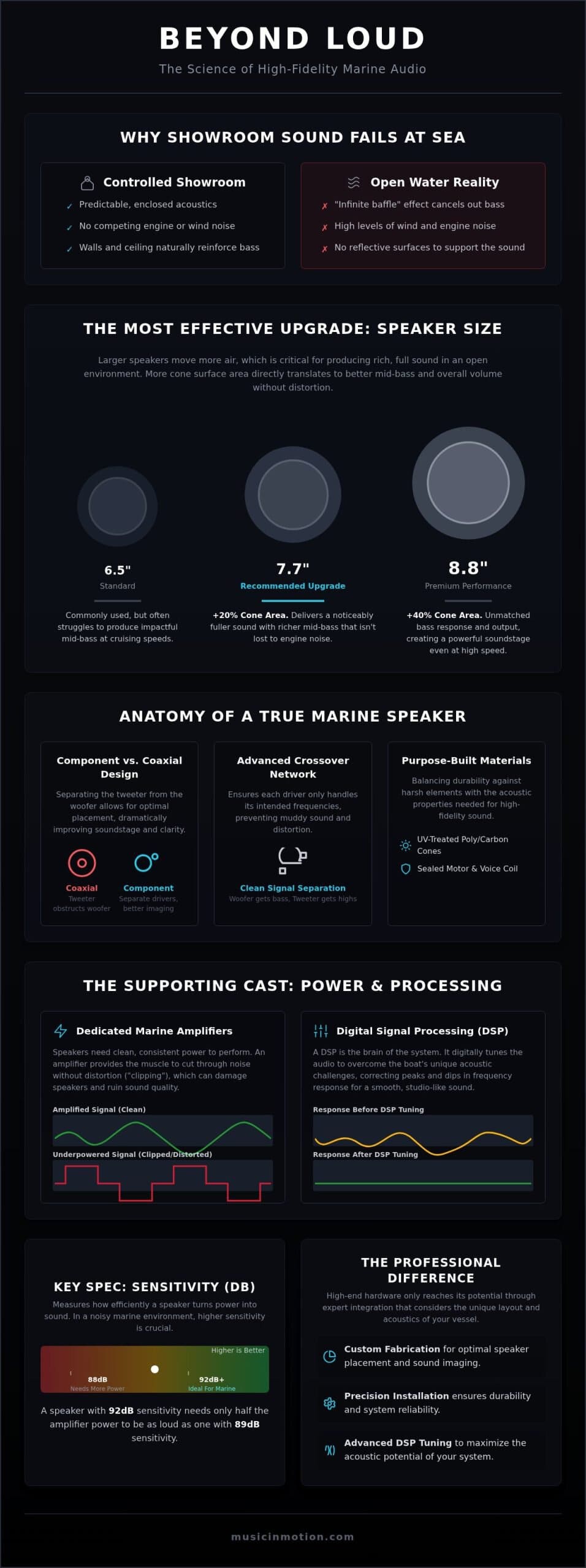
- Learn why upgrading to larger 7.7 inch or 8.8 inch formats is often the most effective way to find the best marine speakers for sound quality.
- Master the technical specs that matter, focusing on how sensitivity ratings help your system cut through wind and engine noise.
- Explore the vital role of dedicated marine amplifiers and DSP tuning in creating a balanced, studio-like soundstage on your boat.
- Understand how professional installation and custom fabrication techniques ensure your high-end hardware performs to its full potential in harsh environments.
Engineering Excellence: What Defines High-Fidelity Marine Audio?
Achieving high-fidelity audio on a boat is an uphill battle against physics. Most retail options focus on being loud enough to hear over a 300-horsepower outboard engine. While volume is necessary, it isn’t the same as quality. The best marine speakers for sound quality maintain their tonal balance even when pushed to high decibels. This requires drivers with significantly higher excursion than standard car speakers. In a car, the cabin acts as a pressurized box that helps reinforce bass. On a boat, you’re dealing with an open-air environment. Your speakers have to move a massive amount of air to create impact, making robust Loudspeaker design principles essential for any premium build.
We look for advanced crossovers that prevent frequency overlap. A muddy soundstage often happens when the woofer and tweeter fight over the same midrange frequencies. High-end marine systems use passive or active crossovers to ensure each component plays its part perfectly. Tweeter choice also changes the experience. Silk domes offer a smooth, warm sound for relaxing at the sandbar. Titanium or hard-dome tweeters provide the “bite” needed to cut through wind noise while cruising. Both have their place, but the choice depends on how you use your vessel.
Overcoming the Open-Air Acoustic Challenge
Boats present the “infinite baffle” problem. Without a sealed enclosure, sound waves from the back of the speaker can cancel out the sound from the front, especially in the mid-bass region. Premium marine drivers are engineered with high-compliance suspensions to compensate for this lack of back-pressure. We also prioritize off-axis response. Since you aren’t always sitting directly in front of the speaker, the driver must disperse sound widely so every passenger hears a full, rich spectrum.
Marine-Grade vs. Audiophile-Grade Materials
Durability shouldn’t come at the expense of acoustic accuracy. We utilize UV-treated polypropylene and carbon fiber cones because they are stiff enough to resist distortion but light enough to remain responsive. These materials don’t just survive the sun; they provide the snap and detail required for high-end audio. We also insist on sealed motor structures. This prevents salt air from corroding the internal voice coil, ensuring your investment sounds as good in year three as it did on day one. True marine fidelity is the balance of durability and harmonic accuracy.
The Best Marine Speaker Series for Sound Quality in 2026
Selecting the right hardware is where your vision for a perfect day on the water starts to take shape. While the industry standard has long been the 6.5 inch speaker, we’ve found that the best marine speakers for sound quality in 2026 are almost always larger formats. Upgrading to 7.7 inch or 8.8 inch drivers provides the surface area necessary to move air effectively without a pressurized cabin. This extra size delivers the rich mid-bass that smaller models often lack, creating a much fuller soundstage that doesn’t disappear the moment you leave the dock.
For the most demanding listeners, we often recommend component systems over coaxial designs. By separating the tweeter from the woofer, we can mount the high-frequency drivers higher up in the boat, closer to ear level. This improves imaging and ensures your music feels like it’s coming from a stage in front of you rather than from under your feet. Understanding Outdoor sound propagation is vital here; sound behaves differently when there are no walls to reflect it, so speaker placement and driver size are your two biggest allies.
The Reference Standards: JL Audio M6 and M3 Series
The JL Audio M6 series remains the undisputed benchmark for tonal balance. Its long-throw woofer design allows for incredible excursion, which translates to deep, controlled bass even at high speeds. We find the M6 series is ideal for boaters who want their vessel to sound like a high-end home theater. The M3 series offers a similar sound signature in a more compact package, making it a great choice for secondary zones like cabins or smaller cockpits where space is at a premium.
High-Output Fidelity: Wet Sounds and Rockford Fosgate
If your goal is to maintain clarity while cutting through the roar of a performance engine, the Wet Sounds REVO series is a top contender. These speakers are built for high-wattage inputs, using advanced cooling to prevent thermal compression during long days of use. Similarly, the Rockford Fosgate M2 series provides a punchy, aggressive mid-bass that excels in open water. Both brands have mastered the art of being loud without becoming harsh. If you’re ready to hear the difference these premium series can make, we can help you design a marine audio system tailored to your specific vessel.
Deciphering Technical Specs: What Actually Impacts Sound Quality?
We often see boat owners get caught up in peak wattage numbers. It is a common trap. While a high “max power” rating looks impressive on a box, it tells you almost nothing about how the speaker will actually sound. RMS power handling is a much more reliable metric because it indicates the continuous power a speaker can manage without failing. However, even RMS is only half the story. To find the best marine speakers for sound quality, we focus on how a driver uses that power to maintain clarity, accuracy, and detail across the entire volume range.
Impedance matching is another critical factor we prioritize during system design. Most marine speakers are rated at 4 ohms, but some high-performance models operate at 2 ohms to draw more power from the amplifier. When we build multi-speaker arrays for larger vessels, we must calculate the total load carefully. An incorrect impedance match can overheat your amplifier or lead to signal clipping, which introduces the very distortion we are trying to avoid. We aim for a “flat” frequency response in high-end builds, though many marine speakers are slightly “colored” with boosted treble to help the music pierce through wind noise.
Sensitivity and Efficiency on the Water
Sensitivity is perhaps the most overlooked specification in marine audio. It measures how loud a speaker plays with a specific amount of power. A 3dB increase in sensitivity effectively doubles your amplifier power. This is vital on a boat because you are competing with engine roar and rushing water. Efficient speakers don’t just play louder; they maintain better detail at lower volumes. When you are anchored at the sandbar, a high-sensitivity speaker provides a rich, full experience without needing to drain your batteries to get there.
Frequency Range and Crossover Points
We look for speakers with significant low-end extension, usually reaching down to 45Hz or 50Hz, to ensure the mid-bass feels impactful. Without this range, the music sounds thin and “tinny” once you get up to speed. We also utilize steep crossover slopes to protect the delicate tweeters from low frequencies. This separation allows the midrange to remain open and airy while the woofer handles the heavy lifting. Maintaining clean headroom prevents the distortion that ruins sound quality. By choosing components that work within their ideal frequency bands, we create a soundstage that feels effortless and natural, even in the middle of the lake.
Beyond the Speaker: Achieving Studio Sound in an Open Environment
We often see boat owners invest in high-end drivers only to pair them with a weak factory head unit. It is a common mistake that leads to disappointing results. Even the best marine speakers for sound quality cannot fix a poor signal. The head unit is your source; if it introduces distortion or has a low voltage output, your speakers will simply reproduce those flaws. To get the most out of your hardware, we look at the entire signal path. A premium marine audio system acts as a cohesive chain where every component supports the next.
High-fidelity transients, the sharp attacks of a drum hit or a guitar pluck, require an amplifier that can react instantly. Without adequate power, these sounds become blurred and flat. We prioritize system designs that maintain signal integrity from the source to the driver. This holistic approach is the only way to achieve studio-grade clarity when you’re miles away from the nearest shore.
Amplification: Clean Power vs. Raw Volume
Amplifiers are the muscle of your system. While Class D marine amplifiers are popular for their efficiency and compact size, the quality of the internal components varies wildly. We look for amplifiers with high signal-to-noise ratios. This ensures that you hear the music, not a background hiss, even when you’re trying to listen over wind and water noise. We typically recommend sizing your amplifier to provide roughly 150% of the speaker’s RMS rating. This extra headroom allows the system to handle musical peaks without clipping, which is the primary cause of speaker failure.
Signal Processing and Tuning
Boats are acoustic nightmares because speakers are rarely placed in ideal listening positions. We use Marine Digital Signal Processing (DSP) to overcome these physical limitations. Time alignment is a vital tool in our kit. By delaying the signal to the speakers closest to you by mere milliseconds, we ensure the sound from every driver reaches your ears at the exact same time. This creates a “center stage” effect that makes the music feel like it’s floating right in front of you.
We also use precision equalization to target frequencies that compete with engine drone. We can boost the mid-bass to stay audible at cruising speeds without making the high frequencies sound harsh or piercing. Professional tuning doesn’t just improve the sound; it extends the life of your hardware by ensuring no component is ever pushed into a dangerous range of distortion. If you are ready to hear your music exactly as the artist intended, our team is ready to design your custom system.
Professional Integration: The Music In Motion Approach
We don’t just sell components; we deliver an acoustic outcome. Even the best marine speakers for sound quality will underperform if the mounting surface isn’t rigid. A high-excursion driver produces a significant amount of force. If the fiberglass panel it is attached to flexes in sympathy with the music, you lose mid-bass impact and introduce muddy distortion. We solve this by creating optimal mounting environments that eliminate baffle flex entirely. Our philosophy centers on delivering a finished result rather than a simple transaction of goods. This ensures your system performs at its peak for years to follow.
Fiberglass is notorious for resonance, which can color the sound and ruin the clarity of a high-end driver. By applying the same precision found in our custom car audio fabrication, we ensure that every watt of power from your amplifier is converted into clean sound rather than wasted energy vibrating the hull. We treat every vessel as a unique challenge, identifying the specific needs of the boat and providing the corresponding fabrication as the answer.
Custom Fabrication for Marine Imaging
Standard factory locations are rarely ideal for critical listening. We often find speakers tucked under gunwales or pointed at passengers’ feet. We build specialized speaker pods to improve off-axis listening. These pods allow us to aim the drivers toward the primary seating area, ensuring the soundstage stays high and wide. We also reinforce hulls with high-density materials to prevent sympathetic resonance. This transforms the boat from a vibrating shell into a precision-tuned enclosure. For those seeking deep, accurate low-end, we design custom-tuned subwoofer enclosures that fit seamlessly into the vessel’s storage compartments without sacrificing utility.
The Finished Result: Reliability and Performance
The environment on the water is unforgiving. Salt air and constant vibration can ruin a DIY installation in a single season. We utilize professional-grade wiring and sealed grounding points to maintain a noise-free signal path. Our “Invisible” sound treatment focuses on the details you can’t see, like internal baffling and specialized damping, which make a massive difference in the final performance. A professionally integrated system outperforms a DIY “bolt-on” every time because we account for the unique acoustics of your specific vessel. We take pride in our 30 years of experience, ensuring your investment is protected and your music is flawless. We have the specialized knowledge to ensure you’re getting the best marine speakers for sound quality by creating the environment they need to shine.
Elevate Your Experience on the Water
Achieving high-fidelity sound in an open-air environment is a complex engineering challenge that goes far beyond simply buying waterproof gear. We’ve explored how larger driver formats and advanced materials provide the foundation for a rich soundstage. We also know that the best marine speakers for sound quality only reach their full potential when supported by a clean signal path and precision DSP tuning. Without professional integration, even the finest hardware can lose its impact to wind and engine noise.
Our team brings 30+ years of high-performance integration and award-winning custom fabrication to every project we touch. We are specialists in open-air acoustic tuning. This expertise ensures your music stays clear and balanced at any cruising speed. We believe in delivering a finished result that improves your daily life on the boat. If you’re ready to transform your vessel into a true sonic sanctuary, contact Music In Motion for a professional marine audio consultation. Let’s build a system that sounds incredible today and survives the seasons to come.
Frequently Asked Questions
What is the best marine speaker size for sound quality?
Larger driver formats like 7.7 inch or 8.8 inch speakers are generally the best marine speakers for sound quality. These larger cones provide the surface area needed to produce impactful mid-bass in an open-air environment. While 6.5 inch speakers are standard, they often sound thin when competing with engine noise. We recommend larger drivers to ensure your music maintains its full body and richness even at high cruising speeds.
Can I use car audio speakers on my boat if they don’t get wet?
We strongly advise against using car audio speakers on a boat. Even if they stay dry, the marine environment is harsh due to salt air and intense UV radiation. Standard car speakers use materials that will quickly corrode or degrade under these conditions. True marine-grade components feature sealed motor structures and UV-stabilized cones designed to survive the moisture and heat that would destroy traditional vehicle hardware.
Do I really need an amplifier for high-end marine speakers?
You absolutely need a dedicated marine amplifier to get the most out of high-fidelity drivers. Most head units only provide about 15 to 20 watts of RMS power, which isn’t enough to drive premium speakers without distortion. An amplifier provides the clean headroom required for transients to sound sharp and clear. This extra power ensures your system maintains its clarity and detail even when you’re cutting through wind at 30 knots.
What is the difference between coaxial and component marine speakers?
Coaxial speakers have the tweeter mounted directly in the center of the woofer, making them easier to install in factory locations. Component speakers separate the two parts. This allows us to mount the tweeters higher up on the vessel, closer to ear level. This separation significantly improves the soundstage and imaging, making it feel like the band is performing right on your deck rather than from under your feet.
How do I stop my boat’s hull from vibrating when the bass hits?
Eliminating hull vibration requires a combination of rigid mounting and sound damping. We use custom fabrication techniques to reinforce fiberglass panels, preventing them from flexing when the bass hits. By building specialized enclosures or using damping materials, we stop the hull from acting like a giant, vibrating bell. This ensures you hear the clean punch of the music instead of the distracting rattling of your boat’s structure.
Will high-end marine speakers last longer than budget options?
High-end marine speakers are a much better long-term investment. Budget options often use cheaper plastics and basic weatherproofing that can fail after just one or two seasons. Premium models utilize advanced materials like carbon fiber and titanium, alongside salt-fog rated hardware. These components are engineered to withstand 2026 weather extremes while maintaining the harmonic accuracy that makes them the best marine speakers for sound quality over time.
How much does a professional marine audio installation cost?
The cost of a professional installation depends entirely on the scope of your project and the level of customization needed. Factors like custom speaker pods, advanced DSP tuning, and the complexity of your vessel’s wiring all play a role. We focus on providing a finished acoustic result rather than just a simple hardware swap. We recommend a consultation to discuss your specific goals and design a system that fits your boat perfectly.
What is the best way to clean and maintain premium marine speakers?
Maintenance is simple but essential for longevity. We recommend rinsing your speakers with fresh, low-pressure water after every outing, especially in saltwater environments. Use a soft cloth and mild soap for cleaning, but avoid any harsh chemicals or abrasive brushes that could damage the UV-resistant coatings. Keeping the grills clear of salt buildup ensures the drivers can move freely and continue to deliver peak performance for years.