Turning up the volume is often the worst way to fix a song you can’t understand. If you’re struggling with how to get clear vocals in car audio, the problem usually isn’t a lack of power; it’s a lack of precision. You’ve likely felt the frustration of a favorite track being swallowed by road noise or muffled by a muddy, cluttered midrange. It’s exhausting to strain your ears just to catch the lyrics, especially when harsh high-end frequencies start to cause listening fatigue after only twenty minutes on the road.
We believe every drive should feel like a front-row seat at a private concert. Our team is here to show you exactly how to achieve that centered, crystal-clear vocal imaging using the latest 2026 hardware and professional tuning techniques. You’ll discover how a properly installed sound deadening layer can drop your noise floor by up to 10 decibels, allowing the subtle nuances of a performance to shine through. We will walk you through the essential three-stage upgrade process, covering everything from high-end DSP calibration to custom speaker pods that bring the soundstage right to your dashboard. It’s time to stop settling for mediocre sound and start enjoying studio-quality clarity.
Key Takeaways
- Identify why factory speaker locations in lower door panels cause muffled audio and how focusing on the 250Hz to 4kHz midrange frequency band is the first step toward clarity.
- Learn how to get clear vocals in car audio by using a Digital Signal Processor (DSP) to correct timing errors and an external amplifier to provide the power needed for distortion-free sound.
- Discover the impact of physical speaker staging, specifically how moving drivers to ear-level via custom A-pillar pods creates a centered, lifelike soundstage on your dashboard.
- Explore how high-quality sound deadening materials eliminate competing road noise, allowing you to hear every lyric clearly without cranking the volume to fatiguing levels.
- Shift your focus from simply purchasing hardware to achieving a finished result through professional system integration and expert calibration.
Why Vocals Sound Muddy: The Common Culprits in Car Audio
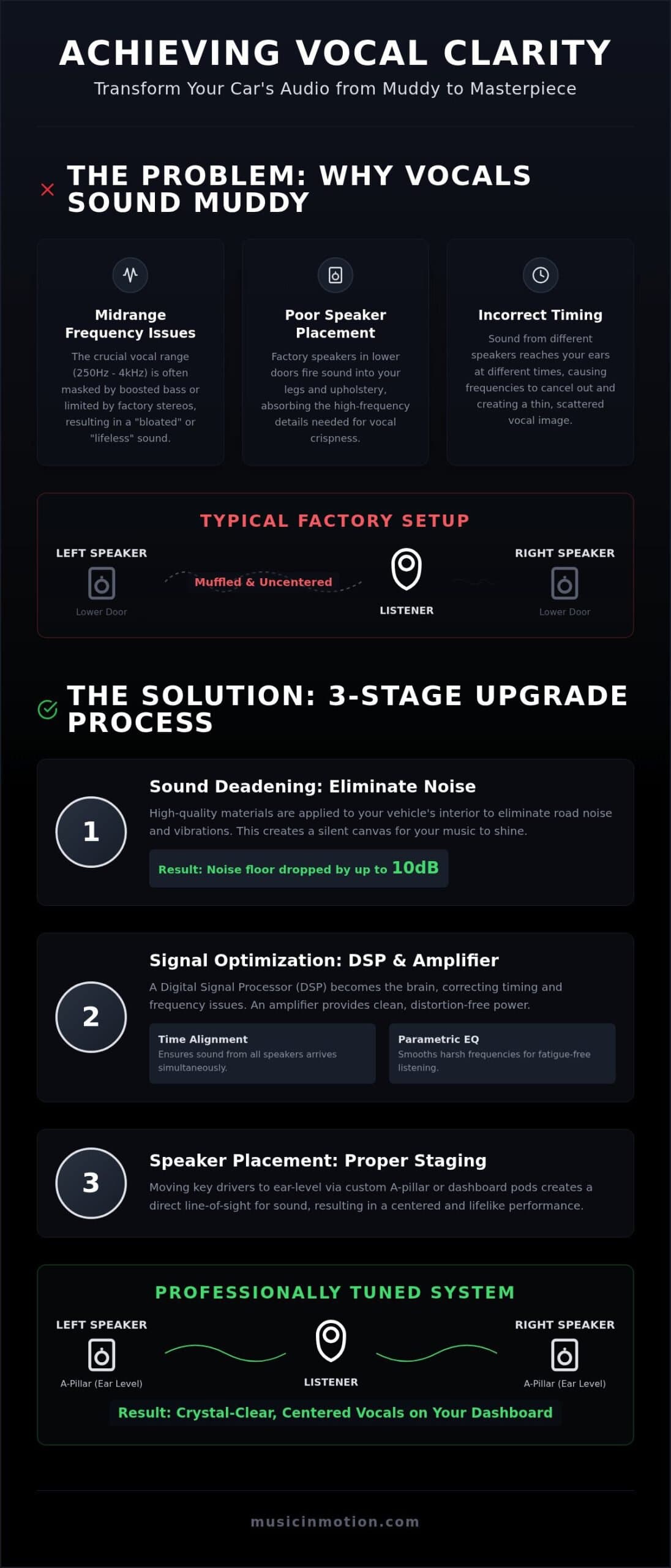
Vocal clarity is more than just hearing the words of a song. We define it as the ability to distinguish the subtle breath, rasp, and unique texture in a singer’s performance. When a system is tuned correctly, the artist feels present, almost as if they are performing live on your dashboard. Most drivers, however, experience a “muddy” sound where lyrics are lost in a sea of muffled noise. This isn’t usually a problem with the artist’s recording. It’s a physical and electrical struggle happening inside your vehicle’s cabin.
The Midrange Frequency Challenge
The heart of any vocal performance lives in the midrange frequency band, which typically spans from 250Hz to 4kHz. This is a narrow window where the human ear is most sensitive. Many factory systems fail here because they use aggressive Audio equalization to boost upper-bass frequencies. While this makes cheap speakers feel more powerful, it creates a “bloated” sound that masks the delicate details of a voice. Additionally, factory head units often “roll off” or limit these frequencies at higher volumes to prevent small, fragile speakers from distorting. This protective measure is exactly why your music feels flat and lifeless when you try to turn it up. Understanding these limitations is the first step in learning how to get clear vocals in car audio.
Physical Obstructions and Sound Absorption
Physics is often the biggest enemy of clear sound. Most car manufacturers place speakers in the lower door panels for convenience. This design choice means the sound is firing directly into your legs, the upholstery, and the floor mats rather than your ears. High-frequency sound waves are highly directional. They require a clear “line of sight” to maintain their energy and detail.
When you are sitting “off-axis” from the speaker, the car’s interior materials absorb the very frequencies that provide vocal crispness. We see this daily in our shop; a speaker buried behind a thick plastic door panel and blocked by a passenger’s leg will never deliver a studio-quality experience. Achieving a “live” feel requires moving past these physical limitations and rethinking how sound travels through your specific vehicle.
Phase Interference and Timing
Phase interference is another common culprit that ruins vocal imaging. This occurs when sound waves from the left and right speakers reach your ears at slightly different times. Because you sit closer to the driver-side speaker, those waves arrive first. This timing gap causes certain frequencies to cancel each other out, leaving a “hole” in the music where the vocals should be. Instead of a centered, strong voice, the sound feels scattered and thin. Correcting this timing is essential for how to get clear vocals in car audio, as it ensures all sound waves work together rather than fighting each other.
Optimizing the Signal: Amplification and DSP Tuning
We often tell our clients that speakers are simply the messengers. If the signal they receive is cluttered or weak, the output will be exactly the same. Achieving studio-quality sound starts long before the air moves. It begins with the quality of your source material and the path it takes through your electronics. While many drivers rely on standard Bluetooth streaming, this often compresses the audio, stripping away the high-frequency detail required for vocal texture. Switching to high-resolution sources like Tidal or FLAC files provides the necessary data for how to get clear vocals in car audio.
The Power of Digital Signal Processing (DSP)
In a modern vehicle, a Digital Signal Processor is the single most important tool for vocal clarity. Think of it as the brain of your system. Because you sit closer to the left speaker, the singer’s voice usually sounds like it is coming from your feet or the door panel. We use a DSP to implement Time Alignment, which delays the signal to the closest speakers by milliseconds. This ensures every sound wave hits your ears at the exact same moment, magically centering the singer’s voice directly on your dashboard.
Beyond timing, a DSP allows us to fix the acoustic peaks caused by your car’s interior. We utilize parametric equalization to smooth out harsh frequencies that cause listening fatigue. If you want to see the technical side of this process, you can explore our guide on professional car audio tuning to see how we dial in the perfect soundstage. This level of control turns a standard car interior into a controlled listening environment where every syllable is distinct.
Clean Power and Signal Integrity
Most factory head units produce only about 15 watts of clean power before they begin to distort. When you turn the volume up to hear a lyric, the amplifier “clips” the signal, adding harmonic distortion that makes vocals sound gritty and harsh. An external amplifier provides “headroom.” This means the system has the power to handle sudden peaks in music without straining. This prevents the “muddiness” that occurs when an underpowered system tries to keep up with your volume demands.
Signal integrity is about more than just volume; it’s about the noise floor. High-quality electronics ensure that the silence between notes remains silent. As researchers develop new materials like sound-suppressing silk to create quieter spaces, we focus on ensuring your electronics don’t add their own hiss or hum to the cabin. Proper crossover settings are also vital. By ensuring your midrange speakers aren’t struggling to play deep sub-bass frequencies, we allow them to focus entirely on the frequency range where voices live. If you’re ready to hear the difference a clean signal makes, our team is ready to design a Car Audio Upgrade tailored to your specific vehicle.
Perfecting Speaker Placement and Custom Staging
If you want to master how to get clear vocals in car audio, you have to look beyond the equipment list. Even the most expensive speakers will sound mediocre if they are firing into your ankles. Vocal imaging relies on high frequencies that are extremely directional. To create a “live performance” feel, we need to move the soundstage from the floor to the dashboard. This physical shift is the only way to ensure the singer’s voice feels like it is coming from right in front of you rather than from under your seat.
Moving the Soundstage Up
We consider the A-pillars and dashboard the “front row” of your vehicle’s concert. By mounting tweeters and midrange drivers at ear level, we achieve a direct line of sight to your ears. This bypasses the absorption issues caused by seats and legs. A deep dive into Understanding Vehicle Acoustics shows that speaker height is the most critical factor in determining the perceived height of the singer.
For the ultimate experience, we often recommend 3-way component systems. These setups include a dedicated 3-inch midrange driver designed specifically to handle vocal frequencies. Our team uses car audio fabrication to create custom pods that blend seamlessly with your interior. These pods allow us to aim the sound precisely toward the driver’s seat, ensuring every detail reaches you without reflecting off the side windows first.
Component vs. Coaxial Speakers
Many drivers ask why they cannot just swap factory speakers for high-end coaxials. Coaxial speakers have the tweeter mounted in the center of the woofer. While they are easy to install, this design often leads to frequency masking. The woofer’s large vibrations can physically interfere with the tweeter’s delicate output. Component systems are different. They use external crossovers to split the signal, sending only the vocal frequencies to the midrange and the high-end sparkle to the tweeter.
Separating these drivers is essential for how to get clear vocals in car audio because it allows each speaker to operate in its ideal range without interference. We typically choose a 6.5-inch driver for mid-bass and a smaller 3-inch driver for the midrange. This specialized approach ensures that the “meat” of the vocal performance isn’t being played by a speaker also trying to handle heavy bass notes.
The Center Channel Myth
Many modern cars come with a factory center speaker in the dash. While this sounds good on paper, it often muddies the vocal imaging. A single center speaker cannot create a wide, immersive soundstage on its own. We find that two perfectly placed and tuned side speakers create a much more convincing “phantom center” than one low-quality speaker in the middle of the dash. It is about precision and staging, not just the number of speakers in the cabin.
Eliminating Competition: Sound Deadening for Clarity
You can have the most precise signal and perfect staging, but if your car sounds like a wind tunnel, those details are lost. Road noise is the silent killer of vocal clarity. Tire hum, wind whistle, and engine vibration sit almost exactly in the same frequency range as the human voice. When these background noises are present, your brain naturally filters out the subtle details of the music to focus on the environment. This is why you feel the need to crank up the volume just to catch the lyrics. It’s a constant battle between your speakers and the road.
Lowering the noise floor is a foundational necessity for any high-end system. By applying high-quality damping mats to the metal surfaces of your doors, we can lower the in-car noise floor by 3 to 10 decibels. This might sound like a small number, but it represents a massive leap in perceived clarity. When the cabin is quieter, you don’t need to fight the environment with raw volume. You can hear the singer’s intake of breath and the trailing edge of a note at much lower, more comfortable listening levels. This is a critical step in how to get clear vocals in car audio.
The Masking Effect of Road Noise
The masking effect occurs when a loud sound prevents you from hearing a quieter one at a similar frequency. Most road noise thrives between 400Hz and 1kHz, which is the heart of the vocal range. Treating the outer door skin reduces the hollow, “tinny” echo that often muddies the midrange. This treatment turns the door from a vibrating metal box into a stable acoustic enclosure. If you are curious about the technical process, you can explore the basics of sound deadening installation and see how it fundamentally changes your listening experience.
Acoustic Foam and Fast Rings
We also focus on the space between the speaker and the door panel. Standard installations often allow sound to leak behind the door card, creating “coloration” and phase issues. We use foam rings to create a perfect seal between the speaker and the factory grill. This ensures every bit of energy is directed into the cabin rather than being lost inside the door. Additionally, we use acoustic tiles behind the speaker to absorb rear waves. This prevents sound from bouncing off the outer metal skin and hitting the back of the speaker cone, which is a common cause of “muddy” audio.
- Vibration Damping: Stops metal panels from ringing like a bell and vibrating with the music.
- Sound Blocking: Creates a heavy barrier against external wind and tire noise.
- Decoupling: Isolates the speaker from the car’s metal structure to prevent unwanted resonance.
Achieving this level of acoustic silence allows your hardware to perform at its peak without outside interference. It’s the difference between hearing a performance in a crowded bar and hearing it in a professional studio. If you want to transform your daily commute into a quiet, high-fidelity experience, our team can design a Custom Installation that addresses the specific acoustic weaknesses of your vehicle.
Achieving Studio-Quality Sound with Music In Motion
At Music In Motion, our philosophy prioritizes the delivery of a finished result over the mere transaction of hardware. We understand that a box of high-end components is only as good as the hands that install and tune them. Every vehicle presents a unique set of acoustic challenges, from glass reflections to restrictive factory speaker grilles. Our mission is to navigate these obstacles to provide you with a listening experience that feels personal, immersive, and incredibly detailed. We offer a spectrum of solutions ranging from foundational speaker upgrades to full-scale custom builds, ensuring every client finds the right path to acoustic perfection.
Custom Fabrication for Vocal Imaging
Vocal clarity lives and dies by the physical placement of your speakers. Our custom fabrication team creates seamless, factory-look speaker pods for A-pillars and dashboards to move the soundstage up to ear level. This is a game-changer for how to get clear vocals in car audio. By utilizing 3-way active systems, we dedicate a specific driver to the midrange frequencies where the human voice resides. This specialized approach allows us to craft a soundstage that feels wide and deep, with a perfectly focused “phantom center” that makes the singer appear as if they are standing right on your hood. These custom-aimed pods ensure that high-frequency energy reaches your ears directly, bypassing the muffling effects of factory door panels.
The Music In Motion Professional Integration
Modern vehicles rely on complex, integrated infotainment systems that control everything from climate to navigation. We specialize in professional integration that retains all your factory features while delivering audiophile-grade sound. Our team uses advanced interfaces to tap into the factory signal before it is ruined by stock processing. If you are just beginning to explore the possibilities, start your journey with our guide to car audio upgrades for stock stereos. We prioritize clean, professional wiring and heat management to ensure your system remains reliable for years to come.
The final “polish” of any project is our professional DSP tuning. We use precision microphones and software to analyze your cabin’s response, correcting for the timing errors and phase issues discussed in earlier sections. This ensures every frequency reaches your ears at the exact same time, locking the vocal image into place. We view ourselves as your partners in customization. Whether we are pushing creative boundaries on a complex custom project or enhancing a standard utility system, our focus remains on the safety, functionality, and ultimate internal experience of the user. We are ready to help you rediscover your music with a level of clarity you never thought possible in a vehicle.
Transform Your Daily Drive into a Private Concert
Achieving studio-quality sound is a journey that balances advanced hardware with expert craftsmanship. We have shown how foundational steps like sound deadening and physical speaker staging in custom A-pillar pods remove the barriers between you and the artist. By combining these physical upgrades with our decades of experience in professional DSP tuning, we ensure your system delivers a centered, lifelike performance on every commute.
Mastering how to get clear vocals in car audio is the first step toward a more rewarding internal experience. We have built a nationwide reputation for high-performance audio integration by focusing on results rather than just equipment lists. Whether you’re looking for a subtle enhancement or a full custom build, we’re here to help you hear your favorite tracks with newfound depth and precision.
Ready for crystal-clear sound? Explore our custom car audio solutions at Music In Motion.
It’s time to stop straining your ears and start enjoying the music as it was meant to be heard. We look forward to helping you rediscover your favorite albums with a level of clarity that transforms every mile behind the wheel.
Frequently Asked Questions
Why do my car speakers sound muffled even after I replaced them?
Your speakers likely sound muffled because they are receiving a processed, low-quality signal from the factory head unit. Even high-end speakers cannot fix a source signal that has been electronically “flattened” to protect the original factory equipment. Additionally, if your new speakers are still mounted low in the door panels, the sound is likely being absorbed by the vehicle’s carpet and upholstery before it ever reaches your ears.
What EQ settings are best for clear vocals?
The best EQ settings for clarity involve a slight boost in the 1kHz to 3kHz midrange window where most human voices reside. You should also apply a high-pass filter to your door speakers, typically around 80Hz. This prevents your smaller speakers from trying to play deep bass, which reduces distortion and allows them to reproduce the singer’s voice with much more precision and detail.
Do I need a subwoofer to get clear vocals?
You don’t strictly need a subwoofer for vocals, but adding one significantly improves the clarity of your entire system. By offloading the deep bass frequencies to a dedicated subwoofer, your midrange speakers don’t have to work as hard. This reduces “intermodulation distortion,” which is a common cause of muddy sound. When your door speakers aren’t vibrating violently to create bass, the vocals become much more distinct.
How much does a professional car audio tune cost?
The cost of a professional tune varies widely based on the complexity of your Digital Signal Processor and the number of speakers in your system. While we don’t quote specific prices here, a high-quality tune involves using calibrated microphones and specialized software to correct timing and phase issues. Investing in a professional calibration is often the most effective way to learn how to get clear vocals in car audio.
Will a new head unit make my car’s vocals clearer?
A high-quality aftermarket head unit often makes a massive difference because it provides a cleaner, uncompressed audio signal. Many factory radios have built-in equalization that rolls off high frequencies or boosts muddy mid-bass to hide the flaws of cheap speakers. Replacing the source unit removes these digital “bottlenecks,” allowing the full texture and detail of the vocal performance to reach your amplifiers and speakers.
What is the best speaker placement for vocal clarity in a truck?
In a truck’s cabin, the best placement for vocal clarity is at ear level on the A-pillars or the top of the dashboard. Trucks have large interiors with many reflective surfaces that can cause sound to bounce and become muddled. Mounting your midrange and tweeters in custom pods ensures a direct “line of sight” to your ears, which creates a much more focused and lifelike soundstage.
Can I get clear vocals without spending a lot of money?
You can improve your system’s clarity on a budget by focusing on acoustic treatments rather than expensive hardware. Installing a small amount of sound deadening in your doors and using foam speaker rings to seal the drivers to the door panels can yield impressive results. These simple, cost-effective steps are a great entry point for how to get clear vocals in car audio without needing a total system overhaul.
How do I stop my door panels from rattling during vocal-heavy songs?
To stop door panels from rattling, you must apply butyl-based vibration damping sheets to the metal surfaces inside the door. This adds mass to the panels and stops them from vibrating in sympathy with your speakers. We also recommend adding a layer of closed-cell foam between the plastic door card and the metal frame to prevent the two surfaces from rubbing together and creating annoying “plastic-on-metal” buzzes.