What if the most expensive subwoofer in the world sounded like a muddy mess because of a simple math error? You finally bought that high-end driver, but now you’re staring at the amplifier specs with a single, nagging question: will this setup actually hit hard, or will it just end in a cloud of expensive smoke? It’s frustrating to feel like you need a physics degree just to get clean bass in your truck or boat. Most enthusiasts worry about how much power does my subwoofer need because the industry complicates things with conflicting Peak and RMS ratings. We understand that hesitation. Nobody wants to risk their investment on a guess.
We are here to simplify the science and give you total confidence in your build. You’re going to master the technical ‘Holy Trinity’ of power, impedance, and enclosure design to build a system that delivers deep, punchy results for years. We will walk you through the exact matching formula we use to ensure your amplifier and subwoofer work in perfect harmony. Whether you are on the road or out on the water, we’ll show you how to achieve a finished result that sounds clean even at high volumes.
Key Takeaways
- Learn how to determine exactly how much power does my subwoofer need by prioritizing RMS ratings over misleading peak power marketing.
- Master the basics of impedance and wiring to ensure your subwoofer and amplifier work together in perfect harmony.
- Apply the 75% to 150% wattage rule to find the power sweet spot that delivers punchy bass without damaging your gear.
- See how choosing between a sealed or ported enclosure dictates your system’s efficiency and mechanical power limits.
- Understand why professional-grade wiring and integration are essential for achieving the high-performance finished result you expect.
Understanding the Core Specs: RMS Power and Impedance
We often hear the question: how much power does my subwoofer need? The answer starts with ignoring the biggest numbers on the box. Those flashy “3000 Watts Max” labels are usually marketing fluff designed to sell entry-level gear. If you want a system that hits hard on every commute without burning out, you need to understand the relationship between RMS power and electrical resistance. We focus on the math that keeps your gear alive while delivering the impact you expect.
RMS Power vs. Peak Power
RMS, or Root Mean Square, represents the continuous power a subwoofer can handle without thermal failure. It is the steady-state performance level that determines your daily listening experience. Peak power is just a momentary burst; it is like a sprinter’s top speed, whereas RMS is the marathon pace. By Understanding Loudspeaker Basics, you can see that every component has a physical limit to how much heat it can dissipate. When you are searching for the true capabilities of your gear, ignore the colorful box art. Instead, look for the small print on the manufacturer’s technical spec sheet or the back of the driver itself. This is where the real data lives.
Demystifying Impedance (Ohms)
Impedance is the other side of the power coin. Measured in Ohms, it represents the electrical resistance the subwoofer provides against the amplifier’s output. We like to visualize this using a simple water pump analogy. Imagine your amplifier is a pump and the subwoofer is the pipe it is pushing water through. A lower impedance, like 1-ohm, acts like a very wide pipe that allows a massive amount of current to flow. A 4-ohm load is a narrower pipe that restricts that flow. This creates an inverse relationship: lower ohms mean less resistance, which forces the amplifier to work much harder to produce more output.
In most car or marine setups, you’ll see 1-ohm, 2-ohm, or 4-ohm configurations. Matching these numbers to your amplifier’s specific capabilities is more critical for equipment longevity than matching brand names. If you force an amplifier to push a 1-ohm load when it was only designed for 4-ohms, it will overheat and eventually fail. We prioritize this balance because a matched system is a reliable system. When you determine how much power does my subwoofer need, you must always look at the wattage rating at the specific impedance your amplifier can safely handle.
Matching Watts: Finding the Power Sweet Spot
Finding the right balance between your gear isn’t just about making noise. It is about creating a system that performs reliably under pressure. When people ask us how much power does my subwoofer need, we typically point them toward the 75% to 150% rule. This means your amplifier’s RMS output should fall between 75% and 150% of your subwoofer’s RMS rating. While a perfect 1:1 match is a great starting point, having a little extra headroom ensures your amplifier doesn’t have to work at its absolute limit to produce the volume you want. A stressed amplifier is a dangerous amplifier.
You also need to distinguish between thermal power limits and mechanical power handling. Thermal limits refer to how much heat the voice coil can dissipate, while mechanical limits involve how far the cone can physically move. An enclosure that is too large can cause a sub to reach its mechanical limit long before it hits its thermal RMS rating. There is a common myth that underpowering a subwoofer will destroy it, but that isn’t technically true. A subwoofer won’t fail simply because it receives 200 watts instead of 500. The danger comes when the user tries to compensate for that lack of power by cranking the volume or gain too high. This leads to clipping, which is the primary cause of speaker failure. When you are Matching RMS Power Ratings, you are actually protecting your investment by ensuring the signal stays clean. If you are unsure about your current setup, our team can help you design custom installations that balance these technical requirements perfectly.
The Dangers of Signal Clipping
Clipping occurs when an amplifier is pushed beyond its internal voltage limits. Instead of a smooth, flowing wave, the signal becomes a “square wave.” This flat-topped signal forces the subwoofer’s voice coil to stay still while receiving maximum current, which generates massive amounts of heat. Without the movement of the cone to help dissipate that heat, the coil will eventually melt. Setting your gain properly is the best defense against this. We often use specialized tools like oscilloscopes to ensure the signal is perfectly clean. Think of the gain as a sensitivity match for your head unit, not a volume knob. It ensures your amp reaches full power without distorting the signal, giving you the loudest possible sound without the risk of a blowout.
Planning for Multiple Subwoofers
If you decide to run two or more subwoofers, the math changes slightly. You must divide the amplifier’s total RMS output by the number of drivers. For example, a 1000-watt RMS mono amplifier will provide 500 watts to each of two subwoofers. We always recommend using identical subwoofers to ensure even power distribution and phase alignment. In marine or powersports applications, you also have to consider your battery capacity. Boats often lack the high-output alternators found in modern cars, so calculating your total system draw is vital. Pushing a high-wattage system without the proper electrical support can lead to voltage drops, which actually increases the risk of clipping. We look at the entire vehicle as a single ecosystem to make sure your audio upgrade doesn’t compromise your reliability. It’s about the finished result, not just the loud volume.
Solving the Impedance Puzzle: Wiring and Ohms
We have established that RMS is your target, but how you wire your system determines if you actually hit that mark. Many clients ask us how much power does my subwoofer need without realizing that the answer depends entirely on the final impedance load. This is where Single Voice Coil (SVC) and Dual Voice Coil (DVC) designs come into play. An SVC subwoofer has one set of positive and negative terminals, while a DVC model has two separate sets. This extra set of terminals isn’t just for show. It gives us the creative flexibility to manipulate the electrical resistance to match your amplifier’s sweet spot.
Matching your final wiring load to the amplifier’s Ohm-stable rating is the most critical step in the installation process. If you wire a subwoofer to a 1-ohm load but your amplifier is only stable at 2-ohms, the amp will go into protect mode or eventually fail. We prioritize this compatibility to ensure your equipment lasts for years. It is about the logic of the build, ensuring every component is working within its intended safety margins while still delivering the hard-hitting bass you want.
Parallel vs. Series Wiring
Parallel wiring halves impedance while series wiring doubles it for identical coils. If we take a DVC subwoofer with two 4-ohm coils and wire them in parallel, the amplifier sees a 2-ohm load. This allows the amp to output more wattage, which is why we use parallel wiring most frequently on dedicated mono-block amplifiers. Conversely, wiring them in series creates an 8-ohm load. This is often useful when we are balancing multiple drivers in complex marine or motorcycle configurations where stability is more important than raw volume. When you are calculating how much power does my subwoofer need, you must decide on your wiring strategy first to ensure your amplifier can actually deliver that wattage at the final impedance.
The Mono-Block Advantage
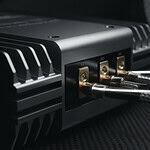
Class D mono-amplifiers are the gold standard for driving subwoofers efficiently. Unlike multi-channel amps, they are specifically engineered for low-frequency reproduction and high current flow. Most modern mono-blocks are stable down to 1-ohm, allowing us to extract massive performance from a relatively small footprint. This efficiency is critical in enclosed boat compartments or compact vehicle trunks where heat management is a constant battle. By choosing a 1-ohm stable amplifier, we ensure the system remains cool and reliable even during long summer days on the water. We focus on these technical details to ensure the final result is a system that performs flawlessly every time you turn the key. Our goal is always to provide a solution that balances high-end technology with everyday reliability.
The Missing Link: Why the Enclosure Dictates Matching Success
You have matched your watts and mapped your ohms, but there is one final variable that determines if your system sings or screams. The enclosure is the physical governor of your subwoofer’s performance. Many people ask us how much power does my subwoofer need without realizing that the box type actually changes the answer. A driver in a sealed box behaves differently than that same driver in a ported one. We don’t just sell boxes; we engineer environments for sound to ensure every component reaches its full potential.
Off-the-shelf prefab boxes are built for “average” subwoofers, but your system isn’t average. We specialize in custom car audio fabrication because it allows us to maximize every watt of your amplifier’s output. By optimizing the internal air volume specifically for your gear, we prevent the muddy response that often plagues mass-produced enclosures. We focus on the finished result, ensuring the physical build supports the electronic specs perfectly.
Sealed vs. Ported Power Handling
Sealed enclosures act like a pneumatic air cushion. This internal pressure helps control the cone’s movement, protecting the sub from over-excursion. Because of this natural braking system, you can often push a subwoofer closer to its thermal RMS limit without worrying about mechanical failure. Ported, or vented, enclosures are much higher in efficiency. They produce more volume with less wattage, but they lose that air cushion below the tuning frequency. This is why ported boxes require a subsonic filter on the amplifier. Without this filter, the sub will move too far and suffer mechanical damage. We always match the Q factor of your subwoofer to the specific enclosure type to ensure optimal cooling and a tight, musical response.
The Role of Custom Fabrication
Custom fabrication is the secret to superior sound in challenging environments. Whether you are dealing with a classic car’s trunk or the tight space constraints of a motorcycle or UTV, a generic box won’t cut it. We design enclosures that fit the specific geometry of your vehicle while maintaining the exact air volume your subwoofer requires. This precision prevents “unloading,” where a sub moves uncontrollably because the box is too large for the power being applied. Beyond performance, we prioritize aesthetic integration. We can make your bass setup look like a factory-installed option or a show-stopping custom piece. If you want a system that hits hard and fits perfectly, we invite you to explore our Custom Subwoofer Enclosures to see what is possible for your ride.
Achieving the Perfect Result: Professional Integration vs. DIY
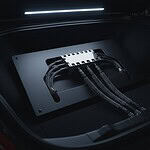
We have covered the math of RMS ratings, the logic of impedance, and the physics of enclosures. However, the most perfectly matched components will still underperform if the installation lacks the proper foundation. When you ask how much power does my subwoofer need, you must also consider how that power travels from your battery to your amplifier. We prioritize high-quality Oxygen-Free Copper (OFC) wiring for every high-current build. Unlike cheaper Copper Clad Aluminum (CCA) alternatives, OFC provides superior conductivity and resists corrosion, which is vital for both car and marine environments. A clean chassis ground is equally important; without a solid electrical return path, even the most expensive amplifier will struggle to deliver its rated wattage.
Modern Vehicle Integration
Newer vehicles present a unique hurdle for audio enthusiasts. Most factory stereos are programmed with aggressive EQ curves and “bass roll-off” to protect low-quality stock speakers as you turn up the volume. If you simply tap into these wires with a basic line-out converter, your new subwoofer will sound thin and weak. We use advanced integration processors to strip away that factory processing and restore a full-range signal. For a deeper look at navigating these complex systems, check out our guide on car audio upgrade for stock stereo components.
Beyond the signal, we also evaluate the vehicle’s charging system. Extreme power needs in high-end builds may require a high-output alternator to keep up with the current draw. We see ourselves as partners in your creative process, helping you decide where to invest for the biggest impact. Professional tuning with a Digital Signal Processor (DSP) is often the final step. It allows us to correct for the acoustic environment of your specific cabin or boat, ensuring the bass is perfectly timed and impactful.
The Music In Motion Philosophy
Our team believes in delivering a finished result rather than just selling a pile of gear in a box. Since 1994, we have focused on the internal experience of the user. We want you to feel the music every time you get behind the wheel or out on the water. We bring this same level of dedication to every project, whether it is a standard utility system or a complex custom fabrication. When you determine how much power does my subwoofer need, we are here to ensure that power is used efficiently and safely.
- Expertise across land, water, and trail applications.
- Solution-oriented designs focused on long-term reliability.
- Seamless aesthetic integration for a factory-plus look.
Building a high-performance audio system should be an exciting journey, not a source of technical frustration. We handle the complexities of wiring, integration, and tuning so you can focus on the music. Ready to hear the difference? Consult with our experts today and let’s start designing a system that hits exactly the way you want.
Step Into the Driver’s Seat of Your Audio Journey
We’ve moved through the technical “Holy Trinity” of power, resistance, and physical space. You now understand that determining how much power does my subwoofer need is just the beginning of a larger conversation about total system balance. By prioritizing RMS ratings and matching them to the right custom enclosure, you ensure your gear hits hard without the constant risk of thermal failure. Whether you’re cruising on land or navigating the open water, the logic of a high-performance build stays the same. We take pride in being more than just a shop; we’re your partners in the creative process. Since 1994, we have specialized in car, marine, and powersports audio that integrates seamlessly with your lifestyle. It’s time to stop guessing and start listening to the impact you’ve always wanted. Let’s build something that makes every drive or voyage feel like a front-row seat.
Design your dream high-performance audio system with Music In Motion and experience the difference that expert custom fabrication can make for your property. We’re ready to help you turn up the volume with total confidence.
Frequently Asked Questions
How much RMS power does my subwoofer actually need?
Your subwoofer needs exactly what its RMS rating specifies, though we recommend staying within a range of 75% to 150% of that number. If you are wondering how much power does my subwoofer need for daily use, look for the “Continuous Power” or “RMS” spec on the driver itself. Matching the amplifier to this number ensures you have enough energy to move the cone without over-stressing the voice coil or the amp’s internal circuitry.
Can I use a 2-ohm subwoofer with a 4-ohm stable amplifier?
No, you should never connect a 2-ohm load to an amplifier that is only stable at 4-ohms. Doing so forces the amplifier to work twice as hard as it was designed to, which leads to rapid overheating and eventual failure. We always match the subwoofer’s final impedance to the amplifier’s lowest safe operating rating. This creates a reliable system that can handle long listening sessions without entering protect mode.
Is it better to have more amplifier power than the sub is rated for?
Yes, having a little extra “headroom” is actually safer than using an amplifier that is too small. An amplifier with a higher RMS rating than the sub can produce a clean, undistorted signal at high volumes. When an amp is too small, users often crank the gain to compensate. This creates clipping, which is the number one cause of subwoofer failure. We prefer a slightly oversized amp for a cleaner finished result.
What is the difference between SVC and DVC subwoofers for matching?
Single Voice Coil (SVC) subwoofers have one set of terminals, while Dual Voice Coil (DVC) models have two, offering more wiring flexibility. DVC subwoofers allow us to wire the coils in parallel to drop the impedance or in series to raise it. This flexibility makes it much easier to get the maximum wattage out of your amplifier. We choose the coil configuration based on the final Ohm load your specific amplifier requires.
Can I match a different brand of amplifier with my subwoofer?
Yes, you can absolutely mix and match brands as long as the technical specifications align. Audio components speak the universal language of Watts and Ohms. While some people prefer the look of a matching brand set, we prioritize the electronic compatibility of the gear. As long as the amplifier provides the correct RMS power at the right impedance, the brand names on the heat sinks don’t affect the sound quality.
What happens if I underpower my subwoofer with a small amp?
Underpowering a sub won’t damage it directly, but the distorted signal from a struggling amplifier will. When you ask how much power does my subwoofer need, the goal is to avoid “clipping.” A small amp pushed to its limit sends a flat, square-wave signal to the sub. This signal generates massive heat because the coil stops moving but still receives current. This heat eventually melts the voice coil, destroying your investment.
Do I need a separate battery or capacitor for my high-power amp?
High-power systems exceeding 1000 watts RMS often require electrical upgrades like a second battery or a high-output alternator. While capacitors can help with minor voltage dips, they are often just a temporary fix for a larger power problem. We evaluate the entire charging system of your vehicle or boat to ensure it can handle the current draw. Proper electrical support is the only way to maintain consistent, hard-hitting bass performance.
How do I know if my amp and sub are properly matched after installation?
A properly matched system sounds clean and punchy at high volumes without the amplifier getting excessively hot. You shouldn’t hear any popping, clicking, or muddy distortion when the bass hits. If the amplifier stays relatively cool and never enters protect mode during a long drive, the match is successful. We use specialized tools like oscilloscopes during our installations to verify that the signal is perfectly clean before the vehicle leaves our shop.