Choosing the loudest speaker on the shelf might be the quickest way to smoke your brand-new amplifier. We’ve seen it happen too often; a weekend project turns into an expensive lesson because the technical handshake between components was ignored. You want a system that hits hard and stays crystal clear, but the jargon surrounding 2 ohm vs 4 ohm speakers car audio often feels like a barrier to that perfect sound.
We understand the fear of damaging expensive gear or dealing with an amp that runs hot enough to fry an egg. Our team at Music In Motion believes you shouldn’t need an engineering degree to enjoy premium audio. This guide will show you how to match your power levels perfectly so you can drive with confidence, knowing your equipment is safe. We are going to break down the impedance math, explain the trade-offs between volume and clarity, and give you the blueprint for a system that performs flawlessly every time you turn the key.
Key Takeaways
- Understand how impedance acts as a traffic controller for your electricity, ensuring your amplifier doesn’t work harder than it’s designed to.
- Compare the benefits of 2 ohm vs 4 ohm speakers car audio to decide if you need maximum volume or higher sound efficiency.
- Learn the mechanics of parallel and series wiring to safely connect multiple speakers without risking a system meltdown.
- Identify the “Ohm Trap” to prevent common mistakes like mixing different impedance ratings on a single channel.
- Master the art of power matching to build a reliable, high-performance system that sounds great on every drive.
What is Car Speaker Impedance? Defining the ‘Ohm’
Think of impedance as the “effective resistance” a circuit offers to alternating current. While a simple lightbulb uses direct current (DC), your car’s music relies on alternating current (AC) to move speaker cones back and forth. This creates a moving target for your amplifier. We measure this electrical resistance in Ohms (Ω). It is the primary factor that determines how much work your amplifier has to do to produce sound.
We often use a water pipe analogy to make this technical concept easier to visualize. In this scenario, voltage is the water pressure pushing through the lines. Current is the actual flow of water moving toward your ears. Impedance represents the size of the pipe itself. A lower Ohm rating means the pipe is wider, allowing a massive amount of power to flow through with very little restriction. While this sounds like a shortcut to louder music, it places a heavy load on the “pump” or your amplifier. Understanding the balance of 2 ohm vs 4 ohm speakers car audio is the first step in building a system that doesn’t just play loud, but stays reliable for years.
Common Impedance Ratings: 2-Ohm vs. 4-Ohm
Standard aftermarket car speakers usually arrive with a 4-ohm rating. This is the industry sweet spot. It provides enough resistance to keep amplifiers running cool while delivering plenty of clarity for vocals and instruments. You will notice that subwoofers frequently deviate from this standard. Many high-output subs use 2-ohm configurations or Dual Voice Coils (DVC) to draw more power from the amplifier. This is a strategic choice. We use these lower ratings to maximize the wattage of mono-block amps, though it requires careful cooling and electrical support. Occasionally, we see 8-ohm home audio drivers adapted for custom car builds. These are rare and usually require massive voltage to reach satisfying volume levels.
The Difference Between Resistance and Impedance
If you grab a multimeter and touch the probes to your speaker terminals, the number on the screen will likely surprise you. A speaker rated for 4 ohms might only show 3.2 ohms of DC resistance. This happens because impedance is a reactive measurement. The Electrical characteristics of dynamic loudspeakers change constantly as they play different notes. A deep bass hit creates a different level of resistance than a high-pitched whistle. Frequency dictates the real-time load on your gear. Nominal impedance is the average rating across the audible spectrum.
Choosing between 2 ohm vs 4 ohm speakers car audio requires looking at your total system architecture. A 2-ohm speaker allows more current to flow, which generates more heat in your amplifier’s circuitry. If your equipment isn’t designed to handle that extra thermal load, it will eventually fail. We focus on matching these ratings to ensure your music stays crisp and your hardware stays safe.
Why Impedance Matching Matters for Performance and Safety
Matching your equipment isn’t just about getting the loudest sound possible. It’s about ensuring your system lives a long, healthy life. When we look at the choice between 2 ohm vs 4 ohm speakers car audio, we are really looking at a trade-off between raw wattage and thermal management. Lowering the impedance allows more power to flow through the circuit, which can increase your volume levels. However, that increased flow generates significant heat. If your amplifier isn’t designed to dissipate that extra energy, it will eventually fail.
Amplifier stability is the foundation of a great build. Every amp has a minimum impedance rating, usually 2 or 4 ohms. If you try to run a 1-ohm load on a 4-ohm stable amp, you are essentially asking the hardware to work beyond its physical limits. This often leads to distortion, clipping, and eventual hardware death. Beyond safety, impedance affects the “damping factor” of your system. A higher impedance, like 4 ohms, typically provides the amplifier with better control over the speaker cone movement. This results in tighter bass and more accurate mid-range response compared to a 2-ohm setup that might prioritize volume over precision.
This balance becomes even more critical when designing premium marine audio systems. Boats and motorcycles lack the enclosed, climate-controlled cabins of most cars. They often face high ambient temperatures and limited airflow around the mounting locations. In these environments, choosing the wrong impedance can turn a fun day on the water into a silent trip home because the amp hit its thermal limit. If you’re unsure about your specific setup, we can help you design a custom audio system that balances power and reliability perfectly.
The Risk of Thermal Runaway
When an amplifier runs too hot for too long, it enters “Protect Mode.” This is a safety feature designed to prevent the internal components from melting. Frequent trips into Protect Mode are a warning sign that your impedance is too low for your amplifier’s capabilities. Over time, these heat cycles weaken solder joints and degrade capacitors on the internal circuit boards. On a motorcycle or a boat, where vibration is constant, these weakened connections lead to intermittent sound or total system failure much faster than in a traditional car installation.
Efficiency vs. Raw Power
A common mistake is chasing the highest wattage number on the box. A 4-ohm system that is perfectly matched to its amplifier often sounds cleaner and more impactful than a 2-ohm system that is straining the power supply. When comparing 2 ohm vs 4 ohm speakers car audio, you should always look at the RMS power rating of your amp at specific impedance levels. This tells you the continuous power the amp can handle safely. High-quality, oxygen-free copper wiring also plays a role here. Cheap wire adds its own resistance, which can confuse the amplifier and lead to inconsistent performance. We prioritize the finished result, ensuring every cable and connection supports the intended impedance load.
Wiring Configurations: Series vs. Parallel Explained
Wiring is the final bridge between your hardware and your hearing. It is the tool we use to dictate exactly how much resistance the amplifier “sees” at its terminals. You aren’t just stuck with the factory rating printed on the back of the speaker magnet. By changing how we route the cables, we can transform a pair of drivers into a specific load that matches your amplifier’s sweet spot. This flexibility is a cornerstone of custom car audio fabrication, allowing us to build massive multi-speaker arrays that remain safe and efficient.
We use wiring to manipulate the electrical relationship between components. Whether you are aiming for maximum volume or long-term durability, understanding the math behind 2 ohm vs 4 ohm speakers car audio configurations is essential. It prevents you from accidentally overtaxing your electrical system while ensuring you get every watt you paid for.
Parallel Wiring: Maximizing Amp Output
Parallel wiring is the most common method for increasing volume in 2 ohm vs 4 ohm speakers car audio setups. In this configuration, you connect the positive terminals of all speakers to the positive terminal of the amp, and do the same for the negatives. This splits the current across multiple paths. The formula is straightforward: if you have two 4-ohm speakers in parallel, the total impedance drops to 2 ohms. This is the standard approach for dual-subwoofer enclosures. It allows your mono-block amplifier to output its maximum rated wattage for deeper, more impactful bass.
You must be cautious with this method. If you parallel three 4-ohm speakers, the load drops to 1.33 ohms. Most standard multi-channel car amplifiers are only stable down to 2 ohms. Pushing below that limit is a recipe for a blown fuse or a fried circuit board. We always verify the amplifier’s minimum stability before committing to a parallel layout to avoid these common pitfalls.
Series Wiring: Protecting Your Equipment
Series wiring works in the opposite direction by stacking the resistance. You route the positive wire from the amp to the first speaker, then connect the negative of that speaker to the positive of the next one. Finally, the last negative wire returns to the amplifier. This adds the resistance together. Two 4-ohm speakers wired this way create an 8-ohm load. This daisy-chain effect is incredibly useful for maintaining system health in complex environments.
We use this technique frequently in large-scale marine or RV systems where we need to run multiple pairs of speakers off a single powerful channel. It keeps the amplifier running incredibly cool and prevents it from being overwhelmed by too many drivers. It is also an effective way to integrate high-sensitivity drivers into a system without them becoming overbearing. By increasing the impedance, we can balance the volume levels across a complex cabin or deck space, ensuring a smooth and consistent listening experience for everyone on board.
Avoiding the ‘Ohm Trap’: Common Impedance Mistakes
Falling into the “Ohm Trap” is a common setback for many DIY enthusiasts. Even with the highest quality components, a simple oversight in impedance can ruin the entire listening experience. Getting the best results from 2 ohm vs 4 ohm speakers car audio requires more than just looking at the price tag. It requires a fundamental understanding of how your components communicate. One of the most frequent issues we see involves the stock stereo bottleneck. Modern factory radios are often surprisingly underpowered. To compensate, manufacturers use low-impedance speakers to draw as much current as possible from the weak internal chips. If you replace these with high-quality 4-ohm aftermarket drivers, you might find the volume is actually lower than when you started. This is the bottleneck in action; the radio simply cannot push enough voltage to drive the higher resistance speakers.
Mixing different ratings on a single channel is another recipe for a frustrating result. Electricity follows the path of least resistance. If you put a 2-ohm and a 4-ohm speaker on the same channel, the 2-ohm speaker will draw significantly more current. This creates a lopsided soundstage where one side of the car is much louder than the other. We also see frequent confusion with Dual Voice Coil (DVC) subwoofers. For example, a DVC 4-ohm subwoofer can be wired to show the amp a 2-ohm or 8-ohm load, but it can never be a 4-ohm load. Misunderstanding these wiring options leads to mismatched loads that can easily trigger your amplifier’s protection circuit.
Impedance rise is a factor often ignored in custom enclosures. As the speaker cone moves against the air pressure inside a box, the electrical resistance actually increases. A subwoofer that measures 2 ohms on a workbench might act more like a 4-ohm load while playing music. We account for these physics during our custom design phase to ensure your amplifier is always operating in its peak power band. Ready to avoid these common pitfalls? Talk to our expert team to ensure your next upgrade is a perfect match for your vehicle.
Upgrading the Stock Stereo
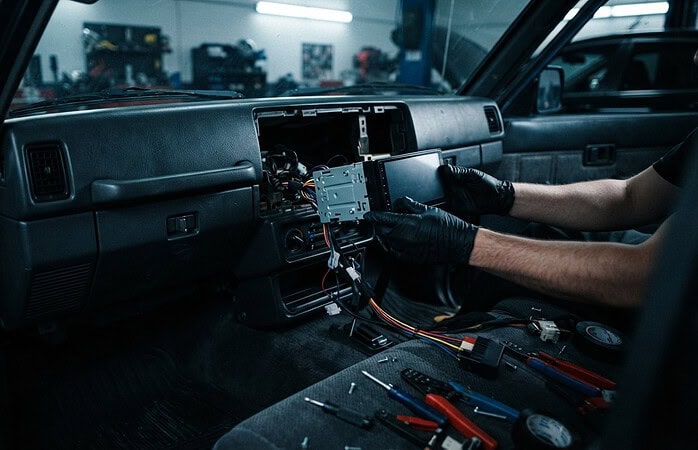
Professional consultation prevents the headache of a quiet system. Many modern factory systems rely on 2-ohm speakers to squeeze every bit of power from a basic head unit. We can help you plan a successful car audio upgrade for stock stereo systems so you don’t lose volume while gaining clarity. Understanding the original equipment’s output is vital before you start swapping parts. We analyze the factory signal to ensure your new speakers will actually perform better than the ones they replace.
The Myth of ‘More is Better’
Raw power isn’t the only metric for a great system. There is a common belief that a 1-ohm load is the ultimate goal for a “loud” system, but this often sacrifices sound quality for sheer force. Clarity is often found at 4-ohms, while raw SPL lives at 1-ohm. Choosing a balanced 4-ohm setup provides the head-room your amplifier needs to reproduce music with precision and detail. It allows the hardware to run efficiently without the constant threat of overheating or clipping. Efficiency and longevity are just as important as peak volume when building a system you can enjoy every day.
Professional System Design: Ensuring Longevity and Clarity
We don’t view impedance as a standalone number on a spec sheet. At Music In Motion, we treat it as the heartbeat of a total system architecture. Building a high-performance audio environment requires looking at how every component interacts under real-world conditions. Choosing between 2 ohm vs 4 ohm speakers car audio is only the beginning of that process. We select amplifiers based on the final calculated impedance of the entire network, ensuring the power supply can handle the current draw without breaking a sweat. This bird’s-eye view prevents the equipment failures that often plague DIY projects.
Professional installation adds a layer of security that goes beyond simple plug-and-play swaps. We use precision tools to measure the actual impedance at the amplifier terminals after the wiring is complete. This step identifies hidden shorts or unexpected resistance drops before they can damage your gear. We also utilize Digital Signal Processing (DSP) to manage power delivery across various loads. A well-tuned DSP allows us to fine-tune the output for each channel, protecting your speakers while maximizing the acoustic potential of your cabin or deck space.
Custom Fabrication and Electrical Integration
Our custom enclosures are more than just boxes; they are engineered environments. We design them to work in harmony with the physical impedance characteristics of your chosen drivers. As a speaker moves, it encounters air resistance that changes its electrical behavior. We account for this “impedance rise” during the fabrication process to ensure your amplifier stays in its most efficient operating range. We also verify that your vehicle’s electrical system, including the alternator and battery, can support the high current demands of low-impedance setups.
Safety is never a secondary concern in our shop. We integrate our audio upgrades with existing vehicle safety systems to ensure no interference with sensors or cameras. This holistic approach ensures that your new sound system improves your driving experience without compromising the underlying technology of your car, boat, or motorcycle.
The Music In Motion Advantage
We prioritize the finished result over the mere transaction of goods. This means we don’t just hand you a box and wish you luck. Our team specializes in high-performance integration for challenging environments, including marine-grade systems and motorcycle audio. These applications face extreme vibration and heat, making proper impedance matching a matter of survival for the hardware. We take pride in building systems that play loud and clear for years, regardless of the weather or the terrain.
Every vehicle has unique requirements. Whether you are chasing the raw power of a 2-ohm subwoofer array or the refined clarity of a 4-ohm component set, we have the specialized knowledge to enhance your ride. We invite you to a professional consultation where we can map out a perfectly balanced system tailored to your specific goals. Let us handle the math so you can focus on the music.
Take Command of Your Audio Architecture
Building a world-class audio system is about more than just buying the most expensive components. It is about the technical handshake between your amplifier and your speakers. We’ve explored how the choice between 2 ohm vs 4 ohm speakers car audio dictates your system’s volume, clarity, and temperature. Whether you are wiring a complex series-parallel array or simply upgrading a factory head unit, getting the impedance right ensures your music stays loud and your hardware stays safe.
Since 1994, we’ve been the custom fabrication experts dedicated to delivering finished results that exceed expectations. Our team holds specialized certifications for marine and motorcycle audio, ensuring your gear survives the elements. We don’t just sell boxes; we architect solutions that integrate everything from high-performance subwoofers to professional integration of radar defense and safety tech. We prioritize the internal experience of the user, making every drive feel like a front-row seat.
Design your perfect sound system with the experts at Music In Motion. We are ready to help you push the boundaries of customization while keeping your system’s reliability at the forefront. Your journey to perfect sound starts with a single conversation.
Frequently Asked Questions
Can I use 2-ohm speakers with a 4-ohm amplifier?
No, you should only use 2-ohm speakers if your amplifier is explicitly rated as 2-ohm stable. A standard 4-ohm amplifier will attempt to draw too much current to power a lower resistance load, leading to overheating or permanent hardware failure. We always recommend verifying your amplifier’s specifications before deciding between 2 ohm vs 4 ohm speakers car audio components for your build.
What happens if my speaker impedance is too low for my amp?
The amplifier will generate excessive heat as it struggles to manage the increased current flow. This typically triggers “Protect Mode,” which shuts the system down to prevent the internal circuits from melting. If the amplifier lacks a protection circuit, the internal solder joints or transistors can suffer catastrophic damage, resulting in an expensive and avoidable replacement.
Does a higher ohm rating mean better sound quality?
Higher impedance generally results in better sound quality because it provides a higher damping factor. This allows the amplifier to exert more precise control over the speaker cone’s movement, which reduces unwanted vibrations. While 2-ohm systems are excellent for achieving maximum volume, a 4-ohm setup is often the preferred choice for listeners who prioritize clarity, detail, and accuracy.
Why does my multimeter show 3.2 ohms on a 4-ohm speaker?
Your multimeter measures DC resistance, while the speaker’s rating refers to AC impedance during operation. Impedance is a reactive measurement that fluctuates based on the frequency of the music being played. A static reading of 3.2 or 3.6 ohms is completely normal for a speaker with a nominal 4-ohm rating, as the laboratory rating is an average across the entire audible spectrum.
What is the difference between a single voice coil and a dual voice coil?
A single voice coil speaker has one set of wiring terminals, while a dual voice coil (DVC) speaker features two independent sets. DVC drivers offer significantly more flexibility when we are designing a system architecture. They allow us to wire the coils in series or parallel to reach a specific impedance that perfectly matches the power output capabilities of your chosen amplifier.
Can I mix 4-ohm and 8-ohm speakers in the same car?
You can mix them in the same vehicle, but you should never put them on the same amplifier channel. Electricity follows the path of least resistance, so the 4-ohm speaker will draw more power and play much louder than the 8-ohm speaker. This creates an uneven and distracting soundstage. We suggest using dedicated amplifier channels to maintain balanced volume levels across different driver types.
How do I know if my amplifier is 1-ohm stable?
You must consult the manufacturer’s spec sheet to see if an RMS power rating is listed for a 1-ohm load. If the documentation only provides ratings for 2 ohm vs 4 ohm speakers car audio, the unit is not designed for 1-ohm operation. Most 1-ohm stable amplifiers are high-end mono-block units specifically engineered to drive massive subwoofer arrays in high-output installations.
Is impedance different for marine audio systems compared to car audio?
The physics of impedance remain identical, but the environmental stakes are much higher on the water. Marine amplifiers often face higher ambient temperatures and restricted airflow, making them more susceptible to thermal failure from low-impedance loads. We use specialized wiring techniques and marine-certified hardware to ensure your system remains reliable even when pushing multiple pairs of speakers in an open-air environment.