That grating pop and hiss coming from your door panel isn’t just a nuisance; it’s your audio system’s way of telling you exactly where it’s failing. We understand how quickly a drive can turn from relaxing to frustrating when a favorite track is drowned out by static. You might worry that your entire setup is ruined or that a full system replacement is the only solution. The reality is that learning how to fix car speaker crackling often starts with a simple, logical process of elimination rather than a massive bill for new hardware.
We are here to help you identify the root cause of your car audio static and follow our professional-grade steps to restore crystal-clear sound to your vehicle. Our team believes that a finished result is more important than a transaction, so we want to empower you with the knowledge to distinguish between mechanical vibration and electrical interference. This guide provides a systematic diagnostic path, covering everything from basic wiring checks to the complex shielding issues found in 2026 digital signal processors. You will gain a clear understanding of your noise source and learn exactly when to tackle the repair yourself or when it’s time to call in a specialist.
Key Takeaways
- Learn to distinguish between mechanical distortion and electrical static to pinpoint the exact source of your audio frustration.
- Follow our systematic guide on how to fix car speaker crackling by using the “Wiggle Test” to find loose terminals or corroded wiring.
- Discover why high-quality grounding and proper RCA cable routing are essential for eliminating interference in modern vehicle electronics.
- Use visual inspections and physical tests to determine if your speakers have suffered permanent mechanical damage like blown cones or burnt voice coils.
- Identify the critical signs of internal equipment failure that signal when it’s time to move beyond DIY and seek professional diagnostic tools.
Identifying the Type of Car Speaker Crackling
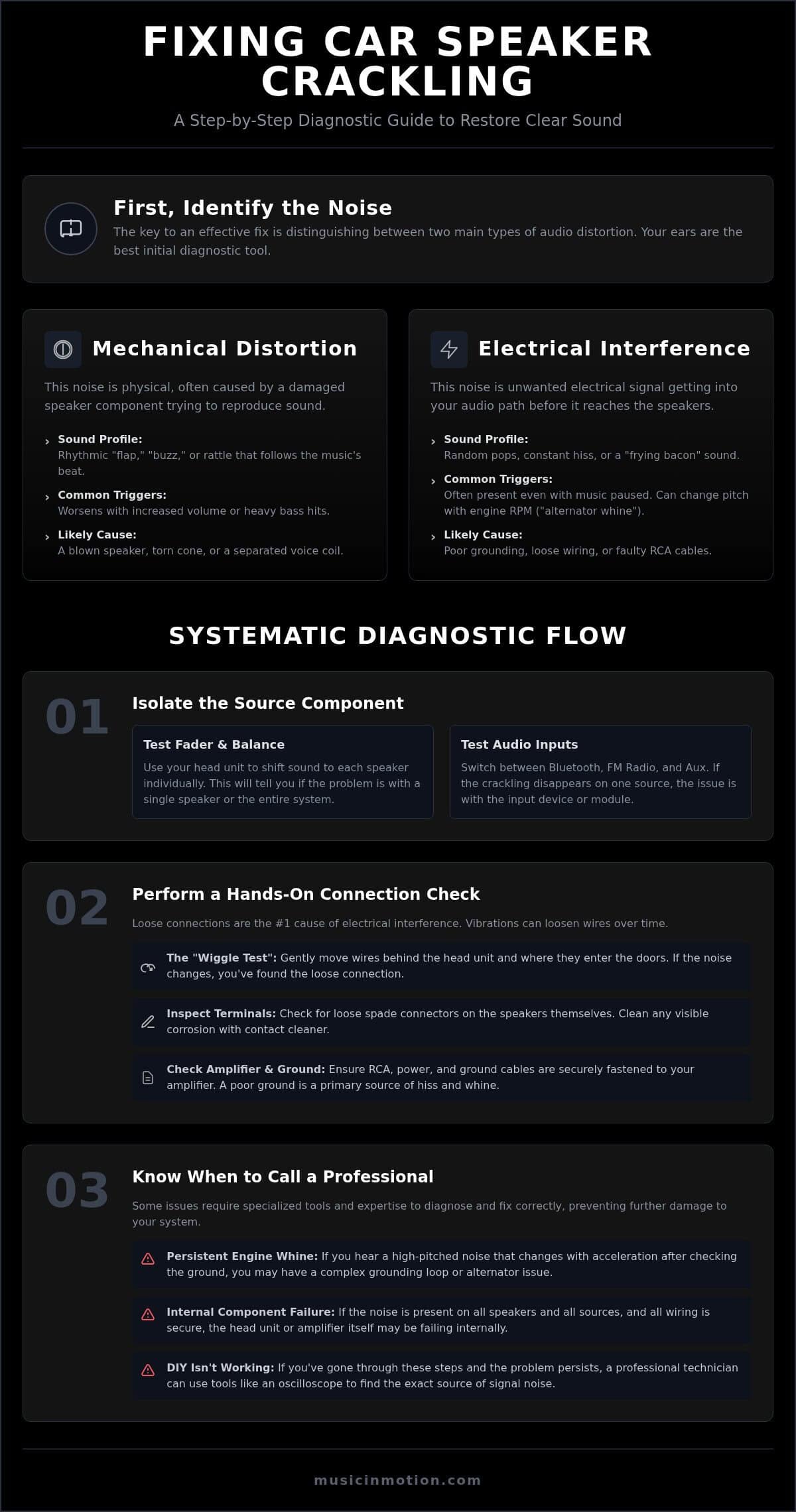
Diagnosis is the foundation of any successful repair. We often see enthusiasts who have already bought new hardware only to find that the annoying pop persists. Distinguishing between mechanical and electrical noise is the essential first step in learning how to fix car speaker crackling without wasting your weekend or your budget. While both sound like “noise,” they originate from completely different failures within your vehicle’s ecosystem.
Mechanical noise is typically rhythmic. It follows the beat of the music and often worsens when the bass hits or the volume increases. Electrical noise, on the other hand, is random. It sounds like frying bacon, sharp pops, or a constant hiss. In many cases, electrical static occurs even when your music is paused. To get a head start, use your head unit’s “Fader and Balance” settings. By shifting the sound to each individual corner, you can determine if the issue is isolated to a single door or if it’s a system-wide problem. Professional technicians often rely on engineering principles like Noise, vibration, and harshness (NVH) to categorize these unwanted sounds and find a permanent solution.
Mechanical vs. Electrical: The Quick Ear Test
You can often diagnose the issue just by changing what you’re listening to. Play a track with heavy bass; if you hear a consistent “flap” or “buzz,” the speaker cone is likely physically damaged. If you hear a high-pitched whistle that changes pitch as you press the gas pedal, you’re dealing with “engine whine” caused by a poor ground. Identifying these symptoms is the fastest way to learn how to fix car speaker crackling at the source. Clipping occurs when an amplifier is pushed beyond its voltage limits, creating a harsh, flattened signal that sounds like a mechanical failure but is actually an electronic signal limitation. Understanding this distinction saves you from replacing perfectly good speakers when the amplifier is the real bottleneck.
Isolating the Source: Head Unit, Amp, or Speaker?
We always suggest testing multiple sources before taking your door panels apart. Switch from your phone’s Bluetooth to a local FM radio station. If the crackling stops on the radio, the issue is likely your phone’s connection or the head unit’s Bluetooth module. If the noise is present across every speaker simultaneously, the problem is centralized in your amplifier or main power wire. Many drivers find that a car audio upgrade for stock stereo units is the best way to resolve these issues, as modern integration kits provide much cleaner signal paths than aging factory wiring. By isolating the hardware one piece at a time, you ensure the fix is permanent and reliable.
Step-by-Step Wiring and Connection Troubleshooting
Once you have identified the type of noise, it is time to get hands-on with the physical components. Wiring issues are the most common reason enthusiasts search for how to fix car speaker crackling. Over time, the vibrations of the road and the constant opening and closing of doors can wreak havoc on even the best factory connections. We always start our diagnostics with the ‘Wiggle Test.’ This involves playing music at a low volume and gently manipulating the wires behind the head unit or where they enter the door. If the crackling stops or intensifies as you move the wire, you have found a loose terminal or a break in the insulation.
The most frequent failure point is the door boot, which is the rubber sleeve protecting the wires as they pass from the car’s body into the door. Because this bundle flexes every time you enter the vehicle, wires can become pinched or frayed. While loose wiring is a common culprit, understanding how speakers get damaged by inconsistent power delivery or physical wear can help you prevent future blowouts. We also recommend inspecting the connections at your amplifier or Line Output Converter (LOC). A loose RCA cable or a poorly seated power wire can introduce enough resistance to create a constant, maddening hiss.
Inspecting Terminal Integrity
Loose spade connectors are often the silent cause of intermittent popping. If these metal clips don’t fit snugly onto the speaker terminals, the signal will jump across the gap, creating a tiny arc that sounds like a crackle. In older vehicles, oxidation can build up on these metal surfaces, acting as a barrier to clean current. You can safely clean these with a bit of electronic contact cleaner and a soft brush. Ensure that the bare metal of the speaker leads is not touching the metal door frame, as this creates a partial short that degrades sound quality. If you find your factory harnesses are beyond repair, our team at Music In Motion can provide professional integration solutions that replace these weak links with high-grade components.
Testing for Shorts and Continuity
A multimeter is your best friend when learning how to fix car speaker crackling that isn’t visible to the naked eye. Set your meter to measure resistance (ohms) and check the reading at the speaker terminals; most car speakers should read between 2 and 4 ohms. If the reading is erratic or infinite, you have a broken wire or a failing voice coil. To perform a continuity test between the speaker and the amp, set your multimeter to the continuity mode and touch one probe to the speaker wire terminal at the speaker and the other to the corresponding terminal at the amplifier output. A ‘ground short’ occurs when the positive signal wire touches the vehicle’s chassis, which will either silence the speaker entirely or cause heavy distortion that mimics a blown cone.
Diagnosing Signal Interference and Grounding Issues
While physical breaks in a wire are often obvious, signal interference is a ghost in the machine. We frequently find that when a client is struggling with how to fix car speaker crackling, the issue isn’t a broken component but a “weak ground.” A ground connection provides the essential return path for electrical current. If that path is restricted by factory paint, surface rust, or a loose bolt, the amplifier cannot maintain a stable signal. This instability manifests as erratic, high-frequency popping that can ruin your listening experience. Unlike a simple hum, these ground-related pops are sharp and unpredictable.
Modern 2026 vehicle electronics add another layer of complexity to your diagnostic path. High-speed data buses now share space with traditional wiring, and they can bleed digital noise into your analog audio lines. We have identified specific shielding failures in some 2026-model digital signal processors where internal interference mimics the sound of a blown speaker. Additionally, if you are using a Line Output Converter (LOC) for factory integration, a failure in its internal circuitry or a poorly matched gain setting can introduce a constant layer of static. Identifying these signal bottlenecks is the only way to achieve a truly professional-grade result.
RCA Cable Health and Routing
Poor cable routing is a leading cause of signal noise. If your RCA cables are bundled next to high-current power wires, they can pick up electromagnetic interference (EMI). We recommend the “Direct Patch” test to rule this out quickly. Simply run a temporary, high-quality RCA cable across your car seats, connecting the head unit directly to the amp. If the noise disappears, your original cables are either damaged or poorly routed. Premium shielded cables are essential for high-end builds because they feature dedicated internal layers designed to reject the electrical “trash” generated by your vehicle’s alternator and computer systems.
Ground Loop Identification
You can often spot a bad ground by watching your vehicle’s other functions. If the crackle intensifies when you turn on your headlights or use your power windows, you likely have a ground loop issue. Always check the amplifier’s ground point first. It should be a short, thick wire bolted directly to the bare metal of the vehicle’s chassis. We never rely on factory bolts that might be shared with other electronics. Our approach to custom car audio fabrication prioritizes dedicated grounding blocks and noise rejection, ensuring that your system has the clean electrical foundation it needs to perform. Solving these invisible issues is a vital part of learning how to fix car speaker crackling for the long term.
Mechanical Failures: Blown Cones and Voice Coils
Sometimes the noise isn’t a ghost in the wiring but a physical injury to the speaker hardware itself. When you are investigating how to fix car speaker crackling, performing a thorough visual inspection is the most logical starting point. We often find that what sounds like a terminal failure is actually a small pebble or a shard of glass from a previous window repair rattling against the cone. Gently removing this debris can instantly restore your sound quality without costing a dime. You should also look for “tinsel lead slap,” which occurs when the thin wires connecting the terminals to the voice coil have loosened and are physically striking the back of the cone during heavy bass notes.
The “Push Test” is another professional technique for diagnosing internal mechanical failure. With the audio turned off, place your fingers evenly around the center of the speaker cone and apply gentle, straight pressure. If you feel a gritty resistance or hear a scraping sound, the voice coil has likely become misaligned or warped. A healthy speaker should move smoothly and silently. If the movement feels restricted or “crunchy,” the internal components have reached the end of their service life. This simple physical check is often more reliable than any electronic test for identifying a truly blown driver.
The Anatomy of a Blown Speaker
Excessive heat is the primary enemy of your audio system. When an amplifier sends a clipped or distorted signal, the voice coil insulation can melt, leading to internal electrical shorts. This damage creates “coil rub,” a metallic scraping noise that many drivers mistake for simple static. Over-excursion is another common failure mode where the speaker is pushed beyond its physical limits, causing the “spider” or the outer foam surround to tear. These tears prevent the cone from moving in a controlled, linear manner, resulting in the distorted crackle you hear at higher volumes. Understanding these failures helps you learn how to fix car speaker crackling by addressing the source rather than just the symptom.
Temporary vs. Permanent Fixes
While some DIY enthusiasts use flexible adhesives to patch small tears in a foam surround, we consider this a temporary band-aid. A patched speaker will never have the same frequency response as the original, and the structural weakness remains. It is vital to remember that a blown speaker is often just a symptom of an improperly tuned amplifier or a mismatched head unit. To verify if a speaker is totally dead, perform a “Battery Pop” test by briefly touching the leads of a 9-volt battery to the speaker terminals to see if the cone moves with a healthy, audible thump. If your speakers are physically damaged, our team can help you select high-performance Car Audio Upgrades that are properly matched to your vehicle’s power requirements to prevent future failures.
Professional Solutions for Recurring Audio Noise
There comes a point in every diagnostic journey where the limits of DIY tools are reached. If you have checked every wire and the noise persists, you might be facing internal component failure within your head unit or amplifier. These complex electronics often require specialized equipment to troubleshoot correctly. We utilize an “Audio RTA” (Real Time Analysis) to visualize the frequency response of your system in real time. This allows us to see exactly where distortion occurs, making it much easier to understand how to fix car speaker crackling that stems from digital signal errors or internal hardware glitches.
Vibrations are another hidden culprit. Sometimes, what sounds like a speaker crackle is actually a loose panel or a metal-on-metal rattle triggered by specific sound frequencies. We often recommend professional sound deadening installation to dampen these sympathetic vibrations. By treating the door cavity with high-grade damping materials, we create a stable environment that eliminates the “fake” crackling caused by mechanical resonance. This approach ensures long-term reliability and provides a much more immersive, sensory listening experience behind the wheel.
Upgrading Beyond the Factory Limits
Most factory systems rely on inexpensive paper-cone speakers that are highly susceptible to moisture and heat damage. Replacing these with high-performance components is often the most cost-effective way to solve recurring noise issues once and for all. In modern vehicles, we also integrate Digital Signal Processors (DSPs) to clean up the “dirty” signals sent from factory head units. Our team focuses on building systems that are noise-free from day one, using premium electronics integration to bypass the inherent limitations of stock hardware. This ensures that your favorite tracks are delivered with technical precision and emotional impact.
Custom Fabrication for Secure Sound
Custom fabrication is the ultimate cure for mechanical rattling. We use specialized speaker adapters and baffles to ensure every driver is mounted securely to the vehicle’s frame, preventing the movement that leads to distortion. In high-vibration environments like cars, motorcycles, or boats, we prioritize heat-shrink and soldered connections over standard crimp terminals. This level of detail prevents the loose connections that frequently lead to intermittent popping. A professional setup doesn’t just sound better; it protects your investment and ensures your vehicle’s sensitive electronics remain safe and functional. By focusing on the finished result rather than just the hardware, we help you master how to fix car speaker crackling for the life of your vehicle.
Restore Your Driving Experience
Your vehicle’s audio system should be a source of enjoyment, not a collection of frustrating pops and hisses. By following a systematic diagnostic path, you can distinguish between simple wiring loose-ends and permanent mechanical damage. We’ve shown that mastering how to fix car speaker crackling often comes down to ensuring clean power and secure connections. Whether you are performing a “Wiggle Test” on a door boot or testing for ground loops, a logical approach saves you time and money.
If your system requires a deeper level of expertise, we are here to help. Our team has specialized in high-performance audio and custom fabrication since 1994, providing solution-oriented diagnostics for even the most complex vehicle electronics. We prioritize the finished result over the mere transaction of goods, ensuring your audio setup remains crystal-clear for years to come. Restore your vehicle’s audio performance with the experts at Music In Motion. We are excited to help you customize a sound environment that improves your daily life on the road and makes every drive feel special.
Frequently Asked Questions
Why do my car speakers crackle even when the volume is low?
Crackling at low volume usually indicates an electrical issue like a poor ground or signal interference rather than a physically blown speaker. While mechanical damage typically requires more power to become audible, electrical static can persist regardless of the gain level. In many cases, a loose connection at the back of the head unit or a failing internal component in the factory stereo creates this constant, frustrating hiss.
Can a bad car battery or alternator cause speaker crackling?
Yes, a failing alternator can introduce “engine whine” or rhythmic popping that changes pitch as your engine’s RPM increases. When the alternator’s internal diodes fail, AC current bleeds into your DC system and creates audible electrical noise. A weak battery can also cause significant voltage drops that starve your amplifier, leading to erratic signal behavior and audible distortion during high-demand moments.
Is it dangerous to keep playing music through a crackling speaker?
Continuing to play music through a crackling speaker isn’t physically dangerous to you, but it can destroy your hardware. The erratic electrical signals that cause crackling often generate excessive heat within the voice coil. Over time, this heat melts the insulation and can permanently short out your amplifier’s output stage, turning a simple speaker replacement into a much more expensive system repair.
How do I know if my head unit is causing the static?
You can isolate a faulty head unit by testing different audio sources like the radio versus a wired auxiliary input. If the static persists across all speakers and all sources, the head unit’s internal pre-amp or digital signal processor is likely the culprit. This is a common point where enthusiasts learn how to fix car speaker crackling by upgrading to a more reliable aftermarket unit with better shielding.
Can moisture in the car doors make my speakers pop?
Moisture is a frequent cause of speaker failure because it corrodes the delicate metal terminals and weakens the paper cones found in factory systems. When water enters the door cavity, it can cause a partial short circuit at the wiring harness. This leads to intermittent popping or a muffled sound that often worsens during rainy weather or immediately after you visit a car wash.
Does Bluetooth connection quality affect speaker crackle?
Bluetooth connection quality impacts audio clarity, though it usually sounds like digital “stuttering” rather than a sharp mechanical crackle. Digital compression and signal dropouts can mimic the sound of electrical interference. If the noise disappears when you switch to a high-quality wired connection, the issue is likely the wireless signal or the Bluetooth module in your phone or dashboard.
How much does it typically cost to have a professional fix speaker noise?
Professional diagnostic fees for car audio noise typically range between $122 and $233 for a comprehensive labor check, though some shops offer basic checks starting at $30. If the issue is a simple wiring fix, you might only pay for an hour of labor, which often ranges from $80 to $150. Replacing a single speaker part can cost between $15 and $350 depending on the quality of the component.
Will adding an amplifier stop my speakers from crackling at high volume?
Adding an amplifier will only stop crackling if the original noise was caused by your head unit “clipping” or running out of power at high volumes. If the crackling is due to a blown speaker or bad wiring, an amplifier will actually make the problem louder and more destructive. We always recommend learning how to fix car speaker crackling by identifying the root cause before you add more power to the system.