What if your boat was the one everyone gravitated toward at the sandbar because the music stayed crystal clear even over the roar of the crowd? We know how frustrating it is when your favorite track sounds tinny or starts to distort just as the party gets going. Finding the best sound system for a pontoon boat party isn’t just about picking the loudest speakers. It’s about building a specialized ecosystem that handles the sun, the spray, and the heavy power demands of a full day on the water.
We’ve seen too many boaters cut their afternoon short because a high-powered amp drained their starting battery or a speaker succumbed to UV damage. You deserve a setup that delivers deep bass you can feel and integrated lighting that sets the mood after sunset. We’re here to help you transform your vessel into the ultimate party destination using professional-grade marine audio, custom fabrication, and intelligent power management. This guide previews the latest 2026 trends in multi-zone control and stealth installations to ensure your boat looks as good as it sounds.
Key Takeaways
- Understand why factory audio falls short in open-air environments and how to choose components that deliver clear sound across the entire deck.
- Discover why 8-inch drivers and dedicated subwoofers are essential components when building the best sound system for a pontoon boat party.
- Learn to protect your starting battery with dual-bank power management systems so you can stay anchored at the sandbar all day without worry.
- Explore how custom fabrication and integrated LED lighting transform standard storage areas into high-performance, aesthetic audio hubs.
- Gain insights into the professional tuning and structural mounting techniques required to ensure your system survives the rigors of the water.
Why Factory Pontoon Audio Fails at the Sandbar
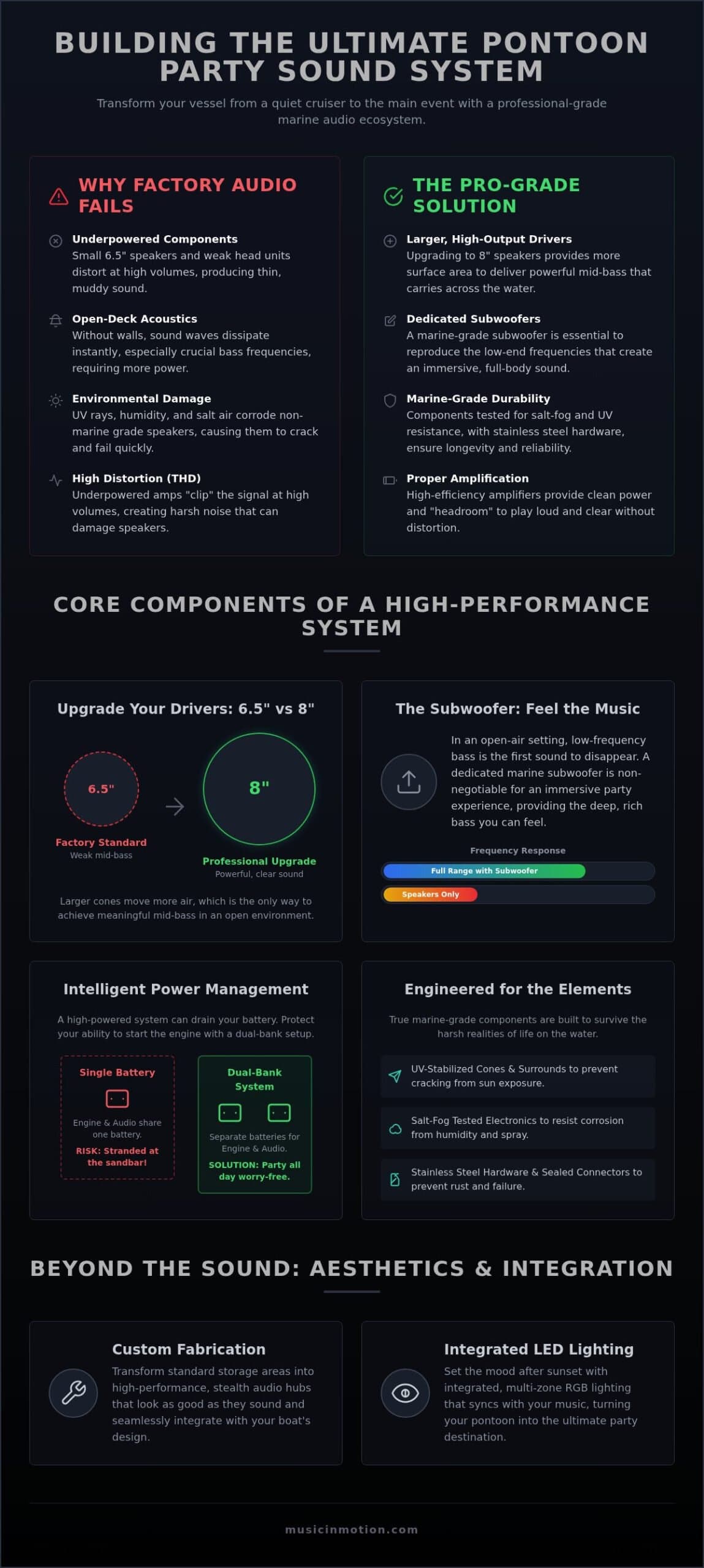
You’ve finally anchored at the sandbar. The cooler is full, and the sun is out. You turn up the volume to get the crowd moving, but instead of the crisp, punchy track you expected, you get a muddy, crackling mess. Most boaters realize too late that a factory-installed setup isn’t designed to be the best sound system for a pontoon boat party. It’s built for basic background noise during a quiet cruise, not for competing with wind, water, and the chatter of a dozen guests.
Factory limitations start at the source. Most pontoons come equipped with underpowered head units and low-sensitivity 6.5-inch speakers. These components might sound fine at the dock, but they quickly reach their limit when pushed. By the time you hit 75% volume, the internal amplifiers start to clip, sending distorted signals that can permanently damage your hardware. We see this every season; boaters try to force volume out of a system that lacks the “muscle” to provide it, resulting in a thin sound that fails to reach the back of the deck.
The Open-Deck Acoustic Problem
In a car, sound reflects off the glass and upholstery, creating a “cabin gain” effect that naturally boosts bass and volume. A pontoon is a completely different animal. There is no roof or walls to trap that energy. Sound waves dissipate instantly into the open air. This is why we often recommend a professional sound reinforcement system designed specifically for marine use. Without those reflective surfaces, your speakers have to work twice as hard to reach the same perceived volume levels.
Environmental stress is another major factor. While “water-resistant” gear might survive a light splash, true marine-grade components are engineered for survival. We prioritize ruggedized electronics because the marine environment is brutal. UV rays turn standard speaker surrounds brittle after just one season, while humidity and salt air corrode non-sealed voice coils. Marine-grade equipment is specifically salt-fog tested and UV-stabilized to ensure the cones don’t crack and the internal motors don’t seize up after a few months on the lake.
Distortion: The Party Killer
Distortion is the fastest way to ruin the vibe of a party. When an amplifier is underpowered, it can’t maintain the integrity of the sound wave at high volumes. Total Harmonic Distortion (THD) measures the accuracy of an amplifier’s signal, where higher percentages indicate the presence of muddy, distorted noise that can ruin the listening experience and overheat your speakers. To overcome the noise of a party, you need high-sensitivity speakers. These components are more efficient at converting power into sound, allowing you to stay loud and clear without pushing your gear into the danger zone.
- Car Audio vs. Marine Audio: Car speakers use paper or untreated materials that fail in high humidity.
- Output Needs: Pontoons require higher wattage to overcome the lack of an enclosed cabin.
- Durability: Professional marine systems use stainless steel hardware and sealed connectors to prevent rust.
The Core Components of a High-Performance Party Audio Setup
Building the best sound system for a pontoon boat party requires more than just high volume. It requires a balance of frequency response and power that can cut through wind and water noise. We focus on four core pillars: high-output speakers, dedicated subwoofers, tower pods, and robust amplification. Each piece must be engineered for the marine environment to ensure reliability and performance. When we design a system, we look at the boat as a whole, ensuring every passenger enjoys the same premium experience.
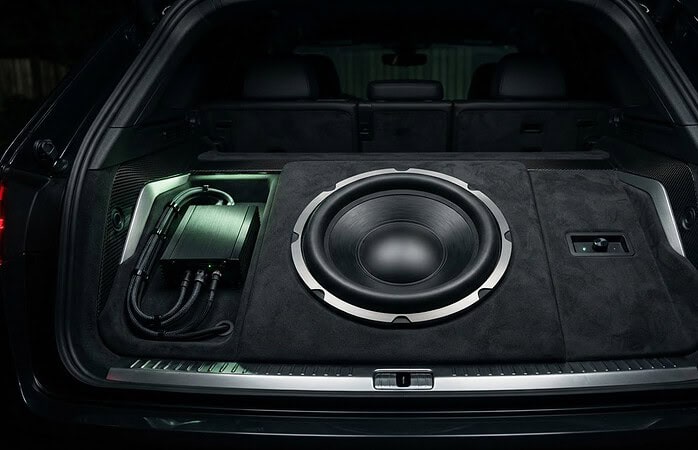
Most factory systems rely on small 6.5-inch speakers. We recommend stepping up to 8-inch drivers. These larger cones have more surface area to move air, which is the only way to get meaningful mid-bass in an open environment. Without that punch, your music sounds like it’s coming through a tin can once you’re twenty feet away. Subwoofers are the secret to a professional result. In an open-air setting, low-end frequencies are the first to disappear. A marine-grade subwoofer fills that void, providing the depth that makes a party feel immersive. This hardware puts a significant load on your boat’s electrical system; therefore, we always match our subwoofers with high-efficiency amplifiers that provide clean headroom without clipping.
Speakers vs. Tower Pods: Finding the Balance
We view deck speakers and tower pods as two different tools. Achieving the best sound system for a pontoon boat party involves strategic placement of both. Coaxial speakers mounted in seat bases provide “near-field” audio for passengers sitting inside the rails. Tower pods, often mounted on the bimini or arch, project “long-range” sound toward the swim platform or people floating behind the boat. For a truly versatile setup, we combine both. You can find more detail on specific hardware in our guide to Premium Marine Audio Systems. If you’re unsure where to start, our team can help you design a custom marine audio layout that fits your specific deck plan.
Multi-Zone Control: Mastering the Social Dynamic
A common mistake is running the entire boat on one volume knob. If the music is loud enough for the people on the tubes, it’s too loud for the person trying to drive. We solve this with multi-zone control. Modern marine head units, often integrated via NMEA 2000, allow us to create independent zones for the bow, stern, and subwoofer. You can keep the bass thumping at the swim platform while lowering the volume at the helm for a conversation. This level of customization ensures the party stays fun for everyone on board, regardless of where they are sitting. This intelligent approach to integration is what separates a standard upgrade from a professional installation.
Power Management: Keeping the Music Playing Without a Dead Battery
Nothing kills the energy of a sandbar gathering faster than a boat that won’t start when it’s time to head home. High-performance audio draws a massive amount of current. If you’re running multiple amplifiers and a subwoofer, your factory battery won’t keep up for long. Building the best sound system for a pontoon boat party requires a power strategy that is just as robust as the speakers themselves. We prioritize a “failsafe” approach to ensure you can play your music at full tilt without ever worrying about your engine’s ability to crank.
The foundation of a reliable party boat is a dual-battery system managed by an Automatic Charging Relay (ACR). This device acts as an intelligent gatekeeper. When the engine is running, the ACR allows the alternator to charge both your starting battery and your audio battery. Once you drop anchor and turn off the engine, the relay automatically isolates the starting battery. This ensures your audio system only pulls from a dedicated “house” bank, leaving your cranking battery fresh and untouched for the ride home. It’s a simple, set-it-and-forget-it solution that provides total peace of mind.
Safety on the water also depends on the quality of your connections. We insist on using 100% Oxygen-Free Copper (OFC) wiring for every installation. Many budget kits use Copper-Clad Aluminum (CCA), which is less conductive and prone to rapid corrosion in humid environments. Using thin, budget-grade wire creates excessive electrical resistance, which generates heat and significantly increases the risk of fire in confined marine compartments. OFC wire stays cool, delivers maximum current to your amps, and resists the “green crust” of corrosion that plagues inferior cables.
Dedicated House Batteries vs. Starting Batteries
There’s a major technical difference between the battery that starts your engine and the one that runs your music. Starting batteries are designed for short, massive bursts of energy. Audio systems require deep-cycle batteries, which are built to provide steady power over several hours. For a typical 4-6 hour session at the sandbar, we generally recommend at least 100 Amp-hours (Ah) of deep-cycle capacity. This provides enough “fuel” to keep the best sound system for a pontoon boat party hitting hard without dropping voltage to dangerous levels.
Smart Charging and Monitoring
We often integrate Bluetooth-enabled battery monitors into our custom builds. These allow you to check your exact voltage and remaining runtime directly from your smartphone. If you have an extreme system with multiple subwoofers, we can also look at high-output alternators to keep up with the demand while cruising. For more information on how we prioritize electrical integrity, check out our Vehicle Safety Systems Roundup which covers essential upgrades for modern electrical demands. Proper monitoring ensures you’re never guessing about your power levels during a long weekend outing.
Beyond Sound: Custom Fabrication and LED Lighting Integration
A high-performance audio setup is only half the battle. To truly build the best sound system for a pontoon boat party, you need to consider how that technology integrates into your boat’s design. We don’t just “screw in” speakers and call it a day. We use custom fabrication to ensure every component looks like it was installed by the original manufacturer. This involves using marine-grade acrylics that won’t yellow in the sun and stainless steel hardware that resists the corrosive effects of a humid environment. Our goal is a finished result that looks as impressive as it sounds.
Most installers treat a pontoon like a car with no roof, but we see it as a floating lounge with unique structural opportunities. We utilize the space inside seat bases and under-helm storage to create hidden performance hubs. This “stealth” approach keeps your deck clear for guests while providing the internal volume needed for high-end audio components. By using custom pods, we can also add speakers in locations where the manufacturer didn’t provide factory holes, ensuring 360-degree sound coverage across the entire vessel.
Custom Enclosures for Pontoons
Many shops use “infinite baffle” subwoofers because they don’t require a dedicated box. While this is a simpler installation, it often lacks the “punch” and accuracy needed to overcome the open-air acoustics we discussed earlier. We prefer building sealed enclosures that fit perfectly into your pontoon’s existing compartments. These custom boxes provide the air pressure control required for tight, rhythmic bass that stays clear at high volumes. Our deep background in Custom Car Audio Fabrication allows us to apply advanced engineering to the water, creating enclosures that are both water-resistant and acoustically superior.
The “Wow” Factor: RGB Lighting Control
Lighting is the ultimate way to set the mood once the sun goes down. We move beyond basic 7-color LEDs and offer digitally addressable RGB lighting. This technology allows for millions of color combinations and dynamic patterns that can sync directly to the beat of your music. We integrate these systems into speaker grilles, cup holders, and under-deck strips to create a cohesive light show. A centralized controller allows you to manage the entire boat’s aesthetic via a smartphone app, making it easy to shift from a relaxing glow to a high-energy party atmosphere. If you’re ready to turn your boat into a show-stopper, schedule a custom marine installation with our team today.
Professional Installation: Turning Your Pontoon into the Ultimate Party Vessel
While many online forums suggest that a weekend DIY project is enough to upgrade your boat, the reality of the marine environment demands a much higher standard. We’ve spent over 30 years perfecting the art of custom installation because we know that the best sound system for a pontoon boat party is only as good as its weakest connection. Rough water, constant vibrations, and relentless exposure to the elements will quickly expose any shortcuts taken during the assembly process. Our team focuses on a professional integration that ensures your investment actually survives the season.
Reliability is our primary goal. We prioritize professional soldering and heat-shrinking for every wire joint instead of relying on standard crimp connectors that can vibrate loose or succumb to corrosion. Structural integrity is another critical factor often overlooked in DIY setups. When we mount heavy tower speakers or custom subwoofer enclosures, we reinforce the mounting points to handle the stress of choppy water. We ensure that your high-end gear stays exactly where it belongs, even when you’re cruising at full throttle across the lake.
The Art of Marine Audio Tuning
Tuning for an open deck is a specialized skill that differs significantly from tuning a car or a home. We use Real Time Analyzers (RTA) to map the soundstage across your entire deck, identifying and eliminating “dead spots” where audio waves might cancel each other out. By calibrating Digital Signal Processors (DSPs), we can ensure every passenger enjoys a balanced, crisp signal regardless of where they’re sitting. We also meticulously set crossovers to ensure your speakers play at maximum volume without the risk of blowing a driver. This level of precision is the same philosophy we apply to a car audio upgrade for a stock stereo, where we maximize the potential of every single component in the chain.
Our “finished result” philosophy means we don’t just sell you hardware; we deliver a complete, high-performance experience. We take immense pride in the safety and functionality of our utility systems, ensuring that your custom project is a show-stopper that remains reliable for years to come. We treat every boat as if it were our own, focusing on the technical details that keep the music playing and the party going.
Ready to Upgrade Your On-Water Experience?
You’ve invested in a pontoon to create lasting memories with friends and family. Don’t settle for off-the-shelf parts that fail to deliver the clarity and energy your gatherings deserve. A professionally integrated system provides the deep bass and intelligent power management you need for a worry-free day at the sandbar. If you’re ready to move beyond the limitations of factory audio and build the best sound system for a pontoon boat party, we’re here to help. Contact Music In Motion for a custom marine audio consultation and let our experts transform your vessel into the ultimate destination on the water.
Take Your Next Sandbar Session to the Next Level
Transforming your boat into the ultimate social hub requires more than just adding volume. It demands a strategic blend of high-output marine components, custom fabrication, and intelligent power management. By moving to 8-inch drivers and dedicated subwoofers, you ensure your music remains clear and punchy across the entire deck. When you combine this performance with a dual-battery system, you can stay anchored all day without ever worrying about a dead engine. We’ve seen how the right setup changes the entire energy of a day on the lake.
We believe the best sound system for a pontoon boat party is one that reflects your personal style while delivering uncompromising reliability. As custom subwoofer fabrication specialists with over 30 years of high-end audio expertise, we focus on providing a finished result that looks and sounds like a factory masterpiece. From premium marine-grade component integration to synchronized LED lighting, we have the specialized knowledge to enhance your experience on the water. Design Your Custom Pontoon Audio System with Music In Motion and start planning your most memorable season yet. We’re ready to help you build something truly exceptional.
Frequently Asked Questions
Will a high-end sound system kill my boat battery while anchored?
Yes, a powerful system can drain a single battery quickly if you don’t have the right setup. We prevent this by installing a dedicated house battery bank and an Automatic Charging Relay (ACR). This configuration ensures your audio pulls from one source while leaving your cranking battery fresh to start the engine. It’s the most reliable way to enjoy the best sound system for a pontoon boat party without getting stranded at the sandbar.
What are the best marine speaker brands for pontoon boats in 2026?
We focus on ruggedized, high-output brands known for their durability in harsh environments. Brands like Kicker are industry staples because they offer specialized 8-inch drivers and integrated LED lighting that handle the marine environment well. We select hardware based on its ability to handle salt, fog, and intense UV exposure. Every boat is different, so we prioritize components that match your specific deck layout and listening style for a finished result.
Do I really need an amplifier for my boat speakers?
Yes, an amplifier is essential for any high-performance setup. Head units usually only provide about 15 to 20 watts of clean power per channel, which isn’t enough to overcome wind and engine noise. An external marine amplifier provides the headroom needed for crystal clear audio at high volumes. Without one, your speakers will likely distort and could suffer permanent damage from clipping when you try to turn the volume up during a party.
Can I use car audio speakers on my pontoon boat?
You shouldn’t use car audio speakers on a boat. Car speakers are designed for enclosed, climate-controlled cabins and often use paper cones or untreated steel components. These materials will rot, rust, or crack within a single season of exposure to humidity and UV rays. True marine speakers use waterproof materials like polypropylene and stainless steel hardware. They are specifically engineered to survive the brutal conditions of the lake or ocean.
How many speakers do I need for a 22-foot pontoon boat?
For a 22-foot pontoon, we generally recommend a minimum of four high-quality 8-inch speakers for balanced sound. If you have a large sun pad or a swim platform, adding a pair of tower speakers can help project music to those in the water. We often suggest adding at least one subwoofer to fill in the low-end frequencies that disappear in open air. This configuration provides total coverage for every guest on board during your outing.
Where is the best place to mount a subwoofer on a pontoon?
The best location is usually under the helm or integrated into a seat base. These spots allow us to build a custom enclosure that protects the driver while providing the necessary air volume for deep bass. Mounting a subwoofer in a central location ensures the low-end frequencies distribute evenly across the deck. Our custom fabrication techniques allow us to hide the enclosure so it doesn’t take up valuable floor space or seating areas.
How do I protect my marine audio system during the winter?
Start by thoroughly cleaning the speaker grilles to remove any salt or debris. If your boat is stored in a cold climate, we recommend removing your batteries or keeping them on a quality multi-stage tender to prevent freezing. Use a breathable boat cover to keep moisture from being trapped against the electronics. These simple steps protect your investment and ensure your system is ready to perform as soon as the ice melts next season.
What is the difference between coaxial and component marine speakers?
Coaxial speakers have the tweeter mounted directly in the center of the woofer, making them easier to install in factory holes. Component speakers separate the tweeter and woofer into two distinct parts. This allows us to mount the tweeters higher up, closer to your ears, which significantly improves the soundstage and clarity. While coaxials are great for general fill, components offer a more refined listening experience for the best sound system for a pontoon boat party.