Why does your premium audio system still sound like the band is performing at your ankles? It’s a frustrating reality for many drivers who find their music feels mushy or disconnected, with the soundstage drooping toward the floorboards instead of sitting proudly on the dash. We understand that frustration. You want to feel the music, not just hear it coming from the door panels.
Learning how to achieve a perfect car audio soundstage is about more than just buying the most expensive speakers. It’s about engineering a bespoke listening experience that rivals high-end home theater setups. We’ve helped countless enthusiasts master the art of car audio imaging to create a clear, centered vocal image that spans the entire width of your windshield.
In this guide, we’ll break down the three essential pillars of a world-class system: physical speaker placement, acoustic treatment, and digital precision. From utilizing 2026’s top-tier processors like the Helix DSP Ultra S to the critical role of sound deadening, you’ll learn how to transform your vehicle’s interior into a true high-fidelity concert hall.
Key Takeaways
- Learn how to visualize a “Phantom Center” where the vocalist appears directly in the middle of your dashboard despite no physical speaker being there.
- Understand why high-quality sound deadening is the essential foundation for lowering your vehicle’s noise floor and preserving delicate musical details.
- Discover how to achieve a perfect car audio soundstage by using Digital Signal Processing (DSP) to master time alignment and precision imaging.
- See how custom fabrication and A-pillar speaker pods can lift your soundstage from the floorboards to the height of your windshield.
- Shift your focus from simply buying hardware to engineering a finished sonic result that is tailored to your favorite musical genres.
What is a Car Audio Soundstage and Why Does it Matter?
Imagine sitting in the driver’s seat and closing your eyes. If you can point to exactly where the lead singer is standing, where the drummer is sitting, and where the guitarist is strumming, you have a soundstage. In professional car audio, we define the soundstage as the perceived physical space where the music is performing. It’s the difference between hearing a speaker in your door and feeling like you’re in the front row of a concert hall. This spatial arrangement is what gives music its life and presence.
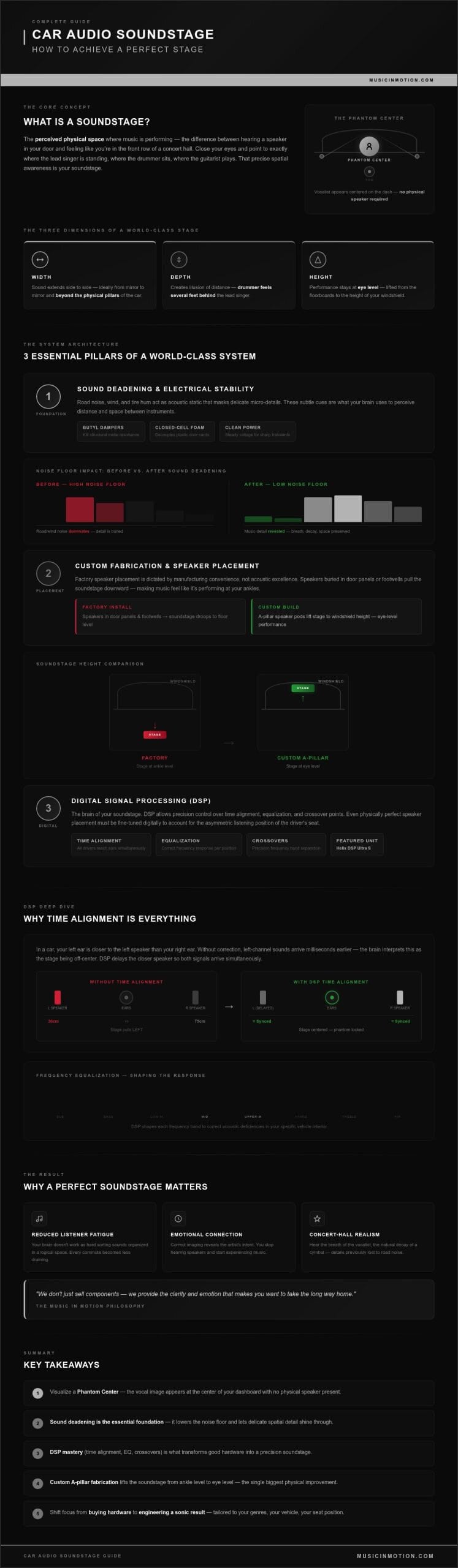
Understanding how to achieve a perfect car audio soundstage starts with the “Phantom Center.” This is the acoustic illusion where a vocalist’s voice appears to come from the center of your dashboard, even though there is no speaker there. Most factory vehicle audio systems fail at this because speaker placement is dictated by manufacturing convenience rather than acoustic excellence. Speakers buried in door panels or footwells pull the soundstage down, making the music feel like it’s coming from your ankles rather than a stage.
The Three Dimensions of Imaging
A world-class stage is built on three pillars: width, depth, and height. Width describes how sound extends from side to side, ideally reaching from mirror to mirror and even beyond the physical pillars of the car. Depth creates the illusion of distance, making it feel like the drummer is positioned several feet behind the lead singer. Finally, height ensures the performance stays at eye level. When planning how to achieve a perfect car audio soundstage, we treat these dimensions as a single cohesive unit. Without all three, your music feels flat and two-dimensional. We focus on lifting that drooping soundstage to ensure every note hits at the right vertical plane.
The Emotional Impact of a Perfect Stage
Why does this matter? It’s about the connection to the artist. When imaging is correct, it reduces listener fatigue. Your brain doesn’t have to work as hard to sort the sounds it’s hearing because they’re organized in a logical space. This creates a sense of realism that standard systems simply can’t match. You stop hearing speakers and start experiencing music. It’s a transformative shift that turns every commute into a private performance. We don’t just sell components; we provide the clarity and emotion that makes you want to take the long way home.
The Foundation: Sound Deadening and Electrical Stability
We often tell our clients that building an elite audio system is like building a house. You wouldn’t put a luxury roof on a crumbling foundation. In the world of high-end mobile electronics, that foundation is your vehicle’s physical environment and electrical health. If you want to know how to achieve a perfect car audio soundstage, you must first address the noise floor. Road noise, wind, and tire hum act as acoustic static that masks the delicate micro-details of a recording. These subtle cues are what your brain uses to perceive the distance and space between instruments. By installing high-quality damping materials, we lower this noise floor, allowing those spatial details to shine through.
Vibration damping is equally critical for a stable image. Without it, your thin metal door panels act as accidental speakers, vibrating out of phase with your actual drivers. This creates a muddy mess that destroys instrument separation. We recommend checking out our guide on Sound Deadening 101: Why Your Car Audio Needs It to see how we transform a noisy cabin into a controlled listening environment.
Lowering the Noise Floor
We use a multi-layer approach to silence the cabin and improve clarity. Butyl-based dampers kill the structural resonance of the metal, while closed-cell foam decouples the plastic door cards from the frame. This prevents mechanical rattles that can distract from the “Phantom Center” we discussed earlier. A quiet cabin doesn’t just make the music clearer; it allows you to enjoy higher detail at lower volumes. You’ll finally hear the breath of the vocalist and the natural decay of a cymbal that was previously lost to road noise.
Clean Voltage for Sonic Clarity
Your audio system is essentially modulated electricity. If your voltage fluctuates during a heavy bass hit, your amplifiers can’t reproduce the sharp transients needed for a crisp soundstage. This instability blurs the image and makes the performance feel flat. While understanding Digital Signal Processing fundamentals helps you tune the system, that processor needs a rock-steady power supply to function with precision. We prioritize high-output alternators and heavy-duty grounding to eliminate hiss and ensure your music remains dynamic.
Effective electrical stability often requires a few key steps:
- Upgrading the “Big Three” wiring to handle increased current demands.
- Using high-quality copper cabling to minimize resistance.
- Ensuring all grounds are secured to bare metal for maximum conductivity.
When your system has the power it needs, the soundstage becomes wider and more effortless. If you’re ready to build a system that never misses a beat, our team can design a custom electrical solution tailored to your specific vehicle’s needs.
Custom Fabrication: Optimizing Speaker Placement
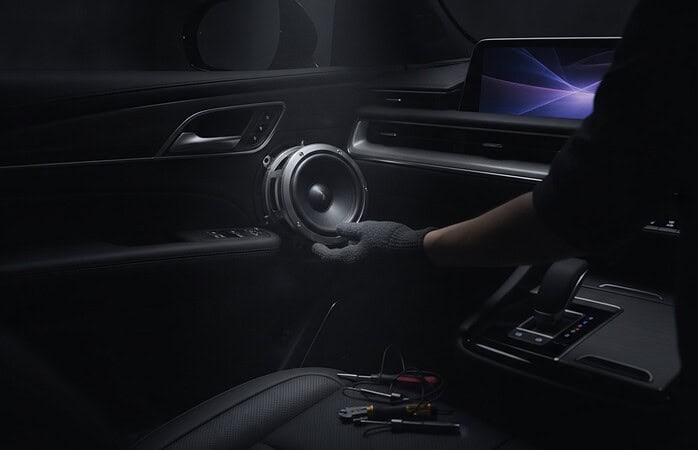
While many shops are content with “drop-in” upgrades, we view your vehicle’s interior as a blank canvas. Custom fabrication is our secret weapon because it allows us to place speakers where they sound best, not just where they fit. Factory door locations are almost always compromised; they’re designed for manufacturing ease, not for high-fidelity imaging. This is the primary hurdle in learning how to achieve a perfect car audio soundstage. By creating bespoke mounting solutions, we can control the angle and position of each driver with surgical precision, ensuring the music reaches your ears without interference from the car’s interior geometry.
The angle of your speakers, known as on-axis or off-axis placement, fundamentally changes your perception of height and clarity. On-axis placement points the speaker directly at the listener, providing maximum detail and a higher soundstage. Off-axis placement uses the cabin’s surfaces to disperse sound, which can sometimes help in narrow interiors. We explore these technical nuances in our deep dive on Custom Car Audio Fabrication: The Art and Science of Superior Sound. Our goal is to find the perfect balance for your specific vehicle, moving beyond the limitations of stock plastic grills.
Lifting the Stage with Custom A-Pillars
Moving your tweeters and mid-range drivers to custom A-pillar pods is one of the most effective ways to lift a “drooping” soundstage. By bringing these speakers closer to ear level, we eliminate the sensation that the band is performing at your feet. This placement also reduces early reflections from the side glass and dashboard that can smear the center image. We align these custom builds with industry standards in automotive audio to create a seamless acoustic transition between your high and mid-frequency drivers, resulting in a cohesive, lifelike performance.
Kick Panel Solutions for Depth
In some cabins, the floorboards actually offer a unique advantage: distance. Custom kick panel mounting can equalize path-length differences between the left and right speakers. Because the speakers are further away from your ears, the relative distance between them is more balanced. This creates a “Deep Dash” illusion, making it feel like the music is coming from beyond your windshield. When we determine how to achieve a perfect car audio soundstage for a client, we weigh the benefits of kick panels against A-pillars based on the specific width and depth of the vehicle’s cabin. This tailored approach ensures a result that is both technically superior and emotionally resonant.
Digital Signal Processing (DSP): The Brain of Your Soundstage
Once we have optimized your speaker placement and lowered the noise floor, we introduce the brain of the system. A Digital Signal Processor (DSP) is the essential tool for anyone wondering how to achieve a perfect car audio soundstage. Modern cabins are acoustic nightmares filled with glass and plastic. A high-end unit like the Helix DSP Ultra S, named the “Best Flagship SQ” DSP in April 2026, uses 32-bit/96kHz processing to clean up this mess. It allows us to control every aspect of the audio signal before it ever reaches your amplifiers. We use these tools to correct the inherent flaws of the vehicle’s interior, ensuring the music sounds as the artist intended.
The Magic of Time Alignment
Distance is the enemy of a perfect soundstage. Because the driver sits closer to the left speakers than the right, sound reaches your ears at different times. This destroys the center image. We solve this through time alignment. We measure the distance from each driver to your head and calculate delays in milliseconds. By delaying the closer speakers, we ensure every note arrives at your ears simultaneously. This process “snaps” the vocalist into a tight, focused position right in the center of your dashboard. It’s the most impactful setting we use to create a lifelike performance.
Phase and EQ Calibration
We also use the DSP to handle phase and equalization. If two speakers are out of phase, they fight each other and cancel out critical frequencies, especially in the mid-bass. This makes the system feel thin and weak. We use a Real-Time Analyzer (RTA) to visualize how sound interacts with your vehicle’s interior. Glass causes sharp frequency peaks that make music sound harsh. We smooth these out to create a response that is accurate yet musical. Tools like the miniDSP C-DSP 8×12 DL utilize Dirac Live auto-tuning to help reach this goal with extreme precision. The goal isn’t just a flat response; it’s a tune that feels natural and engaging.
Our “Table for One” philosophy means we tune the system specifically for the driver’s sweet spot. We also set precise crossovers for each driver. This ensures your tweeters aren’t strained by low notes and your mid-range speakers stay within their optimal operating range. This protects your investment while maximizing clarity. We don’t just sell equipment; we deliver a finished sonic result that transforms your commute. If you’re ready to hear your favorite tracks with absolute precision, contact us to schedule a DSP tuning session.
Achieving the Music In Motion Result
We believe that a high-performance audio system is a partnership between the technician and the listener. Our philosophy is simple: we don’t just sell speakers; we deliver a finished sonic result. While the hardware is important, it’s the professional integration and calibration that truly define the experience. Understanding how to achieve a perfect car audio soundstage requires a collaborative approach. We start by discussing your favorite music genres. A jazz enthusiast might want a pinpoint-accurate center image for a vocalist, while a rock fan might prefer a wider, more aggressive stage that mimics a live stadium. We tailor every build to these specific needs.
Our work spans a wide spectrum of possibilities. Some clients want a stealthy OEM integration that keeps the interior looking factory-fresh. Others want wild custom builds with visible fabrication and LED accents. Regardless of the aesthetic, the goal remains the same: high-fidelity sound that makes you forget you’re in a car. Professional tuning is the final 10% of the process, yet it makes 90% of the difference. It’s the step that bridges the gap between a collection of parts and a unified musical instrument.
Installation vs. Integration
Installation is the act of bolting gear into a car. Integration is making that gear part of the vehicle’s DNA. We use specialized tools like oscilloscopes and distortion detectors to ensure every signal is clean and every amplifier is set for safety and performance. This precision ensures your system is reliable for the long haul, not just the first week after you pick it up. We treat every wire and connection with the same level of care, ensuring the safety and functionality of your vehicle’s standard utility systems remain intact.
Next Steps for Your Build
Take a moment to audit your current system. Where do you hear the singer right now? If the sound feels disconnected or stuck in the door panels, it’s time to identify the weakest link in your signal chain. Whether you need a simple DSP addition or a full custom overhaul, we are here to guide the process. Ready to transform your drive? Connect with our team for a custom consultation and let’s discuss how to achieve a perfect car audio soundstage in your vehicle.
Take the Center Stage in Your Vehicle
Mastering your vehicle’s acoustics is a journey from simply hearing music to truly experiencing it. We’ve explored how a solid foundation of sound deadening combined with precision DSP tuning can lift your audio from the floorboards to eye level. By focusing on custom fabrication and correct time alignment, you now understand how to achieve a perfect car audio soundstage that feels like a front-row seat at a private concert. It’s about more than just hardware; it’s about the emotional connection to every note.
Since 1994, we’ve dedicated ourselves to the art of high-performance integration for land, sea, and air. Our team of master-level custom fabrication specialists doesn’t just install equipment; we engineer a finished result that respects the unique geometry of your cabin. Whether you’re looking for a subtle upgrade or a ground-up custom build, we have the expertise to make your vision a reality. We take pride in being a partner who pushes creative boundaries while maintaining the safety and functionality of your vehicle.
Experience the Music In Motion Difference—Schedule Your Custom Audio Consultation Today. Your favorite tracks deserve to be heard with the clarity and depth only a perfectly staged system can provide. We look forward to helping you transform your daily drive into an immersive musical event.
Frequently Asked Questions
Can I achieve a good soundstage with my factory radio?
You can absolutely maintain your factory radio while building a world-class soundstage. Most modern vehicles integrate essential vehicle controls into the head unit, making a full replacement difficult or undesirable. We use specialized DSPs designed for OEM integration to strip away factory equalization and provide a clean signal for your aftermarket amplifiers. This allows you to keep your dashboard’s original look while enjoying the precision required for a high-fidelity listening experience.
What is the difference between imaging and soundstage?
These terms are related but distinct. Soundstage refers to the perceived width, depth, and height of the performance area, essentially the “room” where the music lives. Imaging describes the specific placement of instruments and vocalists within that space. If the soundstage is the stage itself, imaging is the ability to point to exactly where the guitarist is standing. Both are essential when learning how to achieve a perfect car audio soundstage in any vehicle.
Do I need a subwoofer to have a good soundstage?
A subwoofer is vital for more than just heavy bass; it provides the low-frequency foundation that gives a soundstage its sense of scale. Many recordings contain subtle low-end cues that define the size of the recording environment. Without a well-integrated subwoofer, the soundstage can feel thin and detached. We focus on blending the subwoofer seamlessly with the front speakers so the bass appears to come from the dashboard rather than the trunk or hatch.
Why does my soundstage seem to move when I move my head?
This shift happens because your ears are moving in and out of the “sweet spot” created by time alignment. In a car, you are sitting off-center, meaning sound from the left and right speakers travels different distances. When we tune a system, we optimize it for a specific head position. Moving your head changes those path-lengths, causing the center image to pull toward the closer speaker. Precision tuning minimizes this effect for a more stable experience.
Is time alignment possible without a standalone DSP?
Some premium aftermarket head units include basic time alignment features, but they rarely offer the granular control of a standalone DSP. A dedicated processor allows for much finer adjustments, often down to 0.01-millisecond increments. It also provides independent equalization for every single speaker in the car. For those truly committed to how to achieve a perfect car audio soundstage, a standalone DSP remains the gold standard for professional-grade results and acoustic accuracy.
How long does it take to professionally tune a car audio system?
A professional tune typically takes between four and eight hours of dedicated bench time. We start by measuring the acoustic response of each speaker using a Real-Time Analyzer (RTA) before moving into time alignment and phase correction. This is a meticulous process of listening, measuring, and adjusting. Complex multi-channel systems or competition-level builds may require multiple sessions to ensure the final result meets our rigorous standards for clarity and impact.
Can I have a perfect soundstage for both the driver and the passenger?
Achieving a perfect center image for both seats simultaneously is incredibly difficult due to the physics of path-length differences. Most high-end systems utilize a “driver-centric” tune to provide one person with a flawless experience. However, we can create multiple presets in your DSP. This allows you to switch between a driver-optimized tune and a “center-fill” tune that provides a balanced, enjoyable listening experience for everyone in the vehicle without favoring one side over the other.