Swapping factory speakers for standard car audio gear will never solve your highway sound problems. If you’ve ever stripped the doors and roof off your rig, you already know the frustration: factory audio disintegrates into harsh distortion the moment you hit cruising speed. Wind rush and tire howl easily overpower stock equipment, leaving you with thin treble and nonexistent bass. Planning a true Jeep Wrangler sound system replacement requires a completely different approach than upgrading a conventional passenger vehicle.
In this guide, you will discover how to engineer an open-air audio system that delivers crystal-clear vocals, detailed highs, and punchy bass at 70 mph. We show you how to choose weather-resistant hardware that laughs off trail mud and unexpected downpours, all while retaining your factory touchscreen, steering controls, and trail cameras. From modern databus integration to specialized digital sound processing, here is everything you need to build clean, concert-level sound inside your Wrangler.
Key Takeaways
- Learn why open-air driving eliminates natural cabin bass gain and how high-efficiency amplification cuts through intense highway wind noise without clipping.
- Discover why a modern Jeep Wrangler sound system replacement prioritizes factory databus integration modules over replacing factory touchscreen displays.
- Identify rugged, marine-grade audio components engineered with true IP weather resistance to survive trail dust, driving rain, and routine washouts.
- Explore how targeted acoustic treatment in hollow soundbars and custom subwoofer enclosures restore deep, tactile low-end without consuming valuable cargo room.
- Compare the DIY installation path against specialized digital sound processor (DSP) acoustic calibration designed to balance sound staging for an open cockpit.
Why Factory Jeep Wrangler Sound Systems Fail in Open Air
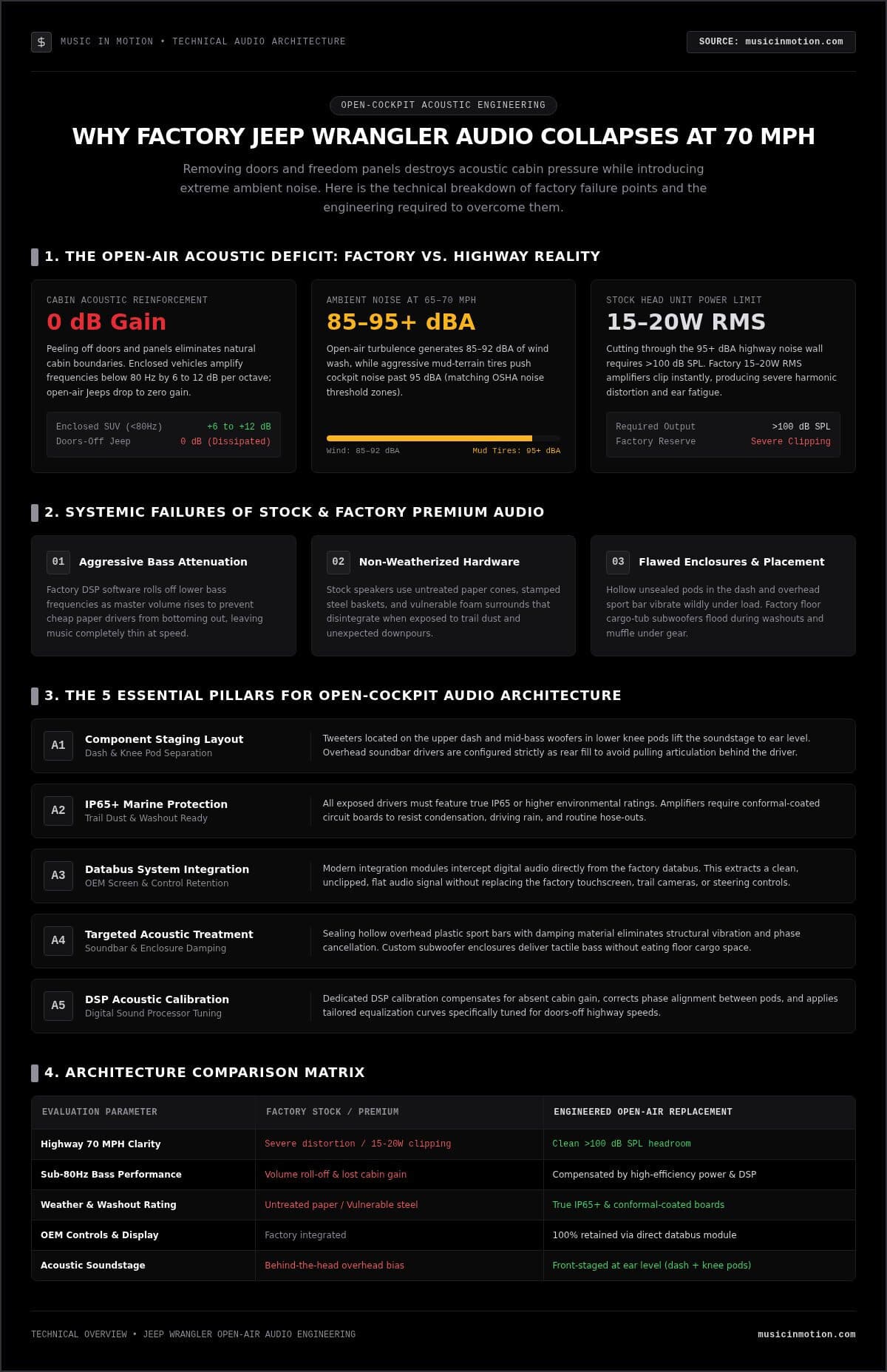
Jeep Wranglers offer unmatched freedom on the trail, but their factory audio systems collapse under real-world driving conditions. Conventional automotive sound relies on a sealed passenger compartment. In a normal sedan or SUV, acoustic boundaries reflect energy back toward your ears, naturally amplifying sub-bass frequencies below 80 Hz by 6 to 12 dB per octave through cabin gain. Across classic and modern Jeep Wrangler platform architectures, peeling off the doors and freedom panels drops that acoustic reinforcement to zero. Without an enclosed cabin to contain pressure waves, your music dissipates into open air, stripping away warmth and depth before reaching the driver’s seat.
To make matters worse, factory hardware is physically ill-equipped for open-cabin exposure. Stock speakers utilize thin paper cones, stamped steel baskets, and untreated foam surrounds. Trail dust penetrates voice coil gaps, while sudden rainstorms soak delicate paper fibers. In addition, stock speaker locations rely on hollow, unsealed plastic pods inside the dash and overhead sport bar. These lightweight plastic enclosures vibrate wildly under load, introducing hollow resonances and acoustic phase cancellation. Solving these structural failures requires a targeted Jeep Wrangler sound system replacement built for abusive outdoor environments.
The Open-Air Acoustic Dilemma: Wind, Tires, and Canvas
Open-air driving creates extreme ambient noise. At 65 to 70 mph with doors off, cabin turbulence reaches 85 to 92 dBA, and aggressive mud-terrain tires can easily push noise past 95 dBA. Cutting through that sonic wall requires a sound pressure level above 100 dB SPL. Factory head units, providing roughly 15 to 20 watts RMS per channel, run out of power almost immediately. Turning the volume dial up forces the internal amp into severe clipping, generating harsh harmonic distortion that destroys vocal clarity and fatigues your ears.
Limitations of Stock and Premium Factory Packages
Factory premium sound systems struggle just as hard. Even high-trim packages suffer from restricted amplifier power and built-in software limitations:
- Aggressive protective attenuation: Factory amplifiers employ digital volume-limiting curves that systematically roll off lower bass frequencies as master volume rises to keep cheap paper drivers from bottoming out.
- Lack of dynamic headroom: Small stock amplifiers lack the current reserves needed to reproduce sudden audio transients over open highway wind wash.
- Flawed subwoofer deployment: Rear floor cargo-tub subwoofers fill with water when drain plugs are pulled and muffle completely beneath trail gear.
Simply bolting a new pair of dash speakers to the factory wiring won’t fix these architectural limits. A complete Jeep Wrangler sound system replacement requires dedicated high-efficiency amplification and specialized acoustic calibration to perform in open air.
Essential Criteria for Choosing a Jeep Wrangler Audio Replacement
Most aftermarket shoppers fall into the trap of buying isolated components rather than designing a cohesive acoustic system. Upgrading a Jeep demands an intentional architecture where drivers, amplification, and signal processing operate in lockstep. Because open-cockpit driving matches the 85 to 90 dBA levels highlighted by OSHA noise exposure standards, your hardware needs the power and physical durability to perform under harsh outdoor conditions without failing. If you plan to retain your factory dashboard electronics, understanding how to configure a car audio upgrade for stock stereo layout will serve as your blueprint for success.
Component speaker architecture always outperforms generic coaxial replacements. Separating your high-frequency tweeters onto the upper dash while loading dedicated mid-bass woofers into the lower knee pods lifts the soundstage to ear level. Coaxial drivers in the overhead soundbar serve best as rear fill; relying on them as your primary audio source pulls the soundstage behind your head, muddying vocal articulation.
Marine-Grade Durability and Environmental Protection
Trail dust, mud splatter, and rainstorms quickly destroy standard paper-cone car speakers. A reliable Jeep Wrangler sound system replacement demands IP65 or higher environmental protection across all exposed interior components. Look for conformal-coated amplifier circuit boards that resist condensation, Santoprene rubber surrounds impervious to UV rot, and composite speaker cones that never absorb moisture. Sealed Deutsch or marine-spec terminal connectors are mandatory to prevent trail water from corroding vital connections.
Amplifier Power and Dynamic Headroom Requirements
Overcoming open-air noise requires genuine power, not deceptive peak ratings. Pay attention strictly to continuous RMS power ratings. You need at least 75 to 100 watts RMS per channel for your front and overhead speakers. Modern Class-D digital amplifiers are essential here: they offer up to 90% electrical efficiency, generating massive dynamic headroom while drawing minimal current from your vehicle’s alternator.
Digital Signal Processing (DSP) and Staging
Digital signal processing solves the unique geometry challenges of an open-air cabin. Upright windshield glass creates harsh early reflections, while asymmetrical seat positions ruin stereo imaging. A properly tuned DSP provides:
- Acoustic time alignment: Delays signals from closer speakers so soundwaves from all corners arrive at your ears simultaneously.
- Parametric equalization: Smooths out harsh windshield glare and boosts mid-bass frequencies prone to highway wash.
- Active crossover points: Directs low-end bass strictly to the subwoofer, keeping your mid-bass drivers and tweeters operating distortion-free.
If you prefer having experienced technicians balance this hardware staging for you, our team at Music In Motion designs custom installations built specifically for demanding open-air driving.
Wrangler Platform Architectures: TJ, JK, and JL/4xe Considerations
Every Jeep generation features distinct chassis wiring, acoustic spaces, and physical dash constraints. What works seamlessly on an older trail rig will trigger communication faults on a modern computerized platform. Designing an effective Jeep Wrangler sound system replacement requires matching your audio components directly to the electrical realities and interior packaging of your specific model generation.
Upgrading Heritage and Workhorse Models: TJ and JK Platforms
Heritage TJ builds (1997–2006) utilize simple 12-volt analog wiring, making traditional single-DIN receiver swaps straightforward. Front audio relies on 4×6-inch lower dash positions, which can be adapted to 5.25-inch drivers using aftermarket brackets, paired with 5.25-inch overhead soundbar speakers. JK models (2007–2018) introduced 6.5-inch sealed knee pods and overhead soundbars. Because aging TJ and JK electrical systems suffer from oxidized factory ground points, running dedicated heavy-gauge ground cables directly to the battery or chassis frame is mandatory before adding high-output amplifiers.
Modern JL and JT Gladiator Digital Bus Integration
Starting with the 2024 refresh and continuing through 2026, all JL and JT trims standardize on a horizontal 12.3-inch Uconnect 5 touchscreen. Aftermarket head units do not fit this dash design. Upgrading these modern platforms requires keeping the factory display and tapping into the CAN databus using a specialized T-harness interface (such as a PAC AmpPRO module). This approach delivers a clean, unclipped preamp signal while retaining:
- Factory safety chimes and backup sensors: Preserves essential alerts through the audio channels without harsh volume spikes.
- Off-road trail cameras and display telemetry: Retains high-definition video feeds and drivetrain angle data directly on the OEM screen.
- Steering wheel controls: Keeps audio volume, phone, and voice-command buttons fully functional.
- Active noise cancellation defeat: Disables factory cabin microphones that would otherwise inject artificial low-frequency hum into high-power aftermarket amplifiers.
Special Considerations for Wrangler 4xe Hybrid Systems
The plug-in hybrid 4xe introduces unique spatial and electrical limits. Its 17-kWh high-voltage traction pack sits directly under the rear passenger seats, eliminating the floor cavities where under-seat amplifiers and enclosures typically go. Power comes from an onboard DC-DC converter rated around 200A to 220A rather than a traditional mechanical alternator. To avoid throwing low-voltage fault codes or dashboard warnings, keep aftermarket continuous current draws under 80A to 100A. Following strict installation standards, such as those established by the Mobile Electronics Certified Professional (MECP) program, ensures high-current 12V power leads remain physically isolated from the 4xe’s orange high-voltage hybrid cables.
Navigating these complex electrical systems ensures your Jeep Wrangler sound system replacement delivers pristine acoustics without compromising factory safety systems or hybrid vehicle reliability.
Acoustic Treatment and Custom Subwoofer Solutions for Jeeps
High-powered speakers and amplifiers only solve half of the open-air audio equation. Without mechanical acoustic treatment, increased acoustic energy simply vibrates the Jeep’s uninsulated sheet metal and hollow composite panels. To get the punchy bass response you want from a Jeep Wrangler sound system replacement, follow a structured physical dampening and enclosure workflow:
- Apply targeted butyl damping: Bond constrained-layer butyl damping directly to thin floor pans and the inner tailgate skin to stop structural panel ringing.
- Insulate hollow overhead cavities: Line the overhead sport bar and hardtop recesses with closed-cell acoustic foam to absorb airborne flutter and reduce summer heat transfer.
- Select an outdoor-ready enclosure: Choose a rugged enclosure engineered with weather-resistant composites that withstand moisture, trail mud, and cargo shifting.
- Anchor mounting hardware directly to structural steel: Secure the subwoofer mounting brackets directly to factory seat studs or tub tie-down points to handle severe trail articulation without flexing.
Applying advanced custom car audio fabrication techniques lets you mold fiberglass enclosures directly around interior contours, locking in precise internal air volume without surrendering valuable rear trunk storage.
Taming Structural Resonance: Sound Deadening the Cabin
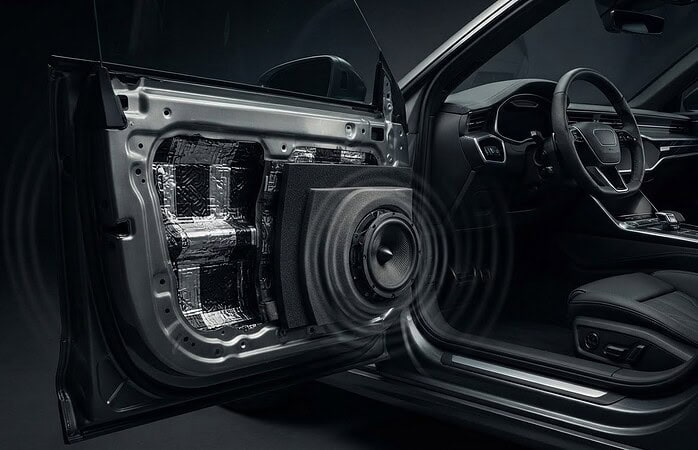
Sheet metal floor pans, doors, and tailgate panels act like acoustic drums under high sound pressure levels. Constrained-layer damping sheets bond an aluminum constraint layer over viscoelastic butyl, converting mechanical vibration into low-level thermal energy. Adding pre-cut thermal foam headliner panels to the fiberglass hardtop can also drop cabin heat while knocking down 3 to 6 dB of ambient road hiss at highway speeds.
Tailgate, Under-Seat, and Custom Subwoofer Enclosures
Wrangler owners cannot afford to sacrifice cargo space to oversized rectangular carpet boxes. Pre-molded side wheel-well enclosures utilize previously wasted corner pockets behind the rear wheel tubs, delivering clean bass while keeping the flat load floor completely open. Tailgate-mounted enclosures bolt directly to the rear swing-gate, aiming bass energy into the open passenger space. For open-top security, rugged down-firing steel enclosures positioned under the front passenger seat isolate the subwoofer driver from trail mud, foot traffic, and prying eyes.
Ready to restore deep, visceral low end to your rig? Explore our tailor-made custom subwoofer enclosures and installations to build the ultimate open-cockpit soundstage.
Planning Your Jeep Wrangler Audio Replacement: Professional vs. DIY
Deciding between a weekend garage project and a professional build comes down to how deeply you want to tear into your Jeep. Swapping overhead soundbar speakers takes less than an hour with hand tools. However, executing a complete Jeep Wrangler sound system replacement with multi-channel amplification and digital processing requires navigating sensitive vehicle data buses, high-current power runs, and hidden dash hardware. Here is how to evaluate the two paths:
- DIY Friendly: Simple coaxial soundbar swaps, basic plug-and-play speaker brackets, and single-DIN receiver retrofits on older TJ models.
- Professional Recommended: Full-system DSP acoustic calibration, CAN-bus integration modules, high-amperage power distribution, custom fiberglass enclosures, and 4xe hybrid power isolation.
Evaluating the Complexity of Modern Wrangler Audio Upgrades
Modern Wranglers present steep installation hurdles. Accessing the driver-side lower knee pods requires stripping large portions of the lower dash, instrument cluster trim, and steering column shroud, turning what looks like a simple speaker swap into a multi-hour teardown. Running heavy 4-gauge power wire through crowded firewall grommets creates real risks of nicking factory wiring bundles or breaching water seals. A pinched rubber boot or improperly routed wire can easily invite persistent water leaks during your next deep water crossing.
The Value of Specialized Audio Engineering and Tuning
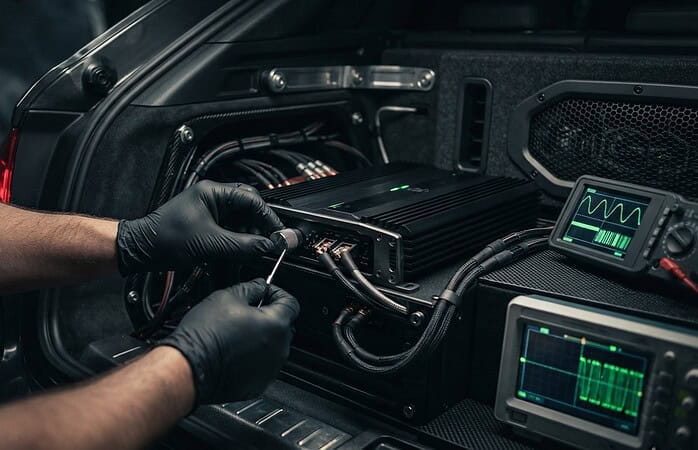
Precision calibration separates mediocre volume from an exceptional open-air experience. We utilize calibrated real-time analyzers (RTA) and measurement microphones at the driver headrest to dial in parametric EQ filters, precise time delays, and active crossover slopes. Beyond acoustic tuning, professional builds emphasize mechanical longevity on rough trails: soldered connections, sealed marine-grade heat shrink, and custom-fabricated mounting brackets that keep heavy electronics secured during extreme axle articulation.
Building Your Complete Off-Road Electronics Package
A ground-up sound overhaul provides the ideal opportunity to integrate advanced vehicle safety systems and trail accessories. While the interior trim is removed, you can seamlessly add dash cameras, blind spot monitoring, backup sensors, and auxiliary switches for trail lighting without cluttering the cabin with exposed wiring. Ready to build an open-air audio experience that holds up to any trail? Explore custom high-performance audio options with Music In Motion.
Transform Your Open-Air Driving Experience
Conquering wind noise and trail turbulence takes more than swapping factory speakers. Building a true open-air concert experience demands an intentional approach: marine-grade durability to withstand mud and rainstorms, multi-channel Class-D amplification for massive dynamic headroom, and precision digital signal processing to anchor your front soundstage. Paired with structural damping and custom-molded enclosures, a well-engineered Jeep Wrangler sound system replacement brings deep low end and crystal-clear vocals back to your highway drive.
With over three decades of custom fabrication and mobile electronics experience, our team knows how to design durable, high-performance systems for demanding off-road and open-cockpit environments nationwide. We engineer every system to protect your factory safety sensors, trail cameras, and vehicle data buses while delivering uncompromising acoustic clarity. You don’t have to settle for weak, distorted audio every time you pull off the doors and roof. Ready to hear your music the way it was meant to be experienced? Upgrade your Jeep Wrangler sound system with the specialists at Music In Motion and make every open-air mile unforgettable.
Frequently Asked Questions
Can I replace my Jeep Wrangler sound system while keeping the factory touchscreen?
Yes, you can execute a full sound upgrade while retaining your factory touchscreen display. Modern vehicle interfaces tap directly into the factory CAN databus before internal factory equalization takes place. This clean integration preserves your factory steering wheel controls, backup cameras, off-road telemetry displays, and safety chimes while supplying an unclipped preamp signal to your aftermarket amplifiers and digital signal processors.
Do I need marine-grade speakers for a Jeep Wrangler if I drive with the top off?
Yes, marine-grade or IP-rated weather-resistant speakers are essential if you frequently drive with the doors and roof removed. Standard automotive speakers use paper cones and untreated foam surrounds that quickly disintegrate from rainstorms, morning dew, and trail dust. Marine-certified drivers feature composite cones, Santoprene rubber surrounds, and sealed motor structures designed to handle direct water spray and mud without failing.
How much amplifier power is needed to hear music clearly at 70 mph with doors off?
You need at least 75 to 100 watts RMS per channel for your main speakers to cut through open-air highway wind roar cleanly. Because highway cockpit noise levels regularly reach 85 to 92 dBA, low-power factory radios clip heavily when pushed. Dedicated high-efficiency Class-D amplification delivers the dynamic headroom required to reproduce crisp vocals and sharp dynamics above tire howl without distortion.
Will upgrading the sound system on a Wrangler 4xe void the hybrid battery warranty?
No, upgrading your audio system does not void your 4xe factory warranty as long as the equipment is installed correctly. Aftermarket audio components connect strictly to the auxiliary 12-volt battery system, never tapping into the high-voltage hybrid traction pack. Keeping continuous amplifier current draw under 80 to 100 amps ensures you stay well within the operating limits of the onboard DC-DC converter.
What is the best subwoofer location for a Jeep Wrangler that does not take up cargo space?
Custom-molded tailgate enclosures and contoured rear wheel-well stealth boxes are the best solutions for preserving rear cargo volume. Tailgate boxes bolt directly to the rear swing-gate, projecting deep bass into the open cabin while leaving the flat floor clear. Alternatively, down-firing steel enclosures mounted securely beneath the front passenger seat offer theft-resistant protection from mud, foot traffic, and open weather.
Why do my aftermarket speakers sound thin and lack bass inside my Jeep?
Aftermarket speakers sound thin primarily because removing the doors and roof eliminates cabin gain, dropping low-frequency reinforcement by up to 15 dB. Unsealed, vibrating plastic pods in the dash and roll bar also create phase cancellation. A comprehensive Jeep Wrangler sound system replacement fixes this by adding butyl vibration damping, digital signal processing, and a dedicated powered subwoofer to restore lost bass energy.
Can I install aftermarket amplifiers and subwoofers without draining my Jeep battery?
Yes, properly installed aftermarket audio systems will not drain your vehicle battery. Efficient Class-D amplifiers draw significant current only during loud dynamic peaks while the vehicle is running. Using proper remote turn-on trigger leads ensures amplifiers power down completely the instant you turn off the ignition, preventing parasitic electrical draw from flattening your 12-volt battery between weekend trail rides.