What if the biggest obstacle to your car’s sound quality isn’t the speakers themselves, but the very screen you use to control them? In 2026, your factory head unit is much more than a radio; it’s a complex command center tied into your safety sensors and vehicle settings. We understand the hesitation that comes with upgrading factory car speakers. You want that crisp, concert-quality impact, but you’re worried about losing your integrated alerts or triggering a dashboard full of error codes. It’s a common frustration that often leaves drivers settled for muffled, uninspired audio.
We agree that you shouldn’t have to choose between modern convenience and premium audio performance. This guide promises to show you how to achieve a high-fidelity transformation while keeping your factory features 100% intact. We’ll explore the essential role of Digital Signal Processors and professional tuning in correcting factory signal limitations. We’re also looking at stealth installation techniques and custom enclosures that preserve your interior aesthetics while delivering massive bass. You’ll discover how we bridge the gap between technical precision and the pure joy of being behind the wheel, focusing on a finished result that sounds as good as it looks.
Key Takeaways
- Retain your vehicle’s integrated safety alerts and resale value by keeping the factory head unit while still achieving premium sound.
- Learn how Digital Signal Processing corrects the “factory EQ” problem, removing the muddy tones that often plague stock audio systems.
- See why upgrading factory car speakers requires a specific focus on high-efficiency components to get the best performance from your original radio.
- Discover the benefits of custom subwoofer enclosures that provide deep, powerful bass without cluttering your interior or sacrificing utility.
- Understand the critical role of professional RTA tuning in transforming a simple installation into a fully integrated, concert-quality experience.
Why Keeping Your Factory Head Unit is the Smart Move in 2026
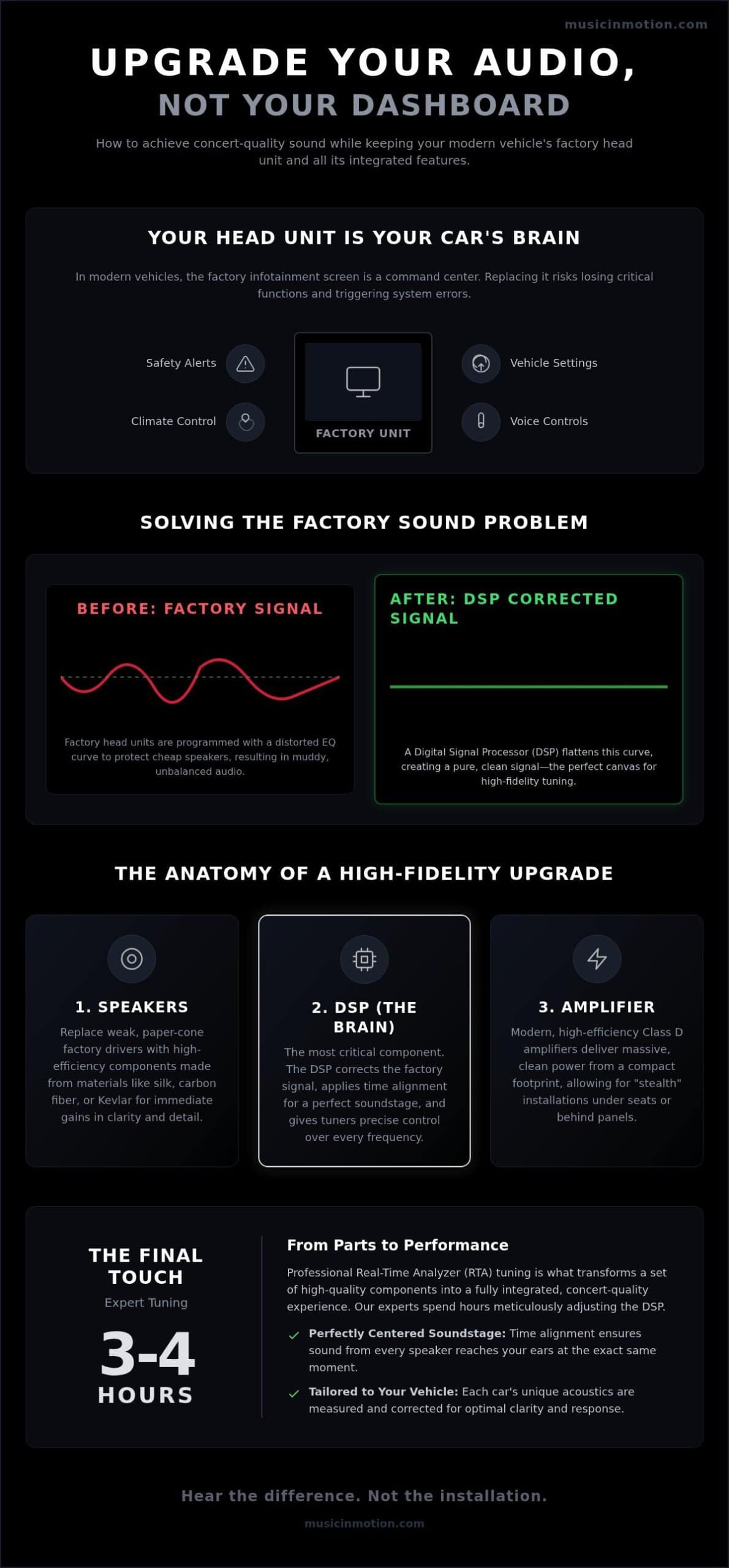
In 2026, your vehicle’s dashboard is far more than a place to mount a radio. It’s a sophisticated command center where the head unit acts as the primary processor for the entire cabin. We’ve seen how modern architectures integrate everything from climate control and tire pressure monitoring to complex engine diagnostics directly into the infotainment screen. Removing this “brain” to gain better sound often results in a cascade of electronic headaches. By keeping the factory interface, we ensure that your car remains as smart and functional as the day it left the showroom.
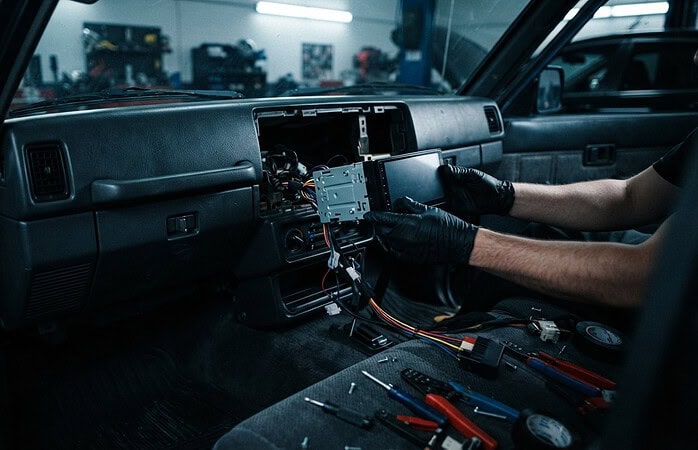
Retaining the original radio is the most reliable way to avoid triggering CAN-bus errors or frustrating dashboard warning lights. Many owners find that upgrading factory car speakers provides the sonic clarity they crave without the risks associated with invasive hardware swaps. This approach preserves your steering wheel controls and factory voice assistants, keeping your hands on the wheel and your focus on the road. It’s a solution-oriented strategy that prioritizes the long-term health and resale value of your vehicle.
The Integration Factor: More Than Just Music
Your car’s audio path is now a critical safety component. Features like parking sensors, lane-departure warnings, and blind-spot alerts often route their chimes through the factory speakers. If you bypass or replace the head unit incorrectly, you might lose these vital signals. We focus on professional integration because 2026 vehicle architectures use high-speed data networks that don’t take kindly to missing components. We use advanced modules to tap into the clean signal before it reaches the factory amp, ensuring every safety feature and vehicle-specific setting remains fully operational.
Preserving the OEM Aesthetic
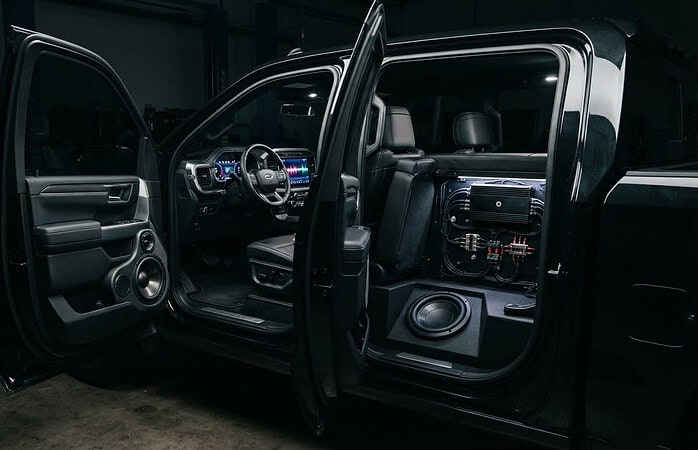
Let’s be honest: even the best aftermarket dash kits rarely match the exact texture, color, and fit of a premium factory finish. High-end vehicle owners choose stealth installations because they want the performance of a high-end system without cluttering the interior’s design. When upgrading factory car speakers, we can hide powerful amplifiers and signal processors behind factory panels. This keeps your cabin looking “factory-fresh” while delivering the sensory experience of a live concert. We believe the best custom work is the kind you can hear but never see.
The Technical Trio: Speakers, Amplification, and DSP
Achieving a high-fidelity listening experience requires more than just swapping out parts. It requires a balanced ecosystem where every component plays its role perfectly. While many enthusiasts focus solely on hardware, true audio performance comes from the synergy between high-efficiency speakers, clean amplification, and precise signal processing. We don’t just sell boxes; we design integrated solutions that work with your vehicle’s specific acoustics to deliver a finished result that exceeds expectations.
Upgrading Speakers for Immediate Clarity
The journey often begins with upgrading factory car speakers. Most manufacturers use inexpensive paper-cone drivers that produce muddy, muffled sound. We replace these with premium materials like silk for smooth highs, or carbon fiber and Kevlar for rigid, responsive mid-bass. Whether we use component sets to separate the tweeter and woofer or coaxial speakers for simpler locations, we always match the impedance to your factory system. This prevents your vehicle’s electronics from entering protection mode and ensures every watt of power is used effectively.
The Essential Role of the Digital Signal Processor (DSP)
In 2026, the DSP is the most critical link in the chain. Factory head units are programmed with “baked-in” EQ curves designed to protect cheap speakers, which often results in a thin, tinny sound at high volumes. A DSP allows us to perform de-equalization, flattening that signal so we can start with a blank canvas. We then use time alignment to ensure sound from every speaker reaches your ears at the exact same moment, centering the soundstage perfectly on the driver’s seat. This professional tuning process, which typically takes our experts 3 to 4 hours to perfect, ensures your system sounds like a live performance rather than a recording.
Modern Amplifier Solutions for Stealth Power
Modern vehicles have limited space, making bulky hardware a thing of the past. We utilize high-efficiency Class D technology to provide massive power from a footprint small enough to hide under a seat or behind a dash panel. Many of our favorite solutions are integrated DSP-amplifiers, which combine processing and power into a single, space-saving chassis. A modern amplifier provides the dynamic headroom factory systems lack by delivering clean, instantaneous power that prevents distortion during musical peaks. This ensures that even at higher volumes, your music remains effortless and crystal clear. If you are ready to hear the difference that professional calibration makes, we invite you to explore our custom installation services to see how we can transform your daily drive.
Solving the ‘Factory EQ’ Problem and Environmental Noise
Many drivers notice that their music sounds thin or “tinny” as they turn the volume up. This isn’t just a limitation of the hardware; it’s a programmed safety feature known as bass roll-off. Manufacturers design factory head units to automatically reduce low-end frequencies at higher volumes to prevent cheap, paper-cone speakers from distorting or blowing out. When upgrading factory car speakers, simply adding more power isn’t enough. We must address the “baked-in” signal processing to ensure your new high-performance drivers receive a full, natural range of sound.
We solve this by moving beyond basic Line Output Converters (LOCs) in favor of advanced integration modules. While a simple LOC taps into a speaker wire to get a signal, an integration module communicates directly with the vehicle’s data network. This is especially important for vehicles equipped with Active Noise Cancellation (ANC). If you add a subwoofer without properly managing the ANC microphones, the system may interpret your music as unwanted noise and attempt to “cancel” it, resulting in a frustrating low-frequency drone. Our solution-oriented approach ensures that every safety chime and noise-management feature continues to work in harmony with your new audio gear.
Advanced Signal Summing and Restoration
Modern 2026 vehicle architectures often split the audio signal into several different channels before they ever reach the doors. A factory amplifier might send only high frequencies to the dash and only mid-range to the doors. To create a high-fidelity feed for your new system, we use signal summing to combine these separate streams back into one full-range signal. We also utilize load-sensing adapters to prevent the vehicle’s computer from triggering “speaker disconnected” error codes. This technical precision allows us to restore the low-end frequencies that the factory originally filtered out, providing the foundation for a truly impactful listening experience.
Environmental Control: Sound Deadening
Even the most expensive speakers struggle to perform in a noisy environment. The “noise floor” is the ambient sound level created by your tires, wind, and engine. If your road noise is high, it masks the subtle details of your music. This is why sound deadening is the most overlooked car audio upgrade for stock stereo systems. By applying vibration damping materials to the inner door skins, we eliminate the rattles and resonances caused by powerful new mid-bass drivers. Lowering the noise floor allows your speakers to shine, delivering a level of clarity that makes every drive feel like a private concert. We focus on these “silent” upgrades because they are the difference between a loud system and a truly great one.
A Phased Roadmap for Your Audio Evolution
We view a high-performance audio system as an evolution rather than a simple transaction. You don’t have to overhaul your entire vehicle in a single visit to experience a massive leap in sound quality. By following a steady, logical roadmap, we help you build a system that grows with your needs while ensuring every new piece of hardware integrates perfectly with your factory electronics. This approach prioritizes a finished result that feels like a natural extension of your car rather than an afterthought.
- Phase 1: The Foundation. upgrading factory car speakers and applying sound deadening to create a clean, resonant-free environment.
- Phase 2: The Low End. Adding a custom subwoofer enclosure and a dedicated mono amplifier to provide the physical impact factory systems lack.
- Phase 3: Total Control. Integrating a multi-channel amplifier and a DSP to manage signal routing and power for the entire cabin.
- Phase 4: Calibration. Final professional acoustic tuning to correct for cabin-specific peaks and dips.
Prioritizing the Upgrade Path
Many of our clients find that starting with Phase 1 offers the most immediate return on investment. Replacing those factory paper cones with high-efficiency drivers brings instant clarity to your music. When you eventually move to Phase 2, the addition of a subwoofer does more than just add bass. It actually improves the performance of your door speakers by allowing them to focus on the mid-range frequencies they handle best. This step-by-step process ensures you never pay for performance you can’t hear. If you want to see what’s possible for your specific vehicle, schedule a system design session with our specialists today.
Custom Fabrication for Stealth Integration
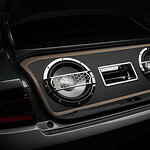
We believe you shouldn’t have to sacrifice your trunk space or cargo utility for better sound. Using advanced car audio fabrication techniques, we can build custom enclosures that disappear into spare tire wells or side utility pockets. We also specialize in creating custom tweeter pods and mounting plates that mirror your factory textures and finishes. This preserves your interior aesthetics while providing the rigid mounting surfaces that high-performance drivers require. Whether you drive a luxury sedan or a rugged SUV, upgrading factory car speakers through our stealth methods ensures your vehicle remains as practical as it is musical.
Achieving Audiophile Results with Professional Integration
We believe the difference between a system that is simply “installed” and one that is “professionally integrated” is the difference between noise and music. Many shops can bolt a speaker into a door or wire an amplifier to a battery. However, upgrading factory car speakers in a way that respects the vehicle’s complex 2026 electronics requires a significantly higher level of care. We focus on long-term reliability by using high-quality wiring, fused protection, and secure mounting points. This ensures your investment is safe and your car’s electrical system remains stable for years to come. Our goal is to provide a finished result that feels like a factory-ordered premium option, only better.
The Art of the Calibration
Even the most expensive hardware sounds poor without proper setup. We use Real-Time Analyzers (RTA) to visualize how sound behaves inside your specific cabin. Every interior has unique acoustic peaks and dips caused by glass reflections, upholstery absorption, and plastic resonances. We fine-tune crossovers to ensure every driver operates within its optimal frequency range. According to industry standards, a complete manual DSP tune by a professional takes approximately 3 to 4 hours to perfect. This meticulous process allows us to calibrate the soundstage for your exact ear position, creating a perfect “center image” that makes it feel like the band is performing right on your dashboard.
Your Partner in Mobile Electronics
We are dedicated to delivering a finished result rather than just a hardware transaction. As vehicles become more complex, our solution-oriented approach keeps you ahead of technical hurdles like factory EQ curves and signal summing. We treat your car with the same respect we show our own, ensuring every wire is neatly loomed and every component is hidden from view. We take pride in our growth as specialists who can handle everything from luxury sedans to rugged off-roaders. If you are ready to transform your daily commute into a high-fidelity sensory experience, contact Music In Motion to design your custom upgrade. We look forward to showing you how upgrading factory car speakers can completely change the way you feel behind the wheel.
Transform Your Daily Drive with Professional Integration
You don’t have to sacrifice your vehicle’s modern safety features or original dashboard aesthetics to enjoy a high-fidelity listening experience. We’ve shown how a strategic approach focusing on digital signal processing and clean amplification can overcome the limitations of any factory radio. By following a phased roadmap, upgrading factory car speakers becomes a rewarding evolution that fits your budget and your lifestyle. We focus on the synergy between hardware and environment, ensuring that every note is crisp and every beat is impactful.
Our team brings decades of experience to every project, specializing in the complex vehicle electronics found in 2026 models. We pride ourselves on custom fabrication and stealth integration techniques that provide high-performance results without cluttering your cabin. We’re here to be your partner in customization, moving beyond simple hardware sales to deliver a finished result you’ll love every time you start the engine. Ready to transform your drive? Consult with the experts at Music In Motion today. We look forward to helping you rediscover your favorite music on the open road.
Frequently Asked Questions
Can I upgrade my speakers without adding an amplifier?
Yes, you can certainly start by upgrading factory car speakers with high-efficiency aftermarket drivers. These components are designed to produce more sound with less power, making them a great match for the limited output of a stock radio. However, you won’t experience their full dynamic range until you add clean, external power. We recommend choosing speakers with a high sensitivity rating to ensure they don’t sound quieter than your originals.
Will adding an aftermarket amplifier drain my car battery?
A properly installed amplifier won’t drain your battery during normal operation. Modern Class D amplifiers are incredibly efficient and only draw significant current when you’re actually playing music at high volumes. We use dedicated power wiring and ignition-sensing turn-on leads to ensure the system shuts down completely when the vehicle is off. For high-output systems, we may suggest a battery upgrade to maintain consistent voltage for your vehicle’s electronics.
What is a DSP and is it really necessary for a factory radio?
A Digital Signal Processor (DSP) is a specialized computer that corrects the audio signal before it reaches your speakers. It’s essential because factory head units are tuned with “baked-in” EQ curves that make premium speakers sound unbalanced. We use the DSP to handle time alignment, equalization, and crossovers. This ensures that every driver in the cabin works in harmony to create a clear, centered soundstage that mimics a live performance.
How do I fix the bass roll-off that happens at high volumes?
We fix bass roll-off by using advanced integration modules or a DSP with signal restoration features. Factory radios often cut low-end frequencies as you turn up the volume to protect cheap speakers from damage. Our solution-oriented approach involves “summing” the factory signals and using processing to add those missing frequencies back in. This provides a consistent, powerful low-end response regardless of how high you set the volume dial.
Will an aftermarket audio upgrade void my vehicle’s factory warranty?
No, upgrading factory car speakers or adding an amplifier does not automatically void your vehicle’s warranty. Under the Magnuson-Moss Warranty Act, a manufacturer cannot deny a warranty claim unless they can prove the aftermarket part actually caused the failure. We prioritize safety by using vehicle-specific harnesses and non-invasive integration techniques. This ensures your vehicle’s factory systems remain untouched and your warranty protections stay fully intact.
Can I still use my steering wheel buttons and voice controls?
You will retain full use of your steering wheel buttons, voice controls, and hands-free calling features. Because we keep your factory head unit as the “brain” of the system, all of your existing interface settings remain functional. We use specialized integration interfaces that translate these signals to your new amplifiers and processors. This allows you to enjoy high-end sound quality without changing the way you interact with your vehicle’s dashboard.
What is the best way to add a subwoofer to a factory system?
The best approach is using a custom subwoofer enclosure designed specifically for your vehicle’s trunk or cargo area. We tap into the factory signal using a high-quality integration module to ensure the subwoofer receives a clean, full-range feed. This method preserves your interior space while providing the deep, physical impact that factory systems can’t replicate. Our custom fabrication ensures the enclosure looks like it belongs in your vehicle from the factory.
How much of a difference does sound deadening actually make for sound quality?
Sound deadening makes a massive difference by lowering your vehicle’s “noise floor.” It reduces road, wind, and engine noise that would otherwise drown out the subtle details in your music. By applying vibration damping to the door panels, we stop the metal from rattling when your new speakers play deep mid-bass notes. This simple addition transforms a loud system into a truly high-fidelity one, making your cabin feel much more solid and quiet.