Did you know that your high-end radar detector is virtually useless against a police officer using a modern LiDAR gun? By the time your detector lets out a beep, the officer already has a precise reading of your speed. We understand the frustration of seeing those red lights in the rearview mirror when you thought you were protected. It’s a common worry for drivers who want to enjoy their vehicle without the constant threat of expensive tickets or bulky equipment cluttering the dashboard.
In this guide, you’ll learn how a professional laser defense system for cars provides the active countermeasures you need to stay protected in 2026. We’ll show you how these systems neutralize advanced LiDAR signals, like the DragonEye, and why a stealthy, integrated installation is the secret to total peace of mind. We’re going to break down the latest technology from brands like AL Priority and Escort, explain the current legal landscape, and demonstrate how our team delivers a finished result that looks like it came straight from the factory.
Key Takeaways
- Understand why traditional radar detectors often miss LiDAR signals and how active countermeasures provide the protection you actually need.
- Discover how a modern laser defense system for cars uses infrared transceivers to shift police signals, giving you the time to react safely.
- Learn why pairing a laser system with a radar detector creates a multi-layered defense strategy for total coverage on any road.
- Identify the key components that make a system effective, including discreet sensor heads and powerful central processing units.
- Explore how our professional, stealth installation ensures your equipment is hidden while maintaining peak performance and factory aesthetics.
What is a Laser Defense System for Cars?
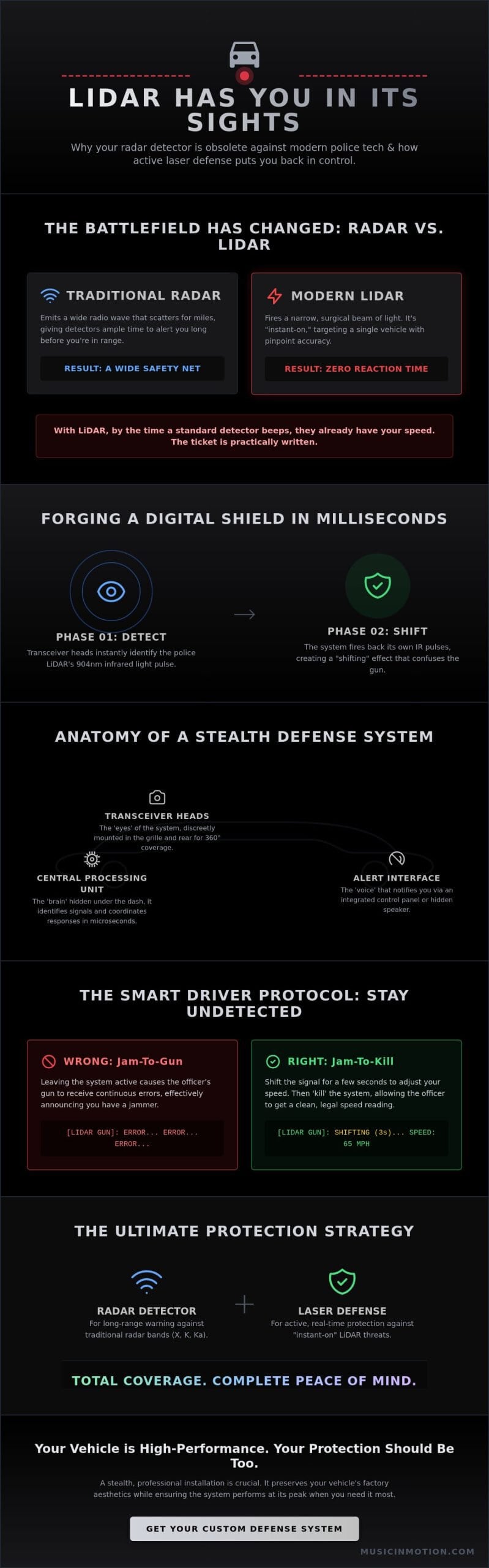
A laser defense system for cars is an active countermeasure designed to protect you from LiDAR speed enforcement. Unlike a traditional radar detector that simply listens for radio waves, these systems use high-speed transceivers to detect and respond to infrared light pulses. We often describe the difference as passive versus active. A radar detector is passive; it’s a warning device that alerts you to a signal. A laser defense system is active; it’s a sophisticated tool that manages the interaction between your vehicle and the police gun. It creates a window of time for you to check your speed and react safely.
LiDAR vs. Radar: Why the Difference Matters
The shift in law enforcement technology has changed the game for drivers across the country. Radar guns emit a wide beam that spreads out over distance. This allows a quality detector to pick up “scatter” from cars far ahead of you, giving you miles of warning. LiDAR is different. It uses a narrow, surgical beam of light that is only a few feet wide even at long distances. This Lidar traffic enforcement is effectively “instant-on.” If your vehicle isn’t equipped with an active laser defense system for cars, the officer has a speed reading the moment your detector alerts you. There is no time to adjust; the measurement is finished before you can even move your foot to the brake.
The Evolution of Traffic Defense in 2026
Modern enforcement has become incredibly sophisticated. We now see police using variable pulse-rate (VPR) guns like the DragonEye. These are specifically designed to defeat older, basic jammers. Because of this, a modern laser defense system for cars must be more than just hardware. It needs to be a software-driven platform. We focus on systems that allow for regular firmware updates. This ensures your defense stays current against the latest police gun technology as it evolves. Our team prioritizes these “smart” systems because they offer the reliability our customers expect.
An effective system relies on three core components to keep you protected:
- Transceiver Heads: These are the “eyes” of the system. We mount them discreetly in the front grille or near the rear license plate to provide total coverage.
- Central Processing Unit (CPU): This is the “brain” hidden under your dash. It identifies the incoming signal and coordinates an immediate, millisecond-perfect response.
- Alert Interface: This can be a small control panel, a hidden speaker, or even an integration into your existing vehicle displays. It notifies you the moment a signal is detected and shifted.
You might hear these devices called “laser jammers” or “laser shifters.” While the terms are often used interchangeably, high-end manufacturers like Escort prefer “shifter” to describe how the system “shifts” the timing of light pulses to prevent a speed reading. Regardless of the name, the goal is the same. We provide a reliable, stealthy solution that gives you total peace of mind behind the wheel.
How Modern Laser Jammers and Shifters Work
We often get asked how these systems actually hide a car from a laser gun. It isn’t magic; it’s high-speed physics. A laser defense system for cars operates in two distinct phases that happen faster than a human can blink. First, the transceiver heads mounted on your car monitor the road for specific infrared light pulses. Police LiDAR guns typically operate on a 904nm wavelength. When these sensors see that specific light pattern, they alert the system’s brain immediately. Once the threat is identified, the system moves into the shifting phase. It fires back its own infrared pulses. These aren’t just random light; they’re timed to mimic the gun’s own signal but with a slight, calculated delay. This confuses the gun, preventing it from calculating a distance and speed.
The Science of Signal Shifting
Traffic enforcement tools rely on the 904nm frequency because it’s invisible to the naked eye. Signal shifting is the process of returning a modified light pulse to the source. By sending back a perfectly timed response, the system effectively creates a digital shield around your vehicle. This process is incredibly precise. It requires hardware that can process data in microseconds to be effective against modern enforcement.
We always educate our clients on proper driver protocol. Jam to Gun (JTG) means the system stays active until you pass the officer. This is usually a mistake. It can tip off the officer that you have a jammer when their gun keeps reading an error code. We recommend Jam to Kill (JTK). With JTK, the system shifts the signal for a few seconds. You slow down to the limit and then kill the system. This allows the officer to get a clean, legal reading of your speed. It maintains your stealth profile and avoids unwanted attention.
Defeating Advanced LiDAR: DragonEye and Beyond
The biggest challenge in 2026 is the Variable Pulse Rate (VPR) gun, like the DragonEye SpeedLidar. Unlike older guns that fire at a steady rhythm, VPR guns change their pulse pattern constantly. They’re designed to outsmart basic countermeasures. High-end systems use sophisticated algorithms to track these shifts in real-time. The CPU analyzes the changing patterns and adjusts the counter-pulses on the fly. It is a high-stakes game of digital cat and mouse. If you are looking for the right radar and laser defense systems for your specific vehicle, we can help you choose the best hardware to defeat these modern threats.
Radar Detectors vs. Laser Defense: Why You Need Both
We often see drivers make the mistake of thinking a high-end radar detector is all they need. While a detector is a vital part of your kit, it only solves half the problem. Think of it as a defense-in-depth strategy. Radar detectors are designed to sniff out radio waves from a distance. They catch the wide, bouncing signals from K or Ka-band guns, often giving you plenty of warning before you even see the patrol car. However, a laser defense system for cars is what handles the surgical, close-range light threats that a detector simply can’t stop. For a deeper dive into how these two technologies interact, check out our Radar Detector vs. Laser Jammer: The Ultimate Defense Guide for 2026.
Think of radar guns like a floodlight; they fill the road with signal that is easy to detect from afar. Laser guns are more like a sniper rifle; they hit one specific spot on your vehicle with incredible precision. You need different tools for different threats. While your detector scouts the horizon for radio waves, your laser defense system for cars stands ready to deflect direct hits. This combination ensures you aren’t left vulnerable to “instant-on” tactics that bypass traditional detectors entirely.
The Limitations of Passive Detection
The problem with relying solely on a radar detector for laser is simple: it’s reactive. When your detector alerts you to a laser signal, it’s already too late. Because LiDAR travels at the speed of light in a narrow beam, the officer has your speed the millisecond that light hits your car. You can’t react fast enough to brake. This is why many people ask, is a radar detector worth it? The answer is yes, but only when it’s paired with active defense. A detector tells you the threat is there; the laser system actually does something about it.
Integrated Systems: The 360-Degree Shield
We believe your car’s interior should remain clean and functional. You don’t need a cluttered dashboard filled with multiple screens and cables. Modern premium systems integrate both radar and laser defense into a single, unified interface. This 360-degree shield provides total awareness without the mess. High-end setups even include directional arrows, telling you exactly where the threat is coming from, whether it’s the front, rear, or side. This level of detail allows you to make informed decisions on the fly. By combining these technologies, we deliver a finished result that offers maximum protection with a minimal footprint inside the cabin.
Key Components of an Effective Countermeasure System
Building a reliable defense isn’t just about buying a box of parts. It’s about assembling a coordinated team of high-tech components that work together in perfect harmony. When we design a laser defense system for cars, we focus on three primary hardware categories. Each piece has a specific job to do, and if one part is weak, the entire shield can fail. We take pride in choosing the right combination of “eyes,” “brains,” and “voice” for every vehicle that enters our shop.
- Transceiver Heads: These are the “eyes” of your system. We mount these small, discreet sensors in the front grille and sometimes on the rear of the vehicle. Their job is to constantly watch for the specific light pulses of a LiDAR gun.
- The Central Processing Unit (CPU): This is the “brain” hidden deep behind your dashboard. It receives data from the sensors, identifies the specific police gun model, and coordinates the millisecond-perfect response.
- In-Cabin Interface: This is how the system talks to you. Depending on your preference, this could be a small hidden LED that changes color, a tiny OLED display, or clear voice alerts through your car’s audio system.
The “head count” or number of sensors is critical. A sleek sports car with a small front profile might only need two transceiver heads for total coverage. However, a large SUV with a massive chrome grille and wide headlights requires more sensors to create a complete digital shield. We analyze the surface area of your vehicle to ensure there are no gaps for a police gun to find a reading.
Sensor Placement: The Science of Line-of-Sight
LiDAR is a line-of-sight technology. If a sensor can’t “see” the road clearly, it can’t protect you. We spend a lot of time on custom fabrication to ensure sensors have an unobstructed view while remaining nearly invisible. If sensors are placed poorly, it creates gaps in your “bubble” of coverage. We call these “punch-throughs.” This is especially challenging on modern luxury vehicles with large chrome accents or complex headlight shapes, which are highly reflective and easy targets for LiDAR. Our goal is always a stealthy, effective installation that maintains the factory look of your car.
Software and Firmware: Keeping the System Current
In 2026, the hardware is only as good as the code running inside it. Police technology doesn’t stand still, and neither should your defense. High-end systems now feature Bluetooth or USB connectivity, allowing for quick firmware updates. When a new LiDAR gun hits the streets, manufacturers release software patches to counter it. We make sure your system is running the latest protection before you leave our bay. If you’re ready to protect your investment with the best technology available, we invite you to explore our custom radar and laser defense systems today.
The Importance of Professional, Stealth Installation
We believe that a high-end laser defense system for cars is only as good as its installation. Many drivers attempt a DIY approach, only to find themselves struggling with dangling wires and misaligned sensors. A transceiver that is even a few degrees off can create a massive gap in your protection, leaving you vulnerable when it matters most. We don’t just sell you a box of parts; we provide a fully integrated solution that preserves the beauty of your vehicle. For those who want the ultimate clean look, our Best Radar Detector Hardwire Install: The 2026 Guide to Stealth Protection explains how we hide power and data lines for a seamless finish.
Our team treats every vehicle as a unique canvas. We understand that the way a system is installed affects both its performance and your daily experience behind the wheel. A messy installation is a constant distraction. A professional, stealthy setup allows you to focus on the road with the confidence that your technology is working perfectly in the background. We prioritize reliability and simplicity, ensuring that your defense system is an asset, not a chore.
Custom Fabrication for Modern Vehicles
Every car that enters our bay requires a tailored strategy. We use advanced techniques like 3D printing and custom acrylic work to create bespoke mounts for your sensors. A Porsche 911 has very different mounting requirements than a Cadillac Escalade. We often hide transceiver heads behind infrared-transparent acrylic in the grille or create custom pods that match the vehicle’s factory trim. Inside the cabin, we can integrate alert displays into empty dash panels or even etch them into the rearview mirror. This commitment to a finished result ensures your interior looks factory-original while providing world-class protection. This is the Music In Motion philosophy: delivering a result that improves your life on the road.
Testing and Calibration: Ensuring the System Works
Installation is only the first step in our process. We verify every laser defense system for cars using actual police-grade LiDAR guns. We don’t guess if your system is working; we prove it. Our testing includes “off-axis” scenarios to ensure you stay protected during lane changes or while navigating sharp curves. This rigorous calibration process sets a high benchmark for what a stealth radar detector install should be. We want you to drive away with total peace of mind, knowing that every detail of your property is in safe, expert hands. Our goal is to provide a reliable shield that lets you enjoy the drive without worry.
Take Control of Your Driving Experience
The road ahead is constantly changing, but your protection shouldn’t be a guessing game. We’ve shown that a reliable laser defense system for cars is the only way to counter the surgical precision of modern LiDAR technology. By combining active signal shifting with a high-quality radar detector, you create a multi-layered shield that handles every threat from the horizon to your front bumper. This combination provides the total peace of mind you deserve while behind the wheel.
Our team brings over 30 years of experience to every project. We don’t just mount sensors; we use custom fabrication to ensure your system is invisible and effective. Every installation we perform is tested against real law enforcement LiDAR to guarantee it performs when you need it most. We focus on the finished result so you can focus on the joy of driving without worrying about expensive tickets or bulky equipment.
Ready to upgrade your vehicle with the ultimate in traffic defense? Explore Custom Radar and Laser Defense Solutions at Music In Motion. We’re here to help you drive with total confidence and security.
Frequently Asked Questions
Is a laser defense system for cars legal to use?
Laser jammers are legal in the majority of states because they emit light rather than radio waves. As of early 2026, they are specifically prohibited in 11 states, including California, Texas, and Virginia, as well as Washington D.C. We always recommend checking your local regulations to stay informed. Because these systems use infrared light, they don’t fall under the federal FCC regulations that govern radar jammers.
Will a laser jammer interfere with my car’s adaptive cruise control?
No, a high-quality laser defense system for cars won’t interfere with your adaptive cruise control or blind spot sensors. Modern hardware from brands like AL Priority uses advanced filtering to distinguish between police LiDAR and your car’s safety systems. We carefully configure each installation to ensure your vehicle’s factory features continue to operate exactly as intended without any annoying false alerts or system errors.
How many sensor heads do I need for full protection on an SUV?
We typically recommend at least three sensor heads for the front of a large SUV. The increased surface area and high-profile grille of an SUV create more targets for a police laser gun. By using three or more transceivers, we create a complete bubble of protection. This prevents the gun from finding a gap or “punch-through” point on your vehicle’s large, flat surfaces.
Can a laser defense system detect police radar as well?
A dedicated laser defense system only detects and shifts infrared light signals. It won’t pick up traditional radar radio waves. To stay protected against all types of speed enforcement, we suggest an integrated setup that combines a radar detector with your laser countermeasures. This creates a 360-degree shield, allowing you to handle both long-range radar and surgical laser threats with a single interface.
What happens when a police officer shoots my car with a laser gun?
Your system will provide an immediate visual and audible alert the moment it detects a LiDAR pulse. While the alert is active, the system is shifting the signal to prevent the officer from getting a speed reading. You should immediately check your speed, adjust if necessary, and then manually kill the system. This allows the officer to get a clean reading at your new speed without any suspicion.
Do I need to update the software on my laser defense system?
Yes, keeping your software current is vital for staying protected against the latest police technology. Manufacturers frequently release firmware updates to counter new Variable Pulse Rate guns like the DragonEye. We choose systems that allow for easy updates via USB or Bluetooth. Our team can also help you verify that your system is running the most effective protection available for the current year.
Can a laser jammer be detected by the police?
Police cannot detect the system itself, but they can see the results of its operation. If you continue to shift the signal until you pass the officer, their gun may display an error code or simply fail to provide a reading. This is why we teach the “Jam to Kill” protocol. By slowing down and then turning off the system, you remain stealthy and avoid raising any unwanted attention.
Is professional installation required for a laser defense system?
Professional installation is essential to ensure your sensors have a perfect line-of-sight to the road. Even a small obstruction or a slight misalignment can render a laser defense system for cars completely ineffective. We use specialized tools and custom fabrication to mount your sensors for peak performance. This maintains a factory-original look that hides the technology from view while ensuring it works when it matters most.